

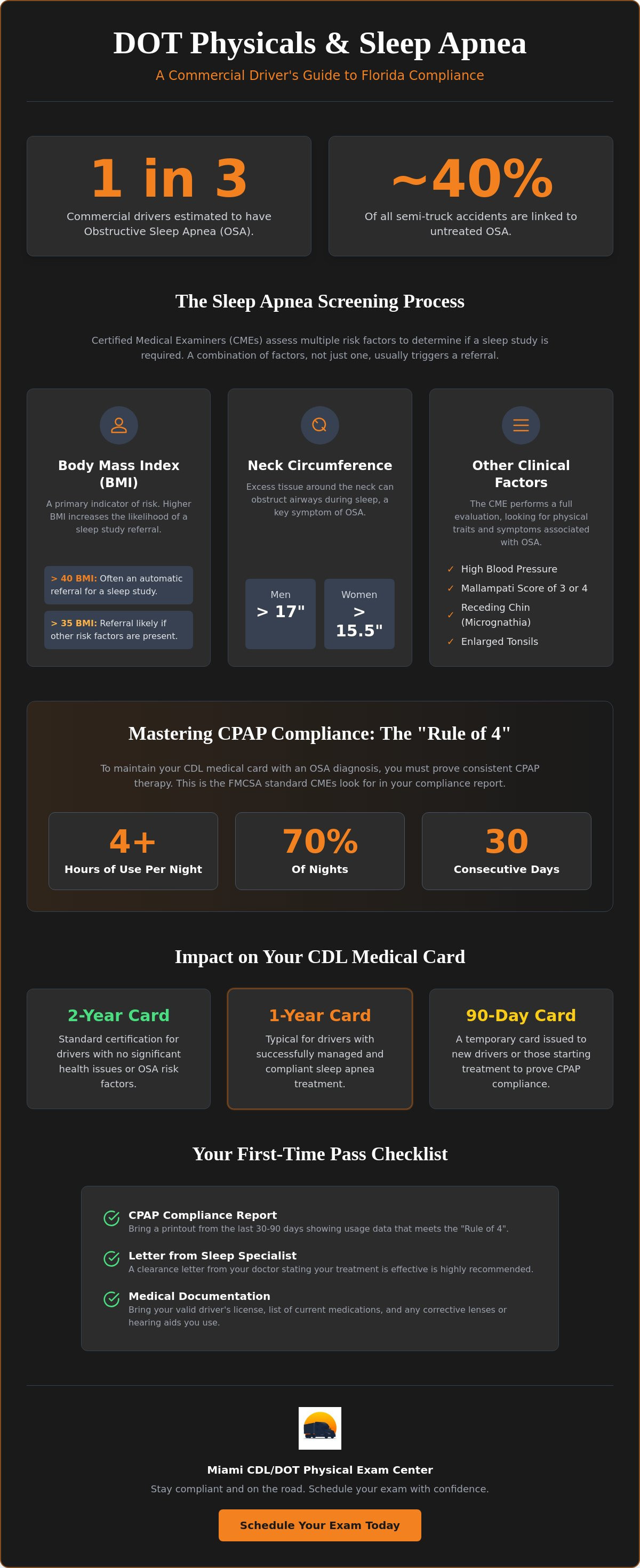
Did you know that roughly one in three commercial drivers lives with obstructive sleep apnea, a condition linked to nearly 40% of all semi-truck accidents? It's a sobering statistic that explains why medical examiners are more vigilant than ever during a DOT physical sleep apnea Florida evaluation. You likely feel the pressure of these regulations every time your medical card is up for renewal. The fear of losing your livelihood due to a high BMI or a large neck size is real, and the confusion surrounding modern FMCSA standards doesn't help.
We understand that your career depends on passing your exam. This guide clarifies the current requirements so you can walk into your appointment with total confidence. You'll learn exactly how sleep apnea affects your CDL medical certification and how to stay compliant with federal standards in 2026. We will cover the specific 70/4 CPAP compliance rules, the differences between home and lab sleep studies, and the correct way to report your medical status to the Florida DMV. Our goal is to help you pass your medical exam on the first try while avoiding the high costs of unscheduled testing.
Key Takeaways
- Identify the specific BMI and neck circumference thresholds that medical examiners use to trigger a sleep study referral.
- Master the "Rule of 4" and learn how to generate the CPAP compliance reports required to maintain your driving status.
- Navigate the process of reporting your medical results to the FLHSMV to satisfy your DOT physical sleep apnea Florida requirements.
- Follow a clear checklist of medical documentation and clearance letters to bring to your appointment for a first-time pass.
- Understand how a sleep apnea diagnosis affects the duration of your medical card and what to expect during your annual renewal.
Understanding Sleep Apnea Requirements for the DOT Physical
Obstructive Sleep Apnea (OSA) is more than just heavy snoring. In the context of commercial driving, it's a serious respiratory condition where your airway becomes blocked during sleep, leading to fragmented rest and severe daytime fatigue. The FMCSA prioritizes screening because untreated sleep apnea is linked to approximately 40% of semi-truck accidents. For any driver seeking a DOT physical sleep apnea Florida certification, understanding how this condition is evaluated is the first step toward keeping your CDL. It's not about catching you in a trap; it's about making sure you're alert enough to handle an 80,000-pound rig safely.
The medical examiner's primary goal is road safety. By Understanding Sleep Apnea and its effects on alertness, you can see why examiners look for risk factors like obesity or high blood pressure. It's a common misconception that a diagnosis means you'll never drive again. In reality, the FMCSA views sleep apnea as a treatable condition. Most drivers face a temporary medical hold rather than a permanent disqualification. A hold simply means you need to complete a sleep study or begin treatment before your full medical card is issued. Once you start effective therapy, you're back on the road.
The FMCSA Sleep Apnea Rule in 2026
Current federal guidelines focus on respiratory dysfunction that interferes with safe driving. While there's no specific law requiring every driver to take a sleep test, your Certified Medical Examiner (CME) has the authority to require one based on clinical judgment. They look at your overall health profile to make a determination. There is no automatic fail for simply having the condition. If you're diagnosed, the path forward involves demonstrating that your condition is under control through consistent treatment and documented machine usage.
Impact on Your CDL Medical Card
A diagnosis changes the timeline of your medical examiner certificate (MEC). While a healthy driver might receive a two-year card, drivers with managed sleep apnea typically receive a one-year certification. This ensures regular monitoring of your treatment compliance. If you're a new driver or just starting treatment, you might receive a 90-day temporary certificate. This short-term card gives you time to prove you're using your CPAP machine correctly. Failing to maintain compliance or skipping your annual DOT physical sleep apnea Florida renewal can lead to the immediate suspension of your driving privileges by the Florida DMV. Stay proactive with your documentation to avoid any gaps in your certification.
The Screening Process: BMI, Neck Size, and Mallampati Scores
During your DOT physical sleep apnea Florida exam, the medical examiner follows a "Standard of Care" protocol to assess your risk. This isn't a random checklist; it's a cumulative evaluation designed to keep you safe behind the wheel. Examiners look for specific physical traits that suggest your airway might collapse during sleep. While one high measurement doesn't always guarantee a referral, a combination of risk factors usually requires further investigation to meet FMCSA Regulations. Understanding these metrics helps you prepare for what the examiner will see.
Body Mass Index (BMI) is often the first metric checked. A BMI of 40 or higher is a significant indicator that often triggers a sleep study referral. If your BMI is 35 or higher, the examiner will look for secondary factors like high blood pressure or a large neck circumference. For male drivers, a neck size of 17 inches or greater is considered a risk; for female drivers, the threshold is 15.5 inches. These measurements help the examiner determine if there's excess tissue that could obstruct your breathing at night. If you're concerned about how these measurements might affect your status, you can schedule your exam with a specialist who understands these nuances.
One critical tool many drivers aren't aware of is the Mallampati Classification. This is a visual assessment where the examiner looks at the back of your throat while your mouth is open. They're checking for "crowding" of the airway. A Class 3 or Class 4 score means your tonsils or soft palate mostly block the view of your throat, which is a strong predictor of obstructive sleep apnea. This visual check is often the deciding factor when other measurements like BMI are borderline.
Clinical Indicators Examiners Look For
Beyond basic measurements, examiners look for specific physical traits like micrognathia, which is a receding chin, or enlarged tonsils. You'll also likely complete the Epworth Sleepiness Scale. This self-reporting tool asks you to rate how likely you're to doze off during daily activities. Be honest but precise. Examiners also consider co-morbidities like Type 2 diabetes or hypertension, as these conditions frequently coexist with sleep disorders and increase your overall cardiovascular risk on the road.
When is a Sleep Study Required?
If your screening reveals high risk, the examiner may refer you for a sleep study. In 2026, home sleep apnea tests have become a popular, cost-effective alternative to in-lab polysomnography, often costing between $150 and $500. If a study is ordered, your examiner might place your certification in a "Pending Determination" status. This isn't a failure. It's a 90-day window that allows you to complete the test and return with results without losing your current medical standing. Resolving this status quickly ensures your CDL remains valid and your income stays steady.
CPAP Compliance: How to Maintain Certification
Maintaining your medical card after a sleep apnea diagnosis depends entirely on one factor: compliance. It's not enough to simply own a CPAP machine; you must prove you're using it effectively to stay safe on the road. For drivers undergoing a DOT physical sleep apnea Florida evaluation, the industry gold standard is the "70/4 rule." This means you must use your device for at least four hours per night on at least 70% of the nights in any given 30-day period. Medical examiners look for this specific data to ensure your treatment is actually reducing daytime sleepiness.
Your machine tracks this usage automatically. To prove compliance, you'll need to provide a formal compliance report, which is a data readout showing your usage patterns over the last 30 to 90 days. Most modern machines use an internal SD card or a cloud-based app to store this information. While CPAP is the most common treatment, it's not the only option. Some drivers successfully use custom-fitted oral appliances or undergo surgical procedures. If you use an alternative treatment, you'll need a signed letter from your sleep specialist confirming that the treatment is effective and that your symptoms are controlled.
Proving Compliance to Your Examiner
Preparation is the key to a smooth appointment. If your machine has wireless capabilities, you can often download your report through an app on your smartphone before you arrive. If you have an older model, make sure to bring the SD card or the machine itself so the data can be verified. For long-haul drivers, staying compliant can be a challenge. Invest in a dedicated power inverter or a portable battery pack to ensure your machine stays running even when you're parked at a rest stop without shore power. Consistent use is the only way to satisfy DOT physical sleep apnea Florida requirements.
What Happens if You Fail a Compliance Check?
Don't panic if your recent usage falls below the 70% threshold. If you have a valid reason for the lapse, such as a machine malfunction or a recent illness, your examiner might grant a 30-day grace period. This temporary window allows you to get back on track and demonstrate a new month of consistent usage. To regain full certification after a lapse, you'll need to work closely with your doctor to adjust your pressure settings or find a more comfortable mask. Once you show a fresh 30-day report meeting the 70/4 rule, your examiner can issue a standard one-year medical card.
FMCSA Regulations and Florida Driver Compliance Standards
Passing your exam is only half the battle. In Florida, you must also ensure your results are correctly recorded with the state to keep your CDL active. While the FMCSA handles federal oversight, the Florida Department of Highway Safety and Motor Vehicles (FLHSMV) manages your actual driving privilege. Successfully navigating a DOT physical sleep apnea Florida exam means nothing if your paperwork doesn't reach the right desk. Florida requires all CDL holders to self-certify their driving category, and for most interstate drivers, this means maintaining a valid medical card on file at all times.
The state system is strictly linked to your medical examiner certificate. If your medical status expires or is not updated in the Florida database, the state will automatically change your license status to "not-certified." In 2026, the FMCSA continues to allow drivers to carry a paper copy of their medical certificate as valid proof for up to 60 days after an exam, but this is only a temporary safety net. You're still responsible for ensuring the FLHSMV records reflect your current health status to avoid any legal complications during a roadside inspection. If you're nearing your expiration date, check our CDL Medical Card Renewal Guide for a full timeline of when to act.
Reporting Your Medical Status in Florida
Once your examiner signs your certificate, follow these steps to stay compliant. First, obtain your signed Medical Examiner Certificate (Form MCSA-5876). Don't leave the clinic without it. Second, use the Florida FLHSMV online portal to upload a digital copy of your certificate. This is the fastest way to update your record. Third, wait 72 hours and then verify your status on the Florida driver license check website. This final step confirms that the state has processed your paperwork and your CDL remains in good standing. Taking these steps prevents administrative errors that could sideline your truck.
Florida CDL Downgrades and Reinstatement
If you miss your filing deadline, the consequences are immediate. Florida will begin the process of downgrading your CDL to a "Non-Excepted" status or even cancelling the commercial privilege entirely. Reinstating a downgraded license often involves paying extra fees and submitting new medical documentation, which wastes both time and money. Avoid an automatic CDL downgrade by staying ahead of your renewal date. If you're worried about your current compliance status, book your DOT physical today to ensure your records are updated before your current card expires.
Preparing for Your Exam: A Roadmap to Certification
Walking into your medical exam without the right paperwork is the fastest way to trigger a "Pending Determination" status. Preparation turns a high-stakes medical review into a routine administrative check. If you have a sleep apnea diagnosis, your examiner needs to see that you're actively managing the condition. By gathering your records early, you prove you're a responsible professional who prioritizes safety. A successful DOT physical sleep apnea Florida evaluation starts long before you sit in the exam chair.
Communication with your sleep specialist is vital. Before your appointment, ask them specifically if your current treatment meets the FMCSA standard of care. You should confirm your latest AHI (Apnea-Hypopnea Index) levels and ensure your mask fit is optimal. If you've recently lost weight or started a new medication, have your doctor document these changes in a formal clearance letter. This proactive approach prevents the medical examiner from having to guess about your health status, which usually leads to shorter certification periods or requests for more testing.
Your DOT Physical Checklist
To ensure a seamless review, bring the following items to your appointment. Don't rely on digital apps alone; having physical backups can save time if there's a technical glitch. Use this list to stay organized:
- A 90-day CPAP compliance report showing you meet the 70/4 usage rule.
- A signed clearance letter from your sleep specialist or primary care doctor.
- A complete list of all current medications, including dosages and prescribing physicians.
- Recent lab results if you're also managing co-morbidities like diabetes.
- Your current driver's license and most recent medical examiner certificate.
On the day of your DOT physical sleep apnea Florida exam, avoid caffeine and nicotine at least two hours before your arrival. These substances can spike your blood pressure, which might trigger additional scrutiny when combined with a sleep apnea history. Aim to schedule your appointment at least 30 days before your current card expires to leave room for any unexpected follow-up requirements.
Why Professional Certification Matters
Choosing the right clinic is just as important as your medical data. You need an examiner who understands the Florida trucking industry and the specific pressures of long-haul routes. A supportive, FMCSA-certified team knows how to guide you through the "Pending Determination" phase if your data is borderline. They act as partners in your career rather than just gatekeepers. Don't leave your livelihood to chance with an examiner who isn't familiar with the latest 2026 sleep standards. Schedule your compliant DOT physical with our FMCSA-certified team today to keep your rig moving and your certification secure.
Stay Road-Ready and Compliant
Navigating the requirements for a DOT physical sleep apnea Florida doesn't have to be a source of stress. By understanding the screening thresholds for BMI and neck size, and strictly following the 70/4 CPAP compliance rule, you protect both your health and your livelihood. It's vital to remember that your certification isn't fully secure until you've confirmed your status through the FLHSMV online portal. Staying proactive with your documentation ensures that your CDL remains in good standing without the risk of a state-level downgrade.
Our FMCSA-certified medical examiners specialize in helping drivers manage these regulations efficiently. We provide hands-on compliance assistance and offer same-day CDL medical cards to keep your rig moving. Don't let complex medical standards or paperwork delays slow your career down. We are here to act as your professional partner in the certification process, ensuring every detail is handled with precision and care.
Book Your FMCSA-Certified DOT Physical Now and drive with the peace of mind that comes from expert support. You've worked hard for your professional license; we'll help you keep it.
Frequently Asked Questions
Can I get a CDL if I have sleep apnea?
Yes, you can definitely obtain or keep your CDL with a sleep apnea diagnosis. The FMCSA views this as a treatable condition rather than a permanent barrier to driving. As long as you demonstrate consistent treatment and provide a compliance report during your DOT physical sleep apnea Florida, you can maintain your certification. Most compliant drivers receive a one-year medical card to ensure ongoing monitoring of their health and road safety.
What is the minimum CPAP usage required for a DOT physical in 2026?
The generally accepted standard in 2026 is the "70/4 rule." This means you must use your CPAP machine for at least four hours per night for at least 70% of the nights in a 30-day period. Your medical examiner will review a data report from your device to verify this usage. Consistent compliance proves that your therapy is effectively managing daytime sleepiness and keeping you alert while operating a commercial vehicle.
Does a large neck size automatically mean I need a sleep study?
No, a large neck circumference alone does not mandate a sleep study. It's one of several clinical indicators, such as a neck size over 17 inches for men or 15.5 inches for women, that medical examiners use to evaluate risk. Your examiner looks at the total picture, including your BMI, blood pressure, and airway crowding. If multiple risk factors are present, they'll likely refer you for further testing to ensure you're fit for duty.
How much does a DOT sleep study cost in Florida?
Sleep study costs in Florida depend on whether you take a home test or an in-lab study. A home sleep apnea test is the most affordable option, typically ranging from $150 to $500. In contrast, an in-lab polysomnography can cost between $1,000 and $3,000 depending on the facility. Many drivers prefer the convenience and lower price of the at-home version when their medical examiner permits it for DOT physical sleep apnea Florida compliance.
What happens if I lie about having sleep apnea on my DOT health history?
Providing false information on your health history is a serious federal offense. If the FMCSA or your medical examiner discovers you've hidden a diagnosis, you face immediate medical disqualification and the possible revocation of your CDL. Beyond the legal risks, untreated sleep apnea significantly increases your chance of a serious accident. It's always better to be honest and work with your examiner to find a manageable treatment plan that keeps you legal.
Can I use an oral appliance instead of a CPAP for my DOT physical?
Yes, oral appliances are an acceptable alternative to CPAP therapy if they effectively control your condition. However, you cannot simply buy an over-the-counter mouthpiece. You must have a custom-fitted device provided by a specialist and bring a clearance letter to your exam. This documentation must prove the appliance reduces your symptoms and keeps your AHI (Apnea-Hypopnea Index) within a safe range for commercial driving.
How do I report my new medical card to the Florida DMV?
Florida requires you to self-certify and submit your medical certificate through the FLHSMV online portal. You should upload your signed Form MCSA-5876 as soon as your exam is complete. After submitting the digital copy, wait about 72 hours and use the Florida driver license check tool to verify your status. This ensures the state has updated your record and prevents an automatic downgrade of your commercial driving privileges.
What BMI triggers a sleep apnea test for truck drivers?
A BMI of 40 or higher is the most common threshold for an automatic sleep study referral. If your BMI is between 35 and 39, you may still be referred if you have at least two other risk factors, such as high blood pressure, Type 2 diabetes, or a large neck size. Examiners use these thresholds to identify drivers who are at high risk for undiagnosed sleep disorders that could impair their driving performance.


