

A CDL isn’t the only detail that matters for DOT compliance. According to the Federal Motor Carrier Safety Administration, a vehicle with a gross vehicle weight rating or gross combination weight rating of 10,001 pounds or more can meet the federal definition of a commercial motor vehicle. Across the United States, requirements depend on the vehicle and how it’s used, including whether the operation is interstate or intrastate.
It’s easy to focus on one requirement, such as a drug test or medical card, when driver and company obligations work together. This guide explains who may need to comply and how drug testing, onboarding, DOT physicals, and medical cards fit into the process.
You’ll also learn how federal testing rules relate to driver qualification and how an FMCSA Clearinghouse Consortium can support compliance. The aim is to clarify the steps, help you understand what applies to your operation, and identify what to address next.
Key Takeaways
- Understand how DOT drug-testing programs and Clearinghouse requirements connect to commercial driving operations.
- See how driver qualification records and hours-of-service rules fit into compliance responsibilities.
- Learn which onboarding documents may be part of preparing a driver to work.
- Find out how DOT physicals and medical cards support driver qualification and ongoing compliance.
How does DOT compliance drug testing work?
DOT drug and alcohol compliance combines testing with program administration, records, and carrier oversight. For motor carriers nationwide, the applicable requirements depend on operations and the drivers’ roles.
Testing Programs
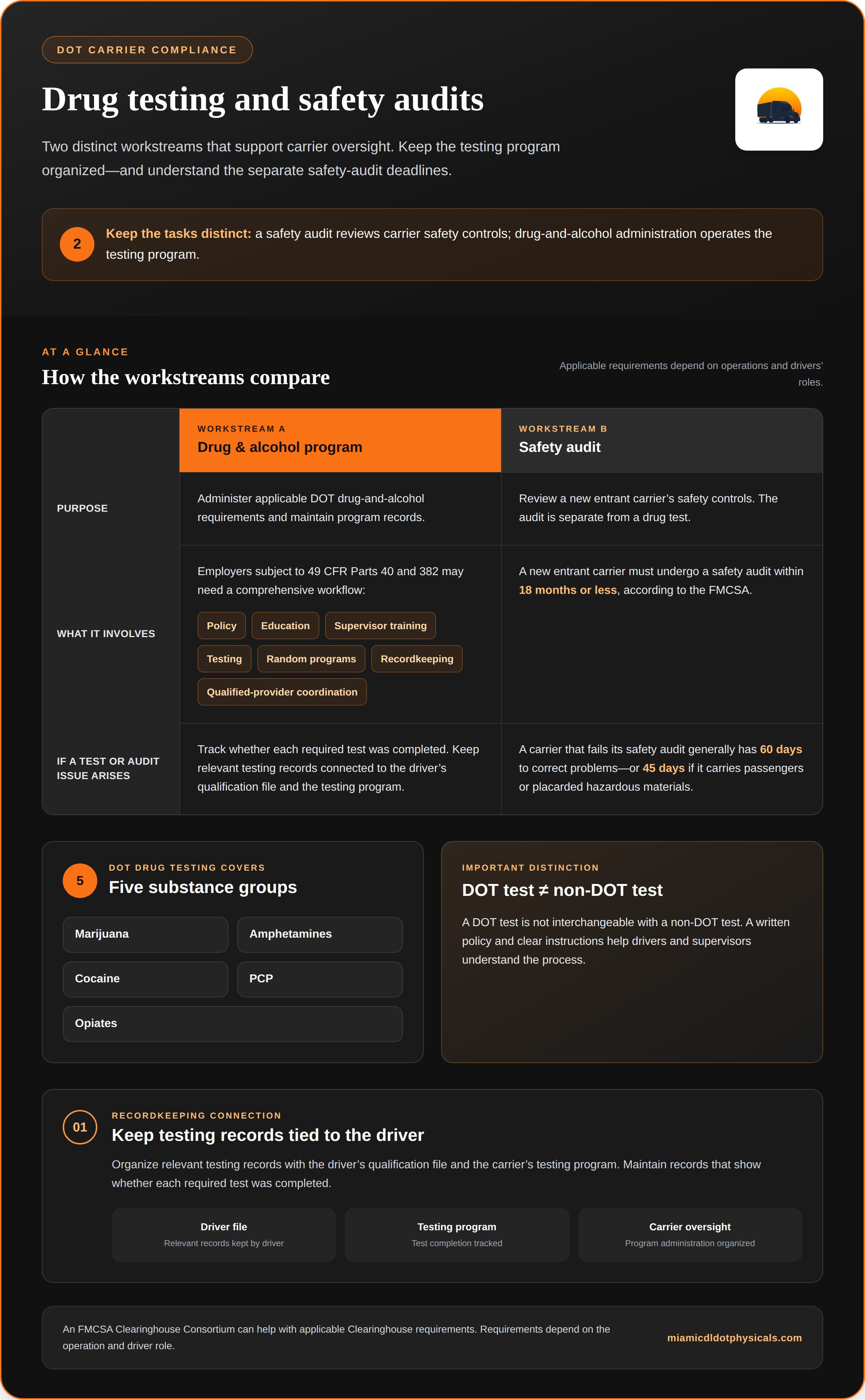
A DOT program involves more than arranging a test. Employers subject to 49 CFR Parts 40 and 382 may need a comprehensive workflow covering policy, education, supervisor training, testing, random programs, recordkeeping, and qualified-provider coordination. Each step supports consistent administration across a carrier’s operations, including when drivers or vehicles change.
Keep testing records connected to the driver’s qualification file and your testing program. For example, a motor carrier should track whether each required test was completed and retain relevant records. An FMCSA Clearinghouse Consortium can help with applicable Clearinghouse requirements.
DOT Testing
DOT drug testing covers marijuana, amphetamines, cocaine, PCP, and opiates. Employers must follow the applicable DOT process; a DOT test is not interchangeable with a non-DOT test. A written policy and clear instructions help drivers and supervisors understand each step.
According to the Federal Motor Carrier Safety Administration, Clearinghouse requirements apply to companies employing drivers of commercial vehicles carrying 16 or more passengers. This requirement makes the driver’s role and vehicle operation relevant when a company establishes its compliance workflow.
Drug-and-alcohol program administration also fits within broader carrier oversight. According to the Federal Motor Carrier Safety Administration, new entrant carriers must undergo a safety audit within 18 months or less. That audit is distinct from a drug test, but organized testing records and qualification files help demonstrate how the carrier manages compliance.
A new entrant carrier that fails its safety audit generally has 60 days to correct problems, or 45 days if it carries passengers or placarded hazardous materials, according to the Federal Motor Carrier Safety Administration. Treat audit preparation and testing administration as related but separate tasks: one manages the carrier’s safety controls, while the other operates its drug-and-alcohol program.
Who Needs To Comply With DOT in Miami?
DOT obligations depend on a vehicle’s weight, use, and route. CDL and non-CDL operations can have different qualification and recordkeeping requirements. Commercial driver compliance in Miami starts with identifying how each vehicle is used.
A CDL violation or out-of-service order can interrupt commercial operations and result in a citation. A recipient may protest a Commercial Motor Vehicle Citation before the applicable review board, which may cancel, modify, or uphold the penalty. Check the applicable payment requirements before pursuing a citation protest.
To obtain or renew a CDL, drivers follow their state’s licensing process and meet the requirements for the license class and endorsements they seek. Driver qualification records and medical status are separate compliance matters from the license itself.
Driver Qualification Files
A driver qualification file brings together records that document a driver’s qualifications. It may include driver history, registrations, medical exams and physicals, and road tests. Organize the file by driver and keep relevant records current as the driver’s status changes.
Federal commercial motor vehicle rules can apply based on vehicle use and weight. The federal definition can include a vehicle rated at 10,001 pounds or more, or one carrying more than 8 passengers for pay or more than 15 without pay. Intrastate rules may differ from interstate requirements.
Hours-of-service compliance concerns federal rules on driving time and rest periods. Carriers should connect those operating records with driver qualification management, rather than treating the file as a one-time onboarding task. This ongoing recordkeeping is central to commercial driver compliance in Miami and elsewhere.
Local Rules and Support
Traffic, parking, and truck-route restrictions affect where commercial vehicles can travel and stop. Plan routes around the vehicle’s use and applicable local restrictions. A route suitable for one truck may not work for another.
State and local transportation agencies oversee different parts of commercial vehicle operations. For driver testing and medical qualification needs, professional providers can support specific parts of compliance. FMCSA Clearinghouse Consortium support can also fit a carrier’s compliance process.
Commercial driver onboarding
Effective onboarding connects each driver’s documentation with the work they’ll perform. Organize records by driver, then match the assigned operation with the relevant qualification information. This gives dispatch and compliance staff a clear reference before the driver begins work.
A driver qualification file may include driver history, registrations, medical exams and physicals, and road tests. Use a consistent filing system so staff can find each record during an inspection or audit. Keep the file current after hiring, since a driver’s medical or qualification status can change.
Clearinghouse requirements also belong in the onboarding workflow. According to the Federal Motor Carrier Safety Administration, these requirements apply to companies employing drivers of commercial vehicles greater than 26,001 lbs. Include the relevant Clearinghouse process when it applies, and distinguish it from general hiring paperwork.
Before assigning work to a new driver, identify the vehicles and duties involved. A driver transporting hazardous materials, for example, may have different operational considerations from one assigned another type of load. Record the driver’s role clearly and connect it to the company’s procedures.
Explain how company procedures address hours of service and applicable regulations. This helps drivers understand how their records relate to daily operations and keeps managers’ documentation aligned with actual assignments. Onboarding is not a one-time form or handoff; it establishes ongoing coordination between the driver and carrier.
Assign responsibility for maintaining records and updating them when information changes. A clear process helps staff spot missing documents before dispatch and prepare for audits or inspections. For a new entrant carrier, consistent onboarding also establishes repeatable procedures as operations develop. Keep the process practical: every record should have a clear place, purpose, and owner.
DOT physicals and medical cards
Medical qualification and drug-and-alcohol testing are separate parts of commercial driver compliance. DOT-regulated CDL holders should complete a physical before their medical card expires and keep their medical status records current.
DOT Physical Exams
A DOT physical exam helps establish a driver’s medical qualification for regulated commercial transportation. Schedule the exam before the current card expires, so the driver’s status can be addressed through ongoing monitoring. The exam is one part of carrier administration, not a replacement for drug-and-alcohol testing.
If a driver’s medical card is nearing expiration, arrange the physical and update the related qualification record. This keeps medical documentation connected to the driver’s other compliance records.
Medical Cards and Certification
A medical card documents a driver’s qualification status. Keep current information with the driver’s qualification records and consider the expiration date when planning transportation assignments. An expired or outdated record can create compliance problems, so monitoring matters after onboarding as well as during renewal.
Requirements can vary by state and operation. In Florida, consider whether the driver’s work is interstate or intrastate when reviewing applicable rules and registration responsibilities. Keep medical certification records separate from license records because they serve different compliance purposes.
DOT drug-and-alcohol testing follows its own program requirements. 49 CFR Parts 40 and 382 address testing and related employer workflows, while a medical card concerns medical qualification. A carrier should manage both tracks and keep the relevant records organized, rather than treating one as proof of the other.
For example, a driver may need an updated physical while also remaining subject to the employer’s testing program. Coordinating those records can help identify upcoming medical-card expirations without confusing them with testing events or violations. A DOT Physical Exam can support the medical qualification step; arrange a DOT physical before the current card expires.
Miami CDL/DOT Physical Exam Center
Miami CDL/DOT Physical Exam Center helps drivers and motor carriers address practical compliance needs with DOT physical exams, DOT and non-DOT drug tests, and an FMCSA Clearinghouse Consortium. These services support distinct tasks, from maintaining medical qualification records to coordinating Clearinghouse requirements.
Turn to the center when a driver needs a DOT physical, a company needs drug testing, or an owner-operator or fleet needs Clearinghouse support. Choosing the service that matches the task keeps medical qualification and testing workflows distinct.
Contact Miami CDL/DOT Physical Exam Center to discuss your compliance needs.
Set up your next compliance step
Choose your next step according to the requirement that needs attention, rather than treating every obligation as one process. A driver preparing for transportation work may need to address medical qualification, while a carrier may need to organize testing or Clearinghouse administration. Clear responsibility for each step keeps records and tasks aligned.
For commercial driver compliance, choose the service that matches your immediate need: a DOT Physical Exam, DOT Drug Test, or Non-DOT Drug Test. Miami CDL/DOT Physical Exam Center provides these services to help drivers and employers address distinct compliance requirements.
Start with the item that affects the driver’s current qualification or company workflow, then plan the next step around it. If you’re ready to discuss your needs, contact Miami CDL/DOT Physical Exam Center. A clear plan can make the next compliance task easier to manage.
Frequently Asked Questions
What are DOT Approved reasons for Drug and/or Alcohol Testing?
DOT drug and alcohol testing may be required for pre-employment, random, post-accident, or reasonable-suspicion situations. The reason depends on the testing event and the employer’s program. Random testing, for example, is part of a random program, while a post-accident test relates to an accident. Document the reason for each test and keep DOT testing separate from non-DOT testing.
What are DOT compliance services and why are they important?
DOT compliance services address separate medical, testing, and administrative needs, including physical exams, drug testing, and Clearinghouse consortium participation. Each serves a different purpose, so one does not replace another. Fleets can assign responsibility for each task to keep procedures consistent across drivers and identify which part of the compliance process needs attention.
What does FMCSA check in a DOT audit?
A new entrant safety audit checks whether a carrier understands applicable regulations and has adequate safety management controls. The audit record review includes an accident register listing crashes that meet the applicable accident definition, kept for 3 years. Auditors may compare records with the carrier’s procedures, so documentation should reflect how operations are actually managed, not simply exist as paperwork.
What federal DOT and FMCSA rules apply to commercial drivers in Miami?
Federal requirements for commercial driver qualification and drug-and-alcohol compliance include 49 CFR Parts 40, 382, and 391. Which requirements apply depends on the vehicle and operation. Interstate and intrastate work shouldn’t be treated as identical, and CDL and non-CDL operations can differ. Classifying the operation helps identify the relevant compliance steps for a driver or carrier.


