

A medical diagnosis does not automatically end a commercial driving career. A medical variance for commercial drivers is an approved exception that may allow a driver with certain medical conditions to qualify despite an otherwise disqualifying condition. It is not a blanket waiver: federal medical qualification and motor-carrier safety requirements still apply.
It’s understandable to want a clear answer about whether a condition affects your ability to drive. The key is that a variance and a routine medical examiner’s certificate serve different purposes. The Federal Motor Carrier Safety Administration says CDL holders must pass a physical examination every 24 months, while federal medical variances are addressed under 49 CFR Part 381, Subpart C, according to the Office of the Federal Register.
This article explains what a variance can do, how it fits within federal medical qualification rules, and why the right certification and documentation matter. It also explains how these requirements relate to motor-carrier safety rules, helping you understand what may apply to your situation.
Key Takeaways
- Understand how a medical variance differs from routine medical certification and why it may matter when a condition affects qualification.
- Learn where federal rules address exemptions and what role medical documentation plays in the process.
- Recognize how vehicle weight and other safety requirements can affect whether federal motor-carrier rules apply.
- See how a DOT physical exam can support your understanding of medical qualification requirements.
What Is a Medical Variance for Truckers?
A medical variance may allow a driver with certain conditions to qualify despite an otherwise disqualifying medical issue. It does not replace routine medical certification or other applicable state requirements.
Medical Certificates and SPE Certificates
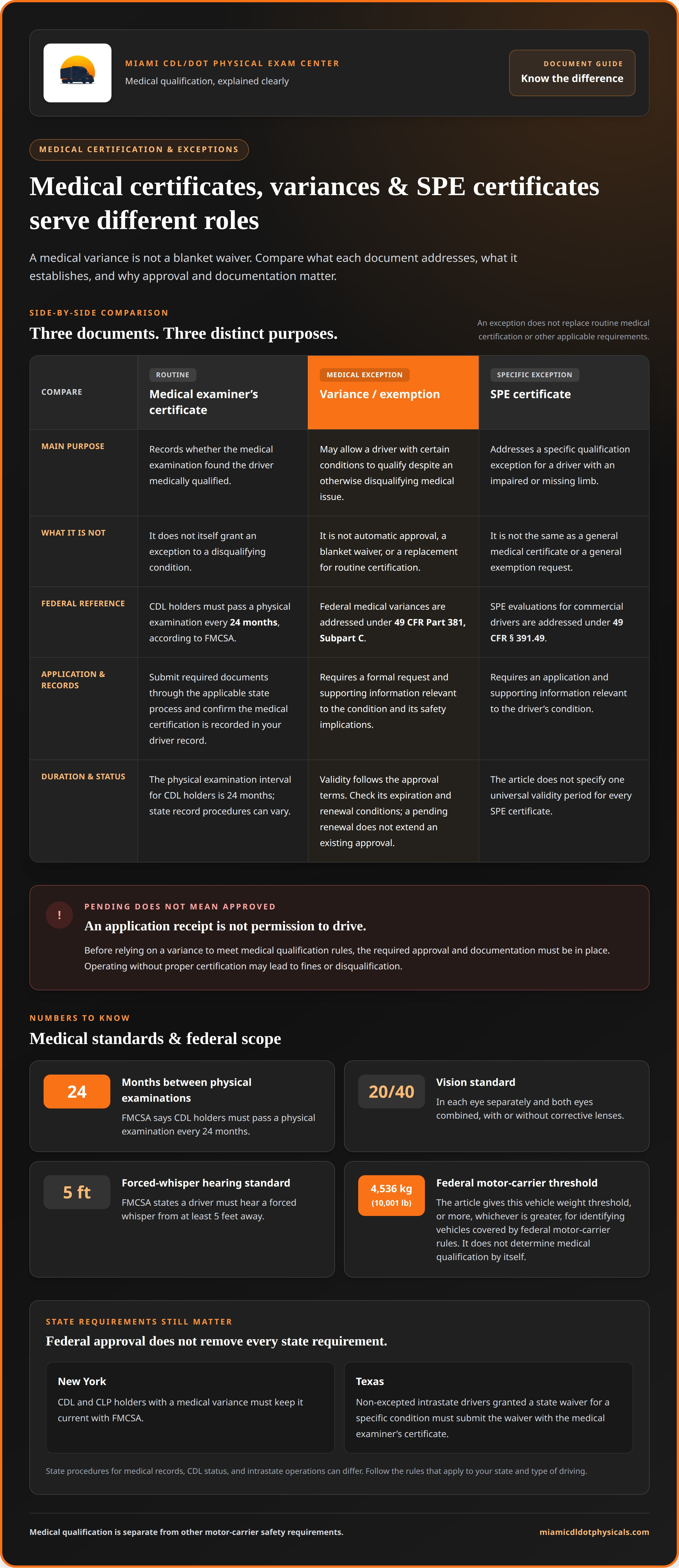
A medical examiner’s certificate records whether an examination found a driver medically qualified, while an exemption or Skill Performance Evaluation (SPE) certificate addresses specific qualification exceptions. The distinction matters: an SPE certificate applies to drivers with impaired or missing limbs, and it is not the same as a general medical certificate. The Federal Motor Carrier Safety Administration says CDL holders must pass a physical examination every 24 months. It also sets a 20/40 vision standard in each eye separately and both eyes combined, with or without corrective lenses. An exemption, SPE certificate, and medical certificate are distinct documents serving different purposes.
Submitting and Checking Medical Certification
State licensing agencies maintain medical certification information in driver records, so submitting the required documents and confirming their status matter to keeping a CDL properly documented. Follow the applicable state process for submitting a medical examiner’s certificate or other required documents. To review your record online, sign in to your state’s MyDMV portal and look for the medical certification status or CDL record section. The displayed status can show whether a submission has been recorded, though portal details and requirements vary by state.
Pending Variance Applications and Driving
A pending application is not an approved variance. Before relying on a variance to meet medical qualification rules, a driver must have the required approval and documentation. Operating a commercial motor vehicle without proper certification may lead to fines or disqualification. Treat the application and permission to drive as separate matters: a receipt alone does not establish that you are qualified to operate.
State Rules for Federal Variances
Federal approval does not eliminate every state licensing or documentation requirement. States may have separate procedures for medical records, CDL status, and intrastate operations. For example, New York requires CDL and CLP holders with a medical variance to keep it current with the FMCSA. Texas non-excepted intrastate drivers granted a state waiver for a specific condition must submit that waiver with their medical examiner’s certificate. Follow the rules that apply to your state and type of driving.
Federal medical qualification requirements for commercial drivers
Federal qualification involves medical fitness, applicable exemptions, and documentation for the type of transportation. A valid license alone does not establish medical qualification.
Federal medical variances for commercial drivers are addressed in 49 CFR Part 381, Subpart C, concerning exemptions for drivers with medical conditions, according to the Office of the Federal Register. The rules provide a formal route to request an exemption, not automatic approval for every condition.
Vision, Color Perception, and Hearing
Federal medical evaluations consider sensory abilities that help drivers safely operate a commercial vehicle. The Federal Motor Carrier Safety Administration states that a driver must hear a forced whisper from at least 5 feet away. Color perception is also relevant to recognizing signals and roadway information, but an individual concern should be assessed through the applicable medical qualification process. These standards help connect an examination to safe transportation duties.
Applying for an Exemption or SPE Certificate
An exemption or Skill Performance Evaluation certificate requires an application and supporting information relevant to the driver’s condition. Gather medical documentation and describe how the condition affects commercial driving; the review concerns the requested exception and its safety implications. SPE evaluations for commercial drivers are addressed under 49 CFR § 391.49. The application route depends on the condition, so an SPE request and a general exemption request aren’t interchangeable.
There is no single variance cost for every driver. Expenses depend on the medical evaluations and documentation involved. FMCSA decision timing depends on the application review, and there is no fixed decision period.
Variance Validity and Renewal
A variance is valid according to its approval terms, so read the document for its expiration date and renewal conditions. No single renewal period applies to every authorization. Start the renewal process in time to prepare the required application materials and updated medical information. A pending renewal does not extend an existing approval.
School transportation can involve additional rules. Pennsylvania school bus driver regulations establish minimum mental and physical requirements under Chapter 71, and drivers continue to carry an annual Physician’s Certificate. A federal variance therefore doesn’t by itself explain every state or school-bus qualification.
Federal motor carrier safety regulations
Federal motor carrier safety regulations cover vehicle use, carrier duties, and driver qualification. A medical variance addresses a medical qualification issue; it does not remove other federal safety requirements.
The Federal Motor Carrier Safety Administration includes vehicles with a gross vehicle weight rating or gross combination weight rating, or gross vehicle weight or gross combination weight, of 4,536 kg (10,001 pounds) or more, whichever is greater. This threshold helps identify vehicles covered by federal motor carrier rules. Meeting it doesn’t, by itself, determine whether a driver meets medical qualification requirements.
Medical records also have a place in the licensing process. CDL holders were required to complete medical self-certification with their State Driver Licensing Agency by January 30, 2014. The change requiring state agencies to add medical self-certification status and medical examiner certificate information to their records became effective on January 30, 2012. These records connect a driver’s certification to their license status.
Electronic reporting affects how medical examination results reach state systems. Medical examiners must transmit examination results by midnight local time on the calendar day after the examination. The examination record and state licensing status are related, but they are not the same record. Completing a physical exam does not mean state records have already updated.
Federal requirements distinguish medical qualification from other motor-carrier safety obligations. A variance covers the specific medical issue stated in its approval; drivers and carriers must still meet applicable operating rules. When reviewing a commercial vehicle assignment, consider the vehicle’s weight rating, the type of operation, and the driver’s recorded certification status together. This helps clarify which federal requirements may apply.
For drivers, the practical takeaway is to treat medical qualification documents and licensing records as connected parts of compliance. Keep the relevant certificate or variance information available, and allow time for the electronic record to reflect the examination result before relying on an updated status. The National Registry and state licensing records serve different purposes, so know which record applies to the requirement at hand.
Definition of a medical variance for commercial drivers
A medical variance is an authorization that may let a commercial driver qualify despite certain otherwise disqualifying medical conditions. Federal rules address these exemptions in 49 CFR Part 381, Subpart C. The variance applies to the condition and terms covered by its approval; it does not erase other medical qualification or motor-carrier safety requirements.
The practical distinction is between a variance and routine certification. A medical examiner’s certificate records the examination outcome, while an exemption letter or Skill Performance Evaluation certificate provides a specific form of permission related to a medical condition. For example, an SPE certificate applies to eligible drivers with impaired or missing limbs. Drivers must carry required variance documents when operating a commercial motor vehicle.
Driving category matters. Interstate commerce and intrastate operations can involve different certification procedures, while an excepted category may affect whether federal medical certification is required. These categories are not medical variances. A state waiver for a specific condition is also different from a federal exemption. For example, Texas requires non-excepted intrastate CDL drivers granted a state waiver to submit it with their medical examiner’s certificate.
Before relying on an approval, read its conditions and confirm that the document covers your condition and intended operation. A pending request is not an approved permit. If a physical impairment affects safe vehicle operation, the applicable variance and supporting documents must be in place before driving under that authorization. State rules may require additional documentation or licensing steps.
If you are considering an exemption, relevant medical documentation helps explain your condition and request. The decision concerns the specific medical issue and whether the requested exception supports safe commercial driving. A variance does not automatically qualify every driver, authorize every vehicle, or apply to every type of interstate commerce.
For routine medical qualification, schedule a DOT physical exam to complete the examination process.
Miami CDL/DOT Physical Exam Center
Miami CDL/DOT Physical Exam Center helps commercial drivers with medical examinations and compliance needs related to federal requirements. A DOT Physical Exam supports the medical certification process by documenting the examination, while the FMCSA Clearinghouse Consortium helps owner-operators and fleets with Clearinghouse compliance. These services address related requirements but do not grant or replace a federal medical variance.
If you need an examination for medical certification or help with Clearinghouse obligations, choose the service that fits your situation. Knowing the difference between routine certification and a variance can help you identify the next step without mistaking an examination for exemption approval.
Contact Miami CDL/DOT Physical Exam Center to discuss the relevant exam or compliance service.
Choose the Right Next Step for Your Driving Status
Before planning a return to commercial driving, distinguish the medical examination you may need from the variance decision itself. A DOT physical exam supports the medical certification process but does not grant an exemption. Keeping these processes separate can help you focus on the requirement that applies to your situation.
A medical variance for commercial drivers concerns a specific medical qualification issue. If you need an examination or related testing, Miami CDL/DOT Physical Exam Center offers DOT physical exams, DOT drug tests, and non-DOT drug tests. These services meet examination and testing needs, not federal variance approval.
Take the next step that matches your need, whether that means arranging an exam or addressing a testing requirement. For assistance with these services, contact Miami CDL/DOT Physical Exam Center. Clear information about the service you need can help you move forward with confidence.
Frequently Asked Questions
What is an FMCSA medical variance for commercial drivers?
A medical variance is an FMCSA authorization that may allow a driver to qualify despite a condition that would otherwise prevent certification. It applies only to the condition and terms stated in the approval, not every medical issue or driving situation. For example, an SPE certificate addresses certain drivers with impaired or missing limbs. A variance does not replace other licensing or safety requirements.
Who qualifies for an FMCSA medical variance or exemption?
A driver may qualify when a medical condition affects standard qualification and the relevant exemption or variance is approved. Eligibility depends on the condition and the requirements of the requested authorization. A driver with an impaired or missing limb may be considered for a Skill Performance Evaluation. A diagnosis or application alone does not establish approval or permission to drive.
What medical conditions require a commercial driver medical variance?
There is no single list of diagnoses that always require a variance. The question is whether a condition affects safe commercial vehicle operation or prevents ordinary medical qualification. Impaired or missing limbs may require an SPE evaluation. The research also identifies diabetes controlled through diet or medication, rather than insulin injections, as a circumstance where a variance may apply. Each condition is assessed under its applicable requirements.
What documents and medical tests are required for a variance application?
Requirements depend on the type of variance and the driver’s condition. Relevant medical documentation helps describe the condition and support the request. Drivers seeking an SPE for an impaired or missing limb must complete the applicable skill performance evaluation; the process is addressed in 49 CFR § 391.49. A medical examiner’s certificate is a separate record, so it should not be treated as the variance itself.
What happens if a commercial driver violates variance conditions or is denied?
A driver who violates approval conditions cannot rely on that variance as permission to operate under those conditions. Driving without proper certification may result in fines or disqualification. If FMCSA denies the request, the driver has no approval to rely on and must meet ordinary medical qualification requirements to drive. A denial does not itself establish that the driver meets those requirements.


