

For CDL and CLP drivers, a paper DOT medical card isn’t the final proof of current certification. Check your state record to confirm your medical certification status and certificate expiration date. According to the Federal Motor Carrier Safety Administration, a medical examiner’s certificate is valid for a maximum of 24 months, though an examiner may issue it for a shorter period.
It’s easy to focus on the card in your hand, but the record linked to your CDL or CLP is what confirms your certification status. This guide explains how to verify a driver's medical certificate, identify an expired or questionable card, and check CDL and CLP records. You’ll also learn what to do if the information on your card doesn’t match your state record, so you can take the right next step.
Key Takeaways
- Keep driver qualification file records current, and note that an examiner may issue a certificate for less than its maximum validity period.
- Check the examiner’s ten-digit National Registry number and compare the certificate’s details for inconsistencies.
- Use the state record to confirm CDL or CLP medical status and the recorded expiration date.
- Learn which commercial drivers need a medical examiner’s certificate and when a DOT physical can help renew it.
Driver qualification file documentation
If your medical certificate is missing, incorrect, or rejected, contact the medical examiner about correcting or replacing it. If your state record is wrong, contact your state driver licensing agency and notify your carrier so it can address the issue in your qualification file.
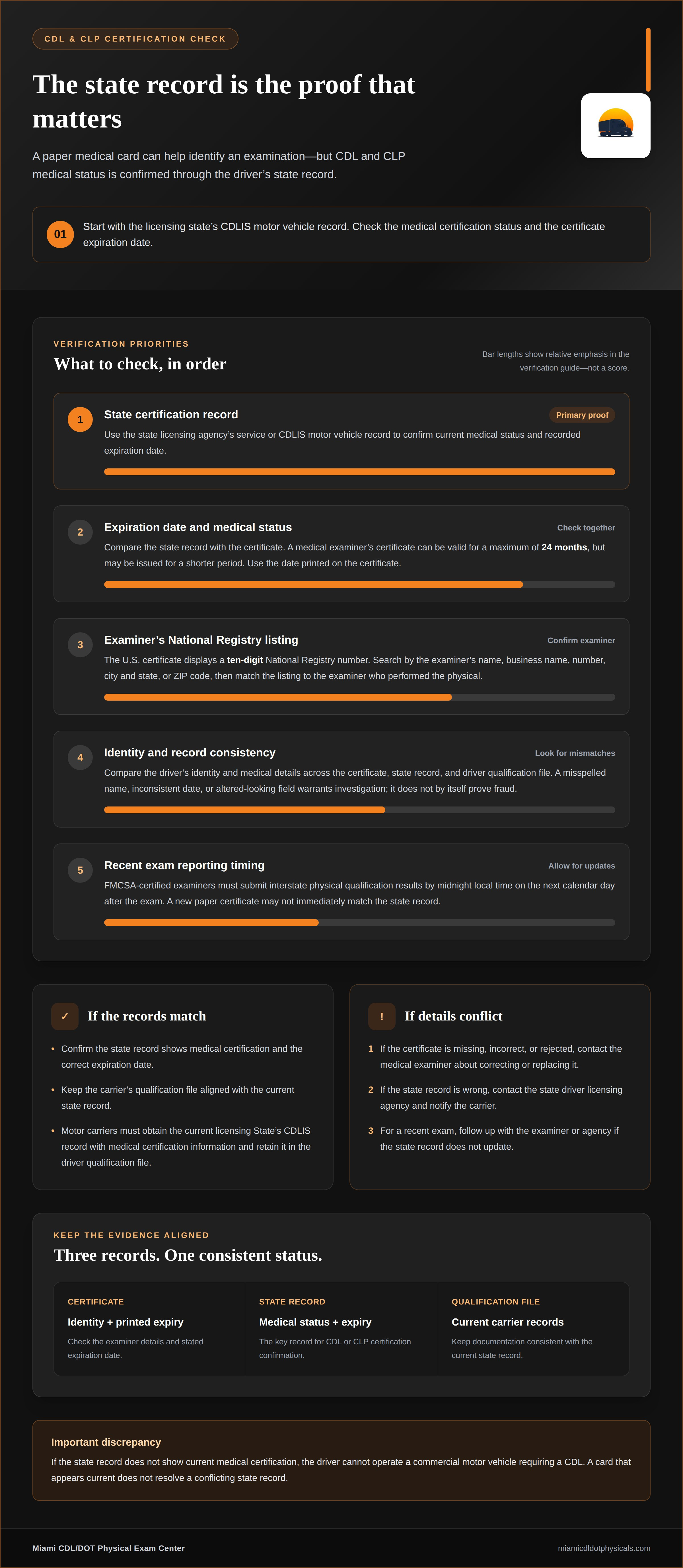
- Match the certificate to the driver qualification file. Under 49 CFR 391.51, the file’s contents are specified by regulation. Compare the driver’s identity and medical certification details across the available records. For example, a certificate with a different name or an incorrect expiration date needs attention before the file can reliably show the driver’s status.
- Check the certificate’s expiration date and account for its permitted duration. According to the Federal Motor Carrier Safety Administration, a U.S. medical examiner’s certificate is valid for a maximum of 24 months, although an examiner may issue it for a shorter period. Use the date printed on the certificate, not the maximum period, to identify its stated expiry.
- Keep the carrier’s qualification file consistent with the current state record. Under NRII, motor carriers must obtain the current licensing State’s CDLIS driver motor vehicle record with medical certification information and retain it in the driver’s qualification file. Compare the medical status and expiration date with the certificate. If details conflict, flag the discrepancy and seek a correction through the examiner or state agency.
- Allow for electronic reporting when reviewing a recent examination. FMCSA-certified medical examiners must submit results of every interstate commercial motor vehicle driver physical qualification examination by midnight local time on the next calendar day after the examination. A newly issued paper document may not immediately match the state record. Note the discrepancy and follow up through the appropriate examiner or agency channel.
Fake or expired certificate warning signs
An expired or invalid certificate can lead to downgraded commercial driving privileges. If the state record does not show current medical certification, the driver cannot operate a commercial motor vehicle requiring a CDL.
- Compare the certificate’s identifying details with the driver’s records. A misspelled name, inconsistent date, or altered-looking field warrants investigation, but does not by itself prove fraud. Confirm that the document belongs to the correct driver and that its expiration date matches the current certification record.
- Check for the examiner’s National Registry number. A U.S. medical examiner’s certificate displays a ten-digit number. Search the National Registry using the examiner’s name, business name, or number to confirm the examiner appears in its records. If the number is missing or the search does not find the examiner, follow up with the examiner.
- Compare the certificate with the state motor vehicle record. For CDL holders, the record shows medical certification status and the certificate’s expiration date. A card that appears current does not resolve a conflicting state record. Treat mismatched dates, missing status, or a “not certified” status as a discrepancy to resolve before driving.
- Consider reporting timelines before assuming a new card is fake. Interstate examination results are submitted electronically, and a state record may not yet reflect a recent exam. If the information remains inconsistent, contact the examiner or state licensing agency to resolve the discrepancy. Don’t rely on a suspicious document or altered details as proof of valid certification.
- If the certificate is expired or needs renewal, a DOT physical exam is the appropriate next step for a new medical examination. A carrier should also keep its qualification file aligned with the driver’s current record.
Official proof of medical certification for CDL and CLP drivers
For CDL and CLP holders, the state record is the key place to confirm medical certification. Follow these steps to check the examiner, online status, and relevant state process.
-
Check the examiner's National Registry listing
Search the FMCSA National Registry using the examiner’s name, business name, or National Registry number. You can also search by city and state or ZIP code. Match the listing to the examiner who conducted the physical. When learning how to verify a driver's medical certificate, use the listing to confirm the examiner’s status, then separately check the driver’s certification record.
-
Verify the certificate online
Use the state licensing agency’s online service or obtain the CDLIS motor vehicle record. Check the driver’s medical status and certificate expiration date. For CDL and CLP holders, electronic examination results sent to the state driver licensing agency are official proof under NRII. A paper certificate can help identify the examination, but it isn’t the final proof of current CDL certification.
After an examination, review the state record for the updated expiration date. If it has not appeared, contact the examiner or state agency about the reporting or record issue. Checking the driver’s official record is the practical way to verify a driver's medical certificate.
-
Account for state rules and privacy
Use the licensing state’s own record process because online tools and status checks vary by state. A motor carrier must obtain the current licensing State’s CDLIS record with medical certification information and retain it in the driver qualification file. Drivers can also use the relevant agency portal to review their own records.
Employers can verify certification through the required driver record. Third parties should follow the state agency’s access and authorization process rather than assume they can view another driver’s information. The record shows medical status and expiration details, not the examiner’s full medical report.
What is a driver's medical certificate and who needs one in the United States?
A Medical Examiner’s Certificate records the result of a commercial driver’s physical qualification examination. Use these steps to identify when it applies and how it relates to your license and driving category.
- Identify the type of driving and vehicle. In the United States, interstate commercial drivers operating vehicles with a maximum gross vehicle weight rating over 10,000 pounds must obtain and maintain a valid Medical Examiner’s Certificate. The vehicle’s rating and whether the work is interstate help determine whether this requirement applies. Don’t assume every person with a commercial driving job follows the same certification process.
- Confirm that an examination supports the certificate. Interstate commercial drivers must obtain Form MCSA-5876 from a certified medical examiner listed on the National Registry. The examination assesses whether the driver meets the physical qualification standards in 49 CFR 391.41. The certificate documents the result; it does not replace the driver’s CDL or commercial learner’s permit.
- Separate medical certification from license self-certification. CDL and CLP holders must self-certify their category of operation to the state driver licensing agency under 49 CFR 383.71. The chosen category must match the driver’s actual commercial operation. A current medical certificate alone doesn’t correct a mismatch between the self-certified category and the driving performed.
- Check whether you hold a CDL before submitting medical documents. Non-CDL holders aren’t required to self-certify or submit a copy of their medical examiner certificate to their State Driver Licensing Agency. CDL holders subject to the federal medical examiner certification requirement must provide each new certificate to their licensing agency before the current certificate expires. Follow the state record process that applies to your license.
- If you need an examination to obtain or renew certification, take the next step toward a DOT physical. The examination and certificate address medical qualification, while the state licensing record reflects CDL or CLP certification information.
Miami CDL/DOT Physical Exam Center
Miami CDL/DOT Physical Exam Center provides DOT Physical Exams for commercial drivers who need an examination or are approaching certificate renewal. The exam addresses medical qualification; your state driver record remains the place to confirm that certification information appears correctly. If your certificate has expired or you need a new examination, schedule a DOT physical. The center also offers an FMCSA Clearinghouse Consortium for owner-operators and fleet companies managing federal compliance needs. These services address different parts of commercial-driver compliance, so choose the one that fits your immediate need. Contact Miami CDL/DOT Physical Exam Center to arrange an examination or get compliance support.
Make certificate checks part of your routine
Knowing how to verify a driver's medical certificate gives you a practical way to manage the paperwork that supports your work. Build a simple habit after each examination: organize your documents, compare records when information changes, and resolve mismatches promptly. This also helps you recognize when you need a new medical examination instead of relying on an outdated document.
When an examination is your next step, Miami CDL/DOT Physical Exam Center can help with a DOT Physical Exam. The center also offers DOT and Non-DOT Drug Tests for drivers and employers seeking those services. Choose the support that fits your current need, then continue managing your certification records with care. Contact Miami CDL/DOT Physical Exam Center to discuss your next step. A steady routine can make staying organized feel more manageable.
Frequently Asked Questions
What makes a DOT medical card valid?
A valid card reflects a qualifying examination by a certified medical examiner and has not passed its expiration date. For CDL and CLP holders, also confirm that the state record shows current medical certification. A paper card alone may not establish current CDL status. If its details conflict with the licensing record, resolve the discrepancy before relying on it for commercial driving.
How can I confirm a medical examiner's certificate is valid and not expired?
Read the expiration date printed on the certificate, then compare it with the medical certification information in the state driver record. Check that the examiner’s National Registry number is present and that the listing matches the examiner. For CDL or CLP records, current medical status and the certificate’s expiration date are key details. Follow up with the examiner or state licensing agency if anything does not match.
What information should appear on a DOT medical examiner's certificate?
Look for the driver’s identifying details, examination information, expiration date, and the medical examiner’s ten-digit National Registry number. The certificate is Form MCSA-5876. Compare its details with the relevant state record, especially the recorded expiration date for a CDL or CLP holder. If a key detail is missing or inconsistent, have the examiner address the document rather than altering it yourself.
How long is a DOT medical certificate valid, and what are the renewal deadlines?
A U.S. medical examiner’s certificate can be valid for up to 24 months, but the examiner may set a shorter period. Use the expiration date on your own certificate to plan renewal. Keep your medical certification information current with the state licensing agency and check the state record for your status. Allow time for the updated information to appear in the state record.
How do medical certificate verification rules differ by state?
States use different record-checking processes, so check your licensing state’s portal or CDLIS motor vehicle record for medical status and the expiration date. Nevada offers an online DMV dashboard, South Carolina provides an online processing-status check, and Texas has its own electronic submission and medical-certification procedures.


