

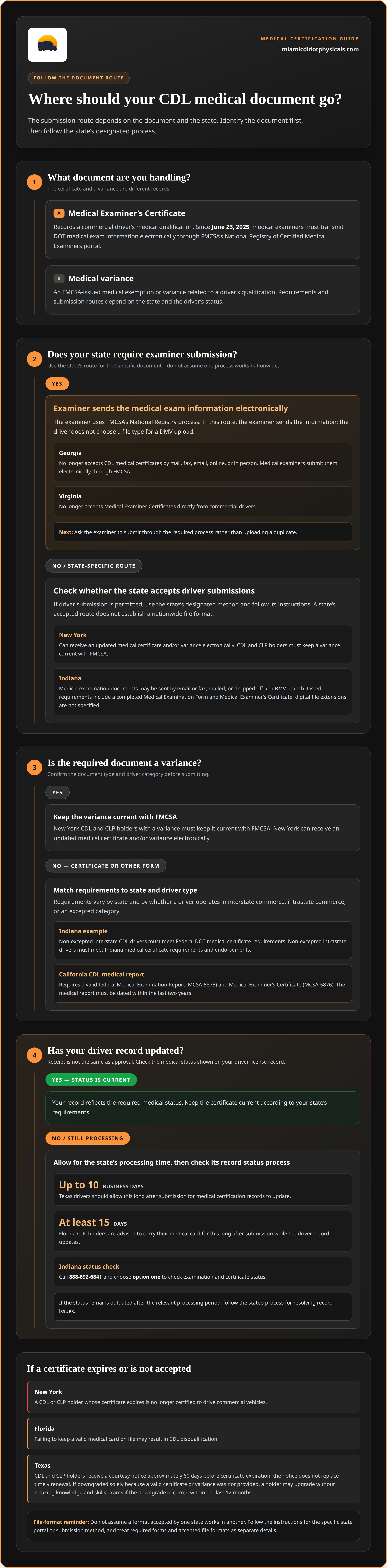
For many CDL drivers, the medical examiner submits the Medical Examiner’s Certificate electronically through the FMCSA National Registry portal. The driver does not upload it directly to the DMV. Procedures for a variance document or other state-specific submission vary, so to learn how to upload a medical certificate to a state DMV, first identify who must send it and where it needs to go.
It’s understandable to want confirmation that your documents have been received and your CDL medical status is current. The submission route depends on the document and the state: this guide explains the main routes for certificates and variance documents, how to handle file requirements, and how to confirm your certification is on file.
The next step can differ by state. Learn when electronic reporting applies and what to do if your record needs an update, then follow the process for your state to keep your commercial driving paperwork in order.
Key Takeaways
- Find out whether your state expects the medical examiner or the driver to submit documents; the route can differ by document type and state.
- Don’t assume one file format or upload process works nationwide. Follow the instructions for the specific state portal or submission method.
- Plan ahead to keep certification current. Texas drivers should allow up to 10 business days for medical certification records to update, according to the Texas Department of Public Safety.
- Medical certificates and variance documents serve different purposes. The required forms depend on the state and the driver’s certification status.
Accepted file formats
A file format is the digital type used to save a document, such as a scan or image. Don’t assume a format accepted by one state will work in another.
A Medical Examiner’s Certificate is the document recording a commercial driver’s medical qualification. Since June 23, 2025, medical examiners must transmit DOT medical exam information electronically through FMCSA’s National Registry of Certified Medical Examiners portal. In this process, the examiner sends the information, rather than the driver choosing a file type for a DMV upload.
A medical variance is an FMCSA-issued medical exemption or variance related to a driver’s qualification. New York CDL or CLP holders must keep a variance current with FMCSA. New York can receive an updated medical certificate and/or variance electronically, allowing the DMV to update a driver’s status without an office visit.
State procedures show why it’s important to follow the required submission route instead of guessing which file type to use. Georgia no longer accepts CDL medical certificates by mail, fax, email, online, or in person; medical examiners submit them electronically through FMCSA. Virginia also no longer accepts Medical Examiner Certificates directly from commercial drivers. Use the state’s designated process for each document.
Indiana offers a different example: CDL holders can send medical examination documents by email or fax, mail them, or drop them off at a BMV branch. The listed requirements include a completed Medical Examination Form and Medical Examiner’s Certificate, but don’t specify digital file extensions. Treat the required forms and accepted file formats as separate details.
Before uploading, identify whether the document is a certificate, variance, or self-certification form. If the state accepts driver uploads, follow its portal instructions. If the state requires the medical examiner to transmit the information electronically, ask the examiner to submit it through that process rather than uploading a duplicate.
Keeping a medical certificate current and on file
A current medical certificate is an unexpired record supporting a CDL holder’s medical qualification. Filing and renewal requirements depend on the state and the driver’s certification category.
There is no single nationwide submission deadline for every state. According to the Texas Department of Public Safety, Texas medical examiners must transmit examination results by midnight local time on the calendar day after the examination.
DMV processing fees vary by state. Distinguish any filing charge from the cost of the medical examination, and check the applicable state fee schedule before submitting documents.
Missed or Rejected Certificates
A missed or rejected certificate is one that has expired or has not been accepted as proof of the driver’s required medical status. In New York, a CDL or CLP holder whose certificate expires is no longer certified to drive commercial vehicles.
Florida warns that failing to keep a valid medical card on file may result in CDL disqualification. Texas sends CDL and CLP holders a courtesy notice approximately 60 days before certificate expiration, but the notice doesn’t replace timely renewal. If a Texas CDL or CLP was downgraded solely because a valid certificate or variance wasn’t provided, the holder may upgrade without retaking knowledge and skills exams if the downgrade occurred within the last 12 months.
Receipt and Approval Confirmation
Receipt confirmation means the state received a submission; approval means the driver’s record reflects the required medical status. Allow time for processing, then use the state’s record-status process to confirm the update.
Texas drivers should allow up to 10 business days after submission for medical certification records to update. Florida CDL holders are advised to carry their medical card for at least 15 days after submission while their driver record updates. Indiana CDL holders can check examination and certificate status by calling 888-692-6841 and choosing option one.
Check the medical status shown on your driver license record, not just whether a document was sent. If the status remains outdated after the relevant processing period, follow the state’s process for resolving record issues.
Medical certificate and variance documentation
A medical examiner’s certificate records a commercial driver’s medical qualification. A medical variance is an FMCSA exemption or waiver that may apply to a driver’s medical qualification.
State and Driver-Type Requirements
Document requirements depend on the state and driver type. They vary according to whether a driver operates in interstate commerce, intrastate commerce, or an excepted category.
Indiana requires non-excepted interstate CDL drivers to meet Federal DOT medical certificate requirements. Non-excepted intrastate drivers must meet Indiana medical certificate requirements and endorsements. The applicable process depends on where the driver operates and their category.
New York CDL and CLP holders who use their licenses for non-excepted commerce must pass a USDOT physical with an examiner listed on the FMCSA National Registry. A New York CDL or CLP holder with a variance must keep it current with FMCSA.
Required Accompanying Information and Documents
Required accompanying documents are the forms and supporting records a state needs for medical certification. The exact documents depend on the state and the driver’s qualification category.
California CDL medical report submissions require a valid federal Medical Examination Report, form MCSA-5875, and Medical Examiner’s Certificate, form MCSA-5876. California CDL holders must submit a medical report dated within the last two years.
For California driver license or learner’s permit applications, the medical forms must be completed by a U.S.-licensed doctor of medicine, doctor of osteopathy, physician’s assistant, advanced practice nurse, or doctor of chiropractic. New York non-excepted CDL and CLP holders need a physical from an examiner listed on the National Registry.
Georgia documentation includes a valid, unexpired Medical Examiner’s Certificate, also called a DOT Physical Card. When applicable, include a federal Skills Performance Evaluation or a federal or Maryland Waiver/Exemption, form DL-171.
Indiana renewal documents include the completed Medical Examination Form, or long form, and the Medical Examiner’s Certificate. Texas CDL-10 is titled Certification of Physical Exemption under 49 CFR PART 391/390. Match each form to the state’s required submission process.
What information and documents must accompany a medical certificate?
An accompanying document is a form or record submitted with a medical certificate to support a driver’s CDL medical status. Required paperwork depends on the state, the driver’s category, and whether the state or medical examiner sends the information.
Start by identifying the exact document the state requires. California CDL medical report submissions require a federal Medical Examination Report, form MCSA-5875, and a Medical Examiner’s Certificate, form MCSA-5876. California CDL holders must submit a medical report dated within the last two years. These forms serve distinct purposes, so don’t treat one as a replacement for the other.
Additional paperwork can depend on an exemption or evaluation. Georgia documentation includes a valid, unexpired Medical Examiner’s Certificate or DOT Physical Card. When applicable, it also includes a federal Skills Performance Evaluation or a federal or Maryland Waiver/Exemption, form DL-171. Include the document that matches the driver’s status.
Some states use a separate form to record a certification category or exemption. Texas CDL-10 is titled Certification of Physical Exemption under 49 CFR PART 391/390. It is not the same document as a medical examiner’s certificate, so use it only for the purpose its title describes.
Submission rules also determine who sends the record. Medical examiners submit Medical Examiner Certificates electronically through FMCSA’s National Registry portal. Georgia DDS no longer accepts CDL medical certificates by mail, fax, email, online, or in person. Virginia DMV no longer accepts Medical Examiner Certificates directly from commercial drivers.
Louisiana’s process changes on September 15, 2026: drivers will no longer need to submit a certificate copy to the Office of Motor Vehicles for CDL issuance. DOT medical providers will upload the certificate’s existence to Federal Motor Carrier. Match the document and sender to the state process before submitting.
If you need the examination that produces a medical certificate, schedule a DOT physical exam.
Miami CDL/DOT Physical Exam Center
Miami CDL/DOT Physical Exam Center can help with the medical examination behind your CDL certificate. Its DOT Physical Exam is relevant when you need a medical evaluation, while the state or medical examiner’s process determines how the certificate reaches your record.
Keep these steps separate: completing an exam does not confirm that your DMV record has been updated. Follow the submission route for your state, then check its record-status process to confirm your certification is current. Owner-operators and fleet companies managing federal compliance can also use the FMCSA Clearinghouse Consortium.
For a DOT physical exam or Clearinghouse support, contact Miami CDL/DOT Physical Exam Center to discuss your next step.
Take the Next Step Toward Staying Ready
Keep your commercial driving plans on track by handling each requirement through the right channel. If you’re still working out how to upload a medical certificate to your state DMV, start with the step you can take now: arrange the relevant medical exam or testing, then follow your state’s submission process.
Miami CDL/DOT Physical Exam Center provides DOT Physical Exams, DOT Drug Tests, and Non-DOT Drug Tests. These services support drivers and employers with medical and testing requirements, while the state determines how documents are submitted and recorded. Arrange the examination or testing you need, then complete the state’s submission steps.
Contact Miami CDL/DOT Physical Exam Center to discuss your next step. With the right task underway, you can approach the remaining paperwork with a clearer plan and keep moving toward your driving goals.
Frequently Asked Questions
How do I submit CDL Medical Certificate and/or Medical Variance Documents?
In many cases, the medical examiner submits the certificate electronically through FMCSA’s National Registry portal. A variance is handled separately: keep it current with FMCSA and follow the process for the state that maintains your CDL record. For example, a New York holder whose status needs updating may have it upgraded after the DMV receives an updated certificate or variance electronically.
Which state DMV is responsible for submitting a medical certificate?
The state agency responsible for your CDL record manages the state certification process; the medical examiner may be responsible for sending examination information electronically. Start with the agency that issued your commercial credential to find its process. Indiana, for example, keeps medical information on file from CDL issuance, so holders do not submit the certificate again during self-certification.
What types of medical certificates does the DMV require?
The required record depends on your credential, operation category, and state. California CDL medical-report submissions require both the Medical Examination Report, form MCSA-5875, and the Medical Examiner’s Certificate, form MCSA-5876. A medical variance is a separate document, not a substitute name for either form. Drivers with an applicable exemption may also need a state-specific exemption form.
How do I upload a medical certificate to my state DMV online?
First determine whether your state accepts a driver upload or receives the examination electronically from the medical examiner. Indiana allows online self-certification through a myBMV account, but its medical certificate is already on file from CDL issuance. Virginia’s upload portal accepts CDL self-certification form DL8 only when the designation change doesn’t add or remove a restriction.
What DMV portal or form should I use to submit a medical certificate?
Use the portal or form assigned to your state and the task you need to complete. Indiana’s online self-certification requires a myBMV account, while Texas CDL-10 is for Certification of Physical Exemption under 49 CFR PART 391/390. These are different processes: the CDL-10 is an exemption form, not a general certificate-upload form.
Can I submit a medical certificate by email, fax, mail, or in person?
Accepted submission methods vary by state and document. Indiana CDL holders can send medical examination documents by email or fax, mail them, or drop them off at a BMV branch. Georgia no longer accepts CDL medical certificates by mail, fax, email, online, or in person because medical examiners submit them electronically. Follow the procedure for your state and document type.


