

A failed DOT new entrant safety audit can put your operating authority at risk if you don’t correct the identified deficiencies. The audit takes place within 12 months after a carrier begins operations, and DOT new entrant audit drug testing requirements include having a compliant testing program in place from the start of operations and a confirmed negative pre-employment drug test before a driver’s first dispatch.
It’s understandable to focus on the audit date, but the records behind your testing program matter just as much. Most carriers have 60 days from the date of FMCSA’s notice to correct audit failures and provide proof, according to the Federal Motor Carrier Safety Administration.
This guide explains what auditors review, from testing policies and enrollment to test records, and what may happen if a carrier fails. It also covers how to interpret the requirements and where DOT drug testing and FMCSA Clearinghouse consortium support fit into a carrier’s compliance process.
Key Takeaways
- Know which written policies, driver acknowledgements, and random-pool records help demonstrate a functioning testing program.
- Understand how a new entrant safety audit is conducted and which supporting records may be requested.
- Recognize testing violations that can trigger an automatic failure, so you can address gaps before they affect your authority.
- Learn what corrective action may involve after a failed audit and how drug testing or Clearinghouse support can fit into your compliance process.
Drug and alcohol testing program requirements
New entrant carriers need an active DOT drug and alcohol program, not just a written policy. Testing, driver coverage, and recordkeeping requirements apply as operations begin.
DOT Program Requirements for New Entrants
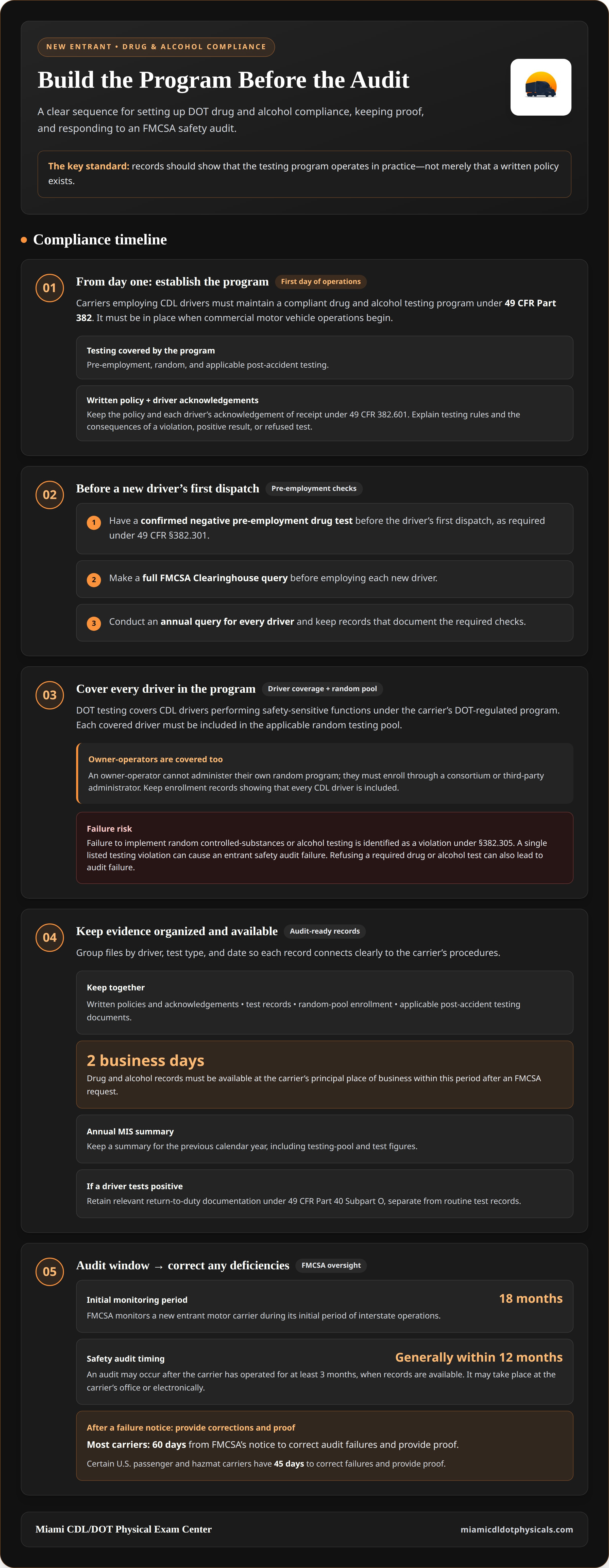
Under 49 CFR Part 382, carriers employing CDL drivers must maintain a compliant drug and alcohol testing program. It must be in place from the first day the carrier operates commercial motor vehicles. The program includes pre-employment, random, and applicable post-accident testing. The Electronic Code of Federal Regulations identifies failure to implement random controlled substances or alcohol testing as a violation under § 382.305. A single listed testing violation can cause an entrant safety audit failure, so records should show that the program operates, not merely exists.
Written Drug and Alcohol Policies
A written policy explains the carrier’s drug and alcohol testing rules and the consequences of violations. Under 49 CFR 382.601, employers must keep the policy and each driver’s acknowledgement of receipt. The policy helps drivers understand testing duties, including what happens after a positive result or a refused test. Keep acknowledgements with program records so the carrier can show that covered drivers received the policy. This is a core part of meeting the DOT new entrant audit drug testing requirements.
Drivers Covered by DOT Testing
DOT testing covers CDL drivers who perform safety-sensitive functions for a carrier, including drivers operating commercial motor vehicles under its DOT-regulated program. Each covered driver must be included in the applicable random testing pool. Owner-operators are covered as well: they cannot administer their own random program and must enroll through a consortium or third-party administrator. Refusing a required drug or alcohol test can lead to audit failure, so accurate enrollment and testing records are essential.
Pre-Employment Tests and Clearinghouse Queries
Before a new driver’s first dispatch, the carrier must have a confirmed negative pre-employment drug test result under 49 CFR §382.301. The carrier must also make a full FMCSA Clearinghouse query before employing each new driver, then conduct an annual query for every driver. These steps help identify prohibited status before safety-sensitive work begins. Small carriers and owner-operators can use a consortium or third-party administrator to manage random-pool enrollment; records should document enrollment and show that every CDL driver is included. The FMCSA Clearinghouse Consortium can support this compliance need.
What Happens During a New Entrant Safety Audit?
During its initial monitoring period, FMCSA reviews a new carrier’s safety practices and operating records. The audit may take place at the carrier’s office or electronically.
New Entrant Monitoring Periods
The new entrant period is FMCSA’s initial oversight of a carrier entering interstate operations. The Federal Motor Carrier Safety Administration monitors a new entrant motor carrier during its initial 18-month period. FMCSA generally conducts the safety audit within 12 months after operations begin. An audit may occur after the carrier has operated for at least 3 months, when records are available. Roadside inspections also provide information about drivers, vehicles, and safety performance during this period.
Provisional Registration Period
Provisional registration describes a new carrier’s early operating status while FMCSA evaluates its safety practices. During this period, the carrier must remain prepared to show how it manages compliance, including written procedures and complete records. The safety audit is a key part of that oversight, but roadside inspections continue to matter too. Certain U.S. passenger and hazmat carriers have 45 days to correct new entrant safety audit failures and provide proof after receiving notice, according to the Federal Motor Carrier Safety Administration.
Audit Records and Retention
Audit records are the documents FMCSA uses to assess whether the carrier followed applicable safety requirements. Retention periods vary by record type, so organize files by subject and date. Keep hours-of-service records and supporting documents for at least 6 months. Retain periodic inspection reports for 14 months, and keep annual-review and motor-vehicle-record documentation for 3 years. Drug and alcohol program records can include testing documentation, written policies, and consortium enrollment records. Organizing these files makes it easier to produce the relevant material when requested. For carriers using a consortium, Clearinghouse consortium support can help address enrollment needs.
Audit procedures and document requests
During an FMCSA audit, carriers may need to explain how their testing program operates and provide records showing compliance. Organize documents by driver, test type, and date so each record is clearly linked to the carrier and its procedures.
Drug and alcohol records must be available at the carrier’s principal place of business within two business days of an FMCSA request. A practical filing system groups policy acknowledgements, test records, random-pool enrollment, and post-accident testing documents. Keep an annual MIS summary for the previous calendar year, including testing-pool and test figures. Together, these records show that the program operated in practice, not just on paper.
Include post-accident testing documentation where applicable under 49 CFR 382.303. If a driver tested positive, retain relevant return-to-duty documentation under 49 CFR Part 40 Subpart O. That file relates to the driver’s return-to-duty process and should be distinguishable from routine test records. Clear dates and driver identifiers help connect each record to the correct event without mixing positive results, refusals, and completed follow-up steps.
Prepare for a document request by keeping records in a consistent order: policy and acknowledgements, driver testing records, pool enrollment, and any applicable return-to-duty documents. File supporting materials with the records they explain. For example, keep a test record with the relevant driver file and program documents. This organization makes missing information easier to spot before an audit.
When asked to document corrections to earlier audit deficiencies, provide records linking each deficiency to its corrective action. Treat that request as a separate response file: include the notice, the corrective evidence, and records showing the updated process. A clear response connects each identified failure with its correction, helping FMCSA assess whether the carrier has addressed the specific issue.
Consequences of failing an audit
A failed entrant safety audit can require corrective action and, if deficiencies remain, threaten operating authority. The audit itself does not produce a safety rating under 49 CFR 385.317, but an unresolved failure still carries serious consequences. Treat each finding as a specific gap in the carrier’s federal safety controls, then match the correction to that finding.
Some drug and alcohol violations trigger automatic failure. Examples include knowingly using a driver who tested positive for drugs, refused a required test, or had a blood alcohol content of 0.04 or greater. One occurrence of a listed violation can be enough. A carrier also risks automatic failure for failing to implement random controlled substances or alcohol testing. These findings point to a breakdown in the testing program, not simply a missing page.
Most U.S. carriers have 60 days to correct new entrant safety audit failures and provide proof after receiving notice, according to the Federal Motor Carrier Safety Administration. A corrective action plan should explain why the safety control failed, what the carrier changed, and what records demonstrate the correction. For example, a gap in random alcohol testing calls for evidence of an implemented program, not only a revised written policy.
If a carrier fails to correct identified deficiencies, FMCSA can revoke its operating authority under 49 CFR Part 385 Subpart D. A carrier that refuses the safety audit has 10 days to agree in writing before registration is revoked on day 11. Administrative review is available within 90 days of the result; filing within 15 days is required to seek a decision before an out-of-service date. Track the notice deadlines and respond with evidence tied to each finding.
Take the next step on DOT testing compliance by addressing testing gaps before they become audit findings.
Miami CDL/DOT Physical Exam Center
Miami CDL/DOT Physical Exam Center offers essential compliance services nationwide, including DOT Physical Exams, DOT Drug Tests, and FMCSA Clearinghouse consortium support. These services address distinct parts of commercial driver compliance: a physical exam supports a driver’s medical qualification, while consortium enrollment helps owner-operators participate in a random testing program.
Use these services when you need a DOT exam, drug test, or help with Clearinghouse consortium participation to meet national standards. They do not replace the carrier’s responsibility to maintain required policies, testing records, and corrective-action documents for a new entrant safety audit. Keeping these responsibilities distinct helps you manage testing and medical needs alongside broader compliance tasks.
Contact Miami CDL/DOT Physical Exam Center to discuss your compliance needs.
Build a More Prepared Compliance Process
Make audit preparation part of your carrier’s routine operations. A clear process for managing driver testing and compliance records helps your team respond consistently as responsibilities change. Understanding the DOT new entrant audit drug testing requirements is one part of the work; assigning responsibility for routine testing and recordkeeping keeps the process active beyond the audit.
Miami CDL/DOT Physical Exam Center provides DOT Drug Tests, Non-DOT Drug Tests, and DOT Physical Exams. These services support testing and medical examination needs, while carriers remain responsible for their own policies, records, and audit responses. Choose the service that matches the task, whether you need a drug test or a driver’s medical examination.
Contact Miami CDL/DOT Physical Exam Center to discuss your DOT-related needs and take the next step with a clear plan.
Frequently Asked Questions
Why Does FMCSA Conduct the Audit?
FMCSA uses the audit to assess whether a new carrier understands and follows federal safety requirements. The review can reveal gaps in managing drivers, vehicles, or testing responsibilities, as well as safety concerns that may require corrective action. Roadside inspection results also provide information about a carrier’s operations during its new entrant monitoring period.
Does an owner-operator with one truck need a random drug testing program?
Yes, if the owner-operator drives a CDL vehicle and performs a safety-sensitive function covered by DOT rules. Operating a single truck does not remove the random testing responsibility. Owner-operators cannot administer their own random program; they must participate through a consortium or third-party administrator. This arrangement places the driver in a random selection pool and helps keep participation records organized.
How do I make sure I pass the drug and alcohol part of the audit?
Create a clear record trail for each covered driver and program requirement. Keep the written policy and receipt acknowledgements together, and make testing and pool-enrollment records easy to match to each driver. Complete required tests before safety-sensitive work begins. Check for missing entries or inconsistent dates, and handle positive results or refusals through the applicable process.
How long does the new entrant period last?
The initial new entrant monitoring period lasts 18 months, according to the Federal Motor Carrier Safety Administration. If FMCSA hasn’t completed a carrier’s audit by the end of that period, and the delay isn’t the carrier’s fault, the carrier may continue operating as a new entrant until the audit is completed. The period therefore relates to FMCSA’s monitoring, not simply the audit appointment.
What is a DOT new entrant safety audit and when must it be completed?
It’s FMCSA’s review of a new motor carrier’s safety practices and compliance records. For most carriers, the audit must be conducted within 12 months after operations begin. A U.S. passenger carrier has a shorter deadline: its audit is required within 120 days after receiving its USDOT number. The audit doesn’t produce a safety rating, but its findings can require corrective action.
What records and documents must carriers show during a new entrant safety audit?
Carriers should be ready to provide records showing how they manage safety and compliance. Drug and alcohol documents may include the written policy, driver acknowledgements, test records, random-pool enrollment, the annual MIS summary, and applicable post-accident or return-to-duty records. FMCSA may also request supporting documents, such as fuel receipts or bills of lading, to verify hours-of-service records. Keep everything organized so it can be retrieved promptly.


