

Understanding the MCSA-5875 form starts with knowing its role: it documents the DOT medical examination, including your health history, examination findings, test results, and the examiner’s determination. It’s the medical examination report, not the Medical Examiner’s Certificate, Form MCSA-5876, which records the certification decision. Keeping those documents straight helps you know what the form does and what it doesn’t.
It’s reasonable to want clear answers before completing paperwork tied to your ability to drive. This guide explains what information the MCSA-5875 collects, how the examiner uses it during a DOT physical, and how it relates to the medical certificate. You’ll also learn practical ways to avoid common form-filling mistakes, such as leaving out relevant health details or arriving without a clear record of your medications. The goal is to help you prepare accurately and understand what happens next.
Key Takeaways
- Learn what the medical examiner records on the form and how those details support the physical examination.
- Understand which vision and other examination results are documented, and why each part matters.
- Spot common form-filling errors, including incomplete answers and inaccurate details, before they complicate the exam.
- See how the examination report fits into the wider medical certification process and what comes next.
What Is the DOT Medical Long Form (MCSA-5875)?
The MCSA-5875 is the Medical Examination Report used to document a DOT medical examination. It records your health history, exam findings, test results, and the examiner’s determination.
Health History and Medication Details
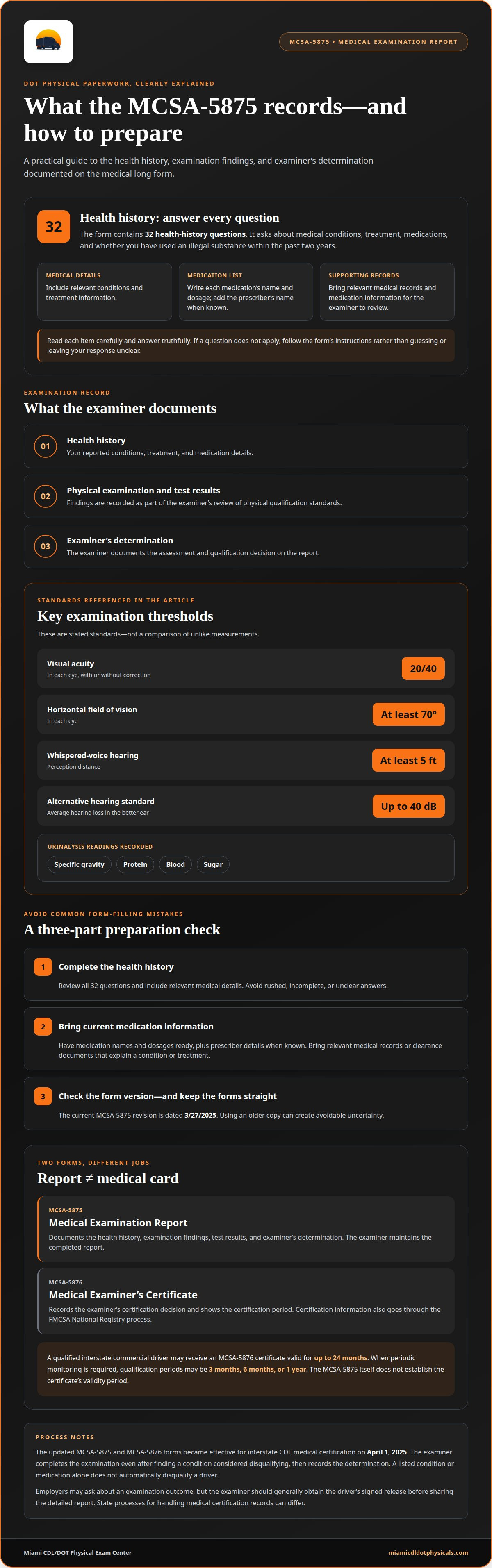
The form’s health history records information about your medical conditions, treatment, and medications for the examiner to review during the physical exam. It contains 32 questions, including whether you have used an illegal substance within the past two years. Accurate details help the examiner assess how your health may affect safe driving. Write down each medication’s name and dosage, and include the prescriber’s name when known. Bring relevant medical records and medication information to support your answers.
Form Versions and Updates
The current MCSA-5875 revision is dated 3/27/2025. The updated MCSA-5875 and MCSA-5876 forms became effective for interstate CDL medical certification on April 1, 2025. Using the current form helps keep the examination record aligned with the applicable version. The updates request more information than forms used before the 2015 changes.
The MCSA-5875 is not the medical card. It documents the examination; Form MCSA-5876, the Medical Examiner’s Certificate, records the examiner’s certification decision separately. Medical certification information also goes through the FMCSA National Registry process.
The form captures examination findings as well as health history. According to the Electronic Code of Federal Regulations, the vision standard requires at least 20/40 visual acuity in each eye, with or without correction. The Electronic Code of Federal Regulations also sets a horizontal field-of-vision standard of at least 70° in each eye.
Drivers provide their health history to the medical examiner during the exam; the examiner maintains the completed report. State processes can differ for handling medical certification records, so the MCSA-5875 itself should not be confused with a state-submitted medical card.
MCSA-5875 Medical Examination Report
The MCSA-5875 records the DOT medical examination, its findings, and the examiner’s qualification decision. Understanding the MCSA-5875 form helps distinguish this detailed record from the separate MCSA-5876 certificate.
Exam Findings and Examiner Assessment
The examiner records examination results and assesses whether the driver meets applicable physical qualification standards. The Electronic Code of Federal Regulations sets vision standards of at least 20/40 visual acuity in each eye, with or without correction, and a horizontal field of vision of at least 70° in each eye. The whispered-voice hearing standard is perception from at least 5 feet away; an alternative allows average hearing loss up to 40 dB in the better ear.
These results inform the examiner’s determination under 49 CFR 391.41-391.49. A listed condition or medication alone doesn’t automatically disqualify a driver.
Report Purpose and Employer Requests
The examination report records the driver’s health history, test results, and examiner’s assessment. Employers may ask about an examination outcome, but the examiner should generally obtain the driver’s signed release before sharing the detailed report. This protects private medical information and distinguishes the examination record from proof of certification.
If a driver questions a decision, the recorded findings provide a basis for discussing the determination with the examiner.
Completing the Examination Report
The examiner reviews the driver’s medical history, conducts the physical examination, records test results, and documents findings on Form MCSA-5875. The form includes urinalysis readings for specific gravity, protein, blood, and sugar. The examiner completes the entire examination even after finding a condition considered disqualifying, then records the determination.
A DOT physical includes completing the examination report as part of the medical evaluation.
Report Validity
The MCSA-5875 documents an examination; it isn’t the medical certificate and doesn’t establish the certificate’s validity period. A qualified interstate commercial driver may receive an MCSA-5876 certificate valid for up to 24 months. When periodic monitoring is required, the form provides qualification periods of 3 months, 6 months, or 1 year.
For drivers, understanding the MCSA-5875 form includes knowing that the certificate, not the report, shows the certification period. Review the examiner’s decision and separate certificate together.
Common form-filling mistakes
Small errors on Form MCSA-5875 can leave the medical examiner with an incomplete or inaccurate record. The form contains 32 health-history questions, so a rushed answer or blank response can omit information relevant to the examination. Read each item carefully and answer it fully. If a question doesn’t apply, follow the form’s instructions rather than guessing or leaving the response unclear.
Medication details are easy to overlook. Before the appointment, write down each current medication’s name and dosage, and the prescriber’s name if known. Bring relevant medical records or clearance documents that explain a condition or treatment. An outdated medication list may not reflect your current treatment, while an omitted medication can leave the examiner without important context.
Another mistake is treating the MCSA-5875 as the medical card. The MCSA-5875 documents the examination; the separate MCSA-5876 records the examiner’s certification decision. Keeping the forms’ roles distinct helps prevent confusion about which document shows the outcome. The current MCSA-5875 revision is dated 3/27/2025, so using an older copy can also create avoidable uncertainty during preparation.
- Incomplete history: Review all 32 questions and include relevant medical details.
- Unclear medication information: Bring current names, dosages, and prescriber details when known.
- Inaccurate answers: Give truthful responses instead of estimating or concealing information.
- Missing supporting documents: Bring relevant records or medical clearances that explain your answers.
Accuracy matters. The form states that submitting fraudulent or intentionally false information violates 49 CFR 390.35. It also identifies 49 CFR 390.37 and 49 CFR 386 Appendices A and B as provisions under which civil or criminal penalties may apply. If you notice an error, tell the medical examiner before the report is completed. Clear corrections help keep the examination record consistent with your actual health history and current documents.
Purpose and role of Form MCSA-5875
Form MCSA-5875 links the physical examination to a documented medical qualification decision. Its purpose is not to serve as a commercial driver’s license or medical card. Instead, it preserves the examiner’s findings and supports the separate medical certification process. That distinction matters because the report and the certificate perform different jobs.
The medical examiner maintains the completed examination report as part of the examination record. It captures the basis for the assessment, such as recorded vision results or other examination findings. The record gives the examiner a reference if the driver’s medical status requires review later. The examiner must keep the completed report for at least 3 years.
The report also connects the in-person examination with federal recordkeeping. After an exam, the medical examiner must upload its results to the FMCSA National Registry by midnight local time of the next calendar day. The Registry process carries certification information forward; it does not make the MCSA-5875 itself a license or proof of certification.
Under the National Registry II rule, effective June 23, 2025, medical certification results can be transmitted electronically to State Driver’s Licensing Agencies. Those results include medically qualified, medically unqualified, and voided examinations. The state agency uses the certification information in its licensing process. The report remains the detailed examination record, while the MCSA-5876 records the certification decision.
For a commercial driver, the practical takeaway is simple: the MCSA-5875 explains the examination record, while the medical certificate communicates the certification outcome. Keeping the roles clear helps prevent confusion when handling licensing documents or discussing an examination with an employer. If you need a DOT physical examination, schedule a DOT physical to complete the medical examination process.
Miami CDL/DOT Physical Exam Center
Miami CDL/DOT Physical Exam Center provides professional DOT physical exams and helps commercial drivers nationwide understand how the examination report relates to medical certification. Schedule a physical when you need an evaluation documenting your health history, examination findings, and the medical examiner’s determination. Bring current medication details and relevant medical records for the examiner to review.
For federal compliance responsibilities beyond the physical, the FMCSA Clearinghouse Consortium supports owner-operators and fleet companies nationwide with Clearinghouse requirements. These services address separate needs, so choose the next step that fits: a medical examination or consortium support.
For help with a DOT physical or related compliance needs, contact Miami CDL/DOT Physical Exam Center.
Make Your Next DOT Step With Confidence
Understanding the MCSA-5875 form can make the medical certification process feel more manageable, but the next step is putting that knowledge into practice. Plan your DOT physical around your work schedule, keep your health information current, and raise any concerns during the examination rather than leaving them unresolved. A clear conversation can help you understand what the examiner records and what your next step may be.
Miami CDL/DOT Physical Exam Center offers DOT physical exams, DOT drug tests, and non-DOT drug tests. Choose the service that fits your immediate need, whether you’re preparing for a medical examination or completing a separate testing requirement.
For a straightforward next step, connect with Miami CDL/DOT Physical Exam Center. Arrive prepared, ask clear questions, and move forward with greater confidence in your compliance process.
Frequently Asked Questions
Who uses the Medical Examination Report Form?
Commercial drivers and qualified medical examiners use Form MCSA-5875 during a DOT medical examination. The driver provides health-history information, while an examiner listed on FMCSA’s National Registry conducts the examination and completes its findings. For example, a driver renewing medical certification uses the form to document the current exam, not as a substitute for a commercial driver’s license or medical certificate.
Can a medical condition listed on the form prevent certification?
A condition listed on the MCSA-5875 does not automatically prevent certification. The examiner assesses the condition alongside its treatment, relevant examination findings, and whether it affects the driver’s ability to meet applicable physical qualification standards. For example, a medication entry alone is not the certification decision. Answer accurately and provide relevant medical context so the examiner can consider the full picture.
How should drivers answer questions about medical history?
Answer each health-history question truthfully and clearly. Include current conditions, relevant past diagnoses, treatment, and medications, even if a condition feels controlled. If a medication changed recently, for example, provide its current name and dosage instead of relying on an outdated list. If you’re unsure what a question means, ask the examiner to clarify it before submitting your answers.
My Employer Asked for My DOT “Long Form.” What Is It?
The “long form” usually means the completed MCSA-5875 examination report, rather than the MCSA-5876 medical certificate. The report contains detailed medical information, so an employer’s request does not by itself mean the full report should be released. A medical examiner should generally obtain your signed release before providing an employer with the detailed examination report. Ask which document the employer needs.
Should I keep a copy of my long form?
Yes, keeping a copy of your MCSA-5875 can help you refer to the examination record later. Drivers are also advised to retain their MCSA-5876 certificate and relevant medical clearances or exemption documents. Store copies securely because the report contains personal health details. If you lose the long form, contact the medical examiner’s office where the physical took place to ask about another copy.
What Information Does the MCSA-5875 Record?
The form records the driver’s health history, examination findings, test results, and the examiner’s determination. Its examination entries can include urinalysis readings for specific gravity, protein, blood, and sugar, as well as hearing results at 500, 1000, and 2000 Hz. These details create a fuller examination record than the separate MCSA-5876 certificate, which records the certification decision.


