
Next to high blood pressure, vision tests are the second most common reason drivers fail their medical exams. It's a stressful reality for any professional whose livelihood depends on a valid medical card. You've spent years on the road, so it's natural to feel anxious about whether your eyesight still meets the strict DOT physical vision requirements. Many drivers worry that a slight change in their vision or a struggle with color plates could end their career overnight.
We're here to provide the clarity you need to walk into your next appointment with confidence. This guide simplifies the FMCSA standards, explaining exactly how the 20/40 rule works and how you can use corrective lenses to pass. You'll learn about the 2026 shift to the Alternative Vision Standard for monocular drivers and how the National Registry II system manages your electronic records. We also cover the specific steps to take if you struggle with color blindness tests, ensuring you have a clear plan to secure your medical certificate and stay behind the wheel.
Key Takeaways
- Learn the exact 20/40 acuity and 70-degree peripheral vision standards necessary to maintain your commercial driving status.
- Understand how to satisfy the DOT physical vision requirements with corrective lenses and the specific legal requirements for wearing them while on duty.
- Explore the 2026 Alternative Vision Standard to see how monocular drivers can now qualify for a medical card without a complex waiver.
- Identify the common causes of temporary vision failure, such as fatigue and eye strain, and how to prepare your eyes for the exam.
- Follow a clear, step-by-step plan for returning to service if you require a follow-up evaluation with an eye specialist.
The Three Pillars of DOT Physical Vision Requirements
The Federal Motor Carrier Safety Administration (FMCSA) places high importance on a driver's ability to see the road clearly. Vision is often the most scrutinized part of the medical certification process because it directly impacts your reaction time and situational awareness. To pass, you must meet three specific pillars that form the foundation of the DOT physical vision requirements. These standards ensure that every driver holding a Commercial driver's license (CDL) can operate heavy equipment safely under various lighting and weather conditions.
Acuity Standards: The 20/40 Benchmark
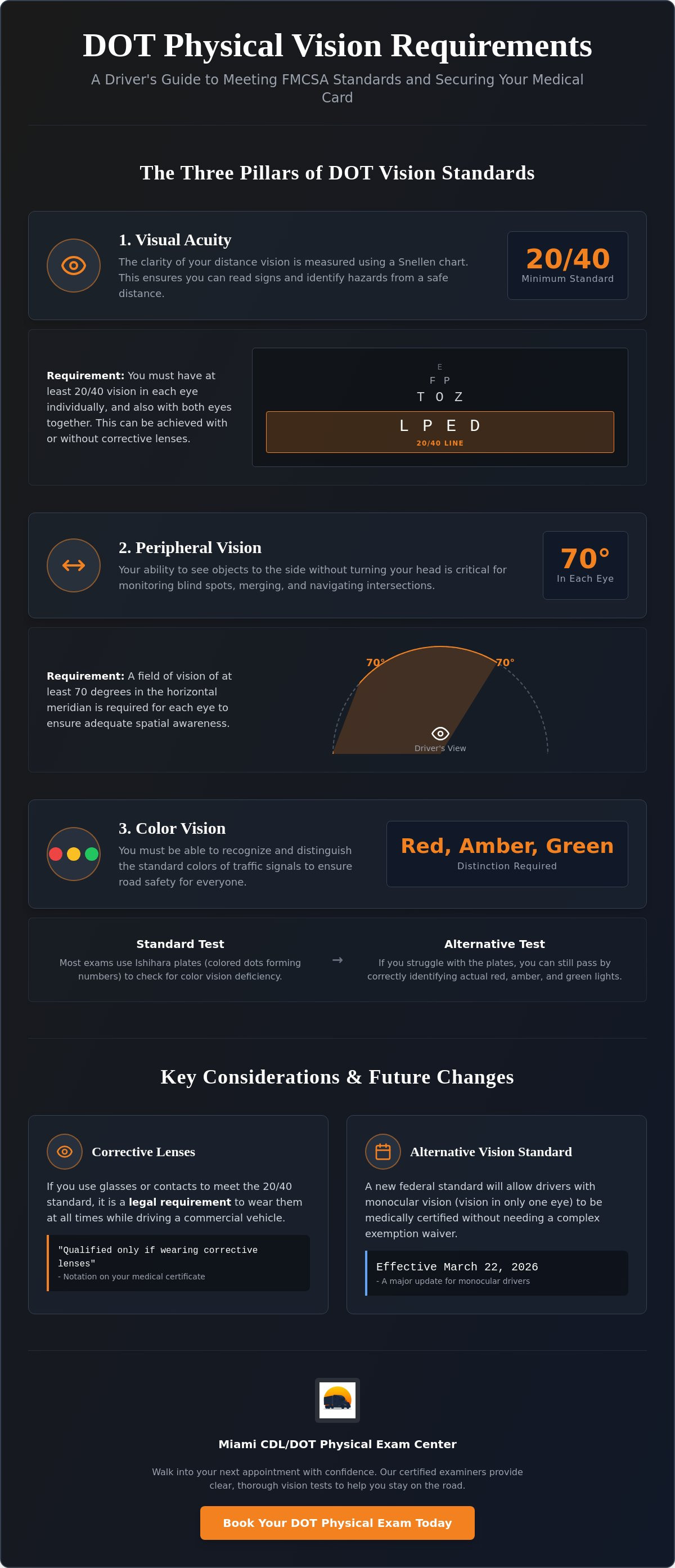
Distance visual acuity is the first hurdle. Examiners use the Snellen chart, which is the standard eye chart featuring rows of letters that get smaller toward the bottom. To qualify, you must have at least 20/40 vision in each eye individually and 20/40 vision when using both eyes together. This means you can see at 20 feet what a person with "normal" vision can see at 40 feet. It's a pragmatic standard designed to ensure you can read road signs and identify hazards from a safe distance.
If you are borderline, examiners might ask you to blink or take a moment to rest your eyes. However, the standard is firm. If you can't read the 20/40 line clearly, you'll likely need to update your prescription before your medical card can be issued. You can meet this requirement with or without corrective lenses, but if you need glasses to pass, you must wear them every time you're behind the wheel. This restriction is noted on your medical certificate to ensure legal compliance during roadside inspections.
Field of Vision and Peripheral Requirements
Seeing what's directly in front of you isn't enough. The FMCSA requires a field of vision of at least 70 degrees in the horizontal meridian in each eye. This measurement determines your ability to detect movement and objects in your peripheral vision without turning your head. It's a non-negotiable safety standard for monitoring blind spots, merging into fast-moving traffic, and navigating busy intersections.
Several factors can impact these results during your exam. Natural changes in the eye as you age can sometimes narrow the field of vision, making it harder to track objects on the side. Medical conditions like glaucoma or certain types of retinal damage can also create "dead spots" in your periphery. If you've had previous eye injuries, it's wise to have an optometrist check your field of vision before your actual DOT appointment.
Finally, you must be able to recognize the colors of traffic signals. You don't need perfect color vision, but you must distinguish between standard red, green, and amber. Most examiners use Ishihara plates (colored dot patterns) for this. If you struggle with the plates, don't panic; many examiners can use alternative tests to verify you can still identify signal lights correctly. This ensures that DOT physical vision requirements remain fair while prioritizing public safety on the highway.
How Color Vision and Corrective Lenses Impact Your Certification
Meeting the distance visual acuity standard is only half the battle. You must also prove that you can safely interpret the world around you, particularly traffic signals. Many drivers fear that being color blind is an automatic disqualification, but that isn't the case. The DOT physical vision requirements focus specifically on your ability to distinguish the colors necessary for safe driving: red, green, and amber. If you can distinguish these colors, you can pass the exam even if you have certain types of color deficiency.
Passing the Color Vision Test
Most examiners start with Ishihara plates. These are the circles filled with colored dots that form numbers. If you struggle with these, don't panic. The FMCSA allows for an alternative test where the examiner shows you actual red, green, and amber lights to verify recognition. The traffic light exception allows drivers who fail standard plate tests to qualify if they can accurately identify the red, green, and amber colors used in traffic control signals. This practical approach ensures that safe, experienced drivers aren't sidelined by a test that doesn't reflect real-world driving conditions.
Guidelines for Glasses and Contact Lenses
If you use glasses or contacts, bring them to your appointment. If you need them to reach the 20/40 standard, the examiner will mark the "Qualified only if wearing corrective lenses" box on your medical card. This isn't just a suggestion; it's a legal mandate. If a roadside inspector catches you driving without your lenses, you face the same penalties as driving with an expired medical card. Always carry a spare pair of glasses in your cab to avoid being placed out of service due to a broken or lost set.
Be careful with "monovision" contact lenses. This is a setup where one eye is corrected for distance and the other for reading. The FMCSA requires each eye to meet the 20/40 standard individually, and monovision setups often fail this requirement because they compromise depth perception. Additionally, an outdated prescription is a common reason for a failed physical. Ensure your lenses are current before scheduling your DOT physical exam to avoid unnecessary delays. Meeting the DOT physical vision requirements with the right lenses keeps your career moving forward and the roads safe for everyone.
The Alternative Vision Standard for Monocular Drivers
In early 2022, the FMCSA simplified the path for drivers with vision in only one eye. The old Federal Vision Exemption Program, which often took months to navigate, was replaced by the Alternative Vision Standard. This change allows you to qualify for a medical card without a federal waiver. If you meet the specific DOT physical vision requirements in your functioning eye, you can maintain your livelihood through a local clinical process. It's a faster, more efficient system that relies on the expertise of your own eye doctor rather than a distant federal agency.
Completing Form MCSA-5871: The Vision Evaluation Report
The most critical step in this process is completing Form MCSA-5871, also known as the Vision Evaluation Report. You must take this form to an ophthalmologist or optometrist for a thorough eye exam. The specialist must verify that your better eye has at least 20/40 distant visual acuity and a horizontal field of vision of at least 70 degrees. This evaluation must be completed within 45 days of your appointment with a certified medical examiner. This timeframe is strict, so schedule your eye appointment close to your DOT physical to ensure the data is current.
Your DOT medical examiner cannot perform this specific evaluation themselves. They rely on the specialist's report to confirm that your vision is stable and that you've adapted to the monocular condition. Make sure your eye doctor signs and dates the form correctly. If the information is incomplete or older than 45 days, the medical examiner will be unable to process your certification, leading to unnecessary downtime. Bringing a clear, fully completed form is the best way to ensure a smooth exam day.
The Road Test Requirement for New Monocular Drivers
New drivers who haven't held a vision waiver before must complete a road test before they can operate in interstate commerce. This test is usually conducted by the employer and focuses on your ability to safely operate a commercial vehicle with your visual limitation. If you already held a valid federal vision waiver before the new rules took effect in 2022, you're generally exempt from this new road test requirement. You simply transition into the new standard during your next renewal by providing the required medical documentation.
Maintaining your status requires more frequent check-ups than a standard medical card. Under the Alternative Vision Standard, you must visit your eye specialist every year for a new MCSA-5871 report. Your medical examiner will then issue a certificate that is valid for a maximum of 12 months. This annual cycle ensures you continue to meet the DOT physical vision requirements and helps identify any changes in your eye health before they become a safety risk on the road. Staying ahead of these annual visits is key to keeping your CDL active without interruption.
A Driver's Checklist: Preparing for the DOT Vision Test
Preparation is the key to a stress-free exam. While the DOT physical vision requirements are straightforward, external factors like fatigue or eye strain can temporarily lower your performance. Walking into your appointment with a plan ensures that your results reflect your true visual ability rather than a bad day on the road. Taking a few proactive steps before you arrive at the clinic can make the difference between a two-year certification and a frustrating follow-up visit.
Physical Preparation for the Eye Exam
Give your eyes a break before your test. Avoid digital eye strain by staying away from smartphones, tablets, and laptop screens for at least two hours prior to your exam. Constant focus on near objects fatigues the ciliary muscles in your eyes, which can make it harder to focus on the distant Snellen chart. If you arrive with tired eyes, you might struggle to read the 20/40 line even if your vision is normally fine.
Be honest during the screening and never try to guess the letters on the chart. If you're squinting or guessing, it's a sign that your current prescription may need an update. For drivers with diabetes, pay close attention to your blood sugar levels on the day of the exam. Spikes in blood glucose can cause the lens of the eye to swell, resulting in temporary blurred vision that could lead to a failed test. Drink plenty of water to stay hydrated, as dry eyes can also cause irritation and slight visual distortions.
The Corrective Lens Wearer's Toolkit
If you wear glasses or contacts, your equipment must be in top shape. Verify that your prescription is current, ideally from an exam within the last 12 months. An outdated prescription is one of the most common reasons drivers fail to meet the DOT physical vision requirements. Before you step into the exam room, clean your lenses thoroughly. Smudges or dust can cause "ghosting" or light streaks, which mimic the symptoms of astigmatism and make the letters appear blurry.
- Bring a Backup Pair: Always carry a second pair of glasses in your vehicle. If your primary pair breaks while you're on a route, you're legally prohibited from driving until they are replaced.
- Contact Lens Care: If you wear contacts, bring your solution and a storage case. Some examiners may ask you to remove them for specific parts of the physical, and you don't want to be caught without a way to store them safely.
- Specialist Documentation: If you have glaucoma, cataracts, or macular degeneration, bring a clearance letter from your eye specialist. This note should state that your condition is stable and doesn't interfere with your ability to operate a commercial vehicle.
If you've recently had LASIK or other corrective eye surgeries, communicate this to your examiner immediately. They'll need to verify that your vision has stabilized and that you've recovered fully from the procedure. Ensure your paperwork is ready and your eyes are rested by scheduling your DOT physical exam with a provider who understands the specific needs of professional drivers.
Renewing Your CDL Medical Card with a Certified Examiner
Choosing the right examiner is the final piece of the puzzle. While you now understand the DOT physical vision requirements, the certified medical examiner is the professional who validates your results and issues your medical card. This process is about more than just checking boxes; it's a partnership to ensure you're safe to operate on public roads. If you struggle with the vision screening, the examiner won't simply disqualify you. Instead, they will provide a specific "Return to Service" path. This usually involves a referral to an eye specialist to update your prescription or evaluate a stable condition, allowing you to return and complete your certification once you meet the standards.
Why National Registry Certification Matters
Federal law requires that every DOT physical is performed by a professional listed on the FMCSA National Registry. These examiners have specific training in commercial driving regulations and understand how to handle complex vision issues, such as the Alternative Vision Standard for monocular drivers. Their expertise helps prevent unnecessary delays in your certification. A certified examiner also manages the critical task of data integrity.
Under the National Registry II system, your examiner is required to submit your results electronically to the FMCSA by the next calendar day. This digital update ensures your medical status is transmitted quickly to your state driver licensing agency. It eliminates the old risks of lost paperwork or manual entry errors at the DMV. By choosing a registry-certified professional, you ensure that your DOT physical vision requirements are documented correctly and your CDL remains in good standing without you needing to make extra trips to a government office.
Fast-Track Your Certification
Efficiency is vital when your income depends on your time behind the wheel. Many drivers prefer to handle all their compliance needs in one visit by combining their physical with a DOT drug test. This approach is highly effective for maintaining total compliance with FMCSA regulations. While the vision test and the drug screen are separate components of your fitness for duty, completing them together ensures there are no gaps in your medical file.
If you arrive prepared with your corrective lenses and any necessary specialist documentation, the process is remarkably fast. Most compliant drivers can walk out with their medical certificate in hand the very same day. Don't leave your livelihood to chance or wait until the last minute to renew. Taking care of your health requirements early gives you the peace of mind to focus on the road ahead. Schedule your professional DOT physical exam today to ensure your certification is handled with the speed and authority you deserve.
Secure Your Medical Certification with Ease
Mastering the DOT physical vision requirements is about understanding the standards and preparing your eyes for success. Whether you rely on the 20/40 rule with corrective lenses or utilize the newer Alternative Vision Standard for monocular vision, compliance is the key to protecting your career. Remember to rest your eyes before your exam, bring your current prescription, and keep a backup pair of glasses in your cab to avoid unexpected downtime on your route.
Our team is here to make the process as smooth as possible. We provide FMCSA-certified medical examiners who understand the high stakes of your profession. We offer same-day CDL medical card issuance and full FMCSA Clearinghouse compliance support to get you back on the road quickly. Book Your FMCSA-Certified DOT Physical Exam Now. Your livelihood depends on clear sight and a valid medical card. Take the next step today and drive with the peace of mind that comes from being fully compliant and ready for the miles ahead.
Frequently Asked Questions
Can I pass the DOT physical if I am color blind?
Yes, you can pass as long as you can recognize the colors of traffic signals. The FMCSA doesn't require you to pass the Ishihara plate test, which is the test featuring circles with colored dots. If you struggle with the plates, the examiner will use an alternative method to verify that you can accurately identify standard red, green, and amber lights.
What happens if I only have 20/50 vision in one eye?
You won't meet the standard DOT physical vision requirements since both eyes must be at least 20/40. However, you can still qualify through the Alternative Vision Standard. This requires your better eye to be 20/40 or better and for an eye specialist to complete Form MCSA-5871. This evaluation proves you've adapted to the vision loss and can drive safely.
Do I need a vision waiver to drive a commercial vehicle in 2026?
No, the old federal vision waiver program is no longer in use. It was replaced in 2022 by a more streamlined clinical process. Drivers who don't meet the standard acuity in both eyes now use the Alternative Vision Standard. This involves a report from their optometrist and an annual medical exam rather than a multi-month waiver application with the federal government.
Can I wear contact lenses during the DOT eye exam?
Yes, you're permitted to wear contact lenses or glasses during the screening. If you need them to reach the 20/40 requirement, your medical card will be marked with a "corrective lenses" restriction. You're legally required to wear those lenses every time you operate a commercial vehicle to maintain your certification and stay compliant during roadside inspections.
How often do I need to have my vision tested for my CDL?
Most drivers have their vision checked every two years during their regular medical exam. If you're operating under the Alternative Vision Standard because of monocular vision, you must have a vision evaluation by a specialist and a DOT physical every year. This frequent monitoring ensures your eye health remains stable enough for safe commercial driving.
Will LASIK surgery disqualify me from getting a DOT medical card?
LASIK surgery doesn't disqualify you from driving. You can be certified as soon as your eyes have healed and your vision meets the 20/40 standard. It's helpful to bring a release from your surgeon to your physical to confirm you've completed your follow-up care and that your vision is stable enough for duty.
What is the Alternative Vision Standard for monocular drivers?
This is a regulatory pathway that allows drivers with vision in only one eye to qualify for a medical card. It requires an eye specialist to perform a thorough exam and document the results on Form MCSA-5871. Once the medical examiner reviews this report, they can certify the driver for up to 12 months at a time.
Can I use a magnifying glass or telescopic lenses to pass the test?
No, the use of telescopic lenses or magnifying aids is not allowed for the vision portion of the exam. The FMCSA standards require that you meet the acuity and field of vision requirements using standard corrective lenses like glasses or contacts. Using prohibited aids will result in a failure of the vision screening during your DOT physical vision requirements check.


