

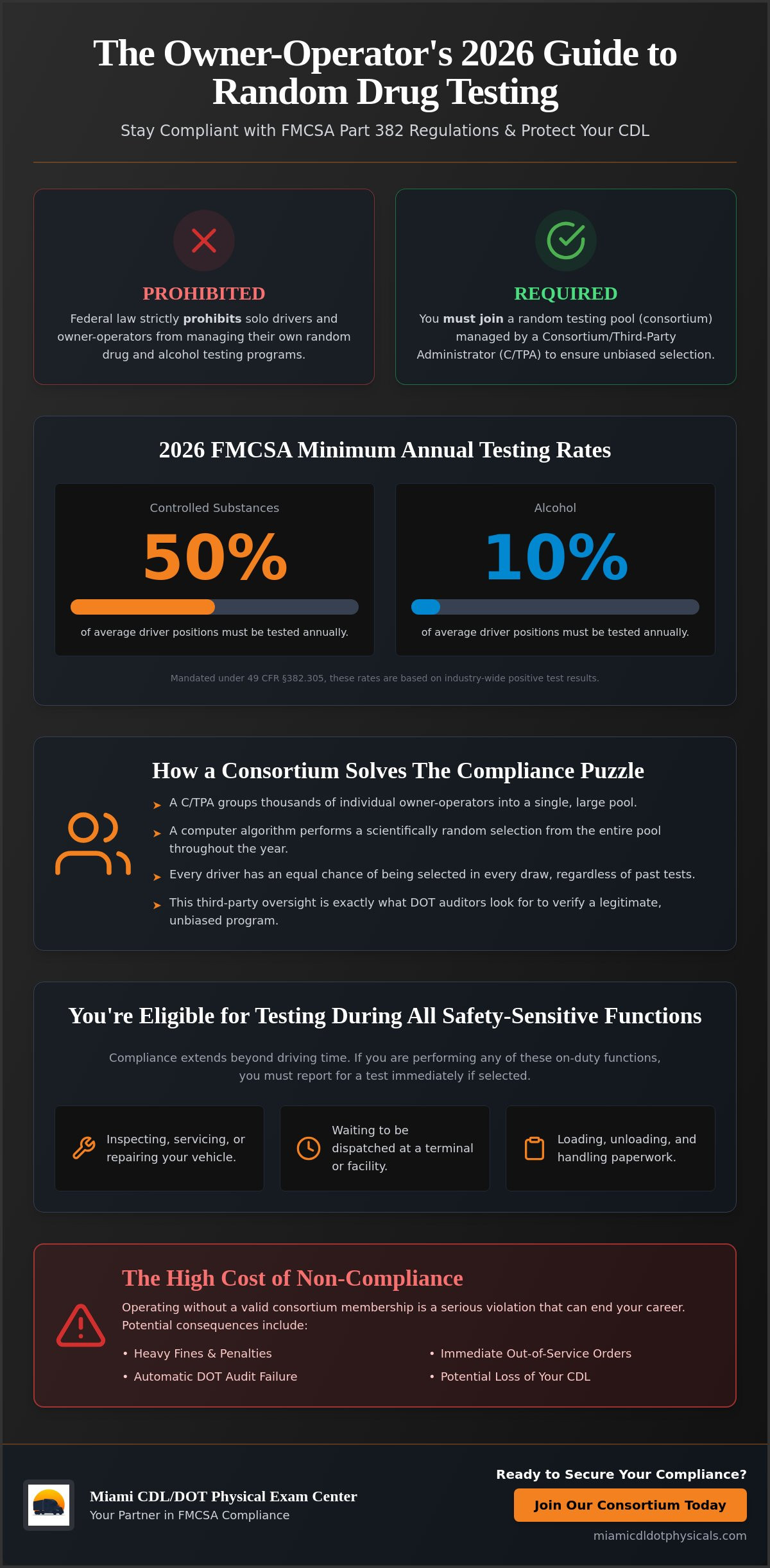
You can't legally manage your own drug and alcohol testing program if you're the only driver in your company. Federal law requires every independent driver to join a random drug testing pool owner operator consortium managed by a third party. It's a common source of frustration for professionals who want to focus on the road instead of buried paperwork and complex FMCSA Part 382 regulations. Failing to have this partnership in place doesn't just invite a fine; it puts your entire livelihood at risk during a DOT audit.
We understand that staying compliant feels like a full-time job on top of your driving schedule. This 2026 guide simplifies the process so you can protect your CDL and stay moving. You'll learn the specific steps to join a consortium, how to navigate your dual role in the FMCSA Clearinghouse, and what the 50% testing rate means for you this year. We'll also cover the stricter 24-hour reporting timelines to ensure you never miss a deadline and stay fully prepared for any inspection.
Key Takeaways
- Understand why solo drivers are legally prohibited from managing their own testing and how a consortium fulfills mandatory FMCSA Part 382 requirements.
- Learn how joining a random drug testing pool owner operator consortium ensures you meet the 2026 testing rates of 50% for controlled substances and 10% for alcohol.
- Discover the essential steps to link your random testing results with your FMCSA Clearinghouse profile to maintain a clean and compliant driving record.
- Identify the non-negotiable features of a reliable C/TPA, including digital reporting and nationwide access to certified testing locations for maximum convenience.
- Gain a clear roadmap for simplifying your regulatory paperwork so you can focus on your business without the constant fear of failing a DOT audit.
What is a Random Drug Testing Pool for Owner-Operators?
If you're an owner-operator, a random drug testing pool owner operator membership is your ticket to legal compliance. This pool is a collective of safety-sensitive employees who are subject to unannounced testing throughout the year. The regulatory backbone of this requirement is FMCSA 49 CFR Part 382. It ensures that the industry remains safe by removing impaired drivers from the road before an accident happens. It's a mandatory partnership that protects both your business and the public.
Randomness is the core of the program. Every driver in the consortium has an exactly equal chance of being selected during every single draw. It doesn't matter if you were just tested last week; your name stays in the pool and could be pulled again immediately. This continuous eligibility follows established drug testing methodologies designed to prevent predictability. Unlike pre-employment tests that act as a one-time entry requirement, or post-accident tests that follow a specific crash, random tests are unannounced and ongoing. A consortium groups thousands of solo drivers together to meet federal percentages. This is the only way a one-person company can mathematically satisfy a 50% testing rate without testing themselves every other month.
The Role of the FMCSA in Random Testing
The FMCSA acts as the governing body that sets the industry's annual minimum testing rates. Under 49 CFR §382.305, these rates are adjusted based on industry-wide positive test results. For 2026, the agency has maintained a 50% drug testing rate and a 10% alcohol testing rate. These rates have remained steady for several years because the industry's positive rate hasn't dropped below the 1.0% threshold. If the FMCSA sees a significant improvement in these numbers, they may lower the requirement in the future, but for 2026, the higher rate stands. Staying in a random drug testing pool owner operator program is essential for maintaining your operating authority. If you operate a vehicle that requires a CDL, these rules aren't optional.
Safety-Sensitive Functions and Testing Eligibility
You're eligible for testing whenever you're performing safety-sensitive functions. This definition covers much more than just the time you spend behind the wheel. It includes time spent inspecting or servicing your vehicle, waiting at a terminal to be dispatched, or even supervising the loading of your trailer. You're considered on-duty during these times and must report for testing immediately if your name is drawn.
- Inspecting, servicing, or conditioning any commercial motor vehicle.
- Waiting to be dispatched at a carrier or shipper facility.
- Loading or unloading cargo and handling paperwork.
- Repairing a disabled vehicle on the side of the road.
Operating without a valid pool membership is a serious compliance gap. It can lead to heavy fines, immediate out-of-service orders, and the potential loss of your CDL. By joining a consortium, you ensure that you're always ready for an audit and fully compliant with federal law.
The Legal Requirement: Why Solo Drivers Need a Consortium
If you operate as a solo driver, you cannot legally manage your own random drug testing program. The FMCSA views you as both the employer and the employee, but for the sake of impartiality, you're prohibited from being the one who draws names for testing. This is the primary legal requirement for owner-operators that necessitates a third party. Without an independent manager, there's no way to prove that your selection for a test was truly random and not just a matter of convenience or avoidance.
A Consortium/Third Party Administrator (C/TPA) solves this problem by acting as a neutral manager. They take the administrative burden off your plate and ensure your company meets federal selection standards. By joining a random drug testing pool owner operator consortium, you're grouped with thousands of other independent drivers. This creates a large, statistically valid pool where a computer algorithm handles the selections. This third-party oversight is exactly what DOT auditors look for during an inspection to verify that your program is legitimate and unbiased. Enrolling in a FMCSA Clearinghouse Consortium is the fastest way to bridge this regulatory gap and ensure your operating authority remains active.
Consortium vs. Standalone Pools
Large motor carriers with hundreds of drivers often run standalone pools. They have enough employees to meet the FMCSA's 50% drug and 10% alcohol testing rates within their own company roster. As an owner-operator, you don't have that luxury. If you tried to run a standalone pool for just yourself, you'd be forced to test yourself at an impossible frequency to meet the percentages, and it still wouldn't be legal. Consortiums offer cost-efficiency by sharing the administrative costs across the entire group. This keeps your annual fees low while providing the same level of compliance as a major fleet. The size of the pool also means your individual name isn't pulled every single time, even though you remain eligible for every draw.
Federal Prohibitions for Owner-Operators
The FMCSA uses specific language regarding 'employer-drivers' to prevent conflicts of interest. The agency's goal is to eliminate any chance of a driver knowing when a test is coming. If you manage your own pool, you'd know exactly when the draw happens, which defeats the purpose of "unannounced" testing. Owner-operators must belong to a pool of at least two people. Be cautious of 'sham' pools that offer low prices but fail to report results to the Clearinghouse or use non-certified labs. A legitimate C/TPA will always provide you with a certificate of enrollment and have a clear process for handling selections and reporting violations within the required 24-hour window. Using a verified partner ensures you aren't just paying for a piece of paper, but for actual legal protection.
How the Random Selection and Testing Process Works
The FMCSA has confirmed the 2026 testing rates at 50% for controlled substances and 10% for alcohol. These percentages represent the minimum number of tests a consortium must complete annually based on the average number of drivers in the pool. When you join a random drug testing pool owner operator program, your name is entered into a database managed by a computer algorithm. This ensures scientific validity and eliminates human bias in the selection process. The random testing process is designed so that every driver has an equal chance of selection during every draw period, regardless of how many times they've been tested in the past.
One of the most critical aspects of compliance is the unannounced rule. You can't receive advance notice that your name has been drawn. Once you're notified of a selection, the DOT requires you to proceed immediately to a collection site. In the eyes of an inspector, immediately means you stop what you're doing and head to the clinic. Any delay without a valid safety reason can be documented as a refusal to test. A refusal carries the same weight as a positive result and will trigger an immediate return to duty process.
The Selection Timeline: Quarterly vs. Monthly Draws
Consortiums typically run their selection cycles on a quarterly or monthly basis to ensure tests are spread evenly throughout the year. It's a common misconception that being tested once clears you for the rest of the year. Because the selection is mathematically random, it's entirely possible to be drawn multiple times in a single year. Always keep your driver information updated in the pool. If your C/TPA can't reach you to notify you of a selection, you risk a non-compliance violation that could ground your truck during an audit.
What to Do When You Are Selected
When you receive a notification, follow these steps to stay compliant and protect your CDL:
- Step 1: Acknowledge the notification from your C/TPA. They'll provide a digital authorization code or the necessary paperwork for the lab.
- Step 2: Locate the nearest certified collection site. A reliable consortium provides access to over 20,000 SAMHSA-certified locations nationwide, so you're never too far from a clinic.
- Step 3: Complete the test and ensure the Medical Review Officer (MRO) receives the results. The MRO verifies the findings before they're reported back to you and the Clearinghouse.
If you're on a long-haul route when selected, don't wait until you return home. Waiting several days to test is often viewed as a violation of the immediate compliance rule. Use your consortium's dashboard to find a testing facility along your current route. Most major truck stops are within a short distance of a certified clinic. Complete the test, secure your documentation, and get back on the road to keep your delivery on schedule.
Integrating Random Testing with the FMCSA Clearinghouse
The FMCSA Clearinghouse is the central database where all drug and alcohol violations are recorded. Your participation in a random drug testing pool owner operator consortium is directly linked to this digital profile. When your name is selected for a random test, the results don't just stay in a private file; they're transmitted to the Clearinghouse to ensure you're legally fit to operate. If you test positive or refuse a test, your C/TPA is legally required to report that violation within 24 hours. This tight reporting window is a critical update for 2026 that leaves no room for administrative delays.
It's a common mistake to think that walking away from a test is better than failing one. Under FMCSA rules, a refusal to test is legally identical to a positive result. This includes failing to show up at the collection site immediately or leaving the facility before the process is finished. Both outcomes trigger an immediate Prohibited status in the Clearinghouse, which grounds your truck instantly. If you fail a random test, you must complete the Return-to-Duty (RTD) process with a DOT-qualified Substance Abuse Professional (SAP). This process involves a series of follow-up tests and significant costs, which is why maintaining compliance in your random pool is the best way to protect your livelihood.
Annual Clearinghouse Queries
Every owner-operator must conduct an annual limited query on themselves to ensure no new violations have been recorded. You also have a specific responsibility to designate your C/TPA within the Clearinghouse portal. This authorization allows your consortium to report results and conduct queries on your behalf. The FMCSA Clearinghouse tracks drug and alcohol violations across all state lines to prevent drivers from hiding a prohibited status by moving to a different state. To stay compliant as both an employer and a driver, you must join a FMCSA Clearinghouse Consortium that understands these dual-role requirements.
Reporting Violations in 2026
The reporting landscape has become much stricter in 2026. Under the Clearinghouse II rule, state licensing agencies now have real-time access to the database. If your status changes to Prohibited, your CDL can be downgraded or suspended almost immediately. You should regularly log into your Clearinghouse dashboard to verify that your information is accurate and that your random drug testing pool owner operator results are being handled correctly.
- Check your dashboard at least once a month to ensure your C/TPA designation is active.
- Verify that your annual query has been completed before the 12-month deadline.
- Ensure your contact information is current to receive immediate alerts regarding your status.
A Prohibited status doesn't just stop you from driving; it often leads to the immediate cancellation of your insurance coverage. Most carriers will not provide liability or cargo insurance to a driver who isn't in good standing with the Clearinghouse. Staying proactive with your consortium ensures that your data is reported accurately and your business remains fully operational.
Choosing a Reliable Consortium for Long-Term Compliance
Selecting the right random drug testing pool owner operator consortium is a business decision that directly impacts your long-term stability. You need a partner that offers more than just a basic membership certificate. In 2026, the speed of information is your best defense against compliance errors. Look for a C/TPA that provides a national reach and a reputation for rapid communication. Waiting days for results isn't just an inconvenience; it's a risk to your Clearinghouse status. Digital reporting and same-day results have become non-negotiable standards for modern drivers. You need a system that updates your records the moment a test is cleared so you can prove your eligibility at any roadside inspection.
Audit support is another critical factor to consider before signing up. When an FMCSA inspector asks for your participation records, you shouldn't have to hunt through stacks of paper. A reliable consortium provides organized, digital files that show your enrollment history and selection records immediately. This level of transparency builds trust with regulators and keeps your safety rating intact. Choosing a one-stop-shop that handles your DOT Physical Exam, DOT Drug Test, and consortium membership simplifies your life. The Miami CDL/DOT Physical Exam Center focuses on this integrated approach to reduce the stress of managing multiple vendors while you're trying to run a business.
What a Professional Consortium Provides
A high-quality consortium uses automated selection systems to remove human error and bias. These systems generate notifications the moment your name is drawn, ensuring you stay within the unannounced window required by federal law. You also gain access to a massive national network of certified collection sites. Whether you're in Miami or hauling a load across the country, you should be able to find a lab within a short drive of your current location. Professional C/TPAs also include Medical Review Officer (MRO) services. The MRO acts as an independent expert who verifies laboratory results and discusses potential medical explanations for findings before they're reported to the Clearinghouse. This step is a vital safeguard for your professional reputation.
Protecting Your Livelihood
The cost of joining a random drug testing pool owner operator program is a small investment compared to the price of non-compliance. A single failed DOT audit can result in thousands of dollars in penalties and a conditional safety rating. This rating can prevent you from working with high-paying shippers and brokers who require a clean record. Staying audit-ready means having all your compliance data in one secure, digital location. We help drivers stay on the road by managing these complex details so you don't have to. You can explore our FMCSA Clearinghouse Consortium services to see how we simplify the process for solo drivers. Our goal is to ensure you're always prepared for an inspection while keeping your operating authority active and secure.
Secure Your Operating Authority and Stay Road-Ready
Compliance is about more than just checking a box; it's about protecting your professional future. By joining a random drug testing pool owner operator consortium, you remove the guesswork from federal mandates. You now understand how these programs handle the unannounced selection process and ensure your results reach the Clearinghouse within the strict 2026 reporting windows. This proactive approach keeps your CDL in good standing and your insurance premiums stable.
We provide the tools you need to stay on the road without the stress of a pending DOT audit. Our team features FMCSA-certified medical examiners and utilizes automated random selection technology to ensure your company remains fully compliant. With full Clearinghouse integration and support, we act as your dependable partner in a high-stakes industry. Don't let paperwork slow you down or risk your livelihood on a technicality.
In addition to managing your regulatory paperwork, maintaining a professional business image is essential; you can learn more about Micro Printing to discover how their custom commercial printing and direct mail services can support your company's growth.
Join our FMCSA Clearinghouse Consortium and stay compliant today. Your business deserves the peace of mind that comes with expert oversight. Stay safe, stay legal, and keep moving forward.
Frequently Asked Questions
Can I manage my own random drug testing pool as an owner-operator?
No, you cannot legally manage your own pool if you are a solo driver. Federal regulations require any single-driver operation to join a consortium managed by a third-party administrator. This ensures the selection process remains scientifically random and unbiased. Managing your own pool would create a conflict of interest, as you would have advance knowledge of the testing schedule. Joining a professional consortium keeps you compliant with FMCSA Part 382.
How often are drivers selected from a random drug testing pool?
Selection frequency depends on the total number of drivers in your consortium and the annual rates set by the FMCSA. For 2026, the industry must meet a 50% drug testing rate and a 10% alcohol testing rate. Because the process is truly random, you could be selected multiple times in a year or not at all. Your eligibility resets with every draw, so you must always stay prepared for a notification.
What happens if I am on the road when I am selected for a random test?
You must proceed to a certified collection site immediately after receiving notification, even if you are on a long-haul trip. Most professional consortiums provide access to a national network of over 20,000 testing locations. Use your provider's dashboard to find a clinic along your current route. Delaying the test until you return home is often viewed as a refusal to test, which carries severe legal consequences for your CDL.
Is a random drug test the same as a pre-employment drug test?
No, these tests serve different regulatory purposes. A pre-employment test is a one-time requirement that must return a negative result before you perform any safety-sensitive functions. In contrast, a random drug testing pool owner operator selection is unannounced and occurs throughout the year. While the laboratory process is similar, the timing and selection method are what distinguish these two mandatory FMCSA requirements.
Do I need to be in a drug consortium if I don't have any employees?
Yes, solo drivers are specifically mandated to join a consortium. The FMCSA doesn't allow one-person companies to operate their own random programs because they cannot meet the requirement for unannounced testing. By joining a group of other drivers, you fulfill the legal obligation to be part of a statistically valid pool. This membership is a core requirement for maintaining your operating authority as an independent professional.
How much does it cost to join a random drug testing consortium in 2026?
Membership costs vary depending on the level of support and additional services provided by the C/TPA. Most owner-operators pay an annual fee to maintain their spot in the pool, which covers the administrative costs of selections and record keeping. While industry averages exist, you should check with your specific provider for their current rates. Remember that the cost of a membership is significantly lower than the fines associated with a failed DOT audit.
What is the difference between DOT and non-DOT random testing?
DOT testing follows strict federal guidelines and is mandatory for anyone with a CDL operating safety-sensitive equipment. Non-DOT testing is a private policy set by an employer for employees who don't fall under federal mandates. As an owner-operator, you must ensure your random drug testing pool owner operator membership specifically covers DOT-regulated tests. Non-DOT results are not reported to the FMCSA Clearinghouse and don't satisfy your legal requirements.
Can I be fired or lose my CDL for a single random drug test failure?
A single failure results in an immediate Prohibited status in the FMCSA Clearinghouse. This status prevents you from performing any safety-sensitive functions, effectively grounding your truck. You won't automatically lose your CDL forever, but you must complete the Return-to-Duty process with a Substance Abuse Professional. State licensing agencies in 2026 have real-time access to this data, so a failure can lead to a license downgrade if not addressed promptly.


