With the FMCSA maintaining a 50% random drug testing rate for the sixth consecutive year in 2026, half of all commercial drivers will face a screening this year. It's natural to feel a sense of pressure when your livelihood depends on a single sample. You likely worry that a standard prescription could trigger a flag or feel confused about how the FMCSA Clearinghouse tracks your history. Staying on the road requires more than just driving skills; it requires a sharp understanding of the strict federal protocols that govern your profession.
This reference will help you master the specific requirements for a DOT drug test Miami so you can approach your next screening with total confidence. We'll provide a clear breakdown of the 5-panel substance list and explain the latest 2026 updates regarding directly observed collections. You'll also learn how to navigate the Clearinghouse reporting process and why joining a compliant consortium is the smartest move for your long-term career stability. By the end of this guide, you'll have the tools to handle every aspect of DOT compliance without the stress.
Key Takeaways
- Identify which federal agencies govern your screening requirements to ensure you meet the specific safety-sensitive standards for your role.
- Master the step-by-step procedures of a DOT drug test Miami to navigate the federal Chain of Custody process with total confidence.
- Review the substances included in the mandatory 5-panel urine screen and learn how to document medical records to protect your CDL.
- Understand the legal requirement for owner-operators to join a drug testing consortium and how the FMCSA Clearinghouse monitors your compliance history.
- Prepare for your screening by arriving with a government-issued ID and following proper hydration techniques to avoid common testing delays.
What is a DOT Drug Test and Who is Required to Take One?
A DOT drug test is a strictly regulated screening process mandated by the federal government for employees in safety-sensitive positions. Unlike standard workplace screenings, these tests follow a rigid protocol to ensure public safety on our roads, rails, and waterways. When you schedule a DOT drug test Miami, you're participating in a program designed to keep the transportation industry free from substance abuse and its potential risks.
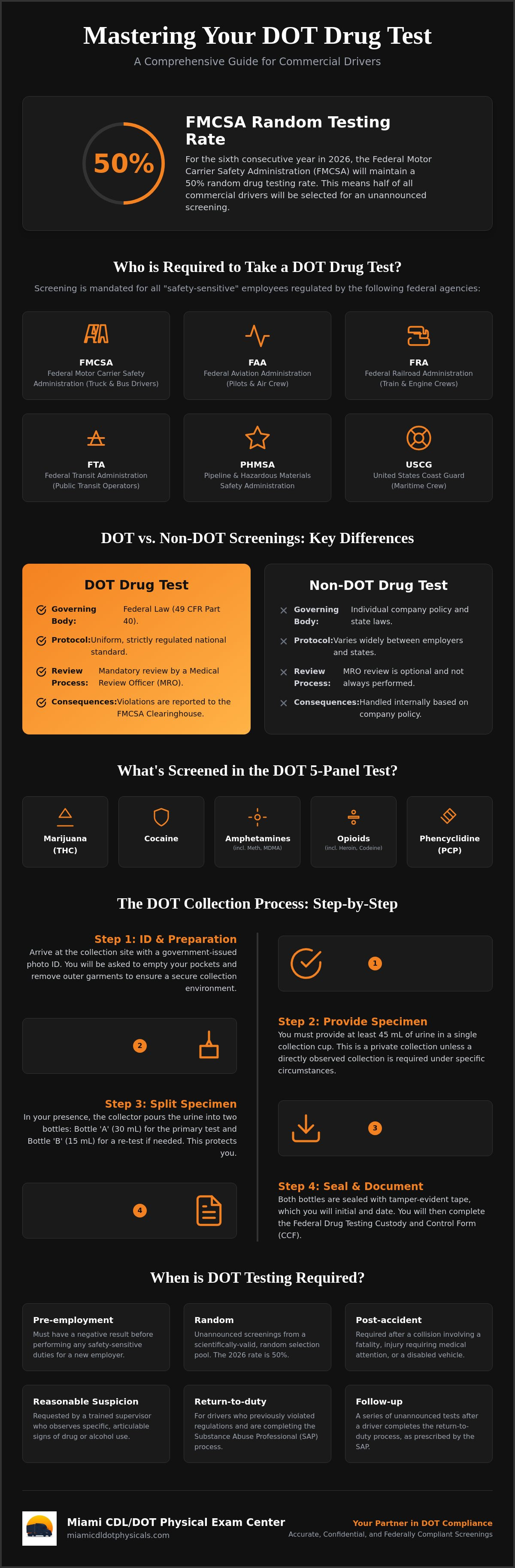
Several federal agencies oversee these requirements, each focusing on a specific sector. These include the Federal Motor Carrier Safety Administration (FMCSA) for truck and bus drivers, the Federal Aviation Administration (FAA) for pilots and crew, and the Federal Railroad Administration (FRA). Other governing bodies include the Federal Transit Administration (FTA), the Pipeline and Hazardous Materials Safety Administration (PHMSA), and the United States Coast Guard (USCG). If your job involves operating a commercial vehicle, handling hazardous materials, or managing public transit, you fall under these safety-sensitive regulations.
Understanding different Drug Testing Methodologies is helpful because DOT standards are much higher than non-DOT tests. A non-DOT drug test is governed by individual company policies and state laws, which vary widely. In contrast, DOT tests are uniform across the United States. They require specific collection procedures, laboratory certifications, and a mandatory review by a Medical Review Officer (MRO). This ensures that every result is validated and legally defensible.
The Legal Framework: 49 CFR Part 40
The Department of Transportation sets the gold standard for compliance through 49 CFR Part 40. This regulation doesn't just specify what substances to test for; it dictates exactly how the collection must happen. It covers everything from the security of the collection site to the specific training required for collectors. Because these rules are federal, they apply the same way in Florida as they do in any other state. This uniformity protects drivers from inconsistent testing practices and ensures that every professional is held to the same high standard of integrity.
Types of Required DOT Testing
Compliance isn't a one-time event. When preparing for a DOT drug test Miami, it's helpful to know which category your screening falls under. You'll encounter several types of mandatory screenings throughout your career:
- Pre-employment: You must receive a negative result before you're allowed to perform any safety-sensitive functions for a new employer.
- Random: Drivers are selected by a computer-generated pool for unannounced testing. As of 2026, the FMCSA requires a 50% random testing rate for drugs.
- Post-accident: This is triggered if a collision involves a fatality or if you receive a citation while a vehicle is towed or medical treatment is required.
- Reasonable Suspicion: Trained supervisors can request a test if they observe physical signs of drug or alcohol use while you're on duty.
- Return-to-duty: This is required for drivers who have previously violated regulations and are completing the process to regain their eligibility.
The DOT Drug Testing Process: A Step-by-Step Guide
Arriving for a DOT drug test Miami shouldn't be a source of anxiety if you understand the procedural safeguards in place. The entire process follows the strict DOT Drug Testing Regulations designed to ensure every driver is treated fairly and every sample is handled with total integrity. From the moment you walk into the facility, the collector follows a standardized script to maintain federal compliance.
Your preparation begins with a government-issued photo ID check. The collector will ask you to remove outer garments like coats, jackets, or hats and leave them in a secure area. You'll also be asked to empty your pockets. While you can keep your wallet, other items must stay outside the collection stall to prevent any accidental contamination of the site. These steps aren't just about security; they protect you by ensuring no one can question the validity of your sample later.
The DOT requires a split-specimen collection for every screening. You'll provide at least 45 mL of urine in a single collection container. The collector then pours this into two separate bottles in your presence: 30 mL goes into Bottle A, and 15 mL goes into Bottle B. Both bottles are sealed with tamper-evident tape and you'll initial the seals to confirm they are yours. This system is a critical safety net for drivers. If Bottle A ever returns a positive result, you have the legal right to request that Bottle B be tested at a different certified laboratory to verify the findings.
If you're looking for a streamlined experience that respects your schedule, you can easily book your next DOT drug test with a provider that understands these complex requirements inside and out.
Collection and Chain of Custody
The collection site must meet specific security standards before your test begins. This includes adding blue dye to the toilet water and securing all water sources in the stall to prevent dilution. Once your sample is sealed, the collector completes the Federal Drug Testing Custody and Control Form (CCF). The Chain of Custody is the legal paper trail for the specimen. This document records every person who handles your sample from the collection site to the laboratory, ensuring it's never left unattended or tampered with during transit.
The Role of the Medical Review Officer (MRO)
The Medical Review Officer is a licensed physician who acts as an independent gatekeeper for your test results. After the laboratory completes its analysis, the MRO reviews the data for accuracy. If a result is non-negative, the MRO will contact you for a private interview. This is your opportunity to explain any legitimate medical reasons for the finding, such as a valid prescription from your doctor. The MRO has the authority to verify your medical records and report the final result as negative if a legal explanation exists, effectively protecting your career from being unfairly derailed by necessary medical treatments.
What Substances are Screened in a Standard DOT 5-Panel Test?
While some private companies use 10-panel or 12-panel screens, federal regulations are very specific about what is required for safety-sensitive roles. For a DOT drug test Miami, you'll only undergo a standard 5-panel urine screen. This consistency ensures that every driver across the country is measured against the same benchmarks. You can find more detail on these specific requirements in the 5-panel drug test guide, which breaks down the science behind the screening.
In 2023, the DOT authorized oral fluid testing as an alternative to urine. However, as of July 2026, urine remains the industry standard for the vast majority of screenings. This is because the Department of Health and Human Services (HHS) requires specific laboratory certifications for oral fluid processing that are still being finalized. The HHS also sets the strict cutoff levels for each substance. These levels determine the exact concentration required to trigger a positive result, which helps prevent false positives from incidental exposure.
The Five Drug Classes Detected
The standard panel targets five specific categories of substances. Marijuana (THC) remains the most discussed, as federal law still classifies it as a Schedule I substance. Even if you have a medical card or live in a state where recreational use is legal, a positive THC result is a violation of DOT regulations. The screen also detects Cocaine metabolites, which stay in the system for several days after use. The Opiate category includes codeine and morphine, along with semi-synthetic opioids like oxycodone and hydrocodone. Amphetamines, including methamphetamine and MDMA, are also screened. Finally, the test looks for Phencyclidine (PCP), a long-standing inclusion in the federal safety panel.
A Note on Prescription Medications
Many drivers worry that their legal prescriptions will cause them to fail their DOT drug test Miami. It's true that certain medications, like those for pain or ADHD, can trigger a positive initial result at the lab. This is where the Medical Review Officer (MRO) plays a vital role. If your lab result is non-negative, the MRO will contact you for an interview. Have your valid prescriptions ready to present during this call. If the MRO verifies that you're using the medication as prescribed, they can report your final result as negative. Be aware that even with a valid prescription, a medication with a "safety-sensitive" warning may still lead to a medical disqualification if it impairs your ability to operate a vehicle safely. Any confirmed violations are reported to the FMCSA Drug & Alcohol Clearinghouse, which can impact your ability to drive commercially.
FMCSA Clearinghouse and Consortium Compliance
A successful DOT drug test Miami is only one half of the compliance equation. The other half involves the FMCSA Clearinghouse, a secure online database that tracks drug and alcohol program violations in real time. This system ensures that drivers who fail a test or refuse to participate cannot simply move to a new state or company to escape their record. It creates a transparent environment where safety remains the top priority for every carrier and driver on the road. Because the database is updated instantly, your eligibility to work is always visible to current and future employers.
Employers must query this database before hiring a driver and at least once every year for current employees. This means your livelihood is directly linked to your Clearinghouse status. If a violation is reported, your CDL privileges are effectively suspended until you complete the return-to-duty process. Managing this digital footprint is just as critical as maintaining your vehicle. It's a continuous requirement that demands your attention to ensure your record remains in good standing.
Managing the FMCSA Clearinghouse
Registration is the first step for any commercial driver. Once you create an account, you can view your own record and provide electronic consent for employers to conduct full queries. If a Medical Review Officer reports a positive result, it stays in the system for five years or until you successfully complete the Return-to-Duty (RTD) process. This process involves working with a Substance Abuse Professional (SAP) and is the only path to clearing your status. You'll need to complete a series of observed follow-up tests to prove your continued compliance.
Owner-Operator Consortium Requirements
For independent drivers, compliance requires an extra step. Federal law prohibits owner-operators from managing their own random testing pools. You must join a FMCSA Clearinghouse Consortium to remain legal. A consortium manages the random selection process for you, ensuring that the 50% random drug testing rate required in 2026 is met through a truly unbiased, computer-generated selection. This protects you from the appearance of favoritism and ensures you meet all federal mandates without the administrative headache.
Joining a consortium takes the guesswork out of federal regulations. It automates the selection process and ensures you're always ready for a surprise screening. This partnership protects your business from heavy fines and keeps you focused on your deliveries rather than paperwork. If you're ready to simplify your regulatory requirements, you can enroll in a compliant consortium today to secure your standing with the FMCSA. Staying active in a random pool is the best way to avoid a sudden interruption in your work when you're called for a DOT drug test Miami.
Preparing for Your Screening: Documentation and Results
Preparation is the final step in securing your professional standing. When you arrive for your DOT drug test Miami, you must present a valid, government-issued photo ID. This can be your CDL or a state-issued identification card. If you're currently taking prescription medications, bring a list of those medications along with the prescribing physician's contact information. While you won't give this to the collector, having it ready for a potential interview with the Medical Review Officer (MRO) ensures you can resolve any non-negative findings quickly. For a complete look at how these requirements fit into your overall health certification, review our DOT physical guide.
Managing your hydration before the appointment is a balancing act. You want to avoid "shy bladder" issues, which occur when a donor is unable to provide a sufficient sample within the allotted time. However, drinking excessive amounts of water can lead to a dilute result. If your sample is too watery, the laboratory may flag it as a "negative-dilute," which often requires a mandatory retest under direct observation. Drink a normal amount of fluids before you arrive to ensure a smooth collection without triggering these extra steps.
You can typically expect your results back within 24 to 48 hours for negative screenings. The laboratory transmits the results to the MRO, who then validates the data and notifies your employer or consortium. If a sample requires additional testing due to a non-negative finding, the timeline may extend by several days. Efficiency is a hallmark of a professional DOT drug test Miami, so choosing a facility that prioritizes clear communication helps you get back on the road faster.
What to Expect During the Appointment
The appointment begins with a formal check-in where the collector verifies your identity and initiates the Federal Drug Testing Custody and Control Form (CCF). After you provide your sample, the collector immediately checks its temperature to ensure it hasn't been substituted or altered. The specimen must be between 90 and 100 degrees Fahrenheit to be accepted. Once the temperature is verified, you'll watch the collector split the sample into two bottles and apply tamper-evident seals. Your initials on these seals confirm that the specimen is yours and has been secured correctly.
Understanding Your Results
A "Negative" result means no prohibited substances were found at or above the federal cutoff levels, and you're cleared for duty. A "Negative-Dilute" result indicates the sample was valid but lacked the necessary concentration, often leading to a request for a second sample. If a result is "Positive," the MRO will contact you to discuss the findings. If the positive result stands, you'll be required to step away from safety-sensitive duties and begin the Return-to-Duty process. This involves an evaluation by a Substance Abuse Professional (SAP), who will guide you through the necessary education or treatment to regain your commercial driving eligibility.
Secure Your Career with Proven Compliance
Navigating federal regulations doesn't have to be a source of constant stress for commercial drivers. By mastering the 5-panel substance list and understanding the protective role of the Medical Review Officer, you can protect your CDL from avoidable violations. Staying active in the FMCSA Clearinghouse and joining a compliant random testing pool are the most effective ways to ensure your long-term success on the road. These steps move you beyond simple testing and into a position of total professional integrity.
When you need a reliable DOT drug test Miami, working with experts who understand the 2026 mandates is essential. Our team features FMCSA Certified Medical Examiners who specialize in comprehensive Clearinghouse Consortium management to keep you legal and focused on your deliveries. We also offer instant results for non-DOT screenings to accommodate all your professional requirements with speed and accuracy.
Schedule your compliant DOT drug test or join our consortium today and take the guesswork out of federal safety standards. You've worked hard to build your career; we're here to help you keep it moving forward with confidence.
Frequently Asked Questions
How long does a DOT drug test take to complete?
A standard appointment usually takes about 15 to 30 minutes from start to finish. This timeframe includes the initial check-in, identity verification, the actual sample collection, and the final signing of the Chain of Custody Form. If you're prepared with your ID and ready to provide a sample, the process is very efficient.
Delays only happen if you can't provide the required 45 mL of urine on your first attempt. Arriving hydrated helps you complete the process quickly so you can get back to your schedule without unnecessary waiting.
Can I fail a DOT drug test for using CBD oil?
Yes, you can fail your test if you use CBD products. Many CBD oils and supplements contain trace amounts of THC that aren't always disclosed on the label. These metabolites can accumulate in your system and trigger a positive result that exceeds federal cutoff levels.
The DOT has issued clear guidance stating that CBD use is not a valid medical explanation for a positive THC result. Since marijuana remains prohibited at the federal level, the Medical Review Officer cannot clear a positive result based on CBD use, regardless of where the product was purchased.
What happens if I cannot provide a sample during the test (Shy Bladder)?
If you're unable to provide 45 mL of urine, the collector will initiate the "shy bladder" protocol. You'll be given up to three hours to provide a sufficient sample and will be encouraged to drink up to 40 ounces of fluids during this time. You must remain at the collection site under the supervision of the collector throughout this entire window.
If you still can't provide a sample after three hours, you'll be required to undergo a medical evaluation within five business days. A licensed physician will determine if a legitimate medical condition prevented you from providing the sample. If no medical cause is found, the event is recorded as a refusal to test, which is treated the same as a positive result.
How long do drug test results stay in the FMCSA Clearinghouse?
Violations remain in the Clearinghouse for five years or until you successfully complete the return-to-duty process. The five-year clock starts from the date the violation was reported. If you complete the required SAP program and follow-up testing in less than five years, the violation stays until the five-year mark is reached.
If the return-to-duty process takes longer than five years, the record stays visible until you've finished all mandatory follow-up tests. This ensures that only drivers who have proven their continued compliance are eligible to operate safety-sensitive equipment.
Is a DOT drug test the same as a DOT physical exam?
No, these are separate requirements even though they're often performed at the same time. A DOT physical evaluates your overall physical fitness, including vision, hearing, and blood pressure, to ensure you meet the medical standards for a CDL. A DOT drug test Miami is a specific laboratory analysis of a urine sample to detect prohibited substances.
While a urine dipstick test is part of a standard physical, that specific test only checks for sugar, protein, and blood to screen for underlying health issues like diabetes. It doesn't count as a federal drug screen. A DOT drug test must be ordered separately by your employer or consortium.
Can I refuse a DOT drug test if I am not currently on duty?
No, you generally cannot refuse a test if you've been notified of a random selection. Once you're notified that your name has been drawn from the random pool, you must report to the collection site immediately. Even if you're at home or between shifts, the requirement to test remains active.
Refusing to report for a test is a major violation that carries the same consequences as a positive result. The refusal will be reported to the FMCSA Clearinghouse and will result in an immediate suspension from safety-sensitive duties until the return-to-duty process is completed.
Will my employer see my prescription medications if they are cleared by the MRO?
Your employer won't see your specific medications if the Medical Review Officer verifies them as a legitimate medical use. The MRO acts as a confidential intermediary. If you provide proof of a valid prescription and the MRO determines the medication doesn't pose a safety risk, they'll report the final result to your employer as "Negative."
The only time an employer might receive medication information is if the MRO determines the drug is legally prescribed but still makes it unsafe for you to drive. In those cases, the MRO may flag a safety concern that requires further medical evaluation for your CDL certification.
How often are drivers selected for random drug testing?
Selection frequency depends on the size of your testing pool and the annual rates set by the FMCSA. As of 2026, the agency requires a 50% annual drug testing rate. Because the selection process is computer-generated and random, it's possible for a driver to be picked several times in one year or not at all.
Every time a selection is made, every driver in the pool has an equal chance of being chosen. Staying active in a DOT drug test Miami consortium ensures you're always part of a compliant pool and ready to meet these unannounced requirements whenever your name is drawn.


