
Could a single misunderstanding of a 5-panel drug test result in an automatic CDL downgrade and a permanent mark on your driving record? For many professional drivers and fleet managers, the fear of accidental disqualification is a constant pressure that impacts their livelihood. Whether you're looking for a reliable 5 panel drug test Miami to meet federal requirements or setting up a workplace safety program, the rules can feel like a moving target. With the FMCSA enforcing a 50% random drug testing rate for CDL drivers in 2026, staying informed isn't just a recommendation; it's a necessity for staying on the road.
We understand that the distinction between DOT and non-DOT standards often feels unnecessarily complex, especially with new rules regarding oral fluid testing and FMCSA Clearinghouse reporting timelines. This guide will help you master every aspect of the 5-panel drug test, from the specific substances screened to the strict 24-hour reporting window for positive results. You'll learn how to maintain a clean record and manage compliance with total confidence. We'll break down the latest 2026 federal standards and Florida-specific workplace protocols so you can focus on what you do best: keeping your business moving.
Key Takeaways
- Understand the five specific drug classes targeted by the SAMHSA-5 standard and how initial cutoff levels affect your screening outcome.
- Identify the critical differences between strict federal DOT mandates and flexible private workplace policies when scheduling a 5 panel drug test Miami.
- Protect your commercial driving credentials by mastering the strict 24-hour FMCSA Clearinghouse reporting rules and the vital role of the Medical Review Officer.
- Ensure your testing is conducted at SAMHSA-certified laboratories to maintain full compliance with federal safety-sensitive industry regulations.
- Learn how a unified approach to drug testing and DOT physical exams saves time, so you don't have to manage multiple appointments for your professional certifications.
Understanding the 5-Panel Drug Test: The Gold Standard for Safety
The 5-panel drug test is the bedrock of safety-sensitive industries. It's not just a box to check; it's a regulated process designed to keep everyone on the road safe. Originally established under the SAMHSA-5 standard, this specific screening was created by the Substance Abuse and Mental Health Services Administration to provide a uniform protocol for federal testing. Over time, the Department of Transportation (DOT) adopted this standard to ensure that every driver behind the wheel of a commercial vehicle meets the same high expectations for sobriety and readiness.
Maintaining your Commercial Driver’s License (CDL) depends on your ability to pass these screenings. If you're looking for a 5 panel drug test Miami, you're participating in a system that defines "safety-sensitive" roles very clearly. These are positions where a single lapse in judgment could lead to catastrophic consequences. By focusing on the most common substances that impair motor skills and cognitive function, the 5-panel standard provides a high level of protection for drivers and the public alike.
What is a 5-Panel Drug Test?
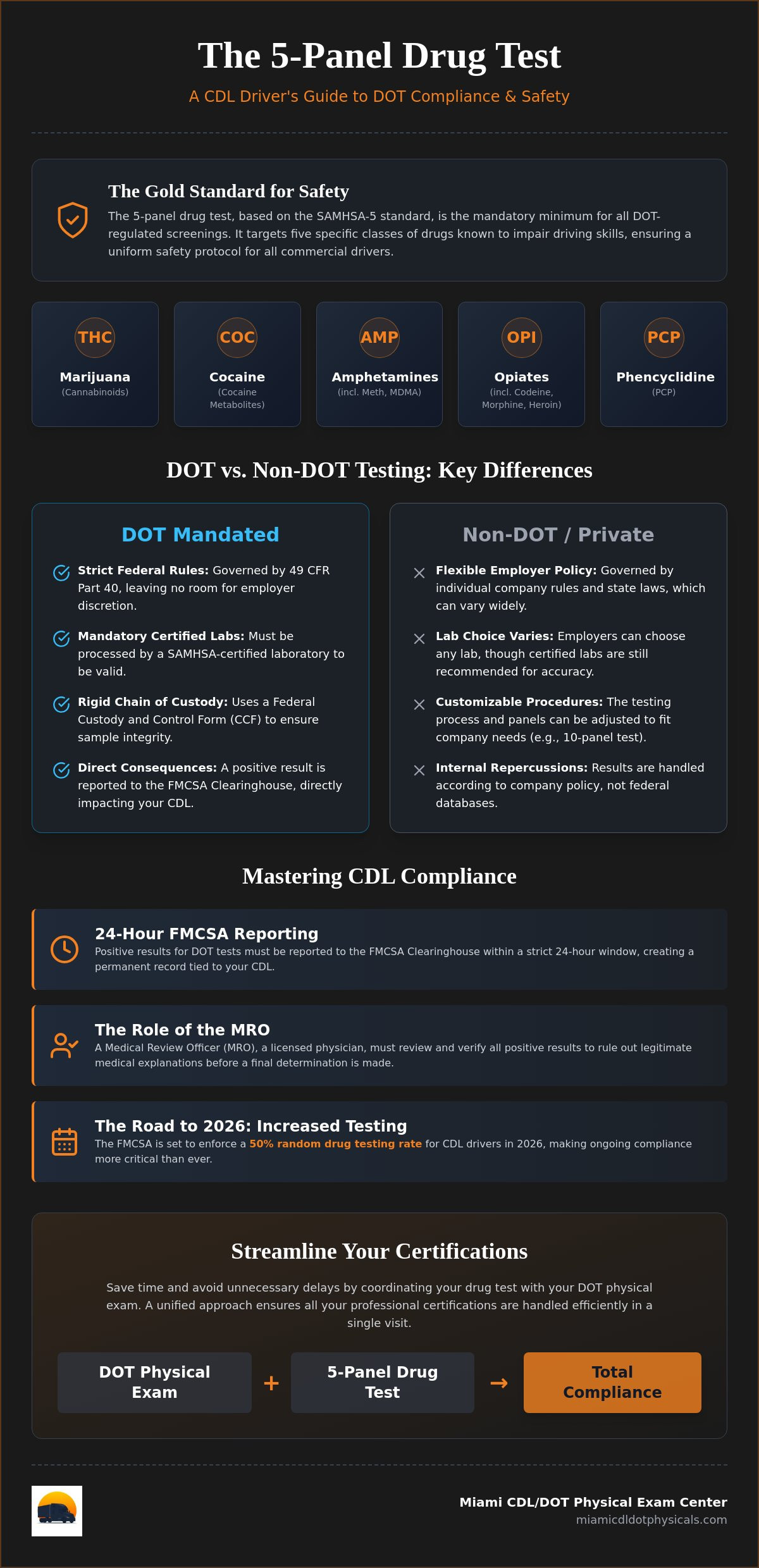
In the world of screening, a "panel" refers to a specific drug class or category being tested. A 5-panel test specifically targets five distinct groups of substances. While other tests might look for a wider variety of drugs, this particular configuration is the mandatory minimum for all DOT-regulated screenings. Urinalysis remains the industry standard for these tests because it's reliable and provides a clear history of recent substance use. You can find a more detailed drug testing overview to understand how different specimen types, like urine or hair, provide different detection windows.
Why the 5-Panel Standard Matters for Drivers
Consistent testing protocols ensure that every driver is treated fairly across the transportation industry. When every fleet follows the same SAMHSA-based rules, it creates a level playing field. This consistency also helps fleet owners manage insurance liability; showing that your drivers are compliant with federal standards can significantly reduce risk profiles. It's much easier to defend a safety record when you have documented, standardized results from a certified laboratory.
It’s also important to remember that drug screening is often linked to other regulatory requirements. Most drivers complete their drug test alongside their DOT physical Miami certification. Combining these services helps you manage your compliance efficiently so you can stay on the road without unnecessary delays. Whether you're an independent operator or managing a large fleet, understanding the 5 panel drug test Miami requirements is essential for long-term professional success.
DOT vs. Non-DOT 5-Panel Testing: Key Differences in Compliance
While a 5 panel drug test Miami might look identical on paper regardless of who orders it, the regulatory machinery behind the scenes is vastly different. A DOT test is a federal event governed by strict oversight, while a non-DOT test is a private matter between an employer and an employee. Understanding these differences is vital because a mistake in the process can lead to legal challenges or the loss of your driving credentials. The primary distinction lies in the lack of flexibility for DOT tests; they must follow every letter of the law to remain valid.
For a test to be legally defensible under federal law, it must be processed by a SAMHSA-certified laboratory. These facilities undergo rigorous inspections to ensure their results meet the highest scientific standards. If you're coordinating a DOT drug test, you'll also encounter strict Chain of Custody protocols. This process ensures the specimen isn't tampered with or swapped, creating a paper trail that protects both the driver and the employer from false accusations or administrative errors.
Federal DOT Testing Standards (Part 40)
The 49 CFR Part 40 regulations act as the "how-to" manual for every federal drug test. One of the most critical components is the Federal Custody and Control Form (CCF). This document tracks the sample from collection to the final report. Unlike private tests, DOT screenings require a mandatory split-specimen collection. The collector divides the urine into two bottles. If the first bottle tests positive, the driver has the right to request that a different certified lab test the second bottle, providing an essential layer of protection against laboratory error.
Non-DOT Workplace Screening Options
Non-DOT testing offers employers more flexibility. While many businesses still choose a 5 panel drug test Miami to mirror federal standards, they aren't restricted to it. Employers can customize their panels to include alcohol, synthetic opioids, or even nicotine. These tests are governed by company policy and state laws rather than federal mandates. In Florida, many employers participate in the voluntary "Drug-Free Workplace Program," which provides workers' compensation insurance discounts in exchange for following specific testing protocols for pre-employment or post-accident scenarios.
The consequences of a "refusal to test" highlight the biggest gap between these two worlds. In a non-DOT setting, a refusal usually leads to termination based on company policy. However, for CDL holders, a refusal is treated the same as a positive result. This violation must be reported to the FMCSA Drug and Alcohol Clearinghouse within 24 hours. As of November 18, 2024, state licensing agencies are required to suspend or revoke CDL credentials automatically based on these Clearinghouse records, making compliance more critical than ever for your livelihood.
What Substances are Screened in a 5-Panel Drug Test?
The 5-panel test is designed to identify the most common substances that impair a driver's ability to operate safely. While the name implies five drugs, modern testing actually screens for a broader range of metabolites. For example, a standard 5 panel drug test Miami now includes expanded testing for semi-synthetic opioids. This means the lab looks for hydrocodone, hydromorphone, oxycodone, and oxymorphone in addition to traditional opiates. This expansion was necessary to address the rising use of prescription pain medications in the workplace.
Every test uses "cutoff levels" to determine a result. The initial screening uses a higher threshold to quickly identify negative samples. If a sample exceeds this limit, it undergoes confirmatory testing using more precise technology, such as gas chromatography-mass spectrometry. This second phase uses a lower cutoff level to ensure the result is scientifically accurate. It's also important to distinguish between legal prescriptions and prohibited usage. Even if you have a valid prescription, a Medical Review Officer (MRO) must verify that the medication does not interfere with your ability to perform safety-sensitive duties.
Marijuana (THC) and Cocaine Screening
Marijuana remains the most detected substance in workplace testing, accounting for 49.2% of all positive results in 2026. THC metabolites are fat-soluble, meaning they store in the body's fat cells and remain detectable for weeks after use. It’s a common misconception that medical marijuana or CBD products are acceptable for CDL holders. Even with the April 2026 reclassification of certain marijuana products to Schedule III, the DOT still prohibits marijuana use for safety-sensitive roles. Cocaine, by contrast, has a much shorter detection window. It typically leaves the system within two to four days, but its primary metabolites are highly detectable during that period.
Opiates, Amphetamines, and PCP
The amphetamine category covers more than just basic stimulants. It includes methamphetamine and MDMA, commonly known as Ecstasy. These substances are high-risk because they can cause severe agitation or sudden crashes in energy. The opiate panel has also evolved to be more specific. While it still screens for codeine and morphine, it specifically looks for 6-acetylmorphine (6-AM), which is a definitive marker for heroin use. This level of detail helps prevent "false positives" from common foods like poppy seeds.
Phencyclidine, or PCP, remains a core component of the screening process. Although its use is less frequent than other substances, its effects are uniquely dangerous for drivers. PCP can cause hallucinations, detachment, and unpredictable behavior. Including it in the 5 panel drug test Miami ensures that these high-risk substances are identified before a driver gets behind the wheel, protecting both the driver and the community.
Compliance and the FMCSA Clearinghouse: Managing Your Results
Managing the results of your 5 panel drug test Miami involves more than just waiting for a phone call. Once the laboratory completes its analysis, the process enters a critical phase of medical and regulatory review. This stage ensures that every result is verified for accuracy and that any positive findings are handled according to federal law. For drivers, this is where the system’s safeguards protect their livelihood from administrative errors or legitimate medical misunderstandings. Professional management of these results is the only way to ensure you stay compliant with the latest federal standards.
If a violation does occur, drivers must navigate the Return-to-Duty (RTD) process. This is a structured path that includes evaluation by a Substance Abuse Professional (SAP) and a series of observed follow-up tests. Since November 18, 2024, the stakes have never been higher. State Driver Licensing Agencies now receive automated alerts from the federal database. If a driver is marked as "prohibited" in the system, their CDL is automatically downgraded or suspended. Proactive compliance is your best defense against these career-ending penalties.
The Role of the Medical Review Officer (MRO)
The Medical Review Officer (MRO) is a licensed physician who acts as an independent advocate for the integrity of the test. They review every laboratory result before it's finalized. If a sample returns a positive result for a substance like a prescribed opioid, the MRO will contact the driver for a private interview. During this call, the driver can provide proof of a valid prescription. If the MRO verifies a legitimate medical explanation, the result is reported as negative. This process protects drivers from "false positives" caused by legal medications that would otherwise trigger a violation.
FMCSA Clearinghouse Reporting Requirements
The FMCSA Clearinghouse is a secure online database that gives employers and regulators real-time access to drug and alcohol violations. As of 2026, the reporting timelines have become much stricter. Employers are now required to report positive results, refusals to test, or SAP completions within 24 hours of the occurrence. This rapid reporting ensures that unsafe drivers are identified immediately across all states. You can schedule your DOT drug test today to ensure your results are handled by professionals who understand these urgent reporting windows.
Owner-operators and small fleets face unique challenges with these rules. Federal law requires independent drivers to join a consortium to manage their random testing pools and Clearinghouse requirements. Because the FMCSA continues to enforce a 50% random drug testing rate for CDL drivers in 2026, being part of a well-managed program is essential. Failing to query the database annually for every driver can lead to significant fines and the loss of your operating authority. Staying organized with a 5 panel drug test Miami provider who handles the paperwork for you allows you to focus on the road instead of the regulatory red tape.
Professional Testing Solutions for Drivers and Fleets
Compliance shouldn't feel like a hurdle that stops your business. It's a tool that protects your career and ensures the safety of everyone on the road. For many professionals, the biggest challenge isn't the test itself but the time and effort required to stay organized. Partnering with a comprehensive service provider allows you to handle your regulatory requirements with efficiency and confidence. We position ourselves as a dependable ally, offering a streamlined approach that covers everything from initial screenings to complex federal reporting.
A "one-stop" approach to medical compliance is the most effective way to minimize downtime. Instead of visiting different clinics for different needs, you can manage your requirements in a single visit. This level of coordination is especially valuable for busy professionals who can't afford to waste hours in waiting rooms. When you work with a partner who understands the specific needs of the transportation industry, you get more than just a test result; you get the peace of mind that comes from knowing every detail is handled correctly.
Choosing a Certified Testing Partner
Selecting the right facility is about more than just convenience. You need a team of FMCSA-certified examiners who know the latest 2026 regulations inside and out. Professional collection sites follow strict protocols to ensure your 5 panel drug test Miami is legally defensible and scientifically accurate. These centers are designed to get you in and out quickly, recognizing that for a driver, time is literally money. Our comprehensive services are built to meet the rigorous CDL medical exam South Florida standards, ensuring you're fully qualified to drive before you leave the office.
Joining a Drug Testing Consortium
If you're an owner-operator, you're legally required to be part of a random drug testing pool. You can't manage your own random selections; federal law mandates that a third party handles this process to ensure it's truly unbiased. A drug testing consortium manages these selections for you, keeping you in total compliance with DOT rules without the administrative headache. This is a vital service for independent drivers who need to stay "active" in the FMCSA Clearinghouse to maintain their operating authority.
Managing a 5 panel drug test Miami and a random testing schedule is much simpler when you have an expert guide. We handle the paperwork, the laboratory coordination, and the MRO reviews so you don't have to. If you're ready to simplify your compliance or need to renew your medical certificate, take the next step today. Contact the Miami CDL/DOT Physical Exam Center to join a compliant consortium or schedule your next test. We're here to help you stay compliant and stay on the road.
Stay Road-Ready with Professional Compliance Management
Navigating the strict standards of federal drug testing doesn't have to be a source of stress. By understanding the specific substances screened and the critical role of the FMCSA Clearinghouse, you can protect your livelihood and maintain a clean driving record. The difference between a compliant result and a career-ending mistake often comes down to the quality of your testing partner. Professional oversight ensures your data is reported accurately and within the mandatory 24-hour windows required by 2026 regulations.
When you're ready to complete your 5 panel drug test Miami, we're here to help you move through the process with ease. Our facility features FMCSA-Certified Medical Examiners and a fully DOT-compliant collection site. We provide expert MRO oversight to ensure every result is handled with the highest level of integrity and professional care. Don't leave your certification to chance when you can work with a team that knows the rules inside and out.
Schedule Your Compliant DOT Drug Test Today
Your career is built on a foundation of safety and reliability. We're proud to be your partner in maintaining those standards so you can stay focused on the road ahead.
Frequently Asked Questions
What drugs are included in a standard 5-panel drug test?
A standard 5-panel drug test targets marijuana (THC), cocaine, amphetamines, opiates, and phencyclidine (PCP). Modern screenings have expanded the amphetamine category to include MDMA and the opiate category to include semi-synthetic opioids like oxycodone and hydrocodone. These five specific drug classes represent the mandatory minimum for all federal safety-sensitive positions under SAMHSA-5 standards.
How long does a 5-panel urine drug test take to provide results?
Most negative results are finalized and reported within 24 to 48 hours after the laboratory receives the specimen. If your 5 panel drug test Miami requires additional confirmatory testing or a Medical Review Officer (MRO) review, the process can take three to five business days. This extra time ensures that the final result is scientifically accurate and legally defensible.
Can I fail a 5-panel drug test if I have a valid prescription?
You won't fail the test if the Medical Review Officer (MRO) verifies that you have a legitimate medical explanation for the result. The MRO will contact you for a private interview to review your prescription details. If they confirm the medication is used as prescribed and doesn't pose a safety risk, they'll report the final result as negative to your employer.
What is the difference between a DOT 5-panel test and a non-DOT test?
DOT tests are strictly regulated by federal law and require SAMHSA-certified laboratories and specific Chain of Custody forms. Non-DOT tests are governed by individual company policies and state laws, which allow for more flexibility in the substances tested. While the panels might look similar, the procedural requirements and the consequences for violations are much stricter for DOT-regulated drivers.
Does a 5-panel drug test include screening for alcohol?
No, a standard 5-panel drug test does not include an alcohol screen. While the Department of Transportation requires alcohol testing for certain situations like post-accident or reasonable suspicion, these are separate procedures. Alcohol testing is typically conducted using breath or saliva samples rather than the urine specimen used for a 5-panel drug screen.
How far back can a 5-panel urine test detect drug use?
Detection windows vary significantly depending on the specific substance and the individual's metabolism. Marijuana can stay detectable in urine for 30 days or more for frequent users, while cocaine and amphetamines usually leave the system within two to four days. Phencyclidine (PCP) typically remains visible for about one week after the last use.
What happens if a driver refuses to take a 5-panel drug test?
A refusal to test is treated exactly the same as a positive result under federal regulations. The collector will document the refusal, and it must be reported to the FMCSA Clearinghouse within 24 hours. This leads to an immediate "prohibited" status in the database, requiring the driver to complete a formal Return-to-Duty process before they can drive again.
Is a 5-panel drug test required for a DOT physical exam?
A drug test isn't a mandatory part of the physical exam itself, but most employers require both for pre-employment or annual compliance. Many drivers choose to schedule their 5 panel drug test Miami at the same time as their medical exam to save time. Completing both requirements in one visit ensures you have all the necessary documentation to maintain your CDL.


