

A routine DOT urine test isn’t automatically observed, but specific situations make direct observation required. Under 49 CFR Part 40, every return-to-duty and follow-up test must be directly observed, and signs of tampering or a specimen temperature below 90°F or above 100°F can also trigger an observed collection. The DOT drug testing observation rules matter because refusing a required collection or interfering with it can count as a testing violation.
It’s understandable to want a clear picture of what happens during an observed collection and why it may be required. This guide explains when observation applies, what the collector and observer do, which specimen checks can affect the process, and what actions may be treated as a refusal or other violation. It also explains how these rules differ from an ordinary collection, so you know what to expect during DOT drug testing.
Key Takeaways
- Learn who may observe a collection and what the observer must watch during the process.
- See how specimen checks and employer standing orders can affect the collector’s next steps.
- Understand how low specimen volume, unusual lab findings, or signs of tampering may lead to another collection.
- Recognize which actions can count as a refusal or testing violation, and what may follow for a driver.
§ 40.67 When and how is a directly observed urine collection conducted?
Under 49 CFR Part 40, direct observation applies to specific DOT drug tests and collection circumstances. The observer watches the urine pass into the container, making the procedure distinct from a monitored collection.
When Direct Observation Is Required
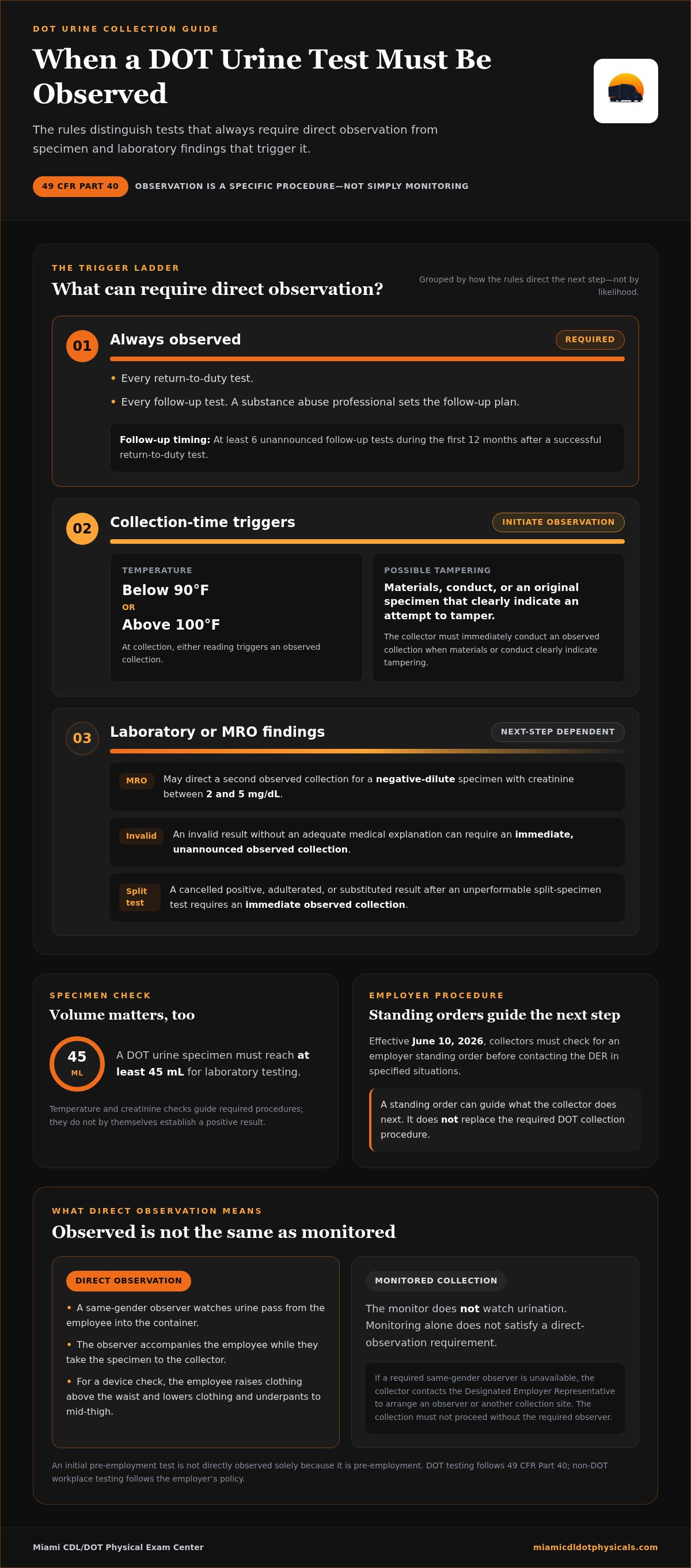
A directly observed collection is required for every return-to-duty test and follow-up test. It may also be required if collection-site materials, employee conduct, or the specimen suggests tampering. For example, finding an item that appears intended to contaminate a sample can trigger observation. These rules explain why a routine drug test may become an observed urine collection.
Before returning to safety-sensitive duty after a violation, an employee must complete a return-to-duty test under direct observation. A substance abuse professional sets the follow-up plan, and every follow-up test must also be observed. According to the U.S. Department of Transportation, the first 12 months after a successful return-to-duty test include at least 6 unannounced follow-up tests. An initial pre-employment test is not directly observed solely because it is pre-employment.
Observer Gender and Employee Identity
DOT rules require the observer to be the same gender as the employee being tested. If the collector is not the observer, the collector explains how to check for devices and watch the urine enter the container. Employees who are transgender or nonbinary can tell the collector or employer representative their gender identity so the collection can be handled under the same-gender requirement.
If a same-gender observer is unavailable, the collector contacts the Designated Employer Representative to arrange an observer or another collection site. The collection must not proceed without the required observer.
Privacy During Observed Collections
During direct observation, the observer watches the urine pass from the employee’s body into the container and accompanies the employee as they take it to the collector. This is the key difference from a monitored collection, where the monitor does not watch urination. The observer’s role is to verify the specimen and identify possible devices.
For a device check, the employee raises clothing above the waist and lowers clothing and underpants to mid-thigh. This check supports the collection’s integrity; observation then focuses on the urine entering the container.
Employer DER standing orders and collection-site procedures
Standing orders and collection findings determine whether the collector must begin direct observation or arrange another collection.
Direct Observation and Monitored Collection
Direct observation means the observer watches urine pass from the employee into the collection container. A monitored collection does not involve watching the urine leave the body, so monitoring alone does not satisfy a direct observation requirement. If the required observer isn’t present, the collection must be arranged according to DOT procedures.
DOT tests follow federal procedures in 49 CFR Part 40. Non-DOT workplace testing follows the employer’s testing policy, so its observation rules may differ.
Collector Duties for Observed Collections
A collector must immediately conduct an observed collection when materials or employee conduct clearly indicate an attempt to tamper with a specimen. An original specimen that appears tampered with also triggers observation. If the specimen temperature is below 90°F or above 100°F at collection, the U.S. Department of Transportation’s procedures treat that result as a reason to initiate an observed collection.
Laboratory findings can trigger another collection. According to the U.S. Department of Transportation, an MRO may direct a second observed collection for a negative-dilute specimen with creatinine between 2 and 5 mg/dL. An invalid result without an adequate medical explanation can require an immediate, unannounced observed collection. A cancelled positive, adulterated, or substituted result after an unperformable split-specimen test also requires an immediate observed collection.
Effective June 10, 2026, the amended DOT rule requires collectors to check for an employer standing order before contacting the DER in specified situations. The standing order can guide the collector’s next step; it doesn’t replace the required collection procedure. For a practical overview of DOT drug-testing procedures, review how the collection is handled from the initial check through documentation.
Specimen volume, temperature, and signs of tampering
DOT collection checks help determine whether a specimen can be accepted or whether direct observation is needed. Volume, temperature, and signs of interference can each affect the next step.
Specimen Temperature and Creatinine
Temperature and creatinine results can flag a specimen that needs closer review. A DOT urine specimen must reach at least 45 mL for laboratory testing. According to the U.S. Department of Transportation, a temperature below 90°F or above 100°F at collection triggers an observed collection.
Creatinine can also affect the decision. According to the U.S. Department of Transportation, an MRO may direct a second observed collection when a negative-dilute specimen has creatinine between 2 and 5 mg/dL. These checks don’t by themselves establish a positive result; they guide the required procedures under 49 CFR Part 40.
Tampering Signs and Specimen Handling
Possible tampering includes materials or conduct that clearly indicate an attempt to alter or substitute a specimen. When DOT rules require it, the collector must respond with a directly observed collection. The observer watches the urine enter the container and the employee take it to the collector.
If a laboratory reports a positive or refusal result but the split specimen test can’t be performed, the result may be cancelled and an MRO may order another observed collection. That is a follow-up collection decision, not an appeal that automatically changes the original finding. The collector still completes the collection procedures under Part 40.
Urine Volume and Shy Bladder Limits
A shy bladder situation arises when an employee can’t provide enough urine for the required specimen. The DOT volume threshold is at least 45 mL, not a five-ounce collection target. Anxiety caused solely by being watched doesn’t qualify as a medical reason for a shy bladder case.
A documented trauma history, such as PTSD from sexual abuse, may support a medical exemption under DOT rules. The collector handles an insufficient sample through the applicable collection procedures; low volume alone isn’t proof of refusal to test. Refusing a required collection is treated separately under DOT rules.
Drug-testing violations
A collection violation can affect a driver’s ability to perform safety-sensitive work. The DOT drug testing observation rules treat refusal of a required or permitted directly observed collection as a refusal to test under 49 CFR Part 40. This is different from a collection irregularity, which may require correction or recollection rather than an employee refusal. Understanding that distinction helps drivers respond appropriately if a collection changes course.
If an observer finds a device during collection, the collector must stop, document the circumstances on the custody and control form (CCF), and notify the Designated Employer Representative (DER). The event counts as a refusal to test. For example, a device that appears intended to carry clean urine or a substitute can trigger this procedure. Accurate documentation records what happened at the collection site and what action followed.
A missed observation can also require prompt action. If a return-to-duty collection wasn’t conducted under the required observed procedure, the employer must direct an immediate recollection under direct observation. A service agent who learns that observation was required but omitted must tell the employer to order that recollection. The DOT drug testing observation rules therefore cover both employee conduct and errors in carrying out the collection.
After a DOT drug-testing violation, the driver must be removed from safety-sensitive functions. The employer must advise the driver about resources for resolving a drug abuse problem. A substance abuse professional evaluates the driver and determines what assistance is needed. Returning to safety-sensitive work depends on completing the required evaluation and return-to-duty process, not simply repeating a test independently.
For a collection that must be completed correctly, schedule a DOT drug test and follow the collection-site instructions.
Miami CDL/DOT Physical Exam Center: DOT Physical Exam
Miami CDL/DOT Physical Exam Center offers nationwide DOT Physical Exams for commercial drivers managing medical certification alongside DOT compliance. A physical exam addresses medical qualification; it does not replace a required drug test or resolve a testing violation. Keep the processes distinct, especially when arranging a return-to-duty test or following a substance abuse professional’s plan.
For owner-operators and fleets managing federal compliance responsibilities nationwide, the FMCSA Clearinghouse Consortium is another relevant option. It supports Clearinghouse participation, while a DOT Physical Exam addresses medical examination needs. Choose the service that matches your next compliance task; neither replaces collection-site procedures.
For help with a nationwide DOT Physical Exam or the FMCSA Clearinghouse Consortium, contact Miami CDL/DOT Physical Exam Center.
Make Your Next Compliance Step Count
Before your next test, keep the collection instructions from your employer or Designated Employer Representative accessible. Confirm the test type and follow the collection-site directions carefully. This preparation helps you focus on the process rather than resolving uncertainty during a time-sensitive appointment.
Understanding the DOT drug testing observation rules can help you recognize when an observed collection is required procedure, not a personal judgment. Miami CDL/DOT Physical Exam Center offers DOT drug testing, Non-DOT drug testing, and DOT physical exams. Choose the service that matches your current requirement, and keep medical qualification separate from drug-testing compliance.
For your next step, contact Miami CDL/DOT Physical Exam Center about the DOT service you need. A clear plan can help you approach the next requirement with confidence.
Frequently Asked Questions
Is a DOT Pre-Employment Drug Test Ever Directly Observed?
A pre-employment DOT urine test isn’t directly observed simply because it’s a pre-employment test. The DOT drug testing observation rules allow observation when a separate collection circumstance calls for it, such as suspected tampering. The key distinction is why observation is required: the test category alone doesn’t automatically mean the collector watches the collection.
Why Does The DOT Require Direct Observation in These Situations?
Direct observation helps protect specimen integrity when a collection raises a specific concern. Watching the urine enter the container can help identify substitution or interference that could undermine a test result. An observed collection is a procedure, not a finding that the employee used drugs. After collection, the specimen still follows laboratory testing and review procedures.
Can a Female Observe a Male in a Direct Observation Drug Screen, and Vice Versa?
No. For a DOT directly observed urine collection, the observer must be the same gender as the employee. Under this procedure, a female observer cannot observe a male employee, or vice versa. If a same-gender observer isn’t available at the collection site, the collector contacts the employer’s Designated Employer Representative to arrange an observer or another collection site.
Why Aren’t All Tests Directly Observed Then?
The DOT drug testing observation rules limit direct observation to specified testing and collection circumstances; it is not routine for every employee. This distinction separates ordinary random or pre-employment testing from collections with a qualifying reason for observation. A test’s timing alone doesn’t make direct observation appropriate; the collection circumstances determine whether it applies.
Are There Questions Regarding the Legality of Directly Observed Drug Screens?
Federal DOT procedures authorize direct observation in specified circumstances, while questions may also arise under state law. Federal collection requirements and state-level legal considerations are separate issues. Employees should understand whether the test is DOT-regulated and why observation is being conducted. A regulated DOT collection follows the federal procedures that apply to that test.
Can a DOT collector observe a routine pre-employment test without cause?
No, not solely because it’s a routine pre-employment test. DOT procedures must authorize direct observation based on a specific circumstance; a collector doesn’t make an ordinary pre-employment collection observed without a qualifying reason. If observation begins, you can calmly ask which collection circumstance applies, then follow the collector’s instructions while the reason is documented.


