

DOT drug and alcohol testing for supervisors requires more than noticing that a driver seems “off.” Under 49 CFR §382.603, covered supervisors must complete 120 minutes of training: 60 minutes on signs of alcohol misuse and 60 minutes on controlled-substance use. They also need to understand how specific, contemporaneous observations can support a reasonable-suspicion referral.
That responsibility can feel high-stakes, especially when safety is at risk and decisions must rest on observable facts, not assumptions. DOT drug and alcohol testing for supervisors helps them recognize possible signs of misuse, respond promptly, and keep a clear record of what they observed.
This guide explains what the training covers, how supervisors assess behavior, appearance, speech, and body odors, and what to document when concerns arise. It also describes how reasonable-suspicion testing fits into the response, so you can understand your role and act with care and consistency.
Key Takeaways
- Understand who needs DOT supervisor training and how it supports reasonable-suspicion decisions.
- Learn to distinguish observable signs in a driver’s behavior, appearance, speech, and body odors from subjective impressions.
- See how the training addresses alcohol misuse and controlled-substance use, and what each part covers.
- Build clear, factual documentation by recording what you observed and when you made the referral.
- Know how to respond to safety concerns, including referral for testing and removal from safety-sensitive duties.
What Is Reasonable Suspicion Training for Supervisors?
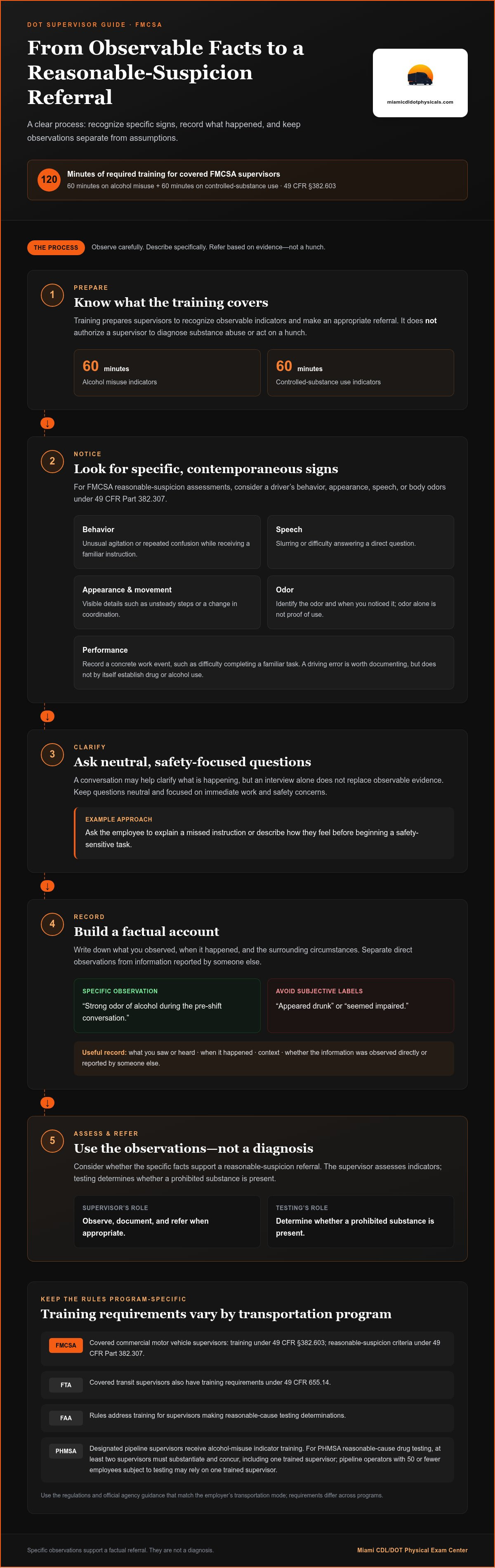
DOT drug and alcohol testing for supervisors starts with recognizing specific signs and following the rules for reasonable suspicion. Under 49 CFR §382.603, covered commercial motor vehicle supervisors complete 120 minutes of training: 60 minutes on alcohol misuse and 60 minutes on controlled-substance use.
The training prepares supervisors to identify observable indicators and refer an employee for testing when appropriate. It does not authorize supervisors to diagnose substance abuse or act on a hunch.
Agencies Requiring Supervisor Training
DOT agencies set training requirements according to the transportation mode and the employees they regulate. Knowing which rules apply helps supervisors follow the relevant standard rather than treating every DOT program as identical.
FMCSA requires covered supervisors of commercial motor vehicle drivers to take training under 49 CFR §382.603. FTA-covered transit supervisors also have training requirements under 49 CFR 655.14. FAA rules address training for supervisors making reasonable-cause testing determinations. PHMSA requires designated pipeline supervisors to receive alcohol-misuse indicator training.
PHMSA’s reasonable-cause drug-testing rule has a separate decision standard: at least two supervisors must substantiate and concur, including one trained supervisor. Pipeline operators with 50 or fewer employees subject to testing may rely on one trained supervisor. The rule does not set a minimum number of training minutes for that drug-testing decision. These distinctions matter because a supervisor’s role and training depend on the employer’s regulated transportation program.
Reasonable-Suspicion Criteria and Interviews
Reasonable suspicion rests on specific, contemporaneous, articulable observations, not personal impressions. Under 49 CFR Part 382.307, an FMCSA supervisor considers a driver’s behavior, appearance, speech, or body odors.
For example, record slurred speech or unsteady movement as observed facts, rather than writing that the driver “seemed impaired.” A conversation may clarify what is happening, but an interview alone does not replace observable evidence. Keep questions neutral and focused on immediate work and safety concerns.
Document what you saw or heard, when it happened, and the surrounding circumstances. Separate direct observations from information reported by someone else. This gives the referral a factual basis and helps distinguish an observable change from assumptions about its cause. The supervisor assesses indicators; testing determines whether a prohibited substance is present.
Official Rules and Training Resources
Supervisors can find the governing requirements in the applicable Code of Federal Regulations sections and agency guidance. For FMCSA-covered drivers, consult 49 CFR §382.603 for training and 49 CFR Part 382.307 for reasonable-suspicion criteria.
Use the Federal Register’s codified regulations in the Electronic Code of Federal Regulations, and consult the relevant agency’s official guidance for program-specific explanations. FAA, FTA, and PHMSA rules differ from FMCSA requirements, so use resources that match the employer’s transportation mode. FMCSA also states that it and other U.S. DOT agencies do not endorse private companies marketing supervisor training to motor carriers. Check that course content addresses the applicable federal requirements.
Recognizing signs and symptoms of drug and alcohol misuse
DOT training teaches supervisors to notice physical, behavioral, speech, and performance indicators. A single change, such as slurred speech or an unusual body odor, is an observation, not a diagnosis. Record what happened and the context, then consider whether the facts support a reasonable-suspicion referral.
Look for specific, observable changes while the employee is working. Examples include difficulty following a routine instruction, unsteady movement, unusual agitation, or speech that becomes difficult to understand. Consider the task and circumstances when assessing the observation. A driving error, for instance, is worth recording as an event, but does not by itself establish drug or alcohol use.
Indicators of alcohol misuse can involve appearance, speech, behavior, or odor. Record the specific detail: “strong odor of alcohol during the pre-shift conversation” is more useful than “appeared drunk.” For behavioral signs, describe the action, such as repeated confusion while receiving a familiar work instruction. Avoid labels that infer a cause you did not observe.
- Behavioral: Record a clear change, such as unusual agitation or repeated confusion.
- Speech: Describe what you heard, such as slurring or difficulty answering a direct question.
- Appearance and movement: Note visible details, such as unsteady steps or a change in coordination.
- Performance: Document a specific work event, such as difficulty completing a familiar task.
- Odor: Identify the odor and when you noticed it, without treating it as proof of use.
For possible controlled-substance use, use the same evidence-based approach. DOT supervisor training includes 60 minutes on controlled-substance symptoms, but supervisors aren’t expected to identify a substance from appearance. Record the employee’s actions and words, not guesses about a drug, dose, or medical condition. The drug test, not a supervisor’s impression, addresses whether a prohibited substance is present.
Ask neutral questions to clarify immediate facts. For example, ask the employee to explain a missed instruction or describe how they feel before beginning a safety-sensitive task. Record the response as accurately as possible. Don’t argue, promise a particular outcome, or suggest answers. An interview can add context, but it cannot replace specific observations.
Part 40 governs procedures for transportation workplace drug and alcohol testing programs; it does not turn symptoms into a diagnosis. Consider the full set of contemporaneous observations, including behavior, appearance, speech, and odor. Keep conclusions separate from facts. “Repeatedly lost balance while walking” states an observation; “used drugs” states an unsupported conclusion.
Supervisor training duration and alcohol/drug curriculum
For FMCSA-covered commercial motor vehicle supervisors, 49 CFR §382.603 sets a 120-minute training requirement. It divides the course into 60 minutes on alcohol misuse and 60 minutes on controlled-substance use. Those two parts address different indicators, so supervisors need to understand both.
Training fees vary by course format, provider, and included materials. Compare the curriculum with the rules for your transportation program, rather than choosing by course duration alone.
Alcohol Misuse and Controlled-Substance Training
The alcohol portion covers physical, behavioral, speech, and performance indicators of probable misuse. The controlled-substance portion addresses signs of use and helps supervisors recognize when observations may warrant a reasonable-suspicion referral. Both parts focus on observable indicators, not diagnosing an employee or identifying a substance by appearance.
For example, training can help a supervisor distinguish a specific observation, such as slurred speech, from a conclusion such as “the driver is intoxicated.” The same principle applies to controlled substances: document behavior or performance changes without guessing their cause. This makes the training practical for real workplace decisions.
Who Must Complete Supervisor Training
Under 49 CFR §382.603, supervisors of drivers subject to FMCSA rules must receive the required training. Employers must make the required content available to everyone designated to supervise covered drivers. A trained supervisor who changes jobs does not need to repeat training at the new job, but a new supervisor must be trained when the trained supervisor leaves.
Recurrent training is not required under §382.603. DOT-regulated commercial motor vehicle owner-operators are exempt from supervisor training, but must register with a consortium for DOT drug and alcohol testing. An FMCSA Clearinghouse Consortium can support owner-operators with that testing-program requirement.
FAA Drug and Alcohol Training Rules
FAA requirements differ from FMCSA’s 60/60 curriculum. Under 14 CFR 120.115, aviation supervisors making reasonable-cause drug-testing determinations need at least 60 minutes of initial training, with recurrent training in subsequent years. Under 14 CFR 120.223, personnel designated to make reasonable-suspicion alcohol-testing decisions need at least 60 minutes of training.
These aviation rules show why employers should match course content to the agency and duties involved. FAA employers must also document training for employees and supervisory personnel in their training program records.
FTA-covered supervisors have a separate standard under 49 CFR 655.14: at least 60 minutes of drug education and 60 minutes of alcohol education. PHMSA-designated supervisors receive at least 60 minutes of alcohol-misuse indicator training under 49 CFR 199.241. The drug reasonable-cause rule uses a distinct decision process, so don’t assume the alcohol curriculum covers it.
Check the applicable CFR part and the supervisor’s assigned responsibilities before choosing training. A course built for one transportation agency may not address another agency’s required content.
Supervisor documentation and recordkeeping
Clear notes help a motor carrier explain the basis for a reasonable-suspicion referral. Under FMCSA regulations, record the specific observations behind the decision, not a conclusion about drug or alcohol use. It is good practice to complete written notes promptly after making a referral.
Use factual language that others can understand without guessing. For example, write, “The employee repeated the same question three times during the pre-trip discussion,” rather than “The employee acted strangely.” For speech, note the words or change you heard. For appearance or movement, describe what you saw, such as stumbling while walking.
Record the context as well as the indicators. Note when and where each observation occurred, what task the employee was performing, and whether the behavior continued or changed. If a coworker reports an event, identify it as reported information and distinguish it from what you witnessed directly. This keeps firsthand observations separate from secondhand accounts.
- Behavior: Describe a specific action, such as repeated confusion during a familiar instruction.
- Speech: Record an observable change, such as slurring or difficulty answering clearly.
- Performance: State the work task and what happened, such as missing a routine step.
- Appearance or movement: Describe visible details without assigning a cause.
- Timing: Record when observations occurred and when you made the referral.
Keep the record neutral and precise. Avoid labels such as “drunk,” “high,” or “using controlled substances” unless the information is a confirmed test result communicated through the proper process. A supervisor documents indicators; notes are not a medical diagnosis or drug test result. Correct errors transparently rather than silently changing an earlier entry.
Timing matters for FMCSA drug-testing records. For a reasonable-suspicion referral, finish your notes before leaving the shift, then follow the motor carrier’s procedures for submitting and securing the record. Don’t leave details only in a personal notebook or informal message.
Retention periods also vary by result. FMCSA reasonable-suspicion testing records must be retained for at least two years for negative results and five years for positive results. The motor carrier’s recordkeeping process should preserve the referral, observations, and related testing records for the applicable retention period.
Before submitting documentation, compare each statement with what you personally observed or were told. Replace judgment words with concrete details, confirm the timeline, and keep the record in the employer’s designated system. This creates a clearer account for later review and supports consistent handling under federal regulations.
Referral and removal from safety-sensitive duties
A reasonable-suspicion referral addresses observed concerns, while removal from safety-sensitive work protects the workplace during the response. After a positive test or refusal, follow the employer’s policy and applicable DOT procedures, document the action, and do not let the employee continue safety-sensitive functions when removal is required.
Referral After a Positive Test or Refusal
A positive result or refusal triggers a formal response under DOT rules and employer policy. Under 49 CFR Part 40.305, refusing a DOT drug or alcohol test is treated as equivalent to a positive test result.
Notify the designated employer representative, preserve the test-related records, and follow the company’s written procedures. Under 49 CFR §382.605, employer policy materials address procedures for drivers who violate Subpart B. Drivers must receive those policy materials under 49 CFR Part 382, so supervisors should follow the process already communicated to the employee.
Removal From Safety-Sensitive Duties
Removal means the employee stops performing safety-sensitive work when the applicable rule requires it. According to the Electronic Code of Federal Regulations, an FMCSA-regulated employee with a confirmed alcohol test result of 0.04 or greater must be immediately removed from safety-sensitive functions.
A reasonable-suspicion referral also requires removing the employee from safety-sensitive work immediately. Arrange a safe way for the employee to leave the worksite; don’t allow them to drive a commercial vehicle. Record who was notified, when duties stopped, and what work was suspended.
Controlled-substance use is a specified violation under 49 CFR §382.213. On-duty alcohol use, pre-duty alcohol use, and alcohol use following an accident are addressed separately under 49 CFR §§382.205, 382.207, and 382.209. Supervisors should identify the relevant conduct, document the observation, and report it through workplace procedures instead of deciding the test outcome themselves.
Handle prescription medication carefully. Don’t tell an employee to stop, change, or conceal prescribed medication. If the employee reports a concern affecting safe work, follow company policy and refer the matter to the designated employer representative. A supervisor’s role is to address immediate safety concerns, document relevant facts, and avoid making medical judgments.
Keep the observation, referral, test status, and work-status decision distinct in your record. For example, document the behavior that led to a reasonable-suspicion referral separately from the later test result. This timeline helps the motor carrier apply its policy consistently and supports accurate records if the case enters a return-to-duty process.
Follow the employer’s written procedures at each stage, including who receives the referral and who communicates work restrictions. A supervisor should not promise a return date or treat completion of a test as clearance to resume duties. Use the employer’s designated process for next steps and maintain a clear record.
Miami CDL/DOT Physical Exam Center: DOT Physical Exam
Miami CDL/DOT Physical Exam Center provides DOT Physical Exams for commercial drivers who need a medical examination. Turn to the center when preparing for a DOT physical or completing an examination as part of your driver requirements.
For owner-operators and fleet companies managing FMCSA drug and alcohol program obligations, the FMCSA Clearinghouse Consortium supports compliance with federal requirements. A physical exam and consortium participation meet different needs, so choose the service that fits your next step.
For a DOT Physical Exam or information about the FMCSA Clearinghouse Consortium, contact Miami CDL/DOT Physical Exam Center or visit miamicdldotphysicals.com.
Make Your Next Compliance Step Clear
Strong safety practices depend on more than a single decision. Establish a workplace routine that gives supervisors a clear path for raising concerns, recording actions, and handing decisions to the right person. Keep the process practical: employees should know where to turn, and supervisors should understand how their observations fit into the employer’s response.
Use what you’ve learned about DOT drug and alcohol testing for supervisors to strengthen that routine and keep safety-sensitive work at the center of each decision. When your next step involves a driver’s medical examination or testing, Miami CDL/DOT Physical Exam Center offers DOT Physical Exams, DOT Drug Tests, and Non-DOT Drug Tests.
Contact Miami CDL/DOT Physical Exam Center to discuss the service that fits your needs. Clear procedures and the right support can help you move forward with confidence.
Frequently Asked Questions
Does the training need to be renewed on a schedule?
For FMCSA supervisors, federal rules don’t require recurrent training after the required course. Employers can still choose refresher sessions to reinforce sound decision-making and documentation practices. Requirements differ across DOT agencies: for example, FAA rules require recurrent training in subsequent years for supervisors making reasonable-cause drug-testing decisions. Check the rules for your transportation program before applying one agency’s schedule to another.
How Does the Reasonable Suspicion Process Work Step by Step?
Start with specific, current observations, then follow the employer’s referral process. Avoid delaying required testing to gather irrelevant details.
- Observe and record the facts supporting concern.
- Notify the designated employer representative and arrange referral for testing.
- Remove the employee from safety-sensitive work during the referral.
- Document the outcome and follow the employer’s process.
For FMCSA alcohol testing, initiation must occur within two hours of observation. If not completed within eight hours, stop further attempts and document why, according to the Electronic Code of Federal Regulations.
How Long Does DOT 60/60 Supervisor Training Certification Last?
FMCSA rules don’t set a federal expiration period for the 60/60 supervisor training. The “60/60” refers to the course’s alcohol and controlled-substance training components, not a recurring certification term. Keep the training record available to show that the supervisor completed the required curriculum. Remember that other DOT agencies can set different training and recurrence requirements, so an FMCSA course record doesn’t establish compliance with every agency’s rules.
What Are the Most Common Reasonable Suspicion Mistakes?
Common errors include relying on rumor, writing conclusions instead of observations, delaying a referral, and allowing an employee to continue safety-sensitive work during the response. For example, “seemed high” doesn’t explain what the supervisor observed. Record concrete details, such as a repeated inability to follow a familiar instruction, and distinguish firsthand observations from information reported by someone else. Apply the employer’s procedure consistently rather than using a different standard for each employee.
How many hours of DOT reasonable suspicion training must supervisors complete?
FMCSA supervisors of covered commercial motor vehicle drivers must complete 120 minutes: 60 minutes on alcohol misuse and 60 minutes on controlled-substance use. The two parts address separate indicators, so completing only one does not cover the full FMCSA requirement. Other DOT agencies have their own rules; don’t assume the FMCSA duration applies to aviation, transit, or pipeline supervisors.
What topics must DOT supervisor drug and alcohol training cover?
For FMCSA supervisors, the course covers symptoms of alcohol misuse and controlled-substance use, including physical, behavioral, speech, and performance indicators. It prepares supervisors to recognize observations that may support a reasonable-suspicion referral, not to diagnose an employee. For example, training distinguishes a specific speech change from a conclusion about its cause. Agency-specific duties can require different content, so match the curriculum to the regulated transportation program.
When can a DOT supervisor require an employee to take a drug or alcohol test?
A supervisor may refer an employee for reasonable-suspicion testing when specific, contemporaneous observations meet the applicable standard. Under FMCSA rules, observations can concern behavior, appearance, speech, or body odors. A rumor, workplace disagreement, or unsupported impression alone is not a factual basis. Record the observations and follow the employer’s testing procedure; supervisors identify grounds for referral, while the testing process determines the result.
How often must DOT supervisors renew or repeat training?
FMCSA regulations don’t require supervisors to repeat the 60/60 course on a recurring schedule. A supervisor who completed the training at a current job isn’t required to take it again solely because of a job change. However, other DOT agencies may require recurrent training. FAA rules, for example, require subsequent-year recurrent training for supervisors making reasonable-cause drug-testing determinations, so verify the applicable agency standard.


