

What if the DOT medical card database for employers isn’t one database at all? That’s the key to avoiding a common verification mistake: medical qualification records and drug-and-alcohol compliance records are maintained through different systems, and neither one gives employers a complete answer on its own.
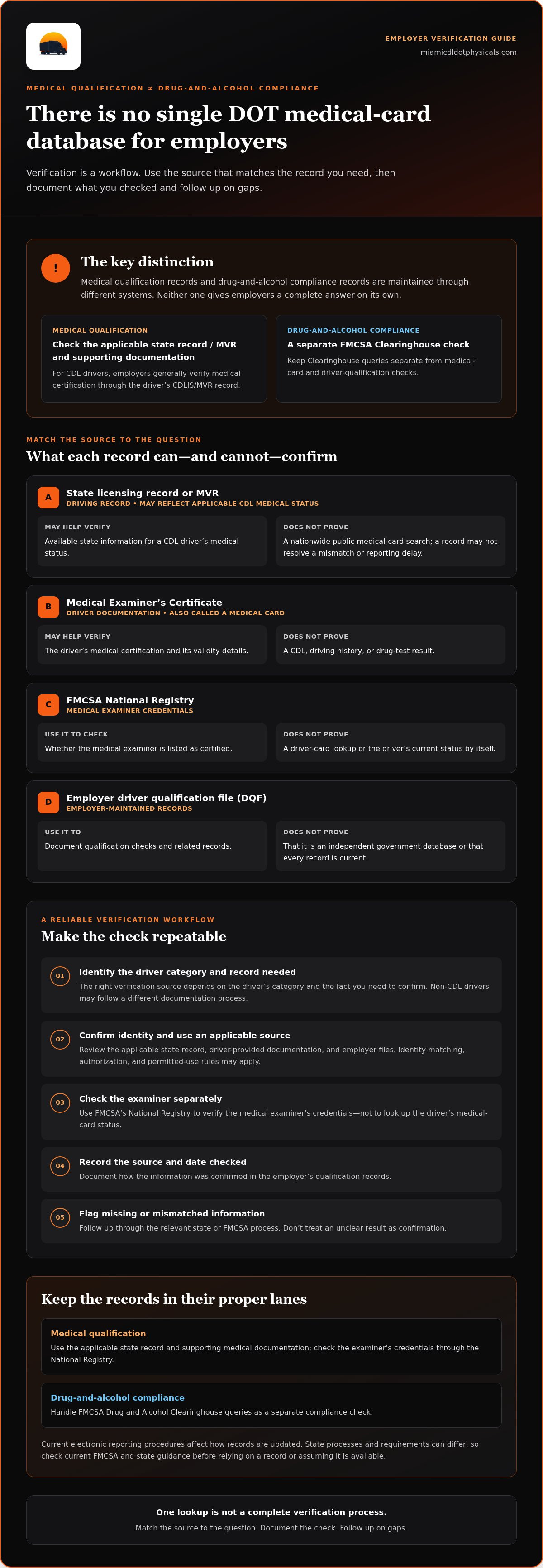
It’s understandable to want one quick lookup to confirm a driver’s status. But relying on an old card, an incomplete record, or a system built for a different purpose can leave gaps in your compliance process. For CDL drivers, employers generally verify medical certification through the driver’s CDLIS/MVR record and confirm the issuing medical examiner is listed on FMCSA’s National Registry. Requirements can differ for non-CDL drivers, and current electronic reporting procedures affect how records are updated.
This guide explains where to check each record, what employers can verify, and how to document follow-up when information is missing or doesn’t match. It also separates medical-card checks from FMCSA Drug and Alcohol Clearinghouse queries, so your team can build a consistent workflow without confusing driver qualification with drug-testing compliance.
Key Takeaways
- The DOT medical card database for employers isn’t one universal lookup; the right verification source depends on the driver’s category and the record you need to confirm.
- Use the National Registry to check a medical examiner’s credentials, not to look up a driver’s medical-card status.
- Compare state records, driver-provided documents, and employer files based on what each can confirm and what access may require.
- Build a repeatable verification workflow that confirms driver identity, records the source and date checked, and flags missing or mismatched information for follow-up.
- Keep medical qualification checks separate from drug-and-alcohol Clearinghouse checks, and choose a compliance process with clear access controls and an audit trail.
Is There a DOT Medical Card Database for Employers? Start with the Short Answer
No, employers shouldn’t expect one universal, searchable federal database that shows every driver’s current DOT medical-card status. Verification is a workflow, not a single lookup. Depending on the driver and the current state process, an employer may need to review state records, driver-provided documentation, and its own qualification files, then document how the information was confirmed.
A DOT medical card, formally called a Medical Examiner’s Certificate, is evidence that a driver has been found medically qualified under the applicable requirements. It isn’t a CDL, a complete motor vehicle record, or a drug-testing result. Each record serves a different purpose and must be checked through the appropriate process.
What employers mean by a DOT medical card database
Employers asking about a DOT medical card database for employers usually want a dependable way to confirm that a driver’s medical qualification is current and keep a record of the check. A medical certificate contains the examiner’s certification information. A state motor vehicle record (MVR), by contrast, is a driving record maintained by a state. Depending on the driver’s status and the state’s procedures, it may show medical qualification information for a CDL holder.
The Commercial Driver's License Information System (CDLIS) helps states share commercial driver licensing information. That infrastructure doesn’t mean employers can search a public, nationwide database for any driver’s medical card. The appropriate verification path can vary with CDL status, driver category, self-certification, and current state implementation. Non-CDL drivers may follow a different documentation process.
What the answer does not mean for employer access
Not having one universal lookup doesn’t mean employers have no way to verify qualification. It means they should use the applicable, current source rather than assume every record is available in one place. Depending on the method, a check may involve an authorized request for state records or a review of documentation supplied by the driver.
Access isn’t automatically unrestricted. Identity matching, authorization, and permitted-use rules may apply, so confirm the requirements before requesting or recording information. If a record is missing or conflicts with the driver’s certificate, pause and follow up through the relevant state or FMCSA process instead of treating an unclear result as confirmation. Check current FMCSA and state guidance for the procedure that applies to each driver.
Which Systems Hold or Verify DOT Medical Qualification Information?
No single system answers every qualification question. State licensing records, the medical examiner’s certificate, employer-maintained files, and federal directories each serve a different purpose. Use the source that matches the fact you need to verify, and check current FMCSA and state procedures before relying on a record or assuming it’s available to you.
| System or record | What it contains | What employers may use it for | What it doesn’t prove |
|---|---|---|---|
| State licensing record or MVR | State driving information, which may reflect applicable CDL medical qualification status. | Check the available state record for a CDL driver’s medical status. | It isn’t a nationwide public medical-card search, and a record alone may not resolve a mismatch or reporting delay. |
| Medical Examiner’s Certificate | The driver’s medical certification and its validity details. | Review documentation, including when the driver provides a copy or the applicable process calls for it. | It isn’t a CDL, driving history, or drug-test result. |
| FMCSA National Registry | Information about certified medical examiners. | Check whether the examiner is listed as certified. | It doesn’t provide a driver-card lookup or establish the driver’s current status by itself. |
| Employer driver qualification file (DQF) | Records the employer maintains under applicable requirements. | Document qualification checks and related records. | It isn’t an independent government database or proof that every record is current. |
| FMCSA Drug and Alcohol Clearinghouse | Drug and alcohol program violation information for CDL holders. | Conduct applicable Clearinghouse queries. | It contains no DOT medical-card records and doesn’t confirm medical qualification. |
State records, CDLIS, and medical certification reporting
State driver licensing agencies record applicable CDL medical qualification information. The Commercial Driver’s License Information System supports information-sharing among states; it isn’t a public nationwide tool for employers to search for a driver’s medical card. FMCSA explains how employers can validate if a driver is medically qualified using the applicable state driving record. Confirm the current state process, the record available, and access requirements before treating a result as final.
National Registry, DQF, and Clearinghouse: three different purposes
Use the National Registry to check the examiner’s credentials, the state record and applicable certificate documents to verify medical qualification, and the DQF to retain the employer’s relevant compliance records. The Clearinghouse is separate: it tracks controlled-substance and alcohol program violations, not medical certification. Keeping these checks distinct makes the DOT medical card database for employers question easier to resolve and helps prevent a drug-testing result from being mistaken for confirmation of medical status.
Employers who also need related services can review DOT physical exam, drug testing, and Clearinghouse Consortium support. A provider can support an exam or testing process, but that doesn’t replace an employer’s record verification.
DOT Medical Card Database vs. Other Verification Options: What Each Can Confirm
Choose a verification method based on the driver’s category and the question you need to answer. No option should be treated as universally sufficient: a CDL driver’s state record may show medical qualification status, while a non-CDL driver’s process may rely on different documentation. Confirm current FMCSA and state requirements before deciding which records apply.
| Method | What it can confirm | What it can’t confirm on its own | Access considerations |
|---|---|---|---|
| State record or MVR review | For a CDL driver, the available state record may show medical qualification status. | It may not explain a discrepancy or show information that hasn’t been recorded or updated. | Verify current requirements: record access, identity details, and permitted use may depend on state procedures. |
| Driver-provided medical certificate | The document can show the examiner’s certification and stated validity details. | It doesn’t establish that a state record is current when an official record is applicable. | Verify current requirements: determine whether documentation is appropriate for the driver’s category and process. |
| Employer DQF review | The employer’s file can show which qualification documents and checks have been collected and recorded. | A file review alone doesn’t independently verify the accuracy or current status of every underlying record. | Verify current requirements: apply the relevant rules for file contents, handling, and access. |
| Third-party compliance support | A provider may help organize administrative steps or support related exams and testing. | Support doesn’t make the provider a government database or establish a legal qualification determination. | Verify before sharing information: clarify authorization, privacy practices, service scope, and who performs each check. |
When a state record or medical certificate review is relevant
For a CDL driver, check the applicable state record for recorded medical qualification status, following current state procedures. A driver-provided certificate can help cross-check the examiner, dates, and details, but don’t assume it replaces an official record when one is required. For a non-CDL driver, confirm which documentation and process apply before relying on either source. If names, dates, or status indicators don’t match, resolve the discrepancy before recording the driver as verified.
When a third-party compliance provider may help
Administrative support can help keep related tasks organized, but it doesn’t replace employer verification or provide automatic access to government records. Keep the scope clear: a medical examination supports the driver’s certification process, while drug testing and FMCSA Clearinghouse Consortium management concern separate drug-and-alcohol compliance needs. The Clearinghouse is not a medical-card verification system.
For related services, review DOT medical exams, testing, and consortium support. A clear workflow still needs to identify the right source, confirm the driver’s identity, and document the employer’s own follow-up. That’s more reliable than searching for a single DOT medical card database for employers to cover every situation.
How Employers Can Build a Reliable DOT Medical Qualification Check
A consistent process makes it easier to spot gaps before an unclear record becomes a larger compliance issue. Treat each check as a documented task: identify the driver’s category, use the appropriate current source, confirm identity, and record the result. The steps below provide a practical framework. Confirm applicable FMCSA and state requirements before putting it into company policy.
A repeatable verification and follow-up workflow
- Identify the driver’s category. Determine whether the driver holds a CDL and which medical qualification process applies. Don’t assume CDL and non-CDL drivers use the same records or documentation.
- Select the appropriate source. For a CDL driver, check the applicable state record using the current procedure. For other driver categories, confirm which official record or supporting documentation applies.
- Match the information to the driver. Confirm identity before recording a status. Compare names and relevant certificate details; don’t treat a similar name or partial match as confirmation.
- Record the check. Under your company procedures, log the check date, source reviewed, outcome, reviewer, and any follow-up action. Keep the record with the appropriate employer file, following current requirements.
- Set a reminder and follow through. Use a reminder process for upcoming certificate expirations or review dates. A calendar alert can prompt a new check, but it isn’t official verification of current status.
If information is expired, missing, inconsistent, or unverified, mark the check as unresolved and assign follow-up. Confirm the right source or documentation, investigate discrepancies, and record how they were addressed. Don’t convert an incomplete lookup into a verified result just to close a task.
Recordkeeping, privacy, and discrepancy controls
Set file-handling rules before collecting or sharing sensitive information. Restrict access to staff who need it for their assigned duties, and follow applicable authorization and privacy requirements. Verify current driver qualification file retention rules for the driver category before deciding which records to keep or how long to retain them. When sources conflict, pause the verification and seek clarification through the appropriate state or FMCSA process.
Checklist: Identify the driver category, check a current and appropriate source, confirm identity, document the date and outcome, and record follow-up until each discrepancy is resolved.
For support with the medical exam or related testing needs, review DOT physical exam and drug testing services. A service provider can support an exam or testing process, but it doesn’t replace your organization’s medical-status verification and recordkeeping workflow.
Choose a DOT Medical Card Compliance Process That Fits Your Fleet
The right process depends on how many drivers you manage, who handles compliance tasks, and how consistently your records are reviewed. A manual tracker may work for a small fleet if someone owns the process and follows it. Larger fleets may need internal safety administration or external administrative support to manage reviews and follow-up. None of these options replaces the employer’s responsibility to follow current FMCSA and state requirements.
Match the process to fleet size and administrative capacity
For a small fleet, assign a named person to maintain centralized records and schedule status reviews. For a larger operation, check how your system or support model handles permissions, audit logs, status updates, and escalation when information is missing or inconsistent. If you consider a vendor, ask which sources it uses, how it confirms access authorization, how corrections are handled, and exactly which tasks are included.
| Approach | Audit trail and access | Status updates and exceptions | Scope to clarify |
|---|---|---|---|
| Manual tracking | Keep a dated log and limit file access to assigned staff. | Set review reminders and assign someone to resolve gaps. | Who checks the appropriate source and records the result? |
| Internal safety administration | Define system permissions and retain review history under company procedures. | Assign responsibility for update checks and escalation. | Which records are reviewed, and who approves unresolved cases? |
| External administrative support | Confirm what documentation is available and how information is protected. | Ask how the provider flags missing, conflicting, or outdated information. | Does the service organize tasks, conduct a permitted record check, or provide another service? Don’t assume these are the same. |
Whatever model you choose, document who checks status, which source they use, how they record the outcome, and what happens when the result is unclear. A DOT medical card database for employers shouldn’t be the basis of your plan; build a repeatable process around the appropriate records and authorized access.
Keep medical qualification separate from drug-testing compliance
The FMCSA Drug and Alcohol Clearinghouse serves its applicable drug-and-alcohol compliance purpose. It isn’t a medical-card database. Keep Clearinghouse queries and consortium administration distinct from medical qualification checks. Consult current FMCSA guidance for Clearinghouse requirements and medical examination procedures, and verify that any resource you use reflects the rules applicable to your fleet.
Start by assigning an owner, documenting your approved verification steps, and setting a follow-up process for exceptions. A medical exam provider can support the exam process, but doesn’t replace employer verification. Review DOT exams, testing, or consortium support for related service needs.
Make Driver Qualification Checks a Consistent Fleet Routine
There isn’t one universal DOT medical card database for employers that resolves every driver’s status. The right verification path depends on the driver’s category and applicable state process. Use a current, appropriate source, confirm the driver’s identity, and document the check and any follow-up.
Keep medical qualification records distinct from the FMCSA Drug and Alcohol Clearinghouse, which serves a separate drug-and-alcohol compliance purpose. A repeatable workflow helps your team track responsibilities, identify missing or inconsistent information, and resolve exceptions instead of treating an unclear result as confirmation.
When your operation also needs medical exams or testing support, choose a provider for those specific services while keeping employer verification responsibilities clear. The center offers FMCSA-certified medical examinations, DOT and non-DOT drug testing, and FMCSA Clearinghouse Consortium support for owner-operators and fleets. These services support related compliance needs, but they don’t provide access to a DOT medical-card database or replace your record checks.
Ask about DOT medical exams, drug testing, or Clearinghouse Consortium support to discuss support for your related compliance needs. With clear ownership and consistent follow-up, your team can manage driver qualification checks with greater confidence.
Frequently Asked Questions
Is there a national DOT medical card database employers can search?
No, employers shouldn’t expect one universal federal database that lets them search any driver’s current medical-card status. Verification may involve the applicable state driving record, a driver-provided Medical Examiner’s Certificate, and the employer’s own qualification records. Which source applies depends on the driver’s category and current state procedures. Confirm the driver’s identity, use an appropriate current source, and document the result rather than treating one system as a complete answer.
Can employers check a driver’s DOT medical card online?
Sometimes, but there isn’t one online federal lookup for every driver’s medical-card status. For CDL drivers, an employer may review the applicable state record, subject to current procedures and access requirements. A driver may also provide a medical certificate for review or cross-checking. Confirm that the record matches the driver and reflects current status. If information is missing or inconsistent, follow up through the relevant state process instead of assuming an online result is conclusive.
What does the FMCSA National Registry show employers?
The FMCSA National Registry lets users check medical examiner information, including whether an examiner is listed as certified to perform applicable examinations. It isn’t a driver medical-card database and doesn’t independently confirm a specific driver’s current qualification status. Employers can use it to check the examiner named on a certificate, then verify the driver’s status through the appropriate record or documentation for that driver category. Keep these two checks separate in your process.
Is the FMCSA Clearinghouse the same as a DOT medical card database?
No. The FMCSA Drug and Alcohol Clearinghouse tracks controlled-substance and alcohol program violations for CDL holders. It doesn’t contain DOT medical-card records and can’t verify whether a driver’s medical certification is current. Employers should use applicable state records and supporting medical documentation for qualification checks, and use the Clearinghouse for its separate drug-and-alcohol compliance purpose. Keeping the workflows distinct prevents a Clearinghouse result from being mistaken for medical-status confirmation.
How often should employers verify a driver’s medical certification?
Follow applicable FMCSA and state requirements, and set a repeatable review schedule that accounts for certificate expiration and relevant status changes. Don’t assume an annual review alone will confirm a driver’s status throughout the year. Use an appropriate current source when checking, and treat calendar reminders as prompts to verify, not as proof of qualification. Record the check date, source, outcome, and any follow-up so your team can see when the status was last confirmed.
What should an employer do if a driver’s medical-card information is missing or expired?
Don’t record an unclear or expired result as verified. Confirm the driver’s identity, check the appropriate current state record or documentation for that driver category, and follow up through the relevant state or FMCSA process if information is missing or doesn’t match. Document the issue, who is resolving it, and the outcome. If the certificate appears expired, confirm current qualification before relying on it; don’t assume a pending update has completed.
Do employers still need to keep a copy of a CDL driver’s medical certificate?
Don’t assume a paper copy is always the only or required verification record for a CDL driver. CDL medical status may be recorded through state licensing processes, and current transition procedures can affect how paper certificates are used. As of September 2026, an FMCSA nationwide exemption allows CDL and CLP holders to use a paper medical card as proof of qualification for up to 60 days after issuance. Verify current FMCSA and state rules for recordkeeping and the driver’s circumstances.


