

A negative result alone won’t put you back behind the wheel. The DOT return to duty drug test is one required milestone, but the SAP process and employer responsibilities determine when you’re eligible to resume safety-sensitive work. A separate hair test or non-DOT test does not replace the federally required DOT test.
After a violation, you must complete a Substance Abuse Professional (SAP) evaluation and any recommended education or treatment before the SAP can determine that you’re eligible for testing. Your employer then arranges a directly observed DOT return-to-duty test. A negative result is required before you return, and follow-up testing continues after you resume work.
This guide walks through the process from violation to eligibility, explains what the DOT test involves, and outlines how the SAP, employer, and FMCSA Drug and Alcohol Clearinghouse fit into the process. It also explains why a non-DOT hair test doesn’t meet the DOT requirement.
Key Takeaways
- A DOT violation starts a required return-to-duty process. It does not automatically clear you to resume safety-sensitive work.
- The DOT return-to-duty test comes after the SAP evaluation and completion of any education or treatment the SAP recommends.
- A non-DOT hair test or other screen does not replace the required DOT return-to-duty test.
- Prepare by following test instructions, bringing identification, and providing accurate information during collection.
- Employers coordinate authorization and documentation. Clearinghouse reporting and follow-up testing are also part of the compliance process.
What a DOT return-to-duty drug test means for a CDL driver
A DOT return-to-duty drug test is the federally regulated test a driver must take after a qualifying DOT drug or alcohol violation and completion of the required Substance Abuse Professional (SAP) process. It is not automatic clearance to drive. You must complete the SAP’s recommended steps, be authorized to test, and receive a negative result before resuming safety-sensitive duties.
In practical terms, the return-to-duty test is a directly observed DOT test required after a driver completes the prescribed evaluation and any recommended education or treatment. It differs from a pre-employment test, which is part of hiring; a random test, which is selected under an employer’s testing program; and follow-up tests, which take place after the driver returns under the SAP’s plan. This overview of drug testing describes how tests can differ, but a DOT return-to-duty test must follow the applicable federal procedures.
Which events can trigger the return-to-duty process?
The process begins with a qualifying violation under DOT rules, not simply a suspicion or an informal workplace screen. Triggers can include a verified positive drug test, a prohibited alcohol result, a refusal to test, or other conduct that qualifies as a violation under the applicable regulations. Depending on the circumstances and regulatory criteria, a refusal can include failing to appear for a test as directed or failing to cooperate with the testing process.
A supervisor’s concern, an unconfirmed result, or a non-DOT screening by itself should not be treated as a confirmed DOT violation. DOT testing follows specific procedures, including review and verification where required. When an employer determines that a DOT violation occurred, it must follow the required process; a separate screening is not a substitute. The applicable trigger depends on the event and the rules governing the driver’s testing program.
Who controls the return-to-duty decision?
Each party has a defined role. The driver must follow instructions, complete the SAP process, and participate in required testing. The SAP evaluates the driver, recommends education or treatment when needed, and determines when the driver is eligible for a return-to-duty test. The employer authorizes or arranges the test and ensures the driver meets applicable requirements before assigning safety-sensitive work.
A testing provider collects the specimen and supports the testing process. It does not decide whether the driver has completed SAP requirements or may return to duty. A negative result is necessary, but it does not replace the SAP’s evaluation, the employer’s responsibilities, or required Clearinghouse steps. Keep the process documented, and don’t assume that scheduling a test, completing a separate screen, or receiving an informal clearance makes you eligible to drive.
How the FMCSA return-to-duty process works, step by step
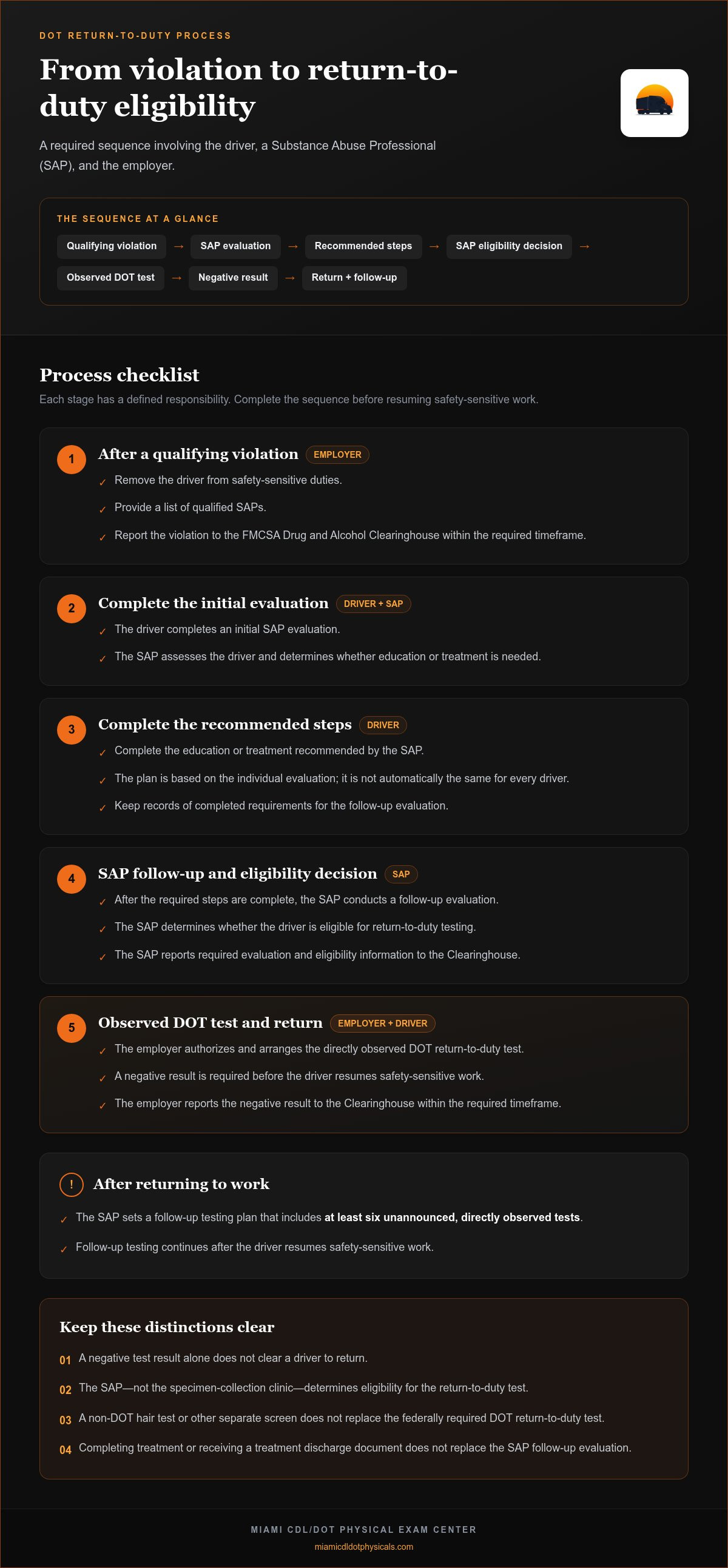
The process has distinct stages. A driver can’t move directly from a violation to testing, and completing treatment alone doesn’t satisfy every requirement. Under 49 CFR Part 40: DOT Drug and Alcohol Testing Regulations, the SAP, employer, and driver each have responsibilities. The sequence below shows how they fit together.
- Employer: After a qualifying violation, remove the driver from safety-sensitive duties and provide a list of qualified SAPs. The employer reports the violation to the FMCSA Drug and Alcohol Clearinghouse within the required timeframe.
- Driver and SAP: The driver completes an initial SAP evaluation. The SAP assesses the driver and determines whether education or treatment is needed.
- Driver: Complete the education or treatment the SAP recommends. The plan is based on the individual evaluation and is not automatically the same for every driver.
- SAP: After the required steps are complete, the SAP conducts a follow-up evaluation and determines whether the driver is eligible for return-to-duty testing. The SAP reports required evaluation and eligibility information to the Clearinghouse.
- Employer and driver: The employer authorizes and arranges the return-to-duty test. The driver must receive a negative result before returning to safety-sensitive work. The employer then reports the negative result to the Clearinghouse within the required timeframe.
The SAP evaluation and required education or treatment
A Substance Abuse Professional is a DOT-qualified professional who evaluates a driver after a violation and oversees the return-to-duty process. The SAP recommends education or treatment when the assessment calls for it, then evaluates the driver again after those steps are complete. A treatment discharge or course-completion document is not a substitute for the SAP’s follow-up evaluation or a return-to-duty clearance.
Follow the SAP’s recommendations and keep records of completed requirements so the follow-up evaluation can address them. The SAP, not the clinic collecting a specimen, determines when you’re eligible to take the return-to-duty test.
The return-to-duty test and employer authorization
The DOT return to duty drug test must have a negative result before the driver resumes safety-sensitive work. FMCSA return-to-duty tests are directly observed. A testing provider handles collection and testing procedures, while the employer authorizes the test and determines when applicable requirements permit the driver to return. A clinic cannot independently restore work eligibility or promise reinstatement.
The process continues after the driver returns. The SAP sets a follow-up testing plan that includes at least six unannounced, directly observed tests during the first 12 months; the plan may extend longer. Employers also have Clearinghouse reporting and recordkeeping duties. Owner-operators and fleets can use FMCSA Clearinghouse Consortium support to help manage compliance responsibilities alongside professional DOT drug testing.
DOT return-to-duty drug test versus hair testing and other screens
A test can detect drugs without meeting DOT requirements. Its purpose and governing procedures matter, not just the specimen or result. A separate hair test or employer-directed non-DOT screen is not a substitute for a DOT return-to-duty test. The comparison below distinguishes the federal testing step from other screening and monitoring.
| Test type | Purpose | Governing rules | Satisfies DOT return-to-duty requirements? |
|---|---|---|---|
| DOT return-to-duty test | Completes the required test after the driver finishes the SAP process and is authorized to test. | DOT procedures under 49 CFR Part 40 and applicable FMCSA rules. | Yes, when properly authorized and completed under the required procedure with a negative result. |
| Non-DOT hair test | Provides a separate drug screen under a non-DOT program. | Employer or program rules, not DOT return-to-duty procedures. | No. It cannot replace the required DOT test. |
| Other employer-directed non-DOT screen | Serves an employer’s separate screening purpose, such as its workplace policy. | The non-DOT program’s rules. | No. Its result is not the required DOT result. |
| DOT follow-up test | Monitors compliance after the driver returns to safety-sensitive work. | DOT procedures and the SAP’s follow-up plan. | No. It is a separate testing stage. |
Can a hair follicle test replace the required DOT test?
No. A negative hair test does not fulfill the DOT return-to-duty requirement. The DOT return to duty drug test must follow applicable federal testing procedures, with the result processed and verified through the DOT testing program. A non-DOT screen may serve its own purpose, but it cannot establish that a driver has completed the DOT testing requirement.
Specimen rules matter. DOT drug testing uses urine specimens. Although federal rules authorize oral fluid testing, it is not operational until the required HHS-certified laboratories are in place. A specimen accepted in another screening program does not automatically qualify for a DOT return-to-duty test.
How follow-up testing differs from the return-to-duty test
The return-to-duty test is required before a driver resumes safety-sensitive work. Follow-up testing takes place afterward under the SAP’s plan, so it is not another name for the initial test. The plan requires at least six unannounced, directly observed tests in the first 12 months after the driver returns. The SAP may extend follow-up testing for up to five years.
Follow-up collections must also follow applicable DOT procedures, including direct observation. Employers have Clearinghouse reporting and recordkeeping responsibilities, and follow-up testing remains part of ongoing compliance. Keep the test purpose clear when a collection is arranged. A separate screen, a return-to-duty test, and follow-up tests serve different purposes and are not interchangeable.
What drivers and employers should prepare before the test
Preparation helps keep the collection aligned with its purpose. Before a DOT return-to-duty drug test, the driver and employer should understand the instructions, test designation, and required paperwork. A testing provider collects and processes the specimen under applicable procedures, but collection staff cannot determine whether the SAP process is complete or authorize a return to safety-sensitive work.
Driver checklist before a return-to-duty collection
Follow the employer’s instructions rather than relying on details from a previous test. A return-to-duty collection has a specific DOT purpose and must be arranged through the applicable process. Before you go, confirm where and when to report, what identification to bring, and how to reach the employer if instructions are unclear.
- Follow the test instructions. Use the collection location and reporting details provided by your employer, and arrive as directed.
- Bring required identification. Use the ID specified in your instructions so the collection can be documented accurately.
- Provide accurate information. Complete forms truthfully. If asked to disclose prescription medication or relevant medical information, use the proper process and share it with the designated testing official or medical review professional, not casually with collection staff.
- Keep the test purpose clear. A personal screen, hair test, or unrelated non-DOT test does not fulfill the federal return-to-duty requirement.
For more context on testing programs and collection procedures, read this DOT drug testing compliance guide.
Employer checklist for an orderly compliance process
Before arranging collection, employers should confirm that the driver has completed the applicable SAP requirements and that the SAP has determined the driver is eligible for return-to-duty testing. The employer must authorize the test and communicate its purpose clearly so the collection is designated and documented correctly. A generic or incorrectly designated drug screen may not meet the DOT requirement.
- Verify the process stage. Confirm the SAP’s follow-up evaluation and eligibility determination before scheduling the return-to-duty test.
- Use the correct test designation. Give the collector the DOT testing purpose and follow current collection and documentation procedures, including direct observation requirements for return-to-duty testing.
- Track Clearinghouse duties. Employers must report a negative return-to-duty result by the close of the third business day after receiving it. Keep required records and ensure the driver’s status and applicable requirements support a return to safety-sensitive duties.
Owner-operators and fleets also need a reliable way to manage compliance responsibilities. FMCSA Clearinghouse Consortium support can help with the administrative work, while professional DOT drug testing covers the collection step. Treat testing as part of the documented compliance process, not as a substitute for SAP or employer decisions.
Complete the process with DOT testing and Clearinghouse support
Completing a DOT return-to-duty drug test is one part of a broader compliance process. Follow the sequence: finish the SAP’s requirements, coordinate test authorization with the employer, complete the required DOT test, and document the result and related records. A testing service supports the collection step. It does not replace the SAP’s evaluation, the employer’s responsibilities, or the driver’s obligation to complete the process.
How DOT testing support fits into compliance
Professional DOT drug testing supports the required test using the correct DOT purpose and applicable collection procedures. Before collection, the employer should establish that the driver is eligible for testing and authorize the test. The result then informs the employer’s next compliance actions, including required Clearinghouse reporting. A testing provider cannot independently determine eligibility or authorize a return to safety-sensitive work.
Employers must report a negative return-to-duty result to the FMCSA Drug and Alcohol Clearinghouse by the close of the third business day after receiving it. Keep the result connected to the correct driver and test purpose, and retain the documentation required for employer records. A collection receipt or unrelated screening result does not show that all return-to-duty requirements are complete.
The center provides DOT drug testing and FMCSA Clearinghouse Consortium support. For owner-operators and fleets, consortium support can help manage compliance responsibilities alongside the testing process. Read the FMCSA Clearinghouse Consortium guide for more context on program administration.
Next steps for owner-operators and employers
Identify who is responsible for each task. A driver should complete the SAP’s requirements and follow employer instructions. An employer should authorize the correct test, track required reporting, and confirm that the applicable process supports any return to safety-sensitive duties. Owner-operators should also understand how their testing and Clearinghouse responsibilities are managed. A consortium can support program administration, but it does not replace the driver’s, employer’s, or SAP’s role.
- Complete the SAP process: Follow the recommendations and wait for the required eligibility determination.
- Coordinate authorization: Have the employer arrange the correct DOT return-to-duty test.
- Complete testing and document the result: Follow collection instructions, then ensure the employer receives and reports the result as required.
Taking these steps in order helps keep testing, documentation, and Clearinghouse responsibilities aligned. The center’s DOT testing and compliance services include DOT drug testing and FMCSA Clearinghouse Consortium support.
Make your next compliance step clear
Returning to safety-sensitive work takes more than completing a test. Know who is responsible for your next step, and keep a written record of instructions, completed requirements, and pending decisions to stay organized as the process moves forward.
If you’re preparing for a DOT return to duty drug test, follow the employer’s directions and keep the test connected to the correct compliance process. Don’t rely on assumptions or unrelated screening results. Clear communication between you and the people managing each step can help prevent avoidable confusion.
Drivers and fleets can use occupational testing and compliance services to support their needs. Keep your records organized and take the process one step at a time.
Explore the center’s DOT drug testing and compliance services to take your next step.
Frequently Asked Questions
Is a return-to-duty drug test required after every positive DOT test?
A verified DOT drug-testing violation generally requires the driver to complete the return-to-duty process before performing safety-sensitive work again. A laboratory result may need review by a Medical Review Officer before it is verified, so an initial result or informal workplace screen is not automatically a confirmed violation. The circumstances and violation classification matter. Employers must follow current FMCSA and 49 CFR Part 40 requirements for the case.
Can I return to driving after a negative return-to-duty test?
No. A negative result alone does not establish that you can return to driving. The applicable SAP evaluations and recommendations must be complete, and the employer must handle its authorization, eligibility, and documentation responsibilities. For example, a driver who has a negative result but has not completed the SAP’s required follow-up evaluation still has a step outstanding. Confirm your status and any remaining requirements with the employer before operating a commercial vehicle.
Can a hair follicle test count as a DOT return-to-duty test?
No. A separate hair follicle screen does not satisfy the DOT return-to-duty requirement, even if its result is negative. DOT compliance depends on an authorized test conducted under applicable federal procedures, not just a result from another screening method. If an employer also uses non-DOT testing, keep its purpose and records distinct from the DOT test. An unrelated screen does not establish return-to-duty eligibility.
Does the return-to-duty drug test have to be directly observed?
Yes. A DOT return-to-duty test must be conducted under direct observation, making observation part of the required collection procedure, not an optional employer preference. Follow the collector’s instructions throughout the process. If you’re unsure why the collection is observed, ask the collection staff to explain the steps without refusing or interrupting the procedure. The employer and testing provider should apply current 49 CFR Part 40 requirements.
What happens after I pass the return-to-duty drug test?
After a negative result, the employer must complete applicable compliance steps before assigning safety-sensitive work. The SAP’s follow-up plan may require additional tests after you return, so track the instructions and attend each test as directed. Your employer also has Clearinghouse reporting duties. If your status or responsibilities are unclear, ask the employer what remains before you resume work rather than relying on the result alone.
How is a return-to-duty test different from a follow-up test?
The return-to-duty test is required before a driver may resume safety-sensitive duties. Follow-up tests take place after the return, according to the SAP’s plan. The plan is individualized, not a schedule the driver selects. Follow-up tests are unannounced and directly observed, and the plan includes at least six tests during the first 12 months. Keep the SAP’s instructions accessible so you can respond correctly when a follow-up test is due.
Who arranges the DOT return-to-duty test?
The employer directs the driver through the applicable DOT testing process and arranges or authorizes the return-to-duty test after the SAP determines the driver is eligible to test. Follow the employer’s instructions and bring the requested identification. The testing provider conducts the collection but does not decide whether the SAP process is complete or the driver can return to work. Owner-operators should understand how their testing and Clearinghouse responsibilities are managed.


