

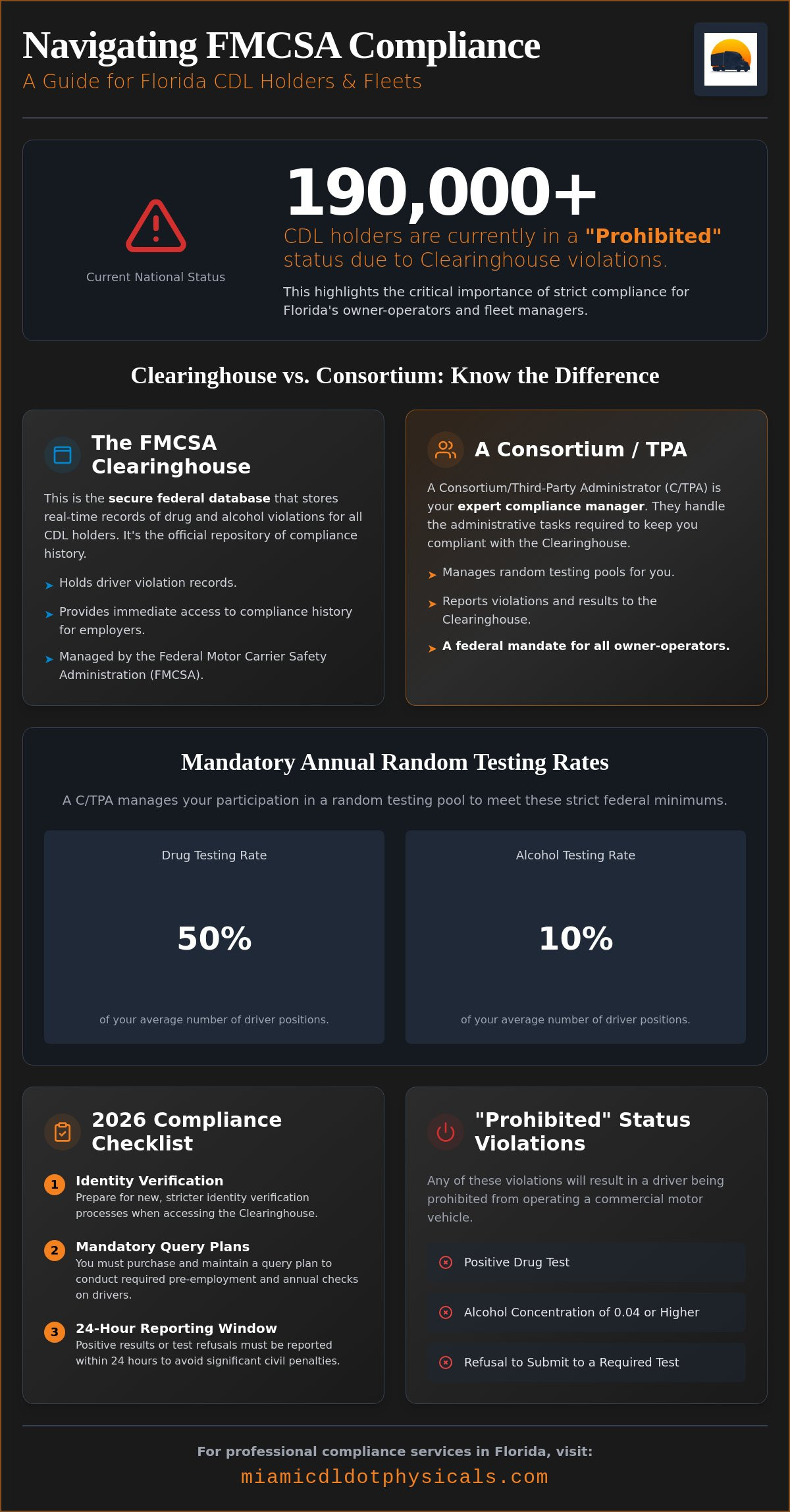
Over 190,000 CDL holders currently sit in a prohibited status because of Clearinghouse violations. For Florida owner-operators and fleet managers, this statistic highlights the high stakes of federal oversight. Managing an FMCSA clearinghouse consortium Florida program has become more demanding with the 2026 identity verification rules and the strict 24-hour window for reporting positive results. You likely feel the pressure of these administrative hurdles and the constant worry about a surprise audit or a downgraded license.
We recognize that your main goal is to keep your trucks moving while staying fully compliant. This guide provides a straightforward path through the latest regulatory updates. You'll learn how to master federal drug and alcohol compliance with our comprehensive breakdown of Florida consortium requirements and the 2026 FMCSA updates. We will outline the steps to automate your random testing selection and secure your records so you are always prepared for an inspection without the stress of manual tracking.
Key Takeaways
- Understand the critical role of a Third-Party Administrator in managing federal drug and alcohol reporting to keep your CDL in good standing.
- Learn how an FMCSA clearinghouse consortium Florida program automates random testing pools and ensures your records are always audit-ready.
- Discover why consortium enrollment is a legal requirement for owner-operators and how it protects your business from costly civil penalties.
- Get clear instructions for navigating the new 2026 identity verification process and purchasing mandatory query plans for your drivers.
- See the efficiency of consolidating your DOT physical exams and drug testing with a single professional compliance partner in Florida.
What is an FMCSA Clearinghouse Consortium?
The Drug and Alcohol Clearinghouse is a secure federal database that maintains a real-time record of drug and alcohol program violations for CDL holders. Established and managed by the Federal Motor Carrier Safety Administration (FMCSA), this system ensures that drivers who've violated safety regulations can't simply move to a different state or employer to hide their record. The primary goal is to improve road safety by providing employers and enforcement agencies with immediate access to a driver's compliance history. It's a digital shield that keeps the professional driving community and the public safe.
Managing this data can be a full-time job. This is where an FMCSA clearinghouse consortium Florida service provider becomes essential. A consortium, often referred to as a Third-Party Administrator (C/TPA), acts as an expert manager for your compliance needs. They handle the administrative heavy lifting, from reporting violations to managing random testing pools. For owner-operators, joining a consortium isn't just a convenience; it's a federal mandate. The law requires single-driver operations to have an outside entity manage their random selections to prevent bias and ensure the integrity of the safety program.
The Difference Between the Clearinghouse and a Consortium
It's helpful to view the Clearinghouse as the repository and the consortium as the active manager. The Clearinghouse holds the records, but it doesn't conduct tests or automatically know when a violation occurs. Your consortium ensures that data flows correctly from the testing site to the federal database. While the driver is responsible for their own conduct, the C/TPA holds the legal responsibility for reporting specific events, such as a refusal to test or a positive result, on behalf of the employer or owner-operator. This partnership keeps your records accurate and your business in good standing.
Key Terminology for Florida Drivers
Understanding the language of the FMCSA is the first step toward staying compliant. A driver's status in the database is typically listed as either 'Prohibited' or 'Not Prohibited.' A 'Prohibited' status means the driver has an active violation and cannot operate a commercial vehicle until they complete the return-to-duty process. Violations include positive drug tests, alcohol concentrations of 0.04 or higher, and refusals to submit to a test. The Medical Review Officer (MRO) is another key figure. These certified physicians review every laboratory-confirmed positive result to determine if there's a valid medical reason for the finding, providing a necessary layer of protection and accuracy for the driver.
How a Florida DOT Drug Consortium Simplifies Compliance
Compliance shouldn't feel like a second job. When you join an FMCSA clearinghouse consortium Florida, you shift the burden of administrative tracking to specialized experts. This partnership ensures that every test conducted meets the rigorous 49 CFR Part 40 standards. It also provides a centralized system for immediate notifications. If a driver is selected for a test or a result is pending, you and the driver receive clear, timely updates. This level of organization is vital for maintaining a "Not Prohibited" status in the FMCSA Drug & Alcohol Clearinghouse. Beyond just scheduling, a consortium acts as a shield during inspections, providing the verified data trails that auditors expect to see.
Random Testing Pool Management
A consortium uses scientifically valid methods to ensure random selections are truly unbiased. For 2026, the FMCSA has maintained the minimum annual random drug testing rate at 50% and the alcohol testing rate at 10%. These rates have remained consistent for six consecutive years, but the consequences for missing a draw are higher than ever. Managing these percentages on your own is difficult, especially for small fleets. By joining a larger pool, your business benefits from a broader statistical base. This protects small businesses from the appearance of bias and ensures your company meets federal quotas every single year without fail. The system automatically handles the draws, so you don't have to worry about manual calendars or spreadsheets.
Reporting and Administrative Relief
The administrative side of compliance involves more than just testing. It requires managing pre-employment, annual limited, and full queries for every driver. A professional consortium handles these tasks through secure portals, giving you 24/7 access to compliance records. This is particularly important given the 2026 requirement for a 24-hour maximum window for reporting positive results or refusals to test. If you miss this deadline, the civil penalties can reach up to $7,155 per violation. In the event of a DOT audit, having organized, digital records means you won't face "paperwork fines" for missing documentation. For comprehensive support, you can partner with a certified compliance center to handle both your exams and your consortium needs in one place. This integrated approach ensures that no detail is overlooked, from the initial physical to the final reporting step.
Owner-Operators vs. Small Fleets: Choosing Your Compliance Path
Choosing how to manage federal compliance depends entirely on the size and structure of your trucking business. While the core FMCSA Clearinghouse requirements remain the same for everyone, the execution varies between a single-truck operation and a growing fleet. For many, an FMCSA clearinghouse consortium Florida provider offers the most efficient way to scale without adding administrative overhead. Managing these requirements in-house often leads to missed deadlines or incomplete records, which can trigger civil penalties of up to $7,155 per violation. Outsourcing provides a safety net that ensures your business remains audit-ready regardless of how many drivers you put on the road.
The cost-benefit analysis of using a consortium usually favors the business owner. In-house management requires constant monitoring of federal updates and manual tracking of testing dates. A consortium automates these processes, allowing you to focus on your routes. Fleet size also impacts your random selection frequency. In a larger consortium pool, the mathematical probability of a single driver being picked multiple times in a row decreases, which can help stabilize your operational schedule and reduce the stress of frequent, unexpected downtime for testing.
Owner-Operator Requirements
If you're an owner-operator, federal law removes the choice of self-management. You're legally required to designate a C/TPA within the Clearinghouse portal to manage your random testing program. This rule exists to prevent drivers from "selecting" themselves for tests, ensuring the integrity of the safety pool. Beyond random draws, your consortium also guides you through the complex Return-to-Duty process if a violation occurs. Staying compliant involves more than just a membership; it requires active participation in a random drug testing pool for owner-operators to secure your livelihood and maintain your "Not Prohibited" status.
Small to Medium Fleet Solutions
As your fleet grows, the complexity of coordinating multiple drivers across different testing cycles increases. Small fleets must track annual queries and ensure that supervisors complete mandatory training for reasonable suspicion testing. A consortium simplifies this by centralizing all driver data in one secure location. This scalability allows you to add or remove drivers from the pool instantly, keeping your random selection frequency accurate according to current federal rates. You can find detailed steps for implementing a random drug testing program in Florida that grows with your company. This proactive approach prevents the administrative bottlenecks that often lead to "prohibited" status for drivers and costly downtime for your trucks.
2026 Compliance Checklist: Identity Verification and Queries
Staying compliant requires more than just enrolling in a program; it demands active participation in the federal system. As of April 27, 2026, the FMCSA has implemented new identity verification requirements to enhance data security and system accuracy. If you manage an FMCSA clearinghouse consortium Florida program, these updates are non-negotiable. Failing to verify your identity through the approved secure web application will result in account lockouts, which can halt your hiring process and lead to missed annual deadlines. Use the following steps to ensure your business meets every 2026 benchmark.
- Step 1: Complete the mandatory identity verification process through the Clearinghouse portal by the April 27 deadline.
- Step 2: Purchase query plans in advance. Both limited and full queries currently cost a flat rate of $1.25 each.
- Step 3: Conduct full pre-employment queries for every new hire before they perform any safety-sensitive functions.
- Step 4: Audit your driver records to ensure all CDL and Commercial Learner's Permit (CLP) information is updated and matches federal records.
- Step 5: Maintain 'Not Prohibited' status for all drivers through consistent participation in your random testing pool.
The New 2026 Identity Verification Mandate
The FMCSA now requires all primary account users, including employers, C/TPAs, and Medical Review Officers, to verify their identity. This move prevents unauthorized access and ensures that the person reporting a violation is exactly who they claim to be. You should prepare for this by ensuring your login.gov or relevant secure web application credentials are active and match your Clearinghouse profile. Don't wait until the last minute; registration delays can prevent you from conducting the queries needed to keep your trucks on the road. If you find the setup process confusing, you can register for our consortium management services to get expert guidance on your account configuration.
Annual Query Requirements
Every employer must conduct at least one query per driver every 12 months. A limited query check confirms if information about a driver exists in the Clearinghouse but doesn't reveal specific violation details. If a limited query shows a hit, you must conduct a full query within 24 hours to see the detailed record. Remember that you must obtain and maintain a signed, written consent form from each driver before conducting a limited query. For full queries, the driver must provide electronic consent directly through the Clearinghouse website. You can find more details in our DOT Drug Consortium Program Florida: The 2026 Compliance Checklist. This proactive tracking ensures you never inadvertently employ a driver in a 'prohibited' status, which protects your business from significant civil penalties.
Success in the trucking industry depends on more than just finding the right routes; it requires a bulletproof compliance ecosystem. When you treat your medical certifications and drug testing as separate, disconnected tasks, details often fall through the cracks. An FMCSA clearinghouse consortium Florida partner bridges this gap by aligning your health records with federal reporting requirements. This integrated approach ensures that your medical examiner's certificate and your drug testing status always move in sync. By consolidating these services, you eliminate the risk of a driver operating with an expired physical or a missing query result.
Miami CDL/DOT Physical Exam Center supports Florida drivers by providing a localized, expert-led solution for these complex needs. We understand that your time is your most valuable asset. That's why we offer an integrated Clearinghouse Consortium management program alongside our certified medical exams. You don't have to visit multiple sites or track different portals to stay legal. We serve as your compliance partner, ensuring that your records are validated, your testing is automated, and your business remains ready for any state or federal inspection.
Integrated Driver Health and Compliance
Having FMCSA-certified medical examiners oversee your drug testing program provides a superior level of oversight. These professionals understand the medical nuances of DOT drug testing and can provide immediate guidance on how certain medications or conditions might affect a driver's status. This expertise reduces the stress of "prohibited" findings and ensures that every test meets the highest clinical and legal standards. A professional consortium provides the automated oversight needed to ensure every driver in your fleet remains eligible to work under the 2026 federal safety standards.
Joining the Consortium
The enrollment process for Florida owner-operators and small fleets is designed for speed and reliability. To get started, you simply need to provide your current CDL information and designate your C/TPA in the federal portal. For your first integrated visit, bring your current medical certificate and your driver's license. We will help you set up your query plan and ensure your identity verification is complete for the 2026 mandate. Taking these steps today secures your professional standing for the year ahead. Don't wait for a violation to find a solution. Contact us to enroll in our FMCSA clearinghouse consortium Florida program and experience the peace of mind that comes with professional management.
Secure Your Professional Future in 2026
Compliance is a moving target that requires constant attention. With the 2026 identity verification deadlines and the strict 24-hour reporting window, managing everything manually is a significant risk to your livelihood. A professional FMCSA clearinghouse consortium Florida partner provides the automated oversight needed to keep your CDL active and your trucks on the road. By centralizing your records, you eliminate the administrative bottlenecks that often lead to "prohibited" status and costly downtime.
Our team of FMCSA-Certified Medical Examiners offers complete DOT drug and alcohol testing and professional consortium management from a single, convenient location. We handle the technical details and query plans so you don't have to navigate the federal portal alone. This integrated approach ensures that every medical certification and test result aligns perfectly with federal standards. Join our FMCSA Clearinghouse Consortium today for total Florida compliance. Stay ahead of the regulations and drive with confidence knowing your records are audit-ready. We're here to ensure your professional success every mile of the way.
Frequently Asked Questions
What is an FMCSA Clearinghouse consortium?
An FMCSA Clearinghouse consortium is a third-party organization that manages drug and alcohol testing requirements for motor carriers and owner-operators. They act as an administrative partner, handling the reporting of violations and managing the random testing pools required by federal law. For many businesses, this service is essential for maintaining accurate records and staying audit-ready without the burden of manual data tracking or complex reporting tasks.
Do owner-operators in Florida need to join a drug consortium?
Yes, federal law requires all owner-operators who drive commercial vehicles to join a consortium. You aren't allowed to manage your own random testing pool because the FMCSA requires an independent party to handle the selection process for single-driver companies. Joining an FMCSA clearinghouse consortium Florida provider ensures that your random draws are scientifically valid and that you stay compliant with all state and federal safety regulations.
What are the new 2026 FMCSA identity verification requirements?
Effective April 27, 2026, the FMCSA requires all Clearinghouse users to complete a new identity verification process. This involves registering through a secure web application to confirm your identity before you can access driver data or report violations. This mandate applies to employers, C/TPAs, and Medical Review Officers. It's designed to protect sensitive driver information and prevent unauthorized account access across the professional driving industry.
How much does it cost to join a DOT drug consortium?
The cost of joining a consortium depends on the specific services you need and the number of drivers in your company. Most providers charge an annual enrollment fee that covers administrative costs and random pool management. Additional costs usually include the price of the drug tests themselves and the federal query fees. It's best to review different service tiers with your provider to find a plan that fits your operational budget.
What happens if a driver fails a random drug test in the consortium?
If a driver fails a test, they are immediately moved to a prohibited status in the federal database. They must stop driving commercial vehicles right away. To return to work, the driver has to complete a specific Return-to-Duty process. This involves evaluation by a Substance Abuse Professional and successful completion of any required treatment or education before they can take a return-to-duty drug test and resume safety-sensitive functions.
How often are random drug tests conducted in a Florida consortium?
Random tests are conducted year-round to ensure the industry meets the minimum annual testing rates. Currently, the FMCSA requires drug testing for 50% of the average number of driver positions and 10% for alcohol. Selections are made at least quarterly. This consistent schedule ensures that every driver in the FMCSA clearinghouse consortium Florida pool has an equal chance of being selected during every draw throughout the calendar year.
Can a consortium conduct my annual Clearinghouse queries?
Yes, a consortium can manage your annual queries if you grant them the proper permissions in the Clearinghouse portal. They will conduct the required limited queries for your existing drivers every 12 months and notify you if a full query is necessary. This automation is a major benefit for busy fleet managers who want to avoid the civil penalties associated with missing annual check deadlines or failing to maintain accurate query records.
How do I register for the FMCSA Clearinghouse in 2026?
To register in 2026, you must first verify your identity through the mandated secure web application. Once verified, visit the official FMCSA Clearinghouse website to create your employer or driver profile. You'll need your USDOT number and contact information to complete the setup. After your account is active, you can purchase query plans and designate your chosen consortium to begin managing your drug and alcohol program compliance.


