

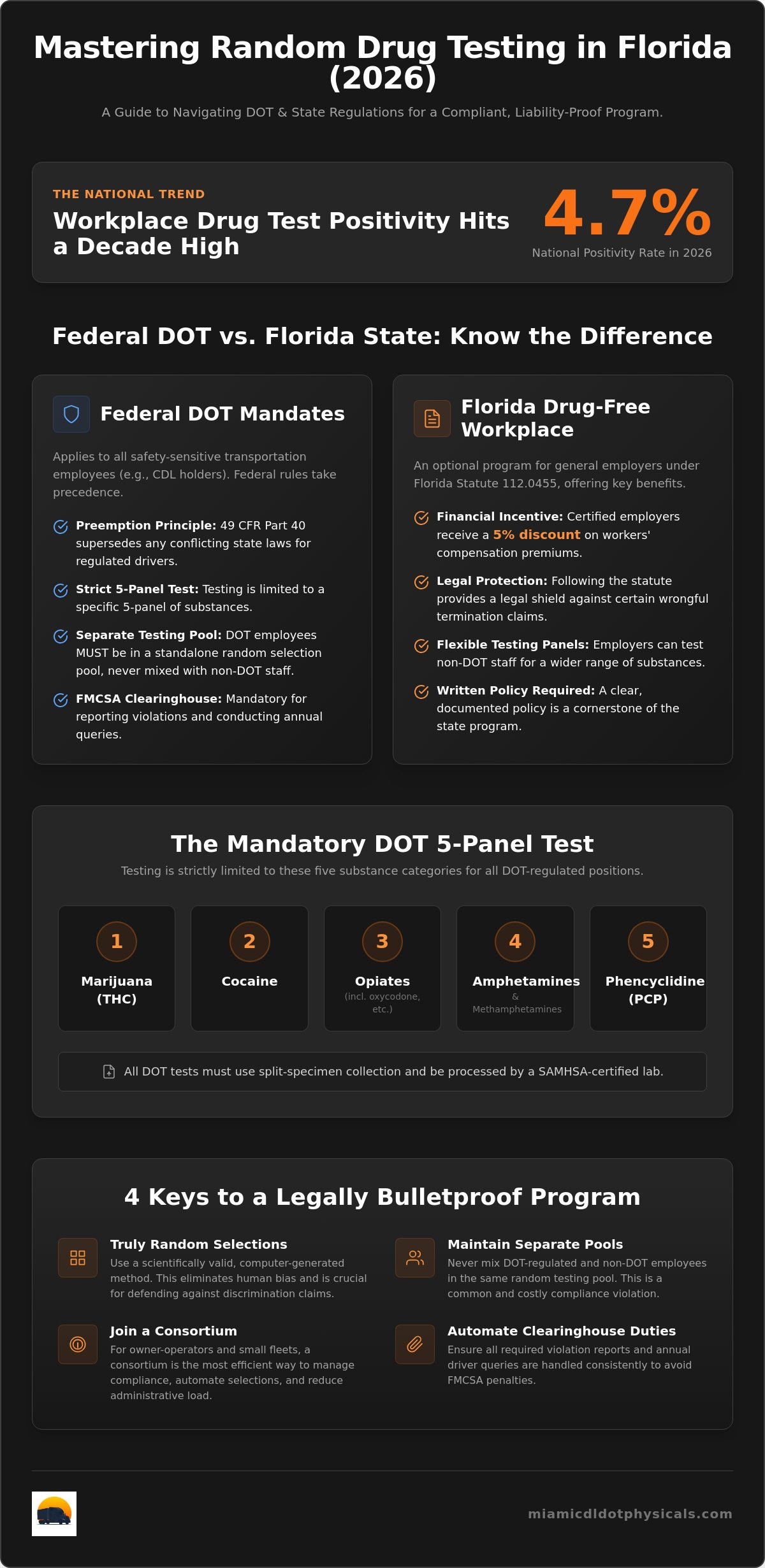
The national workplace drug testing positivity rate hit 4.7 percent in 2026, marking the highest level of detection in over a decade. For business owners in the Sunshine State, implementing a compliant random drug testing program Florida regulators and federal authorities approve is no longer just a recommendation; it's a critical shield against liability. You likely feel the pressure of balancing Florida's Drug-Free Workplace Act with strict DOT Part 40 mandates while trying to keep your fleet on the road. It's frustrating to manage the administrative weight of random selections when you're focused on daily operations.
This guide simplifies the process by providing a clear roadmap for 2026 compliance. You'll learn how to build a legally sound testing policy that satisfies both state incentives, like the 5 percent workers' compensation premium credit, and federal FMCSA Clearinghouse requirements. We'll break down the roles of Medical Review Officers (MRO) and SAMHSA-certified labs, explain how to automate your random selection pool, and ensure you're prepared for the latest regulatory shifts regarding marijuana and oral fluid testing.
Key Takeaways
- Understand the preemption principle to ensure your DOT-regulated drivers follow federal Part 40 rules over Florida state statutes.
- Discover why joining a consortium is the most efficient way to manage a random drug testing program Florida requires for small fleets and owner-operators.
- Learn the specific steps for maintaining an accurate employee roster and meeting mandatory monthly or quarterly selection frequencies.
- Automate your FMCSA Clearinghouse compliance to handle violation reporting and annual queries without the administrative headache.
- Identify the key differences between the standard DOT 5-panel test and the expanded panels often used in Florida non-DOT programs.
What is a Random Drug Testing Program in Florida?
A What is a Random Drug Testing Program? is a scientifically valid method of choosing employees for screening where every individual in the pool has an equal chance of being selected. This isn't a "manager's choice" system. It relies on mathematical probability to ensure the process remains fair and unbiased. For many businesses, a random drug testing program Florida standards require is the most effective way to maintain a safe, productive environment.
This protocol serves as a powerful deterrent. Unlike other forms of testing, random screens are unannounced and unpredictable. When employees know they could be selected at any moment, they're significantly less likely to risk substance use. It's the gold standard for safety-sensitive roles, such as commercial driving or heavy machinery operation, where a single mistake can have devastating consequences. By removing the element of "if" and replacing it with "when," you create a culture of accountability.
Understanding how this differs from other protocols is vital for compliance. While Random testing is neutral and periodic, Reasonable Suspicion testing occurs only when a supervisor observes specific, documented signs of impairment. Post-Accident testing is triggered by a workplace incident that meets certain criteria, like property damage or injury. Each has its own legal requirements and documentation needs. Mixing these up can lead to legal challenges, so it's essential to follow the specific triggers for each type.
The Legal Foundation: Florida Statute 112.0455
Florida Statute 112.0455, known as the Drug-Free Workplace Act, provides the rules for both public and private employers. To stay compliant in 2026, you must have a written policy that outlines your testing procedures clearly. Following this statute doesn't just improve safety; it protects your bottom line. Certified employers qualify for a 5% discount on their workers' compensation insurance premiums. This state-mandated credit offers a clear financial return for your commitment to a drug-free environment. Additionally, following these standardized rules provides a legal shield against certain types of wrongful termination or discrimination claims, as long as you apply the policy consistently.
Why 'Random' Must Mean Truly Random
To keep your program legally bulletproof, you must remove all human discretion from the selection process. Using a computer-generated selection tool is the best way to avoid bias and defend against discrimination allegations. If a selection is ever challenged, you need a documented paper trail showing exactly how the names were chosen. Random selection is a neutral, non-discretionary process that ensures every individual in the testing pool has an equal statistical probability of being chosen for screening. This transparency builds trust with your workforce and ensures your business stays on the right side of the law while maintaining a random drug testing program Florida regulators will respect.
Federal DOT vs. Florida State Requirements: Navigating the Overlap
Federal and state regulations often seem to pull in different directions. For Florida fleet owners, the Preemption Principle is the most important concept to master. It dictates that federal law, specifically 49 CFR Part 40, takes precedence over Florida statutes for safety-sensitive transportation employees. If you manage CDL holders, you must follow DOT rules regardless of what Florida's Drug-Free Workplace Act allows for your office staff.
Avoid the common mistake of placing DOT and Non-DOT employees in the same selection pool. This commingling can lead to significant compliance fines. DOT employees must be in a separate pool where selections meet specific annual percentages. Non-DOT employees, like warehouse workers or administrative assistants, can be part of a separate random drug testing program Florida allows, but their testing protocols are often broader and less rigid. Keeping these groups distinct is the only way to ensure your records stand up to an audit.
DOT Part 40 Standards for Florida Fleets
DOT testing is strictly limited to a 5-panel screen. These tests require split-specimen collection and must be processed by a SAMHSA-certified laboratory. The mandatory panel includes:
- Marijuana (THC)
- Cocaine
- Opiates (including hydrocodone, hydromorphone, oxycodone, and oxymorphone)
- Amphetamines and Methamphetamines
- Phencyclidine (PCP)
For a deeper look at these specific requirements, check out our guide on DOT Drug Test Miami: A Comprehensive Compliance Reference for Commercial Drivers.
Florida-Specific Non-DOT Testing Options
Florida law allows for more flexibility with non-regulated staff. You can use hair or oral fluid testing, which provides different detection windows than urine. However, the Medical Marijuana conflict is a major hurdle. While Florida recognizes medical use, the DOT does not. For safety-sensitive roles, a positive test for THC is a violation, regardless of a medical card. Maintaining FMCSA Clearinghouse Compliance is mandatory for reporting these violations for CDL drivers.
Every test result, especially a positive one, must be reviewed by a Medical Review Officer (MRO). This licensed physician validates the result by checking for legitimate medical explanations, such as prescription medications. This step is a legal requirement that protects both the employer and the employee from false positives. If you're unsure which employees belong in which pool, our team can help you organize your compliance strategy today.
Choosing Between a Standalone Program and a Drug Testing Consortium
Deciding how to structure your random drug testing program Florida operations depends largely on the size of your workforce and your internal administrative capacity. Large corporations with hundreds of employees often opt for standalone programs. These businesses typically have dedicated compliance officers and the budget for specialized software to manage their own selection pools. However, for the vast majority of Florida fleets, the administrative burden of a standalone program is simply too high. Managing the math behind statistically valid selections while keeping up with changing federal and Florida State Requirements can quickly become a full-time job.
A drug testing consortium offers a more efficient path for small to mid-sized companies. By joining a consortium, your business is pooled with other companies to create a large, statistically diverse group. This pooling ensures that random selections are truly unpredictable and meet the annual percentage rates required by the FMCSA. It removes the "randomness" headache from your desk and places it in the hands of experts who specialize in regulatory management. The cost-benefit analysis is clear: the small membership fee is a fraction of the cost of hiring a compliance staffer or paying a single non-compliance fine.
The Benefits of Joining a Florida Drug Consortium
Efficiency is the primary driver for joining a consortium. These programs use automated systems to generate selections, ensuring your business stays compliant without manual effort. Beyond the selections, a consortium provides centralized record-keeping that is vital during a DOT inspection. Instead of scrambling to find paper trails, you have digital access to every test result and selection record. For a full breakdown of what to look for, see our DOT Drug Consortium Program Florida: The 2026 Compliance Checklist.
Compliance for Owner-Operators
If you are an owner-operator, you don't have a choice between a standalone program and a consortium. Federal law prohibits individuals from managing their own random testing pool to prevent bias and self-selection issues. You must be enrolled in a third-party consortium to operate legally. This requirement ensures that you are subject to the same unannounced testing standards as drivers in large fleets. To learn more about setting this up, read our Random Drug Testing Pool for Owner-Operators: A 2026 Compliance Guide. Joining a consortium is the fastest way to validate your compliance and keep your business moving in 2026.
Step-by-Step: Managing the Random Selection Process
Execution is where many businesses struggle with their random drug testing program Florida compliance. Success begins with an accurate employee roster. You must ensure every safety-sensitive employee is included in the pool and that the list is updated before every selection cycle. If you hire a new driver or an employee leaves the company, your records must reflect that change immediately. An outdated roster is a common red flag for auditors and can lead to skewed selection data.
The frequency of your selections determines the rhythm of your program. Most Florida fleets choose between monthly or quarterly selections to meet their annual requirements. Once a name is drawn, the notification process must be swift and direct. You should notify the driver only when they are on duty. After notification, the driver must report to the collection site immediately. Any unnecessary delay is a serious violation. In the regulatory world, a 'Refusal to Test' is the legal equivalent of a positive result. It carries the same career-ending consequences and mandatory return-to-duty requirements.
Calculating Selection Rates for 2026
Current FMCSA requirements for 2026 mandate a minimum annual testing rate of 50% for controlled substances and 10% for alcohol. These percentages are based on the average number of driver positions in your pool throughout the year. If a selected employee is on extended leave or off-duty during the selection period, you must document the reason they weren't tested. Selection rates are subject to annual FMCSA adjustment based on industry-wide positive rates. Staying on top of these shifting numbers is vital for maintaining your "Drug-Free Workplace" status in Florida.
The Testing Window and Chain of Custody
Timing and documentation are your best defenses against legal challenges. For alcohol testing, the driver should ideally be tested within two hours of notification. Drug testing must occur as soon as possible, typically before the driver completes their current shift. The Federal Drug Testing Custody and Control Form (CCF) serves as the official record of the specimen's integrity. It tracks the sample from the moment of collection until it reaches the SAMHSA-certified lab. You must also verify that your collection site meets 2026 DOT privacy and security standards to ensure every test is valid and defensible.
Managing these moving parts doesn't have to be a manual burden. You can enroll in our FMCSA Clearinghouse Consortium to automate your selections and ensure your roster is always audit-ready.
FMCSA Clearinghouse Compliance and Consortium Solutions
The FMCSA Clearinghouse is the digital backbone of a modern random drug testing program Florida fleets must maintain. This secure federal database tracks drug and alcohol violations in real-time, preventing drivers from hiding "prohibited" status when moving between jobs. For employers, the Clearinghouse is more than a repository; it's an active reporting platform. You have a legal mandate to report specific violations, and the system ensures that safety-sensitive drivers remain off the road until they complete the necessary rehabilitation steps.
A managed consortium acts as your Third-Party Administrator (C/TPA) to bridge the gap between testing and reporting. While the employer is ultimately responsible for compliance, a consortium partner handles the technical data entry. They ensure that positive test results and official refusals are uploaded correctly to the federal portal. They also help you manage the mandatory annual query requirement. Every year, you must check the Clearinghouse for every driver on your roster to confirm they are still eligible to operate. In 2026, these queries cost $1.25 each, and keeping these records updated is the only way to survive a surprise DOT audit.
Reporting Violations and the Return-to-Duty Process
The timeline for reporting is strict. You must report verified positive results and alcohol violations to the Clearinghouse within three business days. Once a violation is recorded, the driver's status immediately changes to "prohibited." To return to safety-sensitive duties, the driver must engage with a Substance Abuse Professional (SAP). This expert evaluates the driver and prescribes a specific plan for education or treatment. This process has fundamentally changed the Florida hiring landscape. You can no longer rely on a driver's word or a clean local record; you must verify their status through a full pre-employment query before they ever touch a steering wheel.
Why Choose a Managed Consortium Program?
The primary benefit of a managed program is the reduction of administrative overhead. Instead of spending hours tracking selection dates, managing MRO communications, and filing federal reports, you can focus on moving freight and growing your business. A professional consortium provides a "back-office" support system that is invaluable during a DOT intervention. When an auditor asks for your random selection logs or Clearinghouse query history, you can produce organized, defensible records in minutes. This level of preparation turns a high-stress inspection into a routine verification of your safety culture.
Compliance failures are expensive, but they are also avoidable. A professional partnership is your best defense against the complexities of state and federal law. Protect your fleet with our FMCSA Clearinghouse Consortium services and ensure your business stays audit-ready in 2026.
Secure Your Fleet’s Future in 2026
Mastering the overlap between Florida state law and federal DOT mandates is the only way to protect your business from liability. The right structure makes all the difference when you're balancing state-level workers' comp credits with mandatory FMCSA Clearinghouse reporting. Maintaining a robust random drug testing program Florida regulators and federal auditors expect doesn't have to be an administrative burden. You can shift your focus back to the road by leveraging automated systems and expert oversight.
Our team of FMCSA-certified medical examiners and SAMHSA-certified lab partners handle the technical details, from split-specimen collections to secure data reporting. We provide complete audit support to ensure your records are always defensible and accurate. Don't let compliance gaps put your livelihood at risk. Join our FMCSA Clearinghouse Consortium today to ensure 100% compliance. Stay focused on your operations while we keep your professional requirements on track.
Frequently Asked Questions
Is random drug testing mandatory for all employees in Florida?
No, random drug testing isn't mandatory for every worker in the state. It's only a strict requirement for safety-sensitive employees governed by federal DOT regulations. However, many private companies choose to implement a random drug testing program Florida insurers recognize to qualify for a 5% workers' compensation premium discount. This state-level program follows Florida Statute 112.0455, which provides a legal framework for employers who want to maintain a drug-free environment.
How often must random drug tests be performed for CDL drivers in 2026?
For 2026, the FMCSA requires an annual random testing rate of 50% for controlled substances and 10% for alcohol. These tests must be spread reasonably throughout the calendar year. Most Florida fleets conduct selections on a monthly or quarterly basis to ensure they meet these mandated percentages. You must ensure that every driver has an equal chance of selection during every cycle, even if they were tested recently.
Can an owner-operator manage their own random drug testing pool?
No, federal regulations prohibit owner-operators from managing their own random testing pools. You must be enrolled in a third-party consortium or C/TPA to remain compliant. This requirement prevents bias and ensures that your testing process remains truly random and scientifically valid. Enrolling in a managed consortium handles the administrative burden for you while keeping your business fully aligned with FMCSA standards.
What happens if a Florida driver refuses a random drug test?
A refusal to test carries the same legal weight as a confirmed positive result. If a driver refuses, you must remove them from safety-sensitive duties immediately. This violation must be reported to the FMCSA Clearinghouse within three business days. The driver can't return to duty until they complete the full evaluation and treatment process mandated by a Substance Abuse Professional (SAP).
Does a Florida medical marijuana card protect a driver from a positive DOT test?
No, a medical marijuana card doesn't offer any protection for DOT-regulated drivers. The Department of Transportation maintains a strict prohibition on marijuana use for safety-sensitive positions, regardless of Florida's state laws or medical cards. If a driver tests positive for THC, the Medical Review Officer (MRO) will verify it as a violation. This applies even if the driver has a valid prescription from a Florida physician.
What is the difference between a DOT drug test and a Florida Drug-Free Workplace test?
DOT tests are federal requirements under 49 CFR Part 40 and use a specific 5-panel urine screen. Florida Drug-Free Workplace tests are state-governed and offer more flexibility for non-regulated staff. State programs allow for broader drug panels and alternative testing methods like hair or oral fluid. While DOT rules always preempt state law for CDL drivers, your non-regulated employees are typically covered by the Florida-specific statutes.
How are employees selected for a random drug testing pool?
Employees are selected using a computer-generated, scientifically valid method. This process ensures that every individual in the pool has an equal statistical chance of being chosen during every selection cycle. You can't manually pick employees or target specific individuals for testing. Using a neutral, automated selection tool is the only way to defend your random drug testing program Florida operations against claims of bias or discrimination.
What are the employer reporting requirements for the FMCSA Clearinghouse?
Employers must report all drug and alcohol violations to the FMCSA Clearinghouse within three business days. This includes positive test results, alcohol test results over 0.04, and any official refusal to test. Additionally, you're required to conduct annual queries for all current drivers to ensure they don't have existing violations from other employers. These queries are essential for maintaining a safe and eligible workforce.


