

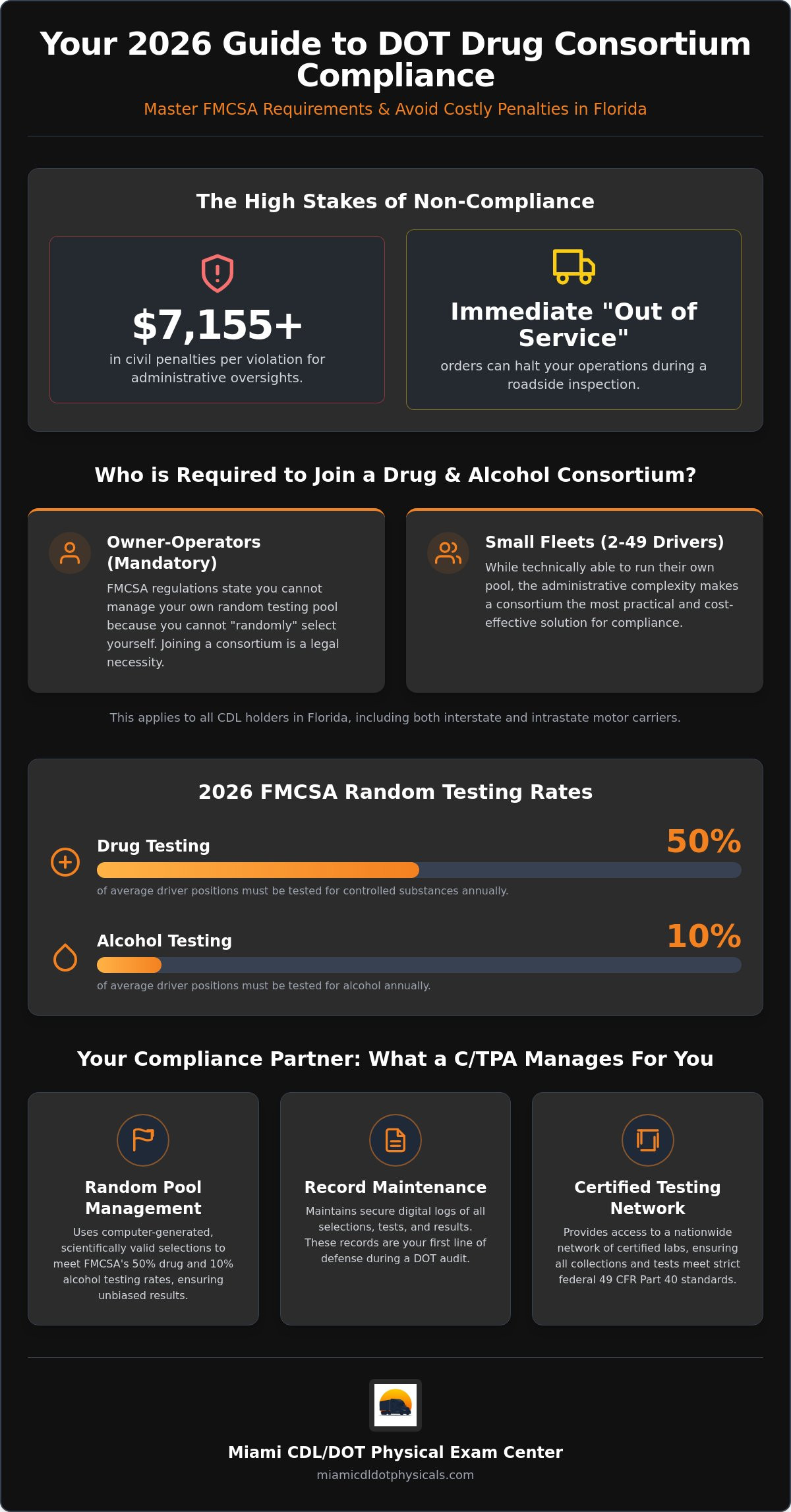
A single administrative oversight in your FMCSA paperwork can cost you over $7,155 in civil penalties and pull your truck off the road immediately. You likely started your business to spend time on the road, not to be buried under a mountain of federal regulations and random testing schedules. It's exhausting to worry about whether you've updated your Clearinghouse queries or if you're meeting the 50% random drug testing rate required for 2026. You deserve a system that works as hard as you do without the constant headache of manual tracking.
This guide provides a clear, actionable 2026 checklist to help you master the DOT drug consortium program Florida requirements so you never have to fear a surprise audit again. We'll walk through the latest FMCSA random testing percentages, explain how to handle the new oral fluid testing rules, and show you how to automate your compliance. By the end of this article, you'll have a straightforward path to keeping your CDL active and your business running smoothly throughout the year.
Key Takeaways
- Identify if your operation is legally required to join a consortium, which includes all owner-operators and small fleets with safety-sensitive employees.
- Stay updated on the 2026 FMCSA random testing rates, which require 50% of drivers to be tested for drugs and 10% for alcohol annually.
- Follow our five-step checklist to join a DOT drug consortium program Florida and ensure your USDOT number is correctly registered.
- Learn how a professional C/TPA manages your FMCSA Clearinghouse queries and random pool selections to automate your compliance.
- Avoid "refusal to test" charges by implementing a protocol for immediate response to random testing notifications.
Understanding the DOT Drug Consortium Program in Florida
A DOT drug consortium acts as a collective pool for random drug and alcohol testing. Instead of managing your own selection process, you join a group where all drivers are treated as a single unit for testing purposes. This setup is specifically designed for owner-operators and small fleets who don't have the volume to run their own statistically valid random pools. In a DOT drug consortium program Florida, a Consortium/Third-Party Administrator (C/TPA) manages the entire operation. They handle the random selections, coordinate the testing, and ensure every driver meets federal 49 CFR Part 40 requirements. They act as your compliance partner, making sure the rules are followed so you can stay focused on the road.
Florida carriers must follow these federal standards even if they never cross state lines. While Florida has its own Drug-Free Workplace laws, the FMCSA regulations take precedence for anyone holding a CDL. This means state-level medical marijuana authorizations aren't a valid defense for a positive test. Using a consortium is often the only practical way to stay compliant and avoid the statutory maximum civil penalty of $7,155 per violation. A standalone program requires a company to have enough employees to meet the 50% random testing rate independently. For a solo driver or a small team, a consortium membership provides the necessary scale to satisfy the DOT without the massive administrative overhead.
Why Consortia Exist: The Goal of FMCSA Compliance
The FMCSA created these requirements to standardize safety across the nation. By pooling drivers together, the system ensures that random selections are mathematically unbiased and scientifically valid. You can't pick and choose who gets tested, which protects the company from claims of discrimination. This approach validates the integrity of the transportation industry and keeps the public safe. It also removes a significant burden from your shoulders. Instead of spending hours on drug testing procedures and complex spreadsheets, you can rely on a system that automates the process for you.
Key Components of a Standard Consortium Program
A professional DOT drug consortium program Florida provides more than just a list of names. It acts as your compliance headquarters by managing three critical areas:
- Random Pool Management: The C/TPA uses computer-generated selections to meet the 2026 FMCSA rates of 50% for drugs and 10% for alcohol.
- Record Maintenance: They keep digital logs of all results and selections. These records are your first line of defense during a DOT audit.
- Certified Testing: You gain access to a network of labs for every required DOT drug test, ensuring the results are legally defensible and meet federal collection standards.
This partnership ensures that if an inspector asks for your proof of enrollment, you can provide the necessary documents immediately. It turns a complex legal requirement into a simple, manageable part of your business routine.
Who is Required to Join a Drug & Alcohol Consortium?
Federal law is clear about who must participate in a random testing pool. If you operate a vehicle that requires a Commercial Driver's License (CDL), you fall under the FMCSA drug and alcohol testing rules. This mandate applies to both interstate and intrastate motor carriers operating in Florida. Whether you're hauling freight across state lines or making local deliveries within the Sunshine State, compliance isn't optional. Enrolling in a DOT drug consortium program Florida ensures that you meet these strict federal standards without having to manage the complex logistics yourself.
The Owner-Operator Requirement Explained
Owner-operators face a unique legal challenge that makes consortium membership mandatory. Under FMCSA Part 382.305, an employer who employs themselves as the only driver must join a random testing pool managed by a third party. You cannot manage your own random testing pool because you can't "randomly" select yourself. The FMCSA requires a scientifically valid method for selection, which is nearly impossible to prove if you're the one pulling your own name. Operating without this membership is a major violation that can lead to heavy fines or an immediate "out of service" order during a roadside inspection. It's much safer to partner with a certified consortium to keep your authority in good standing.
Small fleets with 2 to 49 drivers also frequently join consortia. While these companies could technically run their own pools, the administrative burden is often too high for a small staff. Outsourcing compliance to a C/TPA allows fleet managers to focus on dispatching and growth rather than tracking testing windows and laboratory results. It provides a level of professional oversight that protects the business during a formal DOT audit.
Industries Impacted by DOT Testing Rules
While trucking is the most visible sector, several other industries must adhere to these safety-sensitive regulations. The DOT drug consortium program Florida serves a wide range of professionals, including:
- Trucking and Logistics: Any carrier operating vehicles over 26,001 lbs or transporting hazardous materials (FMCSA).
- Moving and Relocation: Professional companies like BF Happy Movers must also adhere to these standards when operating commercial vehicles for residential or commercial moves.
- Public Transit: Motorcoach operators and transit bus drivers (FTA).
- Aviation: Pilots, flight attendants, and maintenance crews (FAA).
- Maritime and Pipeline: Merchant mariners and pipeline maintenance professionals (USCG and PHMSA).
If your job involves the safe transport of people or goods, you likely need a consortium. The goal is to create a drug-free environment across all modes of transportation. Staying compliant protects your livelihood and ensures you're ready for any inspection.
Checklist: 5 Steps to Joining a DOT Consortium in Florida
Joining a DOT drug consortium program Florida doesn't have to be a bureaucratic nightmare. It's a linear process that protects your livelihood and ensures you're ready for the road. First, verify your USDOT number and operating authority status. Without an active USDOT number, you can't legally register for a consortium. This identification number is the foundation of your entire regulatory profile. Make sure your status is "Active" in the FMCSA system before you proceed to the next step.
Once your authority is set, select a certified Consortium/Third-Party Administrator (C/TPA). Your administrator will guide you through the mandatory pre-employment drug test. You must receive a negative result before you perform any safety-sensitive functions, including driving a commercial vehicle. This initial screening is conducted according to the standards outlined in 49 CFR Part 40, ensuring the test is valid and legally recognized. Don't skip this step; even if you've had a test recently for another company, you usually need a new one for your own consortium enrollment.
Next, register in the FMCSA Clearinghouse and designate your chosen C/TPA. This digital step allows your administrator to conduct required queries and report violations on your behalf. It's a critical part of the 2026 compliance landscape. After finalizing your paperwork and paying your membership fees, you'll receive a Certificate of Enrollment. Keep this document in your compliance file. It's the specific proof inspectors look for during a roadside stop or a formal audit to verify you're part of a random testing pool.
Preparing Your Documentation
Efficiency starts with organization. Gather your driver's license details, company identification numbers, and current medical records before you begin the enrollment process. A valid CDL medical exam is often the first step in total compliance. If your medical certificate is expired, your consortium membership won't keep you on the road. Check your expiration dates now to avoid a lapse in your operating authority. Having these documents ready makes the enrollment process fast and stress-free.
Finalizing Enrollment and Compliance
Signing the service agreement is the final piece of the puzzle. This document outlines exactly how your DOT drug consortium program Florida operates and what you can expect from your C/TPA. It's your responsibility to respond immediately when a random selection occurs. If you're notified of a test, you must proceed to the collection site right away to avoid a "refusal to test" charge. Finally, place your enrollment certificate in your Driver Qualification (DQ) file. Maintaining an organized DQ file ensures you're always ready for an inspection and provides peace of mind while you're managing your business.
Navigating Random Testing Pools and the FMCSA Clearinghouse
The heart of any DOT drug consortium program Florida is the random selection pool. This isn't just a list of names; it's a scientifically designed environment where every driver has an equal chance of being selected in every cycle. For 2026, the FMCSA has maintained high minimum testing rates to ensure industry safety. You must ensure that 50% of your average number of driver positions are tested for drugs and 10% for alcohol throughout the calendar year. These rates have remained stable since 2020 because the industry's positive testing rate hasn't dropped below the 1% threshold required for a reduction.
When a violation occurs, such as a positive test or a refusal, the reporting process is immediate and digital. Under federal law, a refusal to test is legally equivalent to a positive result. Both outcomes trigger an entry into the FMCSA Clearinghouse, which effectively grounds the driver until they complete the Return-to-Duty (RTD) process. This national database ensures that a driver can't simply move to another company or state to hide a failed test. Your consortium manager acts as the critical bridge between the laboratory and this federal database, ensuring all data is uploaded accurately and on time.
Understanding the Random Selection Process
Selections typically happen on a monthly or quarterly basis to spread the testing requirements evenly throughout the year. If your name is drawn, you'll receive a notification from your C/TPA. You must follow the "use it or lose it" rule: once you're notified, you have a very limited window to report to the collection site. Delaying this process without a valid, documented reason can be classified as a refusal. For a deeper look at how these pools are managed specifically for solo drivers, read our Random Drug Testing Pool for Owner-Operators: A 2026 Compliance Guide.
Clearinghouse Queries and Reporting
Your consortium manager needs specific authorization within the Clearinghouse to perform duties on your behalf. This authorization allows them to conduct the mandatory annual "limited" query for every driver on your roster. These queries confirm that no new violations have been recorded by other employers. If a violation is found, the driver must be removed from safety-sensitive functions immediately. The RTD process is the only way back to the driver's seat, involving evaluation by a Substance Abuse Professional (SAP) and a series of follow-up tests over several months.
Managing these moving parts alone is a recipe for administrative stress. You can join our FMCSA Clearinghouse Consortium to let experts handle the reporting and random selections for you. This automation keeps your records clean and your trucks moving without the constant fear of a paperwork error.
Maintaining Long-Term Compliance with a Professional C/TPA
Compliance doesn't end with your initial enrollment. Staying active in a DOT drug consortium program Florida requires ongoing attention to your driver roster. You must notify your consortium manager immediately whenever a driver joins or leaves your team. This ensures the random pool remains accurate and prevents you from being notified to test a driver who no longer works for you. Failing to keep these records current can lead to administrative errors that are difficult to explain during a surprise audit. A clean roster is the first sign of a well-managed safety program.
Record-keeping is another pillar of long-term success. You're legally required to maintain copies of all Custody and Control Forms (CCFs) for five years. While your C/TPA likely keeps digital records, having your own organized system provides an extra layer of protection. It's also wise to conduct an annual review of your compliance status. This brief check-in ensures your FMCSA Clearinghouse credentials are still valid and that your company details haven't changed. These small, proactive steps prevent minor oversights from turning into major legal headaches later on.
Audit Readiness: What to Expect from a DOT Inspection
During a Florida roadside inspection or a formal office audit, a DOT officer will ask for specific proof of your drug and alcohol program. They'll want to see your current enrollment certificate and logs of your random selections. A professional DOT drug consortium program Florida provides an audit-ready portal where you can access these documents instantly. The most common mistakes that lead to fines include failing to provide proof of enrollment or missing a random testing window. Having all your documentation in one place turns a high-stress inspection into a routine verification of your professional standards.
Choosing the Right Partner for Your Fleet
The best compliance partner is one that understands the value of your time. Look for providers that offer a full suite of services, including DOT Physical Exams and drug testing. This allows your drivers to handle all their regulatory requirements in a single visit, getting them back on the road faster. Prioritize speed and responsiveness in your C/TPA. You need a partner who answers the phone and provides clear guidance when you're facing a complex compliance question. Stay legal and on the road; join our FMCSA Clearinghouse Consortium today to simplify your safety program and protect your business for the long haul.
Secure Your Compliance for 2026 and Beyond
Staying ahead of federal mandates is the only way to protect your livelihood from costly fines and out-of-service orders. We've established that joining a DOT drug consortium program Florida is a legal necessity for owner-operators and a smart administrative move for small fleets. By following the five-step enrollment checklist and maintaining an accurate driver roster, you eliminate the stress of manual tracking. You don't have to navigate the FMCSA Clearinghouse or complex random testing pools by yourself. A professional partner ensures your business meets every requirement without the risk of paperwork errors.
Our team offers expert-led compliance management and fast, professional drug screening services to keep your records audit-ready at all times. With our FMCSA-certified examiners on your side, you can handle your medical certificates and drug testing in one convenient location. Enroll in our FMCSA Clearinghouse Consortium and stay compliant today! We're dedicated to helping you master these regulations so you can focus on your professional success with total confidence.
Frequently Asked Questions
Is a DOT drug consortium mandatory for owner-operators in Florida?
Yes, enrollment is a legal requirement for any owner-operator. Federal regulation 49 CFR Part 382.305 states that an employer who employs themselves as the only driver must be part of a random testing program managed by a third party. You cannot legally manage your own random selections, so joining a DOT drug consortium program Florida is the only way to stay compliant with the FMCSA.
What is the difference between a DOT drug test and a non-DOT drug test?
A DOT drug test is a highly regulated federal process that follows 49 CFR Part 40 procedures and uses a standard 5-panel screen. These tests must be processed at HHS-certified laboratories and reviewed by a Medical Review Officer. Non-DOT tests are governed by private company policies or state laws and can include different testing panels or collection methods that don't meet federal transportation standards.
How much does it typically cost to join a drug consortium program?
Most consortium programs operate on an annual membership basis. This fee typically covers the administrative costs of managing the random pool, reporting to the Clearinghouse, and maintaining your compliance records. Some programs include the cost of random tests in the membership fee, while others charge for individual tests as they occur. You should verify the specific fee structure with your C/TPA to ensure it fits your business model.
What happens if I miss a random drug test selection?
Missing a selection without a documented, valid excuse is usually treated as a refusal to test. Under DOT rules, a refusal carries the same legal weight as a positive result. You'll be removed from safety-sensitive duties immediately and must complete the Return-to-Duty process. Always report to the collection site as soon as you receive a notification to protect your CDL and your livelihood.
Do I need to register for the FMCSA Clearinghouse if I'm in a consortium?
Yes, all CDL drivers and employers must maintain an active Clearinghouse account. While your DOT drug consortium program Florida manager handles the actual reporting and queries, you must first register and designate them as your C/TPA. This authorization is the only way your administrator can legally upload results or conduct the mandatory annual queries required for your fleet.
Can a consortium help me if I have a drug testing violation on my record?
A consortium can manage the Return-to-Duty (RTD) testing process once you have been evaluated by a Substance Abuse Professional (SAP). After the SAP clears you to return to work, the consortium coordinates the required follow-up testing schedule. They ensure each test is conducted properly and that the results are reported to the Clearinghouse to show you're back in good standing.
How often will I be selected for random drug testing?
The frequency of selection is entirely random and unpredictable. Because the selection process is computer-generated, you might be picked multiple times in a single year or go several years without a selection. The system is designed this way to ensure that every driver in the pool remains ready for a test at any time, maintaining the integrity of the safety program.
Does my consortium membership expire?
Most memberships expire annually and require a renewal to stay active. It's your responsibility to ensure your membership doesn't lapse, as operating without a valid consortium enrollment is a serious violation. Your C/TPA will usually send a renewal notice before your expiration date. Keep your contact information updated to ensure you receive these critical compliance reminders on time.


