

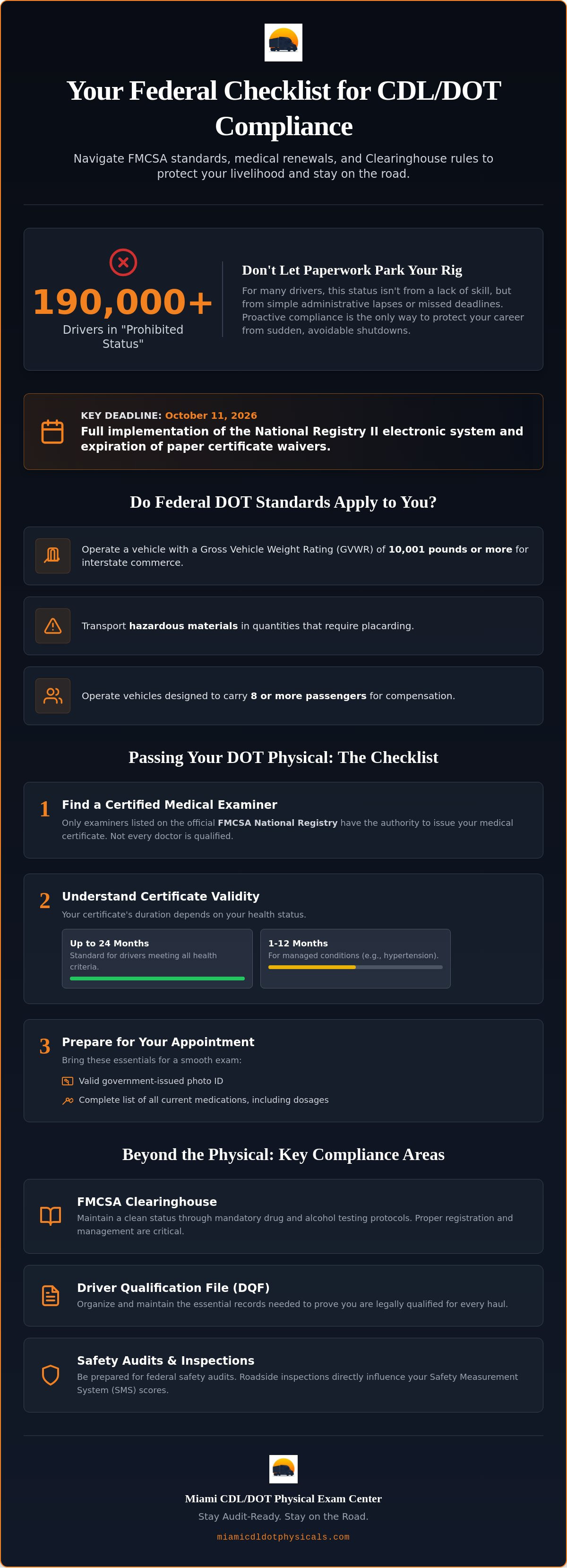
Did you know that over 190,000 commercial drivers are currently in "prohibited status" within the FMCSA Clearinghouse? For most, this isn't due to a lack of skill on the road, but rather a simple lapse in regulatory paperwork or a missed deadline. Maintaining your CDL medical compliance is more than just a legal chore; it's the only way to protect your livelihood from sudden, avoidable shutdowns. With the full implementation of the National Registry II electronic system and the upcoming expiration of paper certificate waivers on October 11, 2026, the rules for staying on the road have become much more precise.
It's completely normal to feel stressed about an upcoming DOT physical or confused by the requirements of a random drug testing pool. You've worked hard for your license, and the last thing you want is a technicality to pull you off your route. This guide, brought to you by Miami CDL/DOT Physical Exam Center, offers a comprehensive, step-by-step federal checklist designed to help you navigate these hurdles with ease. We'll walk through the current FMCSA standards for 2026, including medical card renewals and Clearinghouse consortium management, so you can keep your documentation audit-ready and your status clean.
- Over 190,000 commercial drivers are in "prohibited status" often due to administrative lapses.
- CDL medical compliance is vital for protecting your livelihood.
- New federal rules, including the National Registry II and 2026 waiver expiration, demand precision.
- This guide provides a federal checklist for navigating DOT physicals, drug testing, and FMCSA standards.
Key Takeaways
- Understand the core FMCSA safety standards and the specific role of the DOT in regulating your interstate commercial driving status.
- Identify the steps to maintain your CDL medical compliance Miami, including how to verify FMCSA-certified medical examiners and manage medical card validity periods.
- Navigate the FMCSA Clearinghouse registration process and learn how to maintain a clean status through mandatory drug and alcohol testing protocols.
- Organize your Driver Qualification File (DQF) with the essential records needed to prove you are legally qualified for every haul.
- Prepare for federal safety audits and learn how roadside inspections influence your Safety Measurement System (SMS) scores.
Essential Standards for Commercial Driver Compliance
Commercial driver compliance is the backbone of the American trucking industry. It represents a strict adherence to the safety and health standards set by the Federal Motor Carrier Safety Administration (FMCSA). The Department of Transportation (DOT) oversees these regulations to ensure that interstate commerce remains safe for everyone on the road. For professionals focused on CDL medical compliance Miami, this process involves more than just a simple checkup; it is a proactive strategy to protect your livelihood and your health.
The primary goal of these standards is simple: safety. By regulating both driver fitness and vehicle maintenance, the DOT reduces the risk of accidents caused by mechanical failure or medical emergencies behind the wheel. Compliance is not optional. If you fail to meet these federal requirements, you face severe consequences. These can range from heavy individual fines and driver disqualification to full-scale carrier shutdowns that can end a business overnight. Staying compliant means you are always ready for an inspection or an audit.
The Role of the FMCSA in Driver Oversight
The Federal Motor Carrier Safety Regulations (FMCSR) act as the definitive rulebook for the transportation industry. These federal rules create a uniform standard of safety that applies regardless of which state you are currently driving in. Whether you are hauling freight through the Florida Everglades or crossing state lines into Georgia, the expectations for your conduct and health remain the same. At the core of these regulations is the concept of "fitness for duty." This standard ensures that every driver possesses the physical stamina and mental clarity required to operate heavy machinery for long periods. It is the foundation of a safe and reliable transportation network.
Who Must Comply with Federal DOT Standards?
Federal oversight triggers at specific weight and usage thresholds. If you operate a vehicle with a Gross Vehicle Weight Rating (GVWR) of 10,001 pounds or more, you must follow federal DOT standards. These rules also apply to any driver transporting hazardous materials that require placarding, as well as those operating vehicles designed to carry eight or more passengers for compensation. Understanding these Commercial Driver's License requirements is essential for anyone entering the profession.
You must also understand the distinction between interstate and intrastate commerce. Interstate commerce involves moving goods across state lines or handling cargo that originated outside of Florida. Intrastate commerce stays within state borders. While federal rules specifically target interstate drivers, Florida often adopts these same standards for local operators. Maintaining CDL medical compliance Miami ensures that you remain eligible for the widest range of driving opportunities, keeping your career path open and flexible.
The Medical Certification Checklist: Passing Your DOT Physical
Passing your physical is the most critical hurdle for CDL medical compliance Miami. Not every doctor can perform this exam. Only examiners listed on the FMCSA National Registry have the specific training and authority to issue medical cards. These professionals understand that your health is directly tied to your livelihood. They look for specific indicators that you can safely handle the physical demands of long-haul driving or operating heavy machinery in urban traffic.
While a standard medical certificate is valid for 24 months, your examiner might issue a shorter card. If you have managed health conditions like hypertension or heart disease, you might receive a certificate valid for one year, six months, or even three months. This isn't a failure. It's a monitoring period designed to keep you on the road while ensuring your condition stays stable. You'll receive two versions of your results: the "long-form" medical report for your records and a wallet-sized medical card to carry while driving.
Preparation is the key to a smooth appointment. You must bring a valid government-issued ID and a complete list of all current medications, including dosages and the prescribing doctor’s contact information. If you wear glasses, contacts, or hearing aids, bring them to the exam. Arriving prepared reduces stress and helps the examiner process your certification quickly. To get your medical card efficiently, you can schedule your DOT physical with a certified local specialist who understands the 2026 requirements.
Key Health Benchmarks for 2026
To secure a full two-year certification, your blood pressure must be 140/90 or lower. Vision standards are equally strict. You need at least 20/40 acuity in each eye, with or without correction, and a 70-degree field of vision in each eye. For hearing, examiners typically use a "forced whisper" test. You must be able to hear a whisper from five feet away in at least one ear. If you're concerned about meeting these standards, review these tips on how to pass your DOT physical to prepare your body for the exam.
Managing Disqualifying Conditions and Waivers
Certain conditions require extra documentation to prove you're fit for duty. For instance, drivers with sleep apnea must often provide a 90-day CPAP compliance report. If you have a physical impairment or vision issue that doesn't compromise safety, you may qualify for the FMCSA waiver or exemption programs. Part of the exam also involves checking your status in the FMCSA Clearinghouse to ensure you're eligible for duty. For a deeper look at regional requirements, read about the CDL medical exam South Florida process to ensure you're fully prepared.
FMCSA Clearinghouse and Drug Testing Protocols
The FMCSA Clearinghouse is a secure online database that gives employers and government agencies real-time information about CDL and CLP holders’ drug and alcohol program violations. It's a critical component of CDL medical compliance Miami because it ensures that drivers who are prohibited from operating a commercial motor vehicle (CMV) don't simply move to another state or carrier to hide their record. Registration is mandatory. If you hold a CDL, you must create an account to provide electronic consent for employers to conduct queries. This system keeps the industry transparent and the roads safer for everyone.
Testing isn't just a one-time event during your physical. The FMCSA mandates several types of drug screens. Pre-employment testing happens before you ever get behind the wheel for a new company. Random testing occurs throughout the year, with selections made by a neutral computer program. Post-accident testing is required if an accident involves a fatality or if you receive a citation and a vehicle is towed or medical treatment is administered away from the scene. Each of these tests must follow strict federal collection and laboratory protocols to be valid.
If a violation occurs, the Return-to-Duty (RTD) process is your only path back to the driver's seat. This involves an evaluation by a Substance Abuse Professional (SAP), a prescribed treatment or education plan, and a successful RTD drug test. It’s a rigorous process designed to prioritize road safety while offering a structured way for drivers to recover their status. Skipping any step in this sequence will keep you in a "prohibited" status indefinitely.
Navigating the Clearinghouse Query Process
Employers must use the Clearinghouse to conduct two types of queries. A "limited query" checks for the presence of information in the database, while a "full query" provides detailed violation information. A full query requires your specific electronic consent within the Clearinghouse portal. Every employer must conduct at least one query for each driver they employ every year. To stay ahead of these requirements, many local drivers utilize an FMCSA Clearinghouse consortium Homestead FL to manage these administrative tasks and ensure no deadlines are missed.
Random Drug Testing Pools and Consortiums
For owner-operators, the rules are even more specific. You cannot manage your own random testing pool. Federal law requires you to join a drug testing consortium. A Third-Party Administrator (TPA) manages these pools, ensuring that selections are truly random and that all testing meets DOT standards. This setup removes the burden of administration from the driver. If you need to complete a scheduled or random DOT drug test Miami, working with a certified collection site ensures your results are uploaded correctly to the federal database, maintaining your CDL medical compliance Miami without unnecessary delays.
Managing Driver Qualification Files (DQF)
The Driver Qualification File (DQF) is the central record that proves a driver is legally qualified to operate a commercial vehicle. It is often the first thing a federal auditor will ask to see during an inspection. Maintaining a complete and accurate DQF is a cornerstone of CDL medical compliance Miami. Every motor carrier must maintain a separate file for each driver they employ, containing specific documents that verify the driver's history, skills, and physical fitness.
A standard DQF must include several core documents to be considered complete:
- Driver’s Application for Employment: A completed form covering the last 10 years of driving history.
- Motor Vehicle Record (MVR): An initial inquiry to state agencies for the driver’s three-year driving record.
- Road Test Certificate: Proof that the driver successfully completed a road test or holds a valid CDL.
- Medical Examiner’s Certificate: A copy of the current, valid medical card issued by a certified examiner.
Federal regulations require carriers to keep these files for the entire duration of a driver's employment plus an additional three years after the driver leaves the company. Many modern carriers are moving toward digital DQF management systems. Electronic files are easier to update, harder to lose, and significantly more efficient during a federal audit. Digital systems also provide automated alerts when a medical card or license is nearing expiration, which is vital for staying ahead of deadlines.
The Annual Motor Vehicle Record (MVR) Review
Compliance doesn't end with the initial hire. Safety managers must pull a fresh MVR every 12 months from every state where the driver held a license during that period. Once the MVR is received, the driver must sign a "Certificate of Violations" listing any tickets or offenses from the past year. The safety manager then reviews these documents to ensure the driver still meets the carrier’s safety standards. This annual check catches potential issues before they become legal liabilities for the carrier.
Self-Certification and the State Licensing Agency
Securing your medical card is only one part of the process. You must also provide a copy of that card to the State Driver Licensing Agency (SDLA). This process, known as self-certification, links your medical status to your driving record in the state's database. This step is essential for CDL medical compliance Miami. If the state doesn't have a current card on file, they will "downgrade" your license to a non-commercial status. This effectively stops you from driving professionally until the record is updated. To avoid this risk, book your DOT physical in Miami with a provider who ensures you have the documentation needed to update your state record immediately.
Ensuring Continuous Compliance and Audit Readiness
For new motor carriers, the first 18 months of operation are a probationary period. During this time, you must undergo a "New Entrant Safety Audit." This isn't a roadside inspection; it's a deep dive into your records to ensure you've established effective safety management controls. Successful CDL medical compliance Miami is a major component of this audit. If you can't produce clean medical certificates or drug testing records for your drivers, you risk losing your permanent operating authority before your business even gets off the ground.
Your daily performance on the road feeds into the Safety Measurement System (SMS). Every roadside inspection, whether clean or cited, impacts your Compliance, Safety, Accountability (CSA) scores. These scores are a public record of your safety history. High scores attract more frequent inspections and can even lead to higher insurance premiums. Compliance is a daily habit, not an annual check. By treating every pre-trip inspection and every log entry with precision, you protect your career and your company’s reputation.
Your health is your most valuable professional asset. Many drivers wait until the week of their exam to think about their blood pressure or glucose levels. This reactive approach often leads to "medical surprises" that can result in a temporary disqualification. Regular health maintenance, such as monitoring your diet and staying active, ensures that your bi-annual exam is a routine validation rather than a high-stress event. Staying healthy is the best way to ensure long-term career longevity in the cockpit.
Preparing for Roadside Inspections
Roadside inspections generally fall into three levels. Level 1 is a full inspection of the driver and vehicle, while Level 3 focuses exclusively on the driver’s credentials. To remain "cab-ready," you should always have a dedicated folder containing the following paperwork:
- A valid Commercial Driver’s License (CDL).
- Your current Medical Examiner’s Certificate (MEC).
- Any required medical waivers or Skill Performance Evaluation (SPE) certificates.
- Proof of Electronic Logging Device (ELD) compliance and a backup paper logbook.
Modern inspectors expect you to know how to transfer your ELD data immediately. If you struggle with the technology during an inspection, it can lead to unnecessary delays and increased scrutiny.
Partnering with a Compliance Expert
Managing the intersection of medical exams, drug testing, and Clearinghouse queries is a full-time job. Partnering with a specialized medical center streamlines this process. Having a single point of contact for your physicals and consortium management reduces the chance of administrative errors. It also ensures that your records are always audit-ready. To find a reliable partner for your certification needs, consult with a certified FMCSA medical examiner Miami. This partnership allows you to focus on the road while experts handle the regulatory heavy lifting, ensuring your CDL medical compliance Miami remains flawless.
Secure Your Future on the Road Today
Staying ahead of federal regulations doesn't have to be a source of constant stress. By maintaining a complete Driver Qualification File and staying active in the FMCSA Clearinghouse, you protect your professional status against sudden audits or roadside downgrades. Successful CDL medical compliance Miami relies on more than just a passing grade; it requires a proactive approach to your health and documentation. Partnering with a specialist allows you to focus on your route while ensuring every medical and drug testing requirement is met with precision.
Our facility provides access to FMCSA-certified medical examiners who deliver same-day medical cards and drug testing results. We also offer expert Clearinghouse consortium management for both fleets and owner-operators to keep your records audit-ready. Schedule your FMCSA-certified medical exam at the Miami CDL/DOT Physical Exam Center to handle your compliance needs in one efficient visit. You've worked hard to build your career. We are here to help you keep it moving forward with confidence and peace of mind.
Frequently Asked Questions
What is commercial driver compliance and why is it important?
Commercial driver compliance is the strict adherence to federal safety and health standards set by the FMCSA. It ensures that every operator on the road is physically fit and operating safe equipment. This process is vital because it protects your livelihood from fines or disqualification while keeping the public safe. Maintaining your CDL medical compliance Miami is a proactive way to avoid the stress of sudden roadside shutdowns or failed safety audits.
How often do CDL drivers need to renew their DOT medical certification?
Most drivers must renew their DOT medical certification every 24 months. However, if you have certain health conditions like high blood pressure or heart disease, an examiner may issue a certificate for a shorter period. This could be for one year, six months, or even three months to monitor your condition. Always check the expiration date on your current card to ensure you schedule your next exam before it lapses.
What happens if my DOT medical card expires before I get a new exam?
If your medical card expires, the state licensing agency will automatically downgrade your CDL to a non-commercial driver's license. You cannot legally operate a commercial vehicle until you pass a new physical and submit the updated certificate to the state. This interruption can lead to lost wages and potential issues with your employer's insurance. It's essential to complete your exam and self-certify with the state before the deadline passes.
How do I register for the FMCSA Clearinghouse as a driver?
Drivers register for the FMCSA Clearinghouse online through the official government portal using a Login.gov account. You'll need your CDL number and state of issuance to link your professional record to the database. Once registered, you can provide electronic consent for employers to conduct required queries. This registration is mandatory for all CDL holders to maintain a clean and active status within the federal system.
Are owner-operators required to be in a drug testing consortium?
Yes, federal law requires all owner-operators to join a drug testing consortium. You're prohibited from managing your own random testing pool, so a Third-Party Administrator (TPA) must handle the selections for you. This ensures that the testing process remains truly random and compliant with DOT standards. Joining a consortium is the easiest way to stay legal and avoid the heavy fines associated with drug testing violations.
What documents must be included in a Driver Qualification File (DQF)?
A complete Driver Qualification File must include your employment application, an initial Motor Vehicle Record (MVR), and a road test certificate. It also requires a copy of your current medical examiner’s certificate and the annual review of your driving record. Carriers must maintain these files for every driver to prove they meet federal qualifications. Keeping these documents organized and updated is a critical part of ensuring your CDL medical compliance Miami.
Can I pass a DOT physical with high blood pressure or diabetes?
You can pass a DOT physical with high blood pressure or diabetes as long as the conditions are well-managed. For blood pressure, you generally need a reading of 140/90 or lower to qualify for a standard two-year card. Drivers with diabetes may need to provide additional documentation or meet specific A1C requirements. Your examiner will work with you to ensure your condition is stable enough for the physical demands of commercial driving.
What is the difference between a DOT and a non-DOT drug test?
A DOT drug test is a federally regulated screening that follows strict FMCSA protocols and typically uses a 5-panel urine test. It's required for safety-sensitive positions and results are reported to the federal Clearinghouse. A non-DOT drug test is designed by a private employer for their own internal policies and can vary in the substances tested. While both ensure a drug-free workplace, only the DOT test satisfies federal compliance requirements for commercial drivers.


