
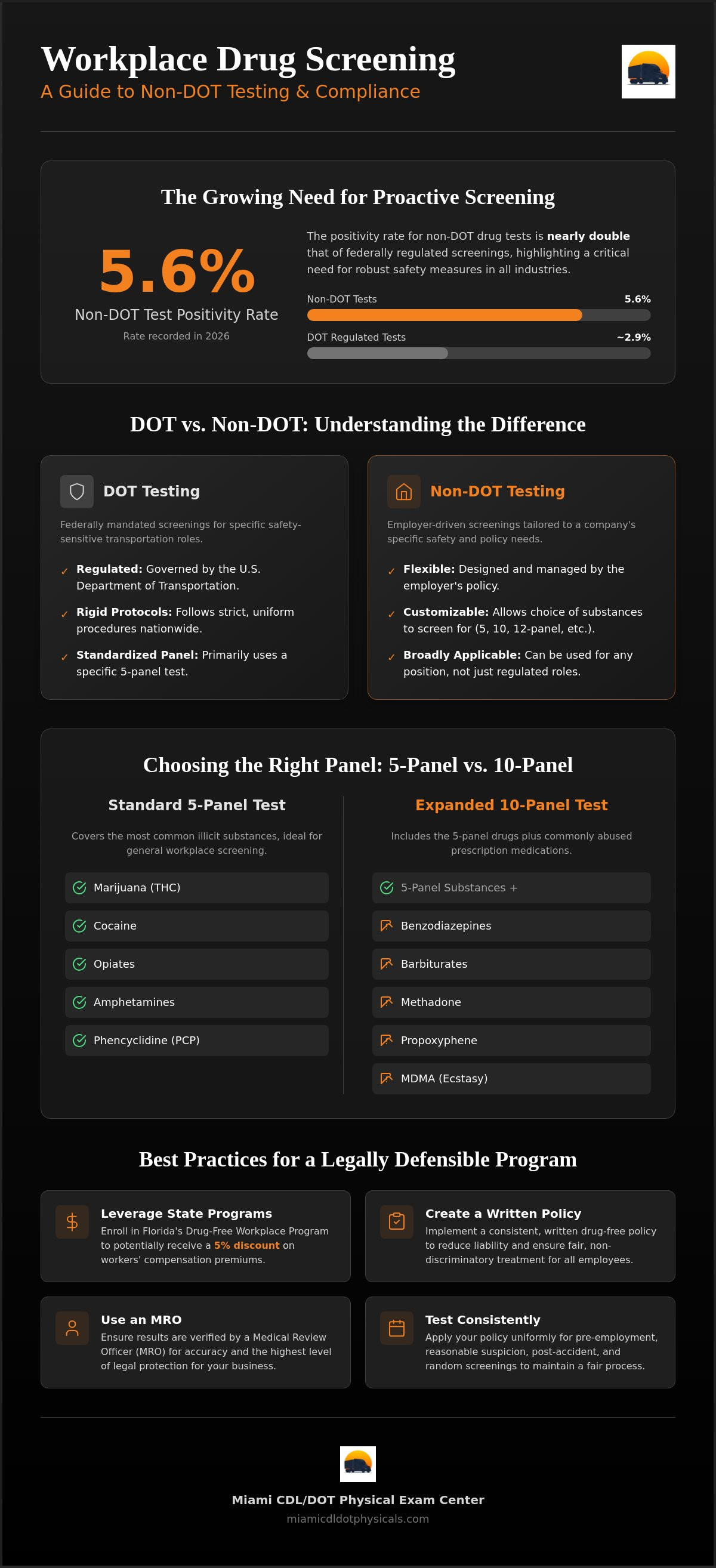
In 2026, the positivity rate for non-DOT drug tests reached 5.6 percent, which is nearly double the rate of federally regulated screenings. For business owners and hiring managers, these numbers highlight a growing need for proactive safety measures that go beyond basic requirements. It's common to feel some anxiety about the legal liabilities of workplace screening or the technical differences between various testing panels. You want a process that is fast and legally defensible so you can focus on your business instead of paperwork. Securing a professional non-DOT drug test Miami ensures your company remains compliant while maintaining the highest safety standards.
This guide will clarify the specific differences between DOT and non-DOT protocols, explore the various panel options available, and provide best practices for building a reliable screening program. You'll learn how to leverage MRO-verified results to protect your workplace and gain the peace of mind that comes with expert documentation. We'll also cover Florida's specific Drug-Free Workplace Program requirements to help you maximize your insurance benefits and maintain a secure environment for your entire team.
Key Takeaways
- Learn how non-DOT testing provides the flexibility to customize safety protocols while maintaining rigorous medical standards for legal defensibility.
- Understand the differences between 5-panel and 10-panel options to choose the right detection level for your specific workplace needs.
- Identify the critical legal distinctions between federal mandates and state-governed policies when scheduling a non-DOT drug test Miami.
- Discover how to implement a consistent, written drug-free workplace policy to reduce liability and ensure fair treatment for all employees.
- Ensure your results are accurate and verified by a Medical Review Officer to provide the highest level of protection for your business.
Understanding the Role of a Non-DOT Drug Test Miami
A non-DOT drug test Miami is a screening process tailored to the specific needs of your business rather than federal mandates. While agencies like the Department of Transportation (DOT) require testing for commercial drivers, non-regulated industries have the freedom to design their own safety protocols. This flexibility allows you to determine which substances to screen for and what detection thresholds to set. Even though these tests aren't federally required, following high medical standards is essential for maintaining a defensible program. A non-DOT drug test is a workplace safety tool for non-regulated positions.
Using professional workplace drug testing standards helps protect your company from legal challenges. By partnering with a facility that uses SAMHSA-certified laboratories and Medical Review Officer (MRO) verification, you ensure that every result is accurate and legally sound. This level of rigor mirrors federal requirements, giving you the same confidence in your data without the rigid federal constraints. It's a proactive way to manage your team's health and safety while staying within the bounds of Florida state law.
Why Employers Choose Non-Regulated Screening
Many Florida business owners implement these programs to qualify for the state's Drug-Free Workplace Program. Under Florida Statute § 440.101, compliant employers can receive a 5 percent discount on their workers' compensation insurance premiums. Beyond the financial incentives, screening helps foster a culture of safety and accountability. It's especially critical for safety-sensitive roles in construction or warehouse environments where federal rules don't apply but the risk of injury remains high. Establishing clear expectations during onboarding helps you attract candidates who value a sober work environment and reduces the long-term costs of turnover.
Common Scenarios for Non-DOT Testing
The most frequent application is pre-employment screening. It acts as a final gatekeeper during the hiring process to ensure new team members meet your company standards. You might also use a non-DOT drug test Miami following a workplace accident that doesn't trigger federal reporting requirements. This helps determine if substance use contributed to the incident, which is vital for insurance claims and internal investigations. For organizations facing more complex internal challenges, the International Investigative Group provides expert guidance on corporate security and comprehensive investigative strategies. Additionally, random testing programs provide an ongoing deterrent, encouraging employees to remain compliant throughout their tenure. Consistent application across these scenarios prevents claims of discrimination and keeps your safety policy airtight.
Standard Non-DOT Drug Test Miami Panels and Methods
Choosing the right detection method is the foundation of any successful workplace safety program. In the medical industry, we use a "panel" system to categorize which substances a test identifies. A higher panel number simply means the test screens for a broader range of drugs. While urine collection remains the standard for most employers due to its reliability and cost-effectiveness, other methods like hair follicle or saliva testing offer different look-back periods. For instance, hair follicle tests can detect substance use for up to 90 days, while urine typically covers the previous few days. Regardless of the method you select, always ensure your samples are processed by SAMHSA-certified laboratories to maintain the highest level of accuracy.
The 5-Panel vs. 10-Panel Comparison
For standard office environments, a basic 5-panel screen is often sufficient to deter substance use. However, businesses involved in manual labor, transportation, or heavy machinery often opt for expanded panels to capture a wider array of prescription and illicit substances. Aligning your choice with Florida's Drug-Free Workplace Program guidelines can also help you secure insurance discounts. You can find more details in our 5 panel drug test Miami guide. Below is a comparison of common substances detected in each panel.
| Substance | 5-Panel Test | 10-Panel Test |
|---|---|---|
| Marijuana (THC) | Yes | Yes |
| Cocaine | Yes | Yes |
| Opiates | Yes | Yes |
| Amphetamines | Yes | Yes |
| Phencyclidine (PCP) | Yes | Yes |
| Benzodiazepines | No | Yes |
| Barbiturates | No | Yes |
| Methadone | No | Yes |
| Propoxyphene | No | Yes |
| Methaqualone | No | Yes |
The Importance of Chain of Custody
The "Chain of Custody" is a rigorous documentation process that tracks a specimen from the moment it's collected until the final result is reported. This procedure is what makes a non-DOT drug test Miami legally defensible. It prevents tampering and ensures that the sample analyzed at the lab belongs to the correct employee. Every person who handles the specimen must sign the custody form, creating an unbroken trail of accountability. If you need a reliable partner to manage this process, our team provides professional non-DOT drug testing that prioritizes integrity and speed. Professional documentation doesn't just provide results; it gives your business a shield against potential litigation by proving the sample remained secure and untainted throughout the entire journey.
Comparing DOT vs. Non-DOT Drug Test Miami Requirements
Understanding the difference between federal mandates and private company policies is the first step in building a compliant screening program. While both types of testing aim to ensure safety, they operate under entirely different legal frameworks. A DOT test follows strict federal guidelines set by the Department of Transportation, while a non-DOT drug test Miami is governed by your specific company policy and Florida state law. This distinction is vital because it determines everything from which drugs you can test for to how you must handle a positive result. Knowing these rules helps you avoid legal pitfalls and keep your workplace secure.
Regulatory Authority and Oversight
Federal oversight defines the DOT testing process. These screenings are mandatory for employees in safety-sensitive positions, such as commercial truck drivers or pilots. The process is highly standardized, typically using a specific 5-panel screen that cannot be altered by the employer. If you manage a fleet of CDL holders, you should consult our guide on the DOT drug test Miami to ensure you meet these federal obligations.
In contrast, a non-DOT drug test Miami falls under employer oversight. This gives you the flexibility to choose from various panel options, ranging from basic 5-panel screens to comprehensive 10-panel or 12-panel tests. You can add specific substances like synthetic opioids or nicotine depending on your industry needs. Additionally, while DOT results must be reported to the FMCSA Clearinghouse, non-DOT results aren't shared with federal databases. This privacy allows you to manage your internal safety culture without federal reporting requirements, keeping the process between you and your employee.
Consequences of a Positive Result
Dealing with a positive result looks different in each program. For DOT-regulated employees, a positive test triggers a mandatory Substance Abuse Professional (SAP) process. The employee is immediately removed from safety-sensitive duties and cannot return until they complete a formal evaluation and treatment program. This process is non-negotiable and strictly tracked by federal agencies to ensure public safety on the roads.
For non-DOT testing, the consequences are determined by your internal HR policy. You have the authority to decide whether a positive result leads to termination, a suspension, or a mandatory employee assistance program. Because these decisions are handled internally, it's essential to have a clear, written drug-free workplace policy in place before you begin testing. This document should outline the exact steps your company will take, ensuring that every employee is treated fairly and consistently. Consistent application of your policy protects your business from claims of unfair treatment while maintaining a secure work environment for everyone.
Best Practices for Implementing a Workplace Testing Program
A successful safety program starts with a clear plan. While the technical side of a non-DOT drug test Miami is handled by medical professionals, the administrative side relies on your company's internal structure. You must treat drug testing as a formal business process rather than an occasional task. This begins with maintaining strict confidentiality. Always keep medical results in a secure, private file that is completely separate from an employee's general personnel record. Limiting access to this information protects your business from privacy claims and ensures you remain compliant with national labor standards.
Consistency is your best defense against legal challenges. If you test one employee after an incident, you must test every employee involved in similar circumstances. Applying rules unevenly can lead to discrimination claims, even if your intentions are good. Training your supervisors is another critical step. They need "Reasonable Suspicion" training to identify the physical and behavioral signs of substance use. This training empowers them to make objective decisions based on observed facts rather than gut feelings or personal biases.
Developing Your Corporate Drug Policy
Your policy is the rulebook for your entire organization. It should clearly define what triggers a test, such as pre-employment screening, random selection, or post-accident investigations. Under Florida law, if you are implementing a new testing program, you must provide a 60-day notice to your employees before it begins. Your policy must also state the exact consequences for a positive result or a refusal to test. Whether you offer a second chance through an employee assistance program or move straight to termination, being transparent from day one prevents confusion and sets high standards for your team.
The Role of Random Selection
Random testing is one of the most effective ways to deter substance misuse. To ensure the process is fair and unpredictable, use an automated selection pool. This removes human error and ensures that every employee has an equal chance of being selected during each cycle. Many businesses prefer third-party management for these pools because it eliminates any perception of internal bias or "targeting" of specific individuals. A steady, well-managed random program shows your commitment to a safe environment. If you are ready to secure your workplace, you can schedule a non-DOT drug test today to begin building a more reliable team.
Maintaining these best practices ensures that your non-DOT drug test Miami program is a tool for growth rather than a source of liability. By focusing on clear communication and professional documentation, you create a workplace where safety is the priority and every employee knows exactly what is expected of them.
Professional Screening with Miami CDL/DOT Physical Exam Center
Miami CDL/DOT Physical Exam Center operates as a specialized medical facility, providing a level of clinical oversight that generic collection sites simply can't match. We don't just collect samples; we manage a comprehensive medical process designed to protect both the employer and the employee. This distinction is vital for businesses that require more than just a "pass" or "fail" result. By choosing a facility rooted in medical expertise, you ensure that every non-DOT drug test Miami is conducted with the same precision used in federal screenings. This professional environment reduces the stress of compliance and gives your candidates a positive first impression of your company's standards.
One of the most significant advantages of partnering with us is our use of Medical Review Officers (MROs) to verify results. An MRO is a licensed physician with specialized training in substance abuse testing. They act as an independent gatekeeper, reviewing every positive result before it ever reaches your desk. This process is the best way to protect your business from false positives caused by legitimate prescription medications. If an employee has a valid medical reason for a detected substance, the MRO verifies the prescription and reports the final result as negative. This clinical verification ensures your hiring decisions are based on facts, not pharmaceutical interference, which is a level of protection many large-scale aggregators fail to provide.
Expertise in Transportation and Workplace Safety
We leverage years of experience in high-stakes DOT compliance to serve our non-DOT clients. We understand that in a fast-paced environment, you can't afford to wait days for a result. Our facility prioritizes speed and accuracy, helping you move candidates through the onboarding process without unnecessary delays. For organizations that manage a mixed workforce, we offer a seamless experience where staff can complete a DOT physical Miami and a drug screen in a single, efficient visit. This integrated approach saves time and ensures that all your safety records are managed by a single, reliable partner.
Getting Started with Your Testing Program
Setting up your screening program is a straightforward process. You can schedule an individual non-DOT drug test Miami for a new hire or establish a corporate account for ongoing fleet and staff management. When your employees arrive at our center, the process is quick and professional. To ensure a smooth experience, remind your team members to bring the following items:
- A valid government-issued photo ID (such as a driver's license or passport).
- Any specific authorization forms or account numbers provided by your company.
- A list of current prescription medications, in case a review by the MRO is required.
Managing workplace safety doesn't have to be a source of stress. By partnering with experts who understand both regulated and non-regulated standards, you gain a dependable ally in maintaining a drug-free environment. Contact the center today to secure your workplace safety and ensure your documentation is legally defensible and professionally verified.
Secure Your Workplace with Professional Screening
Implementing a robust drug-free workplace policy is more than just a regulatory hurdle; it's a strategic investment in your company's safety and long-term reputation. By selecting the right testing panels and maintaining a consistent schedule, you significantly reduce the risk of workplace accidents and lower your insurance liabilities. A professional non-DOT drug test Miami provides the flexibility you need to monitor your team effectively while ensuring every result is legally defensible and accurate.
Our facility offers a professional medical environment where every specimen undergoes SAMHSA-certified lab processing. We prioritize MRO-verified results to ensure your hiring decisions are based on clinical facts, removing the stress of potential false positives from prescription medications. This level of expert oversight protects your business from litigation and creates a culture of accountability for all employees. Schedule your professional non-DOT drug test today to begin building a safer and more reliable workforce. We are ready to help your business maintain the highest standards of safety and professional compliance.
Frequently Asked Questions
What is the most common non-DOT drug test panel?
The 5-panel test is the most common choice for a non-DOT drug test Miami. This standard screen detects marijuana, cocaine, opiates, amphetamines, and PCP. While this covers the most frequently misused substances, many local employers in high-risk industries opt for a 10-panel test. This expanded version includes common prescription medications like benzodiazepines and barbiturates to provide a more comprehensive safety profile for their workforce.
How long do results take for a non-DOT drug test?
Negative results are typically processed and reported within 24 to 48 hours after the specimen arrives at the laboratory. If a sample requires further confirmation testing or a review by the Medical Review Officer, the timeline usually extends to three or five business days. We understand that hiring decisions often depend on these results, so we utilize efficient laboratory partnerships to deliver accurate data as quickly as possible.
Is a non-DOT drug test legally required for all businesses?
No, these tests are not federally mandated for the majority of private employers. Unlike DOT tests which are required for specific safety-sensitive roles, non-DOT testing is a voluntary safety program managed at the employer's discretion. Many Florida businesses implement these programs to qualify for the state's Drug-Free Workplace Program, which offers a 5 percent discount on workers' compensation insurance premiums for compliant companies.
Can an employer watch an employee during a non-DOT urine collection?
Direct observation is generally prohibited for a non-DOT drug test Miami unless there is a specific, documented reason to suspect tampering. Standard collections prioritize employee privacy by using private restrooms with security protocols like dyed toilet water and restricted sink access. This maintains the integrity of the sample while respecting the individual's rights. Observed collections are rare and typically reserved for very specific legal or safety circumstances.
What happens if a non-DOT drug test comes back positive for a prescription medication?
The Medical Review Officer will contact the employee to verify if they have a valid prescription for the detected substance. If the employee provides proof of a legitimate medical script, the MRO will report the final result to the employer as negative. This essential step protects employees from being penalized for following a doctor's orders. It also ensures the employer only receives information regarding unauthorized substance use.
Does a non-DOT drug test show up on a driver's CDL record?
No, non-DOT results are not reported to the FMCSA Clearinghouse or any federal driver databases. These tests are considered private company records and stay between the employer and the employee. Only federally mandated DOT tests are shared with national tracking systems. This allows private companies to manage their internal safety policies without affecting an employee's commercial driving record or federal compliance status.
Can an employee refuse a non-DOT drug test?
An employee has the right to refuse a test, but they must face the consequences outlined in your company's written policy. Most drug-free workplace policies treat a refusal the same as a positive result. This typically leads to the immediate withdrawal of a job offer or termination of employment. It's vital to provide employees with a copy of your policy so they understand these requirements before a test is requested.


