

The FMCSA vision exemption program is no longer the path drivers use to qualify with certain vision impairments. The federal program ended on March 22, 2022, and the alternative vision standard took its place. If reduced vision in one eye could affect your driving career, the current standard may offer a route to qualification, but it requires specific evaluations and a decision by a certified medical examiner.
It can be difficult to know which rules apply when older advice still refers to exemptions. This guide explains the difference between the discontinued program and today’s standard, who may qualify, and what to prepare for the medical certification process.
You’ll learn about the vision requirements, the specialist evaluation and Vision Evaluation Report (Form MCSA-5871), and the certified medical examiner’s role. We’ll also cover the road test requirement for drivers qualifying under the standard for the first time. A DOT physical is part of the medical certification process, but the examiner determines qualification based on your individual evaluation and applicable FMCSA requirements.
Key Takeaways
- The FMCSA vision exemption program has been replaced by the alternative vision standard, so older exemption instructions may no longer apply.
- Eligibility depends on an individualized medical review, including specific vision measures and whether the vision deficiency is stable.
- The Vision Evaluation Report (Form MCSA-5871) documents a specialist’s findings and must reach the certified medical examiner within the required timeframe.
- Gather eye-care records, corrective-lens details, and relevant medical history before your evaluations to help prepare for the certification process.
- Follow the right sequence: identify the applicable pathway, complete the required evaluations, and attend a DOT physical. A road test may also be required for some drivers qualifying under the standard for the first time.
FMCSA Vision Exemption Program: What Drivers Need to Know First
A vision exemption and the alternative vision standard are different processes. A federal exemption was an exception to the usual vision qualification rules. The alternative standard is a separate route written into current regulations for certain drivers who don’t meet the standard in one eye. The FMCSA, or Federal Motor Carrier Safety Administration (FMCSA), oversees federal motor carrier safety requirements. For eligibility and application steps, use current FMCSA guidance and regulations rather than older articles or application instructions.
What does the FMCSA vision exemption program mean?
Traditionally, a federal exemption could allow a driver who did not meet a qualification standard to operate if the agency granted an exception through its exemption process. That approach is no longer available for new federal vision requests: the FMCSA phased out the vision exemption program effective March 22, 2022. References to applying for a new vision exemption may therefore be outdated. Reduced vision does not automatically mean you need an exemption; the applicable pathway depends on your condition and current rules.
What is the alternative vision standard?
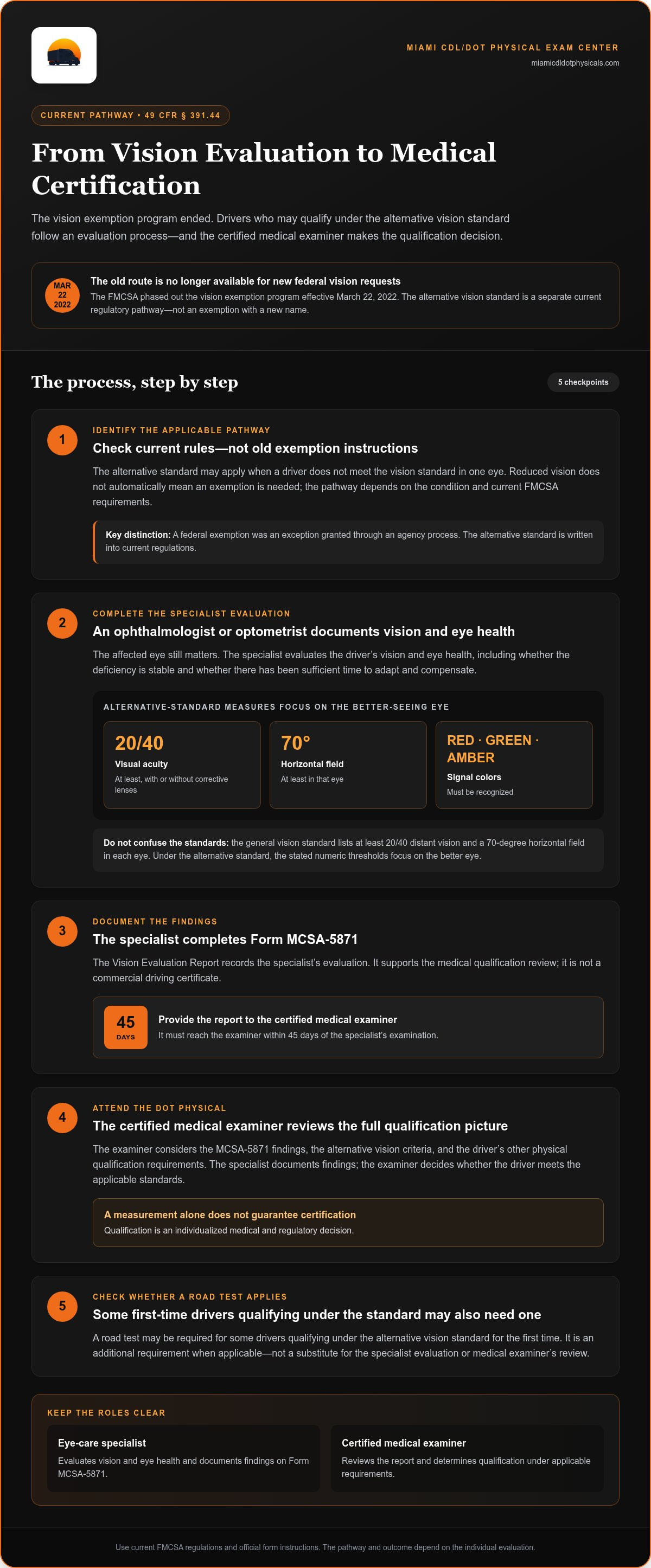
Under 49 CFR § 391.44, some drivers who do not meet the vision standard in one eye may be evaluated under the alternative standard. It is not an exemption with a new name. A driver must have at least 20/40 vision in the better eye, with or without corrective lenses, a horizontal field of vision of at least 70 degrees in that eye, and the ability to recognize standard red, green, and amber traffic signal colors. The vision deficiency must also be stable, with sufficient time for the driver to adapt and compensate.
An ophthalmologist or optometrist completes the Vision Evaluation Report, Form MCSA-5871, after assessing the driver’s vision and eye health. The driver must provide the report to a certified medical examiner within 45 days of the specialist’s examination. The medical examiner reviews the report and decides whether the driver meets the alternative vision standard and the other physical qualification requirements. The specialist provides evaluation findings but does not certify the driver for commercial driving.
The alternative vision standard is a current regulatory pathway evaluated by a medical examiner, not an individual exemption granted by the FMCSA. Meeting its vision measurements does not guarantee certification. The examiner considers the full evaluation and applicable qualification standards.
- General standard: At least 20/40 distant vision in each eye, with or without corrective lenses.
- Visual fields: At least 70 degrees in the horizontal meridian in each eye.
- Color recognition: Ability to recognize standard red, green, and amber traffic signal colors.
These general requirements come from 49 CFR § 391.41(b)(10). If an older source tells you to submit a vision exemption application, compare that advice with current FMCSA rules before acting. The FMCSA vision exemption program is no longer the route for new requests. The next step is to determine whether the alternative standard applies to your circumstances.
How FMCSA’s Alternative Vision Standard Evaluates Driver Eligibility
Eligibility isn’t decided by matching a single test result to a checklist. The alternative vision standard sets specific criteria, but a driver’s qualification is a medical and regulatory decision. Use the measurements below to understand what will be evaluated, not to predict or guarantee a certification outcome.
Which vision measurements and evaluations matter?
Under 49 CFR § 391.44, the alternative standard focuses on the better-seeing eye when a driver doesn’t meet the vision standard in the other eye. The driver must have visual acuity of at least 20/40 in the better eye, with or without corrective lenses, and a field of vision of at least 70 degrees in the horizontal meridian in that eye. The driver must also be able to recognize standard red, green, and amber traffic signal colors.
The affected eye still matters. An ophthalmologist or optometrist evaluates and documents the driver’s vision and eye health, including whether the vision deficiency is stable and whether the driver has had sufficient time to adapt and compensate. The alternative standard’s numeric thresholds refer to the better eye; they don’t mean the affected eye is irrelevant. Corrective lenses may help meet the acuity measure, but the clinical evaluation establishes the relevant findings.
The specialist records the evaluation on the Vision Evaluation Report, Form MCSA-5871. The driver must provide it to the certified medical examiner within 45 days of the specialist’s examination. Review the current FMCSA regulations on driver qualifications and official form instructions to understand the requirements for your evaluation.
Who makes the qualification decision?
The eye-care professional documents vision findings. That report supports the medical qualification review; it is not a commercial driving certificate. The certified medical examiner reviews the report, considers the alternative vision criteria, and assesses the driver’s other physical qualifications. Vision results alone don’t establish that a driver meets every applicable requirement.
This distinction matters: an optometrist or ophthalmologist provides clinical findings, while the certified medical examiner applies the federal qualification standards during the medical examination. The FMCSA establishes those rules; an examiner doesn’t grant a federal vision exemption or change the standard. If the available records don’t resolve a medical question, the examiner may need additional information before making a determination.
Prepare by bringing current eye-care records, details about any corrective lenses, and relevant medical history. Be ready to explain when the vision change occurred and whether it has remained stable. This information helps the examiner understand the specialist’s findings, but it doesn’t replace the required evaluation.
For the medical examination portion of the process, schedule a DOT physical exam. The certified medical examiner will assess your individual circumstances under the applicable standards.
Vision Exemption vs. Alternative Vision Standard: Which Pathway Applies?
The terms describe different processes, not two names for the same option. The federal vision exemption program was a request for an exception to a qualification standard. The alternative vision standard is a current regulatory pathway for certain drivers with a vision deficiency in one eye. Which rules apply depends on your circumstances and current FMCSA requirements, not just on a diagnosis or a past exemption.
| Comparison | Vision exemption | Alternative vision standard |
|---|---|---|
| Purpose | Historically allowed eligible drivers to seek an agency exception to the vision qualification standard. | Provides criteria for evaluating certain drivers who don’t meet the standard in one eye. |
| Decision-maker | The FMCSA considered exemption requests under the former program. | A certified medical examiner determines whether the driver meets the standard and other physical qualifications. |
| Documentation | Older application materials and exemption records relate to the former process. | A vision specialist completes the Vision Evaluation Report, Form MCSA-5871, for the examiner’s review. |
| Current relevance | The FMCSA stopped processing new requests under the federal vision exemption program when it was phased out in 2022. | The current pathway is set out in 49 CFR § 391.44. |
When might the alternative vision standard be relevant?
This pathway may be relevant if a driver doesn’t meet the usual vision requirement in one eye but can meet the alternative criteria. For example, a driver with reduced vision in one eye may still need to demonstrate the required acuity and field of vision in the better eye, recognize standard traffic signal colors, and have a stable deficiency with time to adapt. A one-eye condition alone neither guarantees eligibility nor automatically disqualifies a driver. The specialist’s findings and the examiner’s review determine how the criteria apply.
In short, an exemption asks the agency to grant an exception; the alternative vision standard asks the medical examiner to assess qualification under a separate rule. The FMCSA’s driver exemption program guidance can help clarify the distinction and current federal terminology. Use the applicable regulations and form instructions to identify the pathway that fits your situation.
Why might older exemption guidance no longer fit?
Search results, forum discussions, saved forms, and older articles may still describe the previous application process. That material can provide historical context, but it may recommend steps or forms that no longer apply to new vision evaluations. Check the publication or revision date, then compare the instructions with current FMCSA guidance before sending documents or arranging evaluations. For broader context, review the medical requirements and steps involved in a DOT physical and CDL medical compliance.
Keep the distinction practical: confirm the current rule, gather documents for the pathway that applies, and let the certified medical examiner make the qualification determination. A DOT physical is part of that medical review. Neither a guide nor an examination can promise certification.
How to Prepare for an FMCSA Vision Evaluation and Medical Exam
A clear preparation plan helps keep the vision evaluation and DOT medical examination organized. Start by identifying which pathway applies and reviewing current FMCSA instructions. Forms and steps can differ, so don’t reuse paperwork simply because it appeared in an older discussion of the FMCSA vision exemption program.
What should drivers gather before the evaluation?
Collect records that help the vision specialist and medical examiner understand your condition and its history. Bring your current corrective lenses and details about how you use them. Include existing medical certification or FMCSA correspondence when relevant. The documents needed depend on your circumstances, so review current instructions before the appointments.
- Confirm the pathway and instructions. Review current FMCSA guidance and identify whether the alternative vision standard may apply. Check the current form names, instructions, and any required order of examinations.
- Arrange the vision evaluation. If the alternative standard applies, the relevant form is the Vision Evaluation Report, Form MCSA-5871, completed by an ophthalmologist or optometrist. Use the current version and directions published by FMCSA. Don’t rely on an old saved copy or assume a revision date that isn’t shown in current official materials.
- Organize supporting records. Gather eye-care reports, relevant treatment history, details about corrective lenses, and medical history that may affect the examination. Bring prior certification documents or agency correspondence if they relate to your case.
- Track the report deadline. Under the alternative vision standard, provide Form MCSA-5871 to the certified medical examiner within 45 days of the specialist’s examination. Plan the appointments so the examiner can review the report within that period.
- Attend the DOT medical examination. The examiner reviews the vision information and assesses your overall physical qualification. Bring requested records and answer questions accurately. The examiner may need additional information before making a determination.
What happens during the medical certification review?
The vision findings are one part of the review, not the whole decision. The certified medical examiner considers whether the applicable vision standard is met and evaluates other relevant health factors under federal qualification rules. Depending on the findings and available documentation, the examiner may determine that you qualify, may need more information, or may not be able to certify you at that time. No specific result or certification duration is guaranteed.
A scheduled examination or pending report is not proof of qualification. Follow current FMCSA requirements and your actual medical certification status before driving commercially. For general appointment preparation, use this DOT physical preparation guide.
When your records and vision evaluation are in order, schedule a DOT physical exam as part of your medical certification process.
Next Steps After Learning About the FMCSA Vision Pathway
Turn the rules into a clear sequence: identify which pathway applies, collect relevant records, complete the required vision evaluation, and follow current FMCSA instructions for the medical review. The former FMCSA vision exemption program is not the route for new vision requests, so don’t base your next step on an old application form or a forum post without a publication date.
How can a DOT physical fit into the process?
A DOT physical is the medical examination where a certified medical examiner reviews the information needed to assess your physical qualification. If you have a vision concern, disclose it and bring relevant eye-care records, corrective-lens details, and any required evaluation report. The examiner considers the vision findings alongside other health information. A DOT physical supports the medical qualification review, but it cannot grant an FMCSA exemption or guarantee certification.
The exam is one step in the process, not a substitute for the vision specialist’s evaluation or the rules that apply to your case. For broader context about medical certification and preparing for an appointment, use this DOT physical requirements and process guide.
When should drivers review official FMCSA instructions again?
Review the official instructions before arranging evaluations, submitting forms, or acting on a prior exemption. Confirm that you’re using the current requirements and form instructions, especially if your condition has changed or your records relate to an earlier program. Under the alternative vision standard, Form MCSA-5871 is the Vision Evaluation Report. Follow current FMCSA instructions for completing and delivering it rather than relying on an outdated copy or assumed procedure.
Use current FMCSA guidance for questions about whether a rule or historical exemption applies. A past exemption, previous medical certificate, or old application doesn’t by itself establish your present qualification status. Keep relevant correspondence and evaluation records together so the examiner can review them in context. If you’re unsure which instructions apply, identify the current rule before proceeding.
Once you’ve identified the pathway and gathered the information for your examination, arrange the medical review in the appropriate sequence. Don’t treat a scheduled exam, pending report, or application history as authorization to drive commercially. Follow your current certification status and applicable requirements.
A DOT medical examination helps you complete the medical review with your records ready and your concerns disclosed. Schedule a DOT medical examination as a practical next step. The certified medical examiner will make an individualized determination based on the examination and applicable standards.
Move Forward with a Clear Medical Exam Plan
Choose a next step you can prepare for. Set aside time to confirm which current instructions apply, organize your records in one place, and keep copies of evaluations or agency correspondence. This preparation makes it easier to answer follow-up questions without having to reconstruct your history under time pressure.
If older records refer to the FMCSA vision exemption program, treat them as background rather than proof of your current status. Use current FMCSA guidance for regulatory questions, and rely on the certified medical examiner for the medical qualification review. Keep your work plans aligned with your actual certification status while that review is underway.
For the medical examination component, our center provides FMCSA-certified medical examinations for commercial drivers, as well as DOT and non-DOT drug testing. Scheduling an exam is a practical step in the process, not a promise of a particular decision. Schedule a DOT medical examination when you’re ready, bring your records, and move forward with a clear plan.
Frequently Asked Questions
Is the FMCSA vision exemption program still available in 2026?
No. The FMCSA ended its federal vision exemption program on March 22, 2022, and no longer processes new applications through that program. In 2026, references to applying for a vision exemption may describe the former process. If an older certificate or agency letter is part of your history, don’t assume it establishes your current qualification. Review current FMCSA guidance to identify the requirements that apply now.
What is the FMCSA alternative vision standard?
It’s a separate qualification pathway for some drivers who don’t meet the usual vision standard in one eye. Under 49 CFR § 391.44, the evaluation considers the better eye’s visual acuity and field of vision, color recognition, and whether the deficiency is stable and the driver has adapted. A vision specialist documents the findings, and a certified medical examiner considers them as part of the qualification decision.
Can I drive a commercial vehicle if I am blind in one eye?
Possibly, but blindness in one eye alone doesn’t determine whether you qualify. The alternative vision standard may apply if you meet its requirements in the better eye and satisfy the other evaluation criteria. A specialist may need to document the condition and adaptation before a certified medical examiner reviews the findings. Don’t treat a diagnosis or pending evaluation as authorization to drive; follow your actual certification status.
How do I apply for an FMCSA vision exemption?
You can’t submit a new application under the former FMCSA vision exemption program. If your vision condition may fit the alternative standard, follow current FMCSA instructions for arranging the specialist evaluation and medical examination instead. Don’t mail an old exemption application or rely on instructions copied from the former program. The certified medical examiner evaluates qualification under the current standard; a clinic performing a DOT physical doesn’t grant an FMCSA exemption.
What forms are required for the alternative vision standard?
The key vision document is the Vision Evaluation Report, Form MCSA-5871, completed by an ophthalmologist or optometrist. The driver must provide it to the certified medical examiner within 45 days of the specialist’s examination. Use the current form and instructions published by FMCSA, rather than a saved or printed copy that may be outdated. The examiner may also need other information to complete the medical qualification review.
Does an FMCSA vision exemption guarantee a CDL medical card?
No. A prior exemption doesn’t guarantee current medical certification, and the alternative vision standard isn’t an exemption approval. The certified medical examiner assesses the applicable vision requirements along with the rest of the driver’s physical qualification. The examiner may need more information or may determine that the driver doesn’t qualify. A DOT physical is an evaluation, not a promise of a medical card or a specific certification period.
How long does the FMCSA vision review or exemption process take?
There’s no federal exemption application review time for new vision requests because the former program no longer accepts them. Under the alternative standard, the Vision Evaluation Report must reach the medical examiner within 45 days of the specialist’s examination. That deadline is not a guaranteed decision time. Appointment availability, complete records, and requests for additional information can affect how long the full medical review takes.


