

A longer wait doesn’t automatically mean there’s a problem with your DOT drug test. If you’re wondering how long to get DOT drug test results back, the timing depends on specimen transport, laboratory testing, and whether a Medical Review Officer (MRO) needs to review the result. There isn’t one guaranteed timeline for every test.
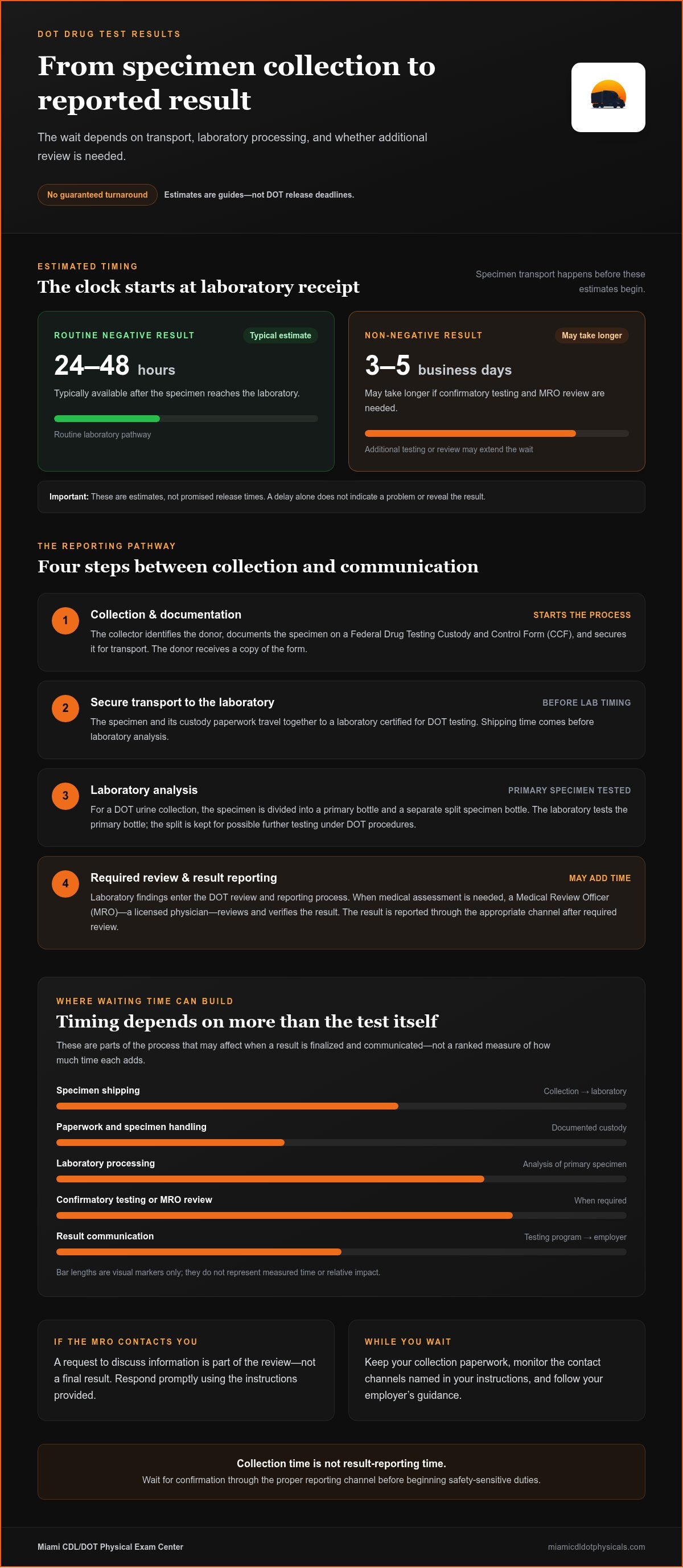
It’s reasonable to want a clear timeline, especially when your employer needs the result before you can begin safety-sensitive work. Negative results are typically available within 24-48 hours after the specimen reaches the laboratory. A non-negative result may take 3-5 business days or longer if it requires confirmatory testing and MRO review. This article explains what happens after collection, what can slow the process, and how to follow up if you’re still waiting. A delay alone doesn’t reveal the result, so use your employer’s or testing program’s contact process for an update.
Key Takeaways
- How long to get DOT drug test results back depends on the testing and review process. Any estimated timeframe is a guide, not a guaranteed release time.
- A specimen moves from collection and chain-of-custody paperwork through transport, laboratory testing, and result reporting.
- Shipping, paperwork, laboratory processing, additional review, or communication can affect timing.
- Keep your collection paperwork, monitor the contact channels named in your instructions, and follow your employer’s guidance while you wait.
- A delay by itself doesn’t reveal the result. Know whom to contact for a status update and how DOT drug testing support can help you complete the screening process.
How long does it take to get DOT drug test results back?
There isn’t one guaranteed timeline for DOT drug test results. For a routine negative result, allow roughly 24-48 hours after the specimen reaches the laboratory. A result that needs additional testing or Medical Review Officer (MRO) review may take several business days or longer. These are estimates, not DOT release deadlines. Time spent transporting the specimen and completing any required review can extend the wait beyond the collection appointment.
What does “getting results back” mean in a DOT drug test?
Collection is the first step, not the finish line. The specimen is documented and prepared for transport, then received and tested by a laboratory certified to perform DOT drug testing. The laboratory’s findings go through the required review and reporting process. If further testing or MRO review is needed, those steps must be completed before the result is finalized and communicated through the appropriate channels.
“Results back” can mean that the laboratory has completed its analysis, that the required review is complete, or that the employer has received the reported result. The driver and employer may not hear about the outcome at the same time. The process can also differ depending on the result pathway. This overview of drug testing describes general testing methods and procedures; DOT-specific requirements govern workplace testing.
Is there a standard DOT drug test turnaround?
No single turnaround time guarantees when an employer will receive a particular result. Compliance Navigation Specialists reported in July 2025 that negative results are typically available within 24-48 hours after laboratory receipt, while non-negative results generally take 3-5 business days and may take longer. Workforce QA reported in January 2026 that negative results commonly fall in the same 24-48-hour range after laboratory arrival, while cases needing further testing and MRO review often take 3-6 business days. These industry estimates were reviewed for this article in October 2026. They aren’t regulatory deadlines or promises about an individual test.
The starting point matters. A collection completed in the afternoon doesn’t mean the laboratory received the specimen that day. Shipping time comes first, followed by laboratory analysis and reporting. A routine negative result may move through the process without the additional steps that can apply to a non-negative finding. In those cases, confirmatory testing and MRO review may be needed before reporting is complete.
A result taking longer than the routine estimate doesn’t, by itself, indicate a problem or reveal the outcome. Transport, processing, or review may still be underway. Treat the timeframe as a planning guide, not clearance to begin safety-sensitive duties. Follow your employer’s instructions and wait for confirmation through the proper reporting channel.
What happens between DOT drug test collection and the reported result?
The collection appointment starts a documented process. The specimen must be identified, handled, transported, tested, and reported through the DOT testing system. The collection time is not the result-reporting time: laboratory analysis and any required review happen afterward. The steps below show where the specimen goes and why a request for more information doesn’t necessarily mean a final result is ready.
How does the DOT urine testing process move through the lab?
At collection, the collector follows procedures to identify the donor and document the specimen on a Federal Drug Testing Custody and Control Form (CCF). The specimen is sealed for secure transport, and the paperwork links it to the collection. The donor receives a copy of the form, which can be useful if a question comes up later.
After transport, the laboratory certified for DOT testing checks the specimen and performs the required analysis. In a DOT urine collection, the specimen is divided into a primary bottle and a separate split specimen bottle. The laboratory tests the primary bottle, while the split is kept for possible further testing under DOT procedures. This preserves a separate portion for a split-specimen test when the rules allow one.
The basic sequence is:
- The collector documents the collection and secures the specimen.
- The specimen and its custody paperwork travel to the testing laboratory.
- The laboratory analyzes the primary specimen and sends its result into the DOT review and reporting process.
- The result is reported through the appropriate channel after required review.
The U.S. Department of Transportation Part 40 Regulations describe the procedures governing these steps. A longer interval between collection and reporting doesn’t, by itself, mean the specimen was mishandled or the test is invalid.
When does a Medical Review Officer become involved?
A Medical Review Officer (MRO) is a licensed physician responsible for reviewing and verifying laboratory drug-test results under Part 40. When a result needs medical assessment, the MRO may contact the donor to discuss relevant information before making a determination. A request for contact is part of the review, not a final result. Respond promptly using the instructions provided, and share information with the MRO rather than trying to predict what the test will show.
Not every result follows the same path. A result that doesn’t need additional assessment may move through reporting without the donor communication involved in a case requiring follow-up. The MRO applies the DOT review process; the MRO doesn’t provide a prediction before that review is complete. The employer receives the reported outcome through the testing program, while the driver may receive separate communications or updates.
Keep your collection paperwork and watch for messages or calls related to the test. If you need to complete a screening, a professional DOT drug test is the first step in the required collection process.
Why can some DOT drug test results take longer than others?
DOT drug test timing depends on the steps a specimen must pass through, and ordinary processing can vary even when no additional review is required. Other cases involve follow-up testing, MRO review, or communication with the donor. These possibilities explain why a result may take longer, but they don’t identify the cause of any particular delay. The testing pathway matters as much as the collection appointment when estimating how long to get DOT drug test results back.
What factors can affect the time to receive a DOT result?
Several parts of the process can affect timing. The specimen must travel from the collection site to the laboratory, and handling or shipping schedules can affect when it arrives. Laboratory workload may also influence how quickly analysis and reporting move forward. Documentation matters too: a paperwork issue may need clarification before the process can continue smoothly. These are possible influences, not proof that any one of them caused a particular delay.
A result requiring additional laboratory testing or MRO review goes through more steps than one that can be reported without further assessment. If the MRO needs to speak with the donor, reaching them and completing the review can add time. Keep your phone and contact details available, and respond promptly to official messages. Don’t assume a delay means the laboratory has found a problem. If the expected timeframe has passed, ask your employer or testing-program contact for a status update.
The comparison below shows the difference in process, not a promised schedule:
Routine processing: The laboratory completes its analysis, and the result moves through standard reporting without the same additional follow-up steps.
Additional steps: Further testing, MRO assessment, donor contact, or an administrative clarification may be needed before reporting is complete.
Does a delayed DOT drug test result mean a positive result?
No. The time that has passed doesn’t determine the test result. A longer wait could reflect transport, laboratory workload, documentation, or review. Even when an MRO contacts a donor, the request for information is part of the review process, not a final result. Follow the instructions in the communication and respond through the stated channel. Don’t draw conclusions from silence or timing alone.
For an update, follow your employer’s instructions about whom to contact. The employer or testing-program contact can check the status through the appropriate process; laboratory personnel may not be able to provide a direct update to the donor. Keep your collection paperwork handy so you can provide relevant details if asked. Until the result is officially reported, treat the outcome as unknown and follow your employer’s direction about work status.
What should you do while waiting for DOT drug test results?
After your collection, focus on what you can control: keep your paperwork, stay reachable, and follow the instructions from your employer or testing program. Don’t rely on a single expected date unless your program has provided one. The right way to follow up depends on who arranged the test and how results are communicated.
Use this simple checklist:
- Save your collection paperwork. Keep your copy of the custody and control form and note the collection date. Have any reference or order details ready if you request an update.
- Monitor your contact channels. Check voicemail, email, and any other channels named in the testing instructions. Make sure you can receive messages and respond if the MRO or program contacts you.
- Follow employer guidance. Ask your employer which process to use for a status update, and follow its instructions about work status while the result is pending.
- Keep communication focused. Contact the appropriate program representative rather than repeatedly contacting laboratory personnel, who may not handle donor updates.
When should a driver follow up about a pending result?
Use the timing and contact process your employer or testing program gave you. There’s no universal waiting period for every test, so don’t assume that a particular number of hours means something is wrong. If the stated timeframe has passed or you haven’t received expected instructions, contact the designated employer or program representative for a status check.
Keep your request clear and factual. Provide your collection date and any reference details on your paperwork, then ask whether an update is available or whether you need to take another step. A neutral status request is more useful than asking the laboratory to speed up its work. For broader driver guidance, review this DOT drug test compliance reference.
What should you do if the MRO contacts you?
Respond promptly using the official contact information or channel provided. Listen carefully to what the MRO requests, answer questions accurately, and provide the requested information through the stated process. If you miss a call, use the callback details in the message rather than sharing sensitive information through an unverified channel.
A request to speak with the MRO isn’t, by itself, a final test result. The MRO’s review must be completed before the outcome is reported through the appropriate process. Don’t try to predict the result from the fact that you were contacted. Follow the instructions and wait for official communication.
If you still need to complete a required screening, our DOT drug testing service can help with the collection process.
How DOT drug testing support helps complete the process
DOT drug test timing depends on the testing and review pathway, and waiting time alone doesn’t tell you the result. A collection appointment begins the process, but laboratory work and any required review happen afterward. Knowing which steps are separate can help you plan without treating an estimate as a guaranteed release time.
Professional DOT drug testing provides a way to complete a required screening. Before your appointment, follow the instructions from your employer or testing program, and keep relevant appointment or collection documents accessible. Clear instructions and organized paperwork help you prepare for the collection stage, while the result follows its own testing and reporting process.
What information helps make a DOT testing visit straightforward?
Start with the directions you’ve received. Your employer or testing program can tell you where to go and what process applies to your screening. Bring or retain the appointment information and any paperwork you’ve been asked to keep. If you’re unsure about a step, use the contact channel provided with those instructions rather than relying on assumptions based on another test or appointment.
At the visit, follow the collector’s directions and keep any documents provided to you. Hold on to them until the result has been reported and any follow-up is complete. They give you details to refer to if you need to ask the program about your test, but they don’t speed up laboratory processing.
Where does the Clearinghouse fit into drug-testing compliance?
The FMCSA Drug and Alcohol Clearinghouse and laboratory testing serve related but different compliance functions. Laboratory analysis and the required review process determine how a particular DOT drug test result is reported. Clearinghouse activity concerns the reporting and tracking of specified drug and alcohol program violations and return-to-duty information. Checking a Clearinghouse record doesn’t produce or accelerate a laboratory result.
Owner-operators and fleets can use FMCSA Clearinghouse Consortium support as part of their broader compliance responsibilities. Keep that work distinct from waiting for a specific test result: each has its own process and purpose. This FMCSA Clearinghouse compliance guide explains how the Clearinghouse fits into the wider compliance picture.
For drivers asking how long to get DOT drug test results back, the most useful approach is to follow the employer’s instructions, remain available for official follow-up, and wait for the result through the proper reporting channel. Don’t interpret a delay as an outcome, and don’t rely on Clearinghouse activity as a substitute for the test report.
If you need to complete a required screening, you can schedule a DOT drug test. The service supports the collection process, while the result timeline depends on the testing and review steps that follow.
Take the next step toward completing your screening
Planning around an employment or compliance requirement is easier when you know what you can act on now. Rather than trying to predict the result from the time that has passed, follow the instructions you’ve received and be ready to respond if the testing program needs information. There may not be a guaranteed answer to how long to get DOT drug test results back, but you can take a clear next step toward completing the screening.
Drivers and fleets can access DOT and non-DOT drug testing, along with FMCSA Clearinghouse Consortium support for related compliance needs. These services support different parts of the process, so choose the one that fits the requirement you need to meet.
Explore DOT drug testing support to complete your screening.
Frequently Asked Questions
How long do negative DOT drug test results usually take?
Negative DOT results are typically available within 24-48 hours after the specimen reaches the laboratory, not necessarily within that time after collection. Shipping comes first, so a specimen collected late in the day may arrive later. Compliance Navigation Specialists reported this typical range in July 2025. Treat it as an estimate, not a deadline. If you need an update, follow your employer’s testing-program contact process.
Can DOT drug test results come back the same day?
A same-day result isn’t a dependable expectation. The specimen must reach a laboratory certified for DOT testing, be analyzed, and move through result reporting. Collection and transport schedules can make a same-day update impractical, even if the collection itself is completed early. Ask your employer what timeline to plan around, and rely on official reporting rather than assuming the test is complete based on an informal update.
Does a delayed DOT drug test result mean I failed?
No. A delay by itself doesn’t establish whether a result is negative or positive. Timing can be affected by transport, laboratory processing, documentation, or additional review. For example, an MRO may need to contact you before completing a review. Don’t infer an outcome from how long you’ve waited. Follow your employer’s instructions and respond promptly if the testing program requests information.
What happens if the Medical Review Officer cannot reach me?
Keep your contact details current and respond to any message from the MRO using the official callback information. Under DOT procedures, if the MRO cannot reach the donor after attempting contact, the MRO must wait 10 days before reporting the result as positive. Don’t assume the result in advance. If you think you may have missed a call, contact the MRO through the verified channel provided.
Who receives DOT drug test results, the driver or the employer?
The employer’s designated representative generally receives the result through the testing program, while the driver may receive separate communication, especially if the MRO needs to speak with them. You and your employer may not be notified at the same moment. If you need to know whether the result has been reported, ask your employer which contact handles testing updates rather than contacting laboratory staff directly.
Are DOT drug test results reported to the FMCSA Clearinghouse?
Not every DOT drug test result is entered in the Clearinghouse. The system records specified violations and related compliance information, rather than serving as a live feed of every negative test or an instant laboratory-results portal. A verified positive result or refusal may trigger required reporting. If you’re checking your Clearinghouse record, remember that it serves a different purpose from asking whether a particular test result has been finalized.
Can I drive commercially while waiting for my DOT drug test result?
For a pre-employment DOT drug test, a driver must have a negative result before performing safety-sensitive duties for that employer. Don’t start driving based only on completing the collection or expecting a quick result. If you’re already employed and awaiting a test connected to another circumstance, follow your employer’s instructions about work status. The rules and next steps depend on why the test was required, so get direction from your employer.


