

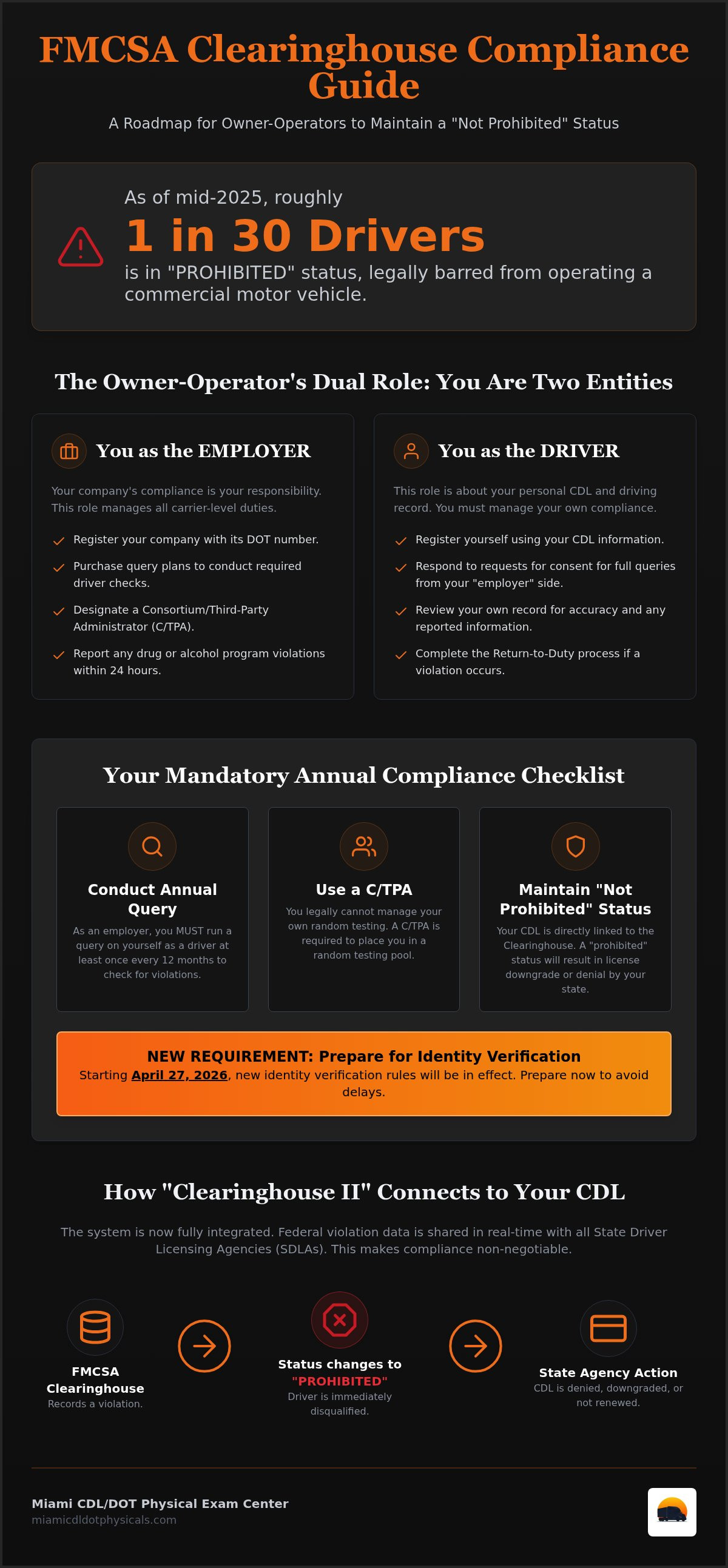
As of mid-2025, roughly 1 in every 30 registered drivers is in "prohibited" status, legally barred from operating a commercial motor vehicle. For a one-person trucking company, a single missed query or a reporting error can ground your business overnight. You already know that keeping up with FMCSA Clearinghouse requirements for owner operators feels like a second full-time job. It's frustrating to manage complex portals and distinguish between your duties as a driver and your obligations as an employer.
You don't have to tackle this regulatory maze alone or risk the heavy fines that are increasing in 2026. This guide provides a clear roadmap to master your mandatory compliance steps, from the new identity verification rules starting April 27, 2026, to the legal necessity of a consortium partner. We'll break down your annual checklist, explain why you can't run random tests on yourself, and show you exactly how to maintain a "not prohibited" status. This article delivers the practical answers you need to keep your CDL in good standing and your truck on the road.
Key Takeaways
- Understand your dual registration responsibilities as both an employer and a driver to ensure full legal compliance within the system.
- Learn why designating a Consortium/Third-Party Administrator (C/TPA) is one of the most critical FMCSA Clearinghouse requirements for owner operators to manage mandatory random testing pools.
- Prepare for the April 27, 2026, identity verification update and the mandatory annual query schedule to avoid costly civil penalties and operational delays.
- Discover how the "Clearinghouse II" rule impacts your CDL standing and why maintaining a "not prohibited" status is vital for your professional livelihood.
- Streamline your regulatory tasks by bundling DOT drug testing with professional consortium management to act as a reliable compliance shield for your business.
What is the FMCSA Clearinghouse for Owner-Operators?
The FMCSA Clearinghouse is a secure, online database that provides real-time information about commercial driver’s license (CDL) and commercial learner’s permit (CLP) holders’ drug and alcohol program violations. The Federal Motor Carrier Safety Administration (FMCSA) established this system to improve road safety by ensuring that drivers with violations can't hide their records by moving from one employer to another. The Clearinghouse is a centralized database designed for real-time compliance tracking of drug and alcohol violations to ensure only qualified drivers remain on the road.
For you as an owner-operator, the Clearinghouse is more than just a digital file; it's a gatekeeper for your livelihood. If a violation is reported, your status changes to "prohibited" immediately. This means you legally cannot perform safety-sensitive functions, including driving a commercial motor vehicle, until you complete the return-to-duty process. Understanding the FMCSA Clearinghouse requirements for owner operators is essential because the system is now fully integrated with state licensing agencies, making your status visible to every enforcement officer in the country.
The Legal Authority Behind the Database
The Clearinghouse operates under the authority of 49 CFR Part 382. These federal regulations mandate that all motor carriers, including independent operators, participate in a drug and alcohol testing program. The FMCSA enforces these rules to identify drivers who have violated federal testing requirements. By 2026, the transition to full database integration is absolute. State driver licensing agencies now use this data to downgrade or deny CDLs for any driver in a prohibited status. This connection between the federal database and your state-issued license makes compliance operationally unavoidable.
Who is Classified as an Owner-Operator?
Under FMCSA rules, you're an owner-operator if you own your equipment and hold your own DOT operating authority. Even if you're a company of one, federal law doesn't exempt you from testing requirements. In fact, it places a unique burden on you. You're viewed as both the employer and the employee simultaneously. This dual role means you must comply with the regulations for both sides of the business. You must manage your own driver record while also fulfilling the reporting duties of a carrier. Meeting the FMCSA Clearinghouse requirements for owner operators requires managing these two distinct identities within the system to keep your business moving. To stay compliant, you'll need to handle several key tasks:
- Registering your company as an employer.
- Registering yourself as a driver.
- Conducting mandatory annual queries.
- Reporting any drug or alcohol violations within 24 hours.
The Dual Role: Registering as Both Employer and Driver
The most common mistake independent drivers make is assuming one registration covers everything. Under the law, you're a "split personality." You're the employer who owns the business and the driver who operates the truck. Because the system tracks these roles separately, you must register twice within the same account to meet the FMCSA Clearinghouse requirements for owner-operators. This ensures you can fulfill your duties as a carrier while also managing your personal driving record.
The employer side of the portal is where you manage your company's compliance, such as purchasing query plans and designating a consortium. The driver side is where you view your own history and grant consent for full queries. Failing to set up both roles correctly can lead to missed notifications or an inability to run the mandatory annual checks required by federal law.
Step-by-Step Driver Registration
Your journey starts with creating a Login.gov account. This acts as your secure foundation for all federal portals. Once you've established your login, you'll enter the Clearinghouse as a driver. You must verify your CDL information precisely, including your license number and state of issuance. This step links your federal record to your actual license. Finally, set up your notification preferences. You want to know immediately if a query is run on your record or if a violation is reported. This transparency protects your livelihood and keeps you informed about your standing in the database.
The Employer Dashboard Obligations
After your driver profile is set, you'll register your DOT number to activate the employer entity. This dashboard is your command center for company compliance. One of your first tasks is purchasing a query plan. You can't check your own record without these credits, and they're required for your annual compliance check. While you're responsible for reporting drug or alcohol violations within 24 hours, you aren't allowed to report your own clean test results. That task falls to your laboratory or consortium. Managing these separate dashboards can be time-consuming, which is why many drivers choose to simplify their compliance by partnering with a professional service provider.
Navigating the FMCSA portal doesn't have to be overwhelming. When you log in, look for the "Role" toggle in the top menu. This allows you to switch between your employer and driver views without logging out. Keep your contact information updated in both sections to ensure you never miss a critical compliance alert. By staying organized and understanding these dual obligations, you ensure your business remains audit-ready and your CDL stays in good standing.
Mandatory Consortium Requirements: The Role of a C/TPA
For most motor carriers, hiring a Third-Party Administrator (C/TPA) is a choice. For you, it's a legal mandate. The FMCSA prohibits owner-operators from managing their own random drug and alcohol testing programs. This means you cannot legally pick your own name out of a hat or report your own clean test results to the federal database. To stay compliant with FMCSA Clearinghouse Requirements for Owner-Operators, you must officially designate a consortium to act on your behalf. This partner serves as your compliance shield, handling the complex reporting tasks that you're restricted from doing yourself.
A C/TPA does more than just store records. They manage your random testing pools, ensuring you meet the 2026 minimum annual testing rates of 50% for controlled substances and 10% for alcohol. They also handle the critical 24-hour reporting window for any drug or alcohol violations. Without a designated C/TPA in the portal, your company is effectively out of compliance, which can lead to significant fines and a "prohibited" status on your CDL. You must log into your employer dashboard to officially name your consortium so they can begin managing your data.
Why the FMCSA Mandates C/TPA Oversight
The core reason for this requirement is to prevent self-reporting bias. The federal drug and alcohol program relies on the integrity of the random selection process. If an independent driver managed their own pool, there's a perceived risk that they might skip a test or fail to report a violation. By requiring a C/TPA, the FMCSA ensures that a neutral third party oversees the process. This buffer protects the safety of the motoring public and provides a verified trail of compliance for your business. It removes the "fox guarding the henhouse" scenario and gives the DOT confidence that your testing program is legitimate and unbiased.
Choosing the Right Compliance Partner
When selecting a partner, look for a provider that understands the specific FMCSA Clearinghouse requirements for owner operators. Your C/TPA should be a one-stop shop that offers both database management and actual testing services. Bundling these tasks reduces the chance of communication errors between the lab and the Clearinghouse. It's often most efficient to work with a professional FMCSA clearinghouse consortium that can handle your DOT physicals and drug tests in one streamlined process. A national provider is essential for drivers who cross state lines, as they ensure your compliance remains valid regardless of where your route takes you. This partnership allows you to focus on the road while experts handle the regulatory paperwork.
2026 Compliance Checklist: Queries, Reporting, and Verification
Compliance in 2026 requires more than just a Login.gov account. The FMCSA has tightened security to prevent fraud and ensure that only authorized users access sensitive driver data. Staying ahead of these changes is a core part of meeting the FMCSA Clearinghouse requirements for owner operators. If you manage your own authority, you must follow a strict calendar of queries and verification steps to avoid heavy civil penalties. These fines can reach $5,833 per occurrence, making a simple administrative oversight a very expensive mistake.
Beyond the initial setup, your ongoing compliance rests on your ability to document your status accurately. You're responsible for maintaining a clear record that proves you've checked the database as required by law. This includes both the annual checks you perform on yourself and any pre-employment checks required if you expand your operation. Keeping these records organized ensures you're always ready for a DOT audit or a roadside inspection.
Identity Verification Updates for 2026
Starting April 27, 2026, the FMCSA will implement a new identity verification integration. This process uses a secure web application to confirm your identity during registration or account updates. You'll need to provide a valid U.S. passport or a state-issued driver's license. Some users may also need to complete biometric verification steps, such as a facial scan, through a mobile device. If the automated system cannot verify your identity, you'll be required to submit additional documentation manually. Complete this process early to avoid losing access to the portal when your annual query is due.
Conducting and Documenting Annual Queries
Every owner-operator must conduct an annual query on themselves at least once every 12 months. A limited query is usually sufficient for this recurring check. It confirms whether the database contains any new information about your driving history. If a limited query shows a "hit," you must conduct a full query within 24 hours to see the details. Even though you're checking your own record, you must still log in as a driver to provide electronic consent. Missing this 12-month window is a major red flag for auditors. In 2025, the average fine for a missed annual query was $10,278, a cost that can easily ground a small business.
If you decide to hire a relief driver or add an additional driver to your authority, you must run a full pre-employment query before they perform any safety-sensitive functions. You cannot rely on a limited query for new hires. For recordkeeping, keep all query results and consent forms for at least three years. Remember that drug and alcohol violations remain on a driver's record for five years or until the return-to-duty process is complete. To ensure you never miss a deadline or a verification update, it's a smart business move to join a professional FMCSA Clearinghouse consortium that manages these timelines for you.
Simplifying Compliance with Professional Consortium Services
Meeting the FMCSA Clearinghouse requirements for owner operators is a high-stakes responsibility that leaves very little room for error. A single administrative oversight or a missed reporting window can lead to immediate operational shutdowns and hefty fines. Professional consortium services eliminate these risks by acting as a dedicated compliance partner. They manage the complex query process and ensure all necessary data is transmitted correctly. Automated query management prevents CDL suspension by ensuring your employer status is always updated before state licensing agencies check the federal database.
Working with a consortium turns a complicated regulatory burden into a streamlined, hands-off process. Instead of wrestling with government portals after a long haul, you can rely on experts to keep your records current and accurate. This partnership is especially valuable during a DOT audit. Having a third-party administrator manage your files provides a verified trail of compliance that auditors respect. It proves that your testing program is unbiased, consistent, and fully integrated with federal standards.
Automated Random Testing Pools
Federal law requires all CDL holders to be part of a random testing pool. Since you cannot legally manage your own selection process, a consortium places you into a larger pool with other professional drivers. This ensures you satisfy the mandatory FMCSA testing percentages for the year without the stress of self-management. When your name is selected, you receive a clear, direct notification with instructions on where to go. Bundling these requirements with your DOT drug test services ensures that every step of the process is handled by a single, reliable entity. It's the most efficient way to keep your DOT physical and drug testing results synced and ready for inspection.
Reducing Administrative Burden
Your time is best spent behind the wheel, not stuck in digital sub-menus. A professional service provider handles the heavy lifting of FMCSA portal updates and query plan management. You gain 24/7 access to your compliance certificates and query results through a secure dashboard. This means you're always ready to prove your "not prohibited" status to brokers or enforcement officers. Taking the guesswork out of federal regulations allows you to focus on growing your business while maintaining a spotless safety record. Join our FMCSA Clearinghouse Consortium today to secure your driving future and stay road-ready.
Secure Your CDL Standing for 2026 and Beyond
The landscape of trucking regulation is shifting, but your business doesn't have to stall. Mastering the FMCSA Clearinghouse requirements for owner operators is about more than just checking a box; it's about protecting your professional identity and your livelihood. By maintaining your dual registration roles and ensuring your identity is verified under the new 2026 standards, you stay ahead of the enforcement curve. A "prohibited" status is often the result of simple administrative neglect, not a lack of safety.
You don't have to manage these complex federal portals alone. Partnering with a dedicated team provides a compliance shield that lets you focus on the road. We offer fast, reliable drug testing services and expert DOT compliance support from FMCSA-certified medical examiners. Register for our National FMCSA Clearinghouse Consortium today to ensure your annual queries and random pools are handled with precision. Take control of your compliance roadmap now and keep your truck moving toward a successful year.
Frequently Asked Questions
Do owner-operators really need to join a drug and alcohol consortium?
Yes, joining a consortium is a mandatory legal requirement for any owner-operator with their own authority. You're prohibited from managing your own random drug and alcohol testing pool or reporting your own test results. A consortium ensures you satisfy the FMCSA's annual random testing percentages, which remain at 50% for drugs and 10% for alcohol in 2026. This partnership acts as a compliance shield for your business.
How much does a Clearinghouse query cost for an owner-operator in 2026?
For 2026, the FMCSA has maintained a flat rate of $1.25 for both limited and full queries. You must purchase a query plan through your employer dashboard before you can conduct the mandatory annual check on your own record. These query credits don't expire, so you can buy them in bulk to cover multiple years or additional drivers if you plan to expand your operation.
What happens if an owner-operator fails to register with the Clearinghouse?
Failing to comply with registration and query rules can lead to civil penalties of up to $5,833 per occurrence. Under the "Clearinghouse II" rules active in 2026, state driver licensing agencies will downgrade or deny your CDL if you're in a "prohibited" status. This makes meeting the FMCSA Clearinghouse requirements for owner operators essential for staying on the road and avoiding a complete loss of your driving privileges.
Can I perform my own annual queries as an owner-operator?
You can conduct your own annual queries, but you must follow a specific process within the portal. First, log in to your employer dashboard and use a purchased query credit to run a limited query on yourself. You must then log in as a driver to grant electronic consent for the check. Because this dual-role process is easy to forget, many drivers prefer to have their consortium manage these checks automatically.
How do I designate a C/TPA in the FMCSA Clearinghouse portal?
To designate your partner, log in to the FMCSA Clearinghouse portal using your employer credentials. Navigate to the "My Dashboard" tab and select the "C/TPAs" option from the menu. From there, you can search for your specific provider by name and authorize them to perform queries and report violations on your behalf. This step is a critical part of fulfilling the FMCSA Clearinghouse requirements for owner operators.
What is the new 2026 identity verification requirement for FMCSA accounts?
Starting April 27, 2026, the FMCSA will require some users to verify their identity through a secure web application during the registration process. You'll need to provide a valid U.S. passport or a state-issued ID card. In some cases, the system may require biometric verification, such as a facial scan, to confirm your identity. This update is designed to increase security and prevent unauthorized access to sensitive driver data.
How long does a drug violation stay in the Clearinghouse database?
A drug or alcohol violation remains on your record for five years or until you successfully complete the return-to-duty process, whichever is longer. If you never finish the required return-to-duty steps with a Substance Abuse Professional, the violation stays in the database indefinitely. This "prohibited" status will be visible to all state licensing agencies, which will result in an immediate downgrade of your CDL.
Do I need to report a clean drug test result to the Clearinghouse?
No, you don't report negative or clean drug test results to the Clearinghouse. The database is only used to track violations, such as positive test results or test refusals. Your medical review officer or consortium handles the reporting of these violations within a strict 24-hour window. Your only reporting duty as an employer is to document that you conducted the mandatory annual query to confirm your record remains clean.


