

Your career as a commercial driver doesn't start behind the wheel. It starts with a clear specimen cup and a clean Clearinghouse record. For many drivers, the thought of a DOT pre-employment drug test Miami brings more anxiety than a steep mountain grade. You might worry that a standard over-the-counter medication will trigger a false positive or feel confused by the 2026 updates to the federal testing panel. We understand that your livelihood depends on this single step. The pressure to get everything right is intense, but you don't have to face the process with uncertainty.
This guide will help you master the federal requirements to ensure regulatory compliance and a smooth start to your new job. You'll learn exactly which substances are tested under the latest 2026 standards, including the addition of fentanyl to the panel. We also break down the collection process and how the FMCSA Clearinghouse tracks your results. This overview provides the clarity you need to walk into your appointment with confidence and secure your spot on the road.
Key Takeaways
- Master the updated 2026 federal testing standards, including the expanded drug panel that now incorporates fentanyl and norfentanyl.
- Understand the security protocols for urine collection to ensure your specimen is accepted without the need for a directly observed test.
- Confirm your FMCSA Clearinghouse status is clear before your employer performs a mandatory pre-employment query to avoid onboarding delays.
- Learn how the Medical Review Officer (MRO) protects your livelihood by verifying legitimate medical prescriptions before results are finalized.
- Simplify your compliance by choosing a specialized facility for your DOT pre-employment drug test Miami that handles both medical exams and screenings in one visit.
Understanding the DOT Pre-Employment Drug Test Mandate
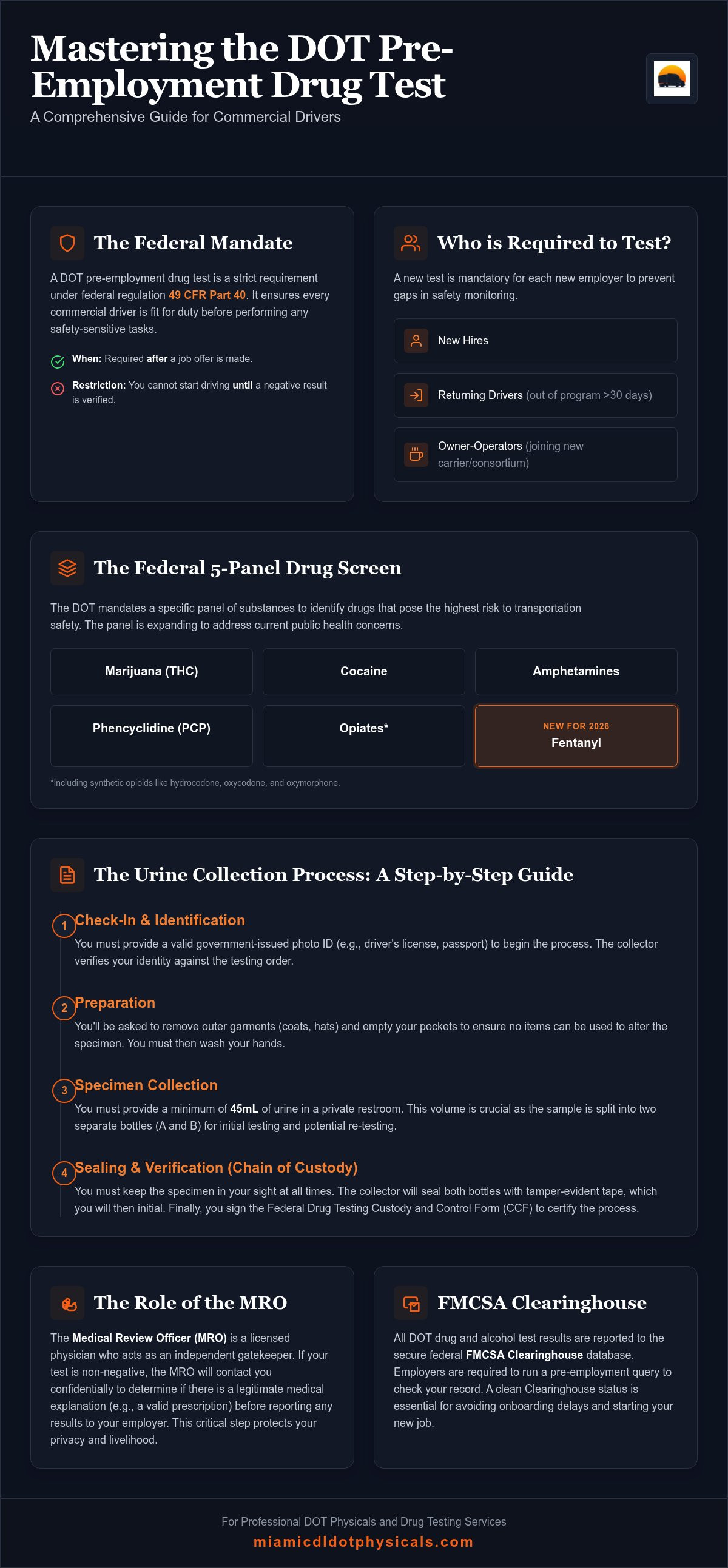
A DOT pre-employment drug test is a federal mandate that requires every commercial driver to pass a screening before they perform safety-sensitive duties for a new employer. This isn't a suggestion; it's a hard requirement under 49 CFR Part 40. The Department of Transportation uses this process to keep impaired drivers off the road and protect companies from massive liability risks. While a standard drug test for a desk job might have flexible rules, the DOT version is highly standardized to ensure every driver meets the same high bar for safety.
Timing is everything with this requirement. Employers can only send you for a DOT pre-employment drug test Miami after they've made a job offer. However, you cannot touch a steering wheel or secure a load until the negative result is verified and recorded. If you start working before the lab clears you, both you and your employer face severe federal penalties. This rule ensures that every professional on the highway is fit for duty from their very first mile.
The 5-Panel Drug Screen Components
The DOT utilizes a specific 5-panel screen to identify substances that most frequently impact driving safety. This panel includes Marijuana (THC), Cocaine, Amphetamines, Phencyclidine (PCP), and Opiates. You should be aware that the opiate category includes synthetic opioids like hydrocodone, hydromorphone, oxycodone, and oxymorphone. As of early 2026, the panel also includes fentanyl and norfentanyl to address the ongoing opioid crisis. The 5-panel test serves as the mandatory federal standard for all commercial transportation drug testing.
Who is Required to Take the Test?
Compliance isn't just for brand-new CDL holders. The mandate applies to several groups who must ensure their records are current before starting work. You'll need a new screen if you fall into these categories:
- New Hires: Anyone joining a new trucking, transit, or logistics firm in a CDL-required role.
- Returning Drivers: Any driver who has been out of a DOT-compliant testing program for more than 30 consecutive days.
- Owner-Operators: Independent drivers who are joining a new consortium or signing a contract with a new carrier.
Even if you had a clean test at your last job, a new employer must initiate a fresh DOT pre-employment drug test Miami to satisfy federal auditors. This consistency prevents gaps in safety monitoring as drivers move between companies.
The Step-by-Step DOT Urine Collection Process
When you arrive for your DOT pre-employment drug test Miami, the process follows a strict sequence to ensure accuracy and fairness. You'll start by providing a valid government-issued photo ID. If you take legally prescribed medications, have your documentation ready, though you usually discuss this with a Medical Review Officer later. These DOT drug and alcohol testing procedures are designed to protect both the driver and the public by ensuring every sample is untainted and correctly identified.
Before you enter the private collection area, you'll be asked to remove outer garments like coats or hats. You must also empty your pockets to confirm you aren't carrying any items that could interfere with the test. The collector will then ask you to wash your hands. Once in the restroom, you must provide at least 45mL of urine. This volume is necessary because the lab splits the specimen into two bottles; one for the initial test and one for a potential re-test if you challenge the results. Choosing a facility that offers both your physical and your DOT drug test can save you significant time during the onboarding phase.
Maintaining the Chain of Custody
The collector's most critical job is managing the Federal Drug Testing Custody and Control Form (CCF). After you provide the specimen, you must keep it in your sight until the collector seals both bottles with tamper-evident tape. You'll then initial the seals to verify they're your samples. This chain of custody tracks every person who touches your specimen from the clinic to the certified laboratory, preventing any chance of a mix-up. Your signature on the CCF confirms that the entire process was handled according to federal law.
What Happens During a "Shy Bladder" Situation?
It's common to feel nervous, and sometimes you simply can't provide the required 45mL immediately. If this happens, it's officially called a "shy bladder" situation. You aren't disqualified right away. Instead, the collector starts a 3-hour clock. During this time, you're allowed to drink up to 40 ounces of fluid to help you produce a sample. You must remain at the collection site during this entire period. If you still cannot provide enough urine after three hours, the test is stopped, and you'll be required to undergo a medical evaluation to determine if a physical condition prevented the collection.
The Role of the Medical Review Officer (MRO) and Result Verification
A Medical Review Officer (MRO) is a licensed physician with specialized training in substance abuse disorders. They act as an independent safeguard between the laboratory and your prospective employer. When you complete a DOT pre-employment drug test Miami, the laboratory sends the results to the MRO for a final review. This step ensures that every result is scientifically valid and legally defensible before it ever reaches a company's safety officer. The MRO's primary job is to determine if a non-negative laboratory result has a legitimate medical explanation.
If the laboratory detects a substance in your sample, the MRO will contact you directly for a private interview. This is your opportunity to provide evidence of legal medication use. You'll have a chance to explain your medical history and provide documentation that justifies the presence of the substance. Throughout this process, your privacy remains a priority. The MRO only reports a final "Negative" or "Positive" status to your employer. They do not disclose your specific medical conditions or the names of your prescriptions, keeping your private health information secure while meeting FMCSA Clearinghouse requirements for safety reporting.
Handling Legitimate Prescription Medications
You should always have your current prescription bottles or pharmacy records easily accessible. Many common medications, such as certain stimulants for ADHD or strong pain relievers, can trigger an initial non-negative result at the lab. When the MRO calls, they will ask for the prescribing physician's name and the pharmacy's contact information to verify your claim. A valid prescription leads to a "Negative" result if used as directed. Once the MRO verifies the prescription is legal and used according to the doctor's orders, the result is downgraded from a laboratory positive to a regulatory negative.
Challenging a Positive Result
Federal law provides you with a specific path to contest a result you believe is inaccurate. You have a 72-hour window from the moment the MRO notifies you of a positive test to request a screening of your "split" sample. As mentioned in the collection process, your specimen was divided into two bottles at the start. If you make this request, the MRO will direct the original laboratory to send the unopened second bottle to a completely different certified laboratory for independent verification. You should know that the driver is typically responsible for the cost of this split sample test, though some employers may choose to cover it. This secondary check is a vital protection for your CDL and your professional reputation.
FMCSA Clearinghouse Requirements for Drivers and Employers
The FMCSA Clearinghouse acts as a national digital record for drug and alcohol violations, ensuring that safety-sensitive infractions follow a driver from state to state. Before you can complete your DOT pre-employment drug test Miami and start your new role, an employer must conduct a full query of this database. This check confirms that you don't have any outstanding violations or unfinished return-to-duty requirements. If a driver tests positive or refuses a test, that information is uploaded immediately, creating a permanent record that only clears once the official rehabilitation process is finished. This system has become the gold standard for road safety by closing the gap between different state licensing agencies.
Registration is a vital first step for every commercial driver. You should create your account long before you apply for a new position. This allows you to review your own record for accuracy and ensures you're ready when a prospective employer requests access. Without a registered account, you can't provide the necessary permissions for a carrier to hire you. Keeping your contact information current in the system also ensures you receive immediate notification if any employer reports a violation or a refusal to test against your CDL number.
Consent and the Query Process
Employers use two types of queries to maintain compliance. A limited query is usually an annual check to see if your record has changed. However, a full pre-employment query is mandatory for every new hire. This process requires your active participation. You must log in to the Clearinghouse portal to grant electronic consent for the employer to see your full history. If you refuse to provide this consent, the employer is legally barred from hiring you for any safety-sensitive position. It's a non-negotiable step in the modern hiring landscape that happens right alongside your DOT pre-employment drug test Miami.
The Return-to-Duty Process After a Violation
If you have a violation on your record, you cannot return to the road until you complete the return-to-duty process. This begins with an evaluation by a Substance Abuse Professional (SAP). The SAP creates a tailored education or treatment plan that you must follow to the letter. Once the SAP clears you, you must pass a return-to-duty drug test before your status in the Clearinghouse changes from "prohibited" to "not prohibited." This process also involves a series of unannounced follow-up tests over the next several months. If you're an owner-operator, managing these requirements is often easier through a specialized FMCSA Clearinghouse Consortium Florida guide. To stay ahead of these federal rules and keep your record clean, you can schedule your compliance services with our certified team today.
Maintaining Compliance with Professional Testing Services
Choosing the right facility for your DOT pre-employment drug test Miami is a strategic decision for your career. A specialized center does more than just collect a sample; it acts as a compliance partner that understands the high stakes of the transportation industry. By utilizing a facility that offers both FMCSA-certified medical exams and drug testing, you eliminate the logistical headache of visiting multiple clinics. This streamlined approach ensures that all your paperwork is handled by experts who are deeply familiar with the 2026 federal updates, including the latest laboratory standards and reporting timelines.
Professional centers utilize SAMHSA-certified laboratories to process every specimen. This certification is the gold standard for accuracy and legal defensibility, protecting you from errors that could derail your hiring process. When your testing is handled efficiently, you reduce the "dead time" between a job offer and your first day on the road. A well-run clinic understands that for a commercial driver, time is literally money. They prioritize speed without sacrificing the rigorous security protocols required by federal law.
Preparing for Your Appointment
To keep your appointment moving quickly, you must arrive prepared. Bring a valid government-issued photo ID, a list of your current medications, and your prospective employer's contact information. Having your medical history ready is particularly helpful if you're combining your drug screen with a physical exam. Many drivers prefer centers that offer same-day testing for their DOT pre-employment drug test Miami because it provides the fastest path to a "Negative" result in the Clearinghouse. For a deeper look at the specific rules governing these sessions, you can read more about DOT drug test Miami for detailed compliance references.
Consortium Solutions for Owner-Operators
If you're an owner-operator, your compliance requirements don't end with a pre-employment test. Federal law requires you to be part of a random drug and alcohol testing consortium. Professional testing centers often manage these consortiums, handling the complex math of random pool selections so you don't have to. They ensure that the correct percentage of drivers is tested throughout the year, keeping you in full compliance with FMCSA standards. This automated management provides peace of mind, allowing you to focus on running your business while experts handle the regulatory heavy lifting. To get started with a team that values your time, book your appointment today and stay road-ready.
Secure Your Future on the Road
Success in the commercial driving industry starts with a commitment to safety and regulatory precision. By staying informed about the 2026 panel updates and the critical role of the Medical Review Officer, you protect your career from unnecessary setbacks. The FMCSA Clearinghouse is now the backbone of driver verification. Keeping your portal active and providing timely consent is just as important as the specimen you provide during your screening. When these elements align, you demonstrate the professionalism that top carriers value most.
Don't let compliance paperwork slow you down when a new opportunity arises. Our facility features FMCSA-certified medical examiners who prioritize your schedule. We offer same-day DOT physicals and drug testing alongside full FMCSA Clearinghouse Consortium management to streamline your onboarding. When you need a reliable DOT pre-employment drug test Miami, we provide the accuracy and speed your livelihood demands. Our team is dedicated to helping you navigate federal requirements with ease and confidence.
Schedule Your DOT Pre-Employment Drug Test Today and take the first step toward a successful 2026 driving season. Your career is waiting, and we are ready to help you reach your goals.
Frequently Asked Questions
What specific drugs are included in a DOT pre-employment drug test?
The standard screen is a 5-panel test that identifies Marijuana, Cocaine, Amphetamines, Phencyclidine (PCP), and Opiates. As of early 2026, the Department of Transportation expanded this panel to include fentanyl and norfentanyl to address rising safety concerns. This federal standard ensures every driver meets the same safety criteria. If you're completing a DOT pre-employment drug test Miami, your sample will be analyzed for these specific substances using highly sensitive laboratory equipment.
How long does it typically take to receive DOT drug test results?
Most negative results are processed and returned within 24 to 48 hours after the laboratory receives the specimen. However, if the initial screen is non-negative, the process takes longer because a Medical Review Officer must verify the findings. This verification involves a private interview and a review of your medical records. While you wait, keep your phone available to respond to any inquiries from the MRO to prevent further delays in your hiring timeline.
Can I start my new driving job before the drug test results are returned?
You cannot perform any safety-sensitive duties until your employer receives a verified negative result from the Medical Review Officer. This rule is strictly enforced under federal law to prevent accidents and reduce liability. Safety-sensitive functions include driving, loading, or inspecting a commercial vehicle. Starting work before the lab clears your result can lead to severe fines for the company and a permanent violation on your federal record, effectively halting your driving career.
Does a DOT drug test check for CBD or marijuana if it is legal in my state?
Federal regulations don't recognize state-level marijuana legalization or medical cards as a valid excuse for a positive test. The DOT maintains a zero-tolerance policy for THC, which is the psychoactive component in marijuana. Drivers should also exercise extreme caution with CBD products. Many of these items contain trace amounts of THC that can accumulate in your system and trigger a positive result during a DOT pre-employment drug test Miami, leading to a prohibited status.
What happens if I fail a DOT pre-employment drug test?
A failed test is immediately reported to the FMCSA Clearinghouse, which places your CDL in a prohibited status. You'll be removed from all safety-sensitive duties and must complete the return-to-duty process. This involves an evaluation by a Substance Abuse Professional (SAP) and a series of unannounced follow-up tests. You won't be eligible to drive for any DOT-regulated employer until the SAP clears you and you pass a fresh return-to-duty drug screen.
Is a new pre-employment drug test required if I am changing employers but have a current medical card?
Yes, a new employer must conduct a pre-employment drug screen regardless of the status of your medical card. Your medical certificate proves physical fitness, but it doesn't satisfy the requirement for a recent drug test. Federal law mandates that every new carrier must have its own verified negative result on file for you. This ensures there are no gaps in your testing history as you transition between different logistics or trucking companies.
How long is a DOT pre-employment drug test result valid for hiring?
A pre-employment result is generally valid for the duration of your immediate hiring process with that specific employer. However, if you've been out of a DOT-mandated random testing program for more than 30 consecutive days, you must undergo a new screen before starting safety-sensitive work. It's best to complete the test as close to your start date as possible to ensure your compliance records are current and fully aligned with federal hiring standards.
What counts as a "refusal to test" during a DOT pre-employment screen?
A refusal to test occurs if you fail to appear at the clinic, leave the site before the process is finished, or fail to provide a sufficient specimen without a medical explanation. Tampering with a sample or failing to cooperate with the collector's instructions also counts as a refusal. In the eyes of the DOT, a refusal carries the same weight as a positive result and will be reported to the Clearinghouse as a serious violation.


