
Did you know that as of early 2026, over 200,000 commercial drivers are currently in a prohibited status within the FMCSA Clearinghouse? It's a staggering number that highlights how easy it is to fall out of compliance when you're juggling complex federal rules. If you're researching DOT vs non-DOT drug testing Miami, you've likely realized that the stakes for your CDL are higher than they've ever been.
We understand that the fear of an administrative error costing you your career is real. It's frustrating to sort through shifting regulations, especially with new 2026 rules regarding direct observation and the pending status of oral fluid testing. This guide is designed to clear the fog. You'll master the critical differences between federal DOT requirements and private workplace testing to ensure your professional standing remains secure. We'll break down exactly what the FMCSA expects from you, how to handle the Clearinghouse, and what you need to know about the latest specimen collection protocols to keep your results fast and hassle-free.
Key Takeaways
- Distinguish between federally mandated screenings and company-specific policies to ensure you always use the correct testing protocol for your specific job role.
- Learn why the rigid 5-panel urine test and Federal Chain of Custody are required for CDL holders, while non-regulated staff may have more flexible testing options.
- Master the reporting rules for the FMCSA Clearinghouse to prevent a "Prohibited" status, a vital step in understanding DOT vs non-DOT drug testing Miami compliance.
- Discover the efficiency of pairing your drug screen with a certified physical exam to keep your medical documentation organized and up to date in a single visit.
- Understand how a professional compliance partner manages the complex 2026 federal requirements and consortium services so you can focus on the road.
DOT vs Non-DOT Drug Testing Miami: Understanding the Fundamental Differences
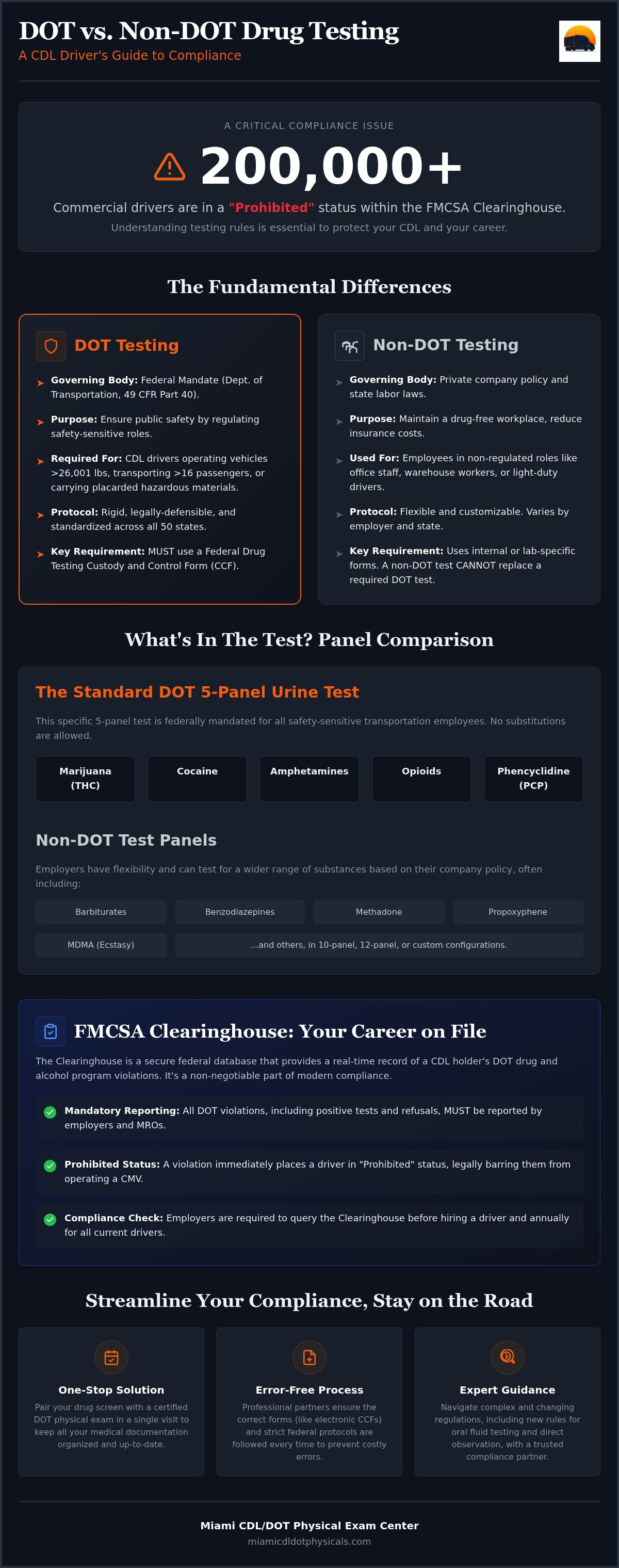
The core difference between DOT vs non-DOT drug testing Miami lies in the authority behind the requirement. DOT testing is a strict federal mandate governed by the Department of Transportation under 49 CFR Part 40. It's designed to ensure public safety by regulating individuals in safety-sensitive roles. In contrast, non-DOT testing is a private policy established by an employer. It follows state laws and internal HR guidelines rather than federal statutes. While both involve drug testing to maintain a safe environment, they operate under entirely different legal frameworks.
One of the most common administrative errors occurs when a driver substitutes a non-DOT test for a required DOT screening. This is a significant compliance violation. Federal law requires a specific Chain of Custody form and oversight by a certified Medical Review Officer (MRO). A standard workplace test lacks these federal safeguards. If you're a CDL holder, taking the wrong type of test won't satisfy FMCSA requirements; it could even lead to a "prohibited" status in the Clearinghouse if a required DOT test is missed as a result.
Who is Required to Take a DOT Drug Test?
Federal regulations identify specific individuals who must participate in the DOT testing pool. This isn't optional; it's a condition of maintaining your professional credentials. You fall under these rules if you operate:
- Vehicles with a gross vehicle weight rating (GVWR) of 26,001 pounds or more.
- Vehicles designed to transport 16 or more passengers, including the driver.
- Any vehicle transporting hazardous materials that require federal placarding.
Beyond trucking, these requirements extend to safety-sensitive roles in aviation, rail, transit, and maritime industries. For CDL holders, being part of this pool means you're subject to pre-employment, random, post-accident, and reasonable suspicion testing under federal guidelines.
When is a Non-DOT Test Appropriate?
Non-DOT testing is the right choice for employees who don't perform safety-sensitive duties defined by federal law. Employers often use these tests to maintain a drug-free workplace and reduce insurance premiums. In Florida, companies following the Drug-Free Workplace Act can receive a 5% discount on workers' compensation insurance. Common scenarios include:
- Pre-employment screening for office-based staff or warehouse workers.
- Post-accident testing for light-duty vehicles that don't meet DOT weight or passenger criteria.
- Reasonable suspicion testing for employees in non-regulated roles.
Because these tests are discretionary, employers have more flexibility. They can choose which substances to test for and what the consequences of a positive result will be, provided they follow state labor laws.
The DOT Drug Testing Process: Federal Standards for Safety-Sensitive Roles
The DOT drug testing process isn't just about collecting a sample; it's a highly regulated legal procedure. While private companies can choose their own rules, federal law mandates strict consistency. This ensures that a driver in one state is held to the exact same standard as a driver in another. The foundation of this system is the DOT drug and alcohol rules, which prioritize public safety through standardized protocols across all 50 states.
One major difference in the DOT vs non-DOT drug testing Miami landscape is the "Chain of Custody." For DOT tests, collectors must use a Federal Drug Testing Custody and Control Form (CCF). This document tracks the specimen from the moment it leaves the donor's sight until it reaches the lab. Any break in this chain can invalidate the test. Most providers have transitioned to electronic CCFs (eCCFs) in 2026 to minimize clerical errors and accelerate reporting. This digital trail ensures that your sample is never confused with another, providing a level of security that standard workplace tests often lack.
The Standard DOT 5-Panel Breakdown
The DOT requires a specific 5-panel urine test. You cannot swap this for a 10-panel or a "quick test" kit if you are in a safety-sensitive role. The panel includes:
- Marijuana (THC)
- Cocaine
- Amphetamines (including methamphetamines and MDMA)
- Opioids (including codeine, morphine, and semi-synthetic opioids like oxycodone and hydrocodone)
- Phencyclidine (PCP)
The 2026 standards continue to include semi-synthetic opioids to address evolving safety concerns. The cut-off level is the specific concentration of a substance in the urine that must be met for a lab to report a result as positive.
The Role of the Medical Review Officer (MRO)
The Medical Review Officer (MRO) acts as an independent gatekeeper. Their job is to review laboratory results and ensure they are accurate. If a lab reports a "non-negative" result, the MRO contacts the driver directly. This interview is a critical protection for the driver. It allows you to provide proof of a legitimate medical prescription that might explain the result. The MRO then determines if there is a valid medical explanation for the presence of the drug before it's reported to your employer.
In a non-DOT testing environment, an MRO review isn't always mandatory. This lack of oversight can lead to unfair disciplinary actions based on false positives or simple clerical mistakes. For DOT-regulated professionals, having a certified expert verify the science is a vital safeguard for your livelihood. If you need a provider who understands these nuances, it's helpful to work with a specialized compliance partner who prioritizes accuracy and driver rights. This level of professional oversight is what keeps your CDL in good standing while ensuring you are treated fairly throughout the process.
Comparing DOT and Non-DOT Drug Testing Protocols and Panels
Understanding the logistical differences in DOT vs non-DOT drug testing Miami is essential for any fleet manager or CDL holder. While both involve a laboratory analysis, the protocols governing them are worlds apart. A non-DOT test is essentially a private agreement between an employer and an employee. In contrast, the FMCSA's drug and alcohol testing program dictates every step of the federal process, from the specific moment of notification to the final reporting of results. This federal rigidity ensures that every driver is treated exactly the same, regardless of which carrier they work for.
Panel Flexibility vs. Federal Rigidity
Employers conducting non-DOT tests have the freedom to customize their drug panels. It's common for private companies to use 10-panel or 12-panel screens that include barbiturates, benzodiazepines, or alcohol. They might even opt for hair or oral fluid testing to get a longer detection window or a less invasive collection. However, DOT testing remains strictly limited to the 5-panel urine test. As of September 2026, while the DOT has authorized oral fluid testing as an alternative, it hasn't been implemented yet because no HHS-certified labs are available to process the samples. Federal panels can only be changed through formal rulemaking, meaning you'll never see substances on a DOT screen that aren't federally approved.
Reporting and Recordkeeping Differences
The consequences of a test result differ significantly based on who owns the data. If you fail a non-DOT test, that information usually stays within your company's HR files. It's a private matter governed by your employment contract and state laws. However, a DOT violation is a matter of federal record. Any positive result or "refusal to test" is immediately reported to the FMCSA Clearinghouse. With over 200,000 drivers currently in a prohibited status in early 2026, this federal database ensures that safety violations follow a driver from one job to the next. Corporate records might eventually be purged, but Clearinghouse records remain visible to all future employers until the Return-to-Duty process is fully completed.
Refusing a test also carries different weight in each scenario. In the private sector, a refusal might lead to termination based on company policy; in the DOT world, a refusal to test is legally equivalent to a positive result. It triggers an immediate removal from safety-sensitive duties and requires a formal evaluation by a Substance Abuse Professional (SAP). Staying compliant means respecting these rigid federal boundaries to protect your professional future and your ability to stay on the road.
Managing Compliance and the FMCSA Clearinghouse for CDL Holders
For a CDL holder, the most significant consequence in the DOT vs non-DOT drug testing Miami debate is the FMCSA Clearinghouse. This database is a permanent digital record of your safety history. While a non-DOT failure might stay between you and a private company's HR manager, a DOT violation goes straight to the federal government. Once a violation is recorded, your status changes to "Prohibited." This isn't just a label; it's a legal barrier that prevents you from performing any safety-sensitive functions, including driving a commercial motor vehicle, until you've successfully completed a specific federal protocol.
The stakes are high because your livelihood depends on a clean record. As of early 2026, more than 200,000 drivers are currently in a prohibited status. Most of these drivers remain sidelined because they haven't started or finished the necessary steps to regain their eligibility. Understanding how this system works is the best way to protect your professional standing and ensure you don't become part of that statistic due to a simple misunderstanding of the rules.
FMCSA Clearinghouse Queries and Violations
Employers must query the database at least once a year for every driver they employ. They also perform a deep query before hiring any new driver. If you have a violation on your record, it's visible to every carrier you apply to. For owner-operators, the rules are even more specific. You're required to belong to a random testing pool and must designate a C/TPA to report violations on your behalf. Managing these filings alone is difficult; many drivers choose to join a specialized FMCSA Clearinghouse Consortium Florida to ensure every report is filed correctly and on time.
The Return-to-Duty (RTD) Process
If you find yourself in a prohibited status, the path back to the driver's seat is the Return-to-Duty process. This starts with an evaluation by a Substance Abuse Professional (SAP). The SAP is a federally recognized expert who determines your required treatment or education plan. This process is mandatory for DOT violations but almost never applies to non-DOT failures. The timeline for completion depends on your individual progress and the SAP's specific recommendations. It's a significant investment of time and resources, but it's the only legal way to clear your prohibited status and return to the road.
Staying compliant means recognizing that the federal government treats your CDL as a professional credential that requires constant upkeep. Don't let an administrative oversight or a misunderstood testing requirement sideline your career. If you're looking for a partner to help you manage these requirements, you can schedule your compliance services today to ensure your records remain spotless and your career stays on track.
Streamlining Your Testing Program with Professional Compliance Services
Managing your professional requirements shouldn't be a full-time job. When you're comparing DOT vs non-DOT drug testing Miami options, the goal is finding a partner that understands the stakes of your livelihood. A specialized medical center handles both regulated and non-regulated needs with precision, ensuring that a simple paperwork error doesn't lead to a suspended license. By centralizing your compliance, you reduce the risk of administrative gaps that often occur when using multiple providers for different staff roles.
Why Specialized Medical Centers Matter
Precision is everything in federal testing. A "fatal flaw" in the collection process, such as using the wrong custody and control form or failing to document a temperature check, can invalidate a test and trigger an immediate compliance review. Specialized centers employ FMCSA-certified examiners who are trained specifically to avoid these errors. There's also the undeniable efficiency of a "one-stop-shop" approach. You can easily combine your drug screen with a DOT physical Miami during a single visit. This saves you time and keeps all your medical documentation in one secure, accessible location, ensuring you meet 2026 compliance standards for all federal agencies.
Consortium Services for Fleet and Owner-Operators
For owner-operators, compliance isn't just about passing a test; it's about being part of a random selection pool. Federal law requires solo drivers to belong to a consortium because they cannot pull their own names for random testing. These services automate the random selection process, ensuring you meet the annual testing rates required by the FMCSA. A professional consortium also provides audit support and recordkeeping, giving you peace of mind if an inspector ever requests your files. It's a proactive way to manage your career without the stress of manual tracking or missed deadlines.
Choosing the right testing site is about more than just convenience. It's about protecting your career with experts who know the federal rules as well as you know the road. Whether you're an individual driver or managing a small fleet, professional compliance services ensure you're always ready for the next haul. Schedule your DOT drug test Miami or physical today to stay ahead of federal requirements and keep your business moving forward.
Secure Your Career with Expert Compliance
Maintaining your professional standing depends on understanding the strict boundaries of federal regulations. Whether you are a fleet manager or an owner-operator, knowing the nuances of DOT vs non-DOT drug testing Miami ensures you never face the career-ending "Prohibited" status in the FMCSA Clearinghouse. By choosing a partner that specializes in transportation compliance, you gain access to FMCSA-Certified Medical Examiners who prioritize accuracy and speed. We handle everything from instant Clearinghouse reporting to comprehensive owner-operator consortium management, ensuring your records are always audit-ready.
Don't leave your livelihood to chance or administrative oversight. Streamline your compliance today by choosing a dedicated center that understands the 2026 standards inside and out. Our team is ready to help you navigate these requirements with ease and efficiency. Book Your DOT or Non-DOT Drug Test Today and focus on what you do best: keeping your business moving forward. We are here to support your professional success every mile of the way.
Frequently Asked Questions
Can a non-DOT drug test result be reported to the FMCSA Clearinghouse?
No, non-DOT drug test results are never reported to the FMCSA Clearinghouse. Federal law only requires the reporting of violations that occur under DOT-regulated testing protocols. If you test positive on a private company screen, it remains a private matter between you and your employer. However, this result won't satisfy federal requirements if you were supposed to be taking a DOT-mandated test instead for your commercial driving duties.
What happens if I accidentally take a non-DOT test for my CDL pre-employment?
Taking a non-DOT test for a CDL pre-employment requirement is a major compliance error. Federal law requires a specific DOT 5-panel test using a Federal Chain of Custody form. If you accidentally take a standard workplace test, you'll need to return to the clinic for a proper DOT screening. This is a critical distinction when navigating DOT vs non-DOT drug testing Miami requirements to keep your commercial license in good standing.
Does a DOT drug test include alcohol screening?
A standard DOT urine drug test does not include alcohol screening. However, the DOT does mandate alcohol testing in specific situations, such as random selections or post-accident investigations. These alcohol tests typically use breath or saliva samples rather than urine. While the drug panel is fixed, the 2026 FMCSA random alcohol testing rate remains at 10% of the driver pool to ensure road safety across the country.
How long does a DOT drug test violation stay on my record in 2026?
In 2026, a violation stays visible in the FMCSA Clearinghouse for five years. However, this timeline only applies if you have successfully completed the Return-to-Duty process and all follow-up testing. If you don't complete these steps, the violation remains on your record indefinitely. With over 200,000 drivers currently in a prohibited status, it's vital to follow the SAP program guidelines to clear your federal record and return to work.
Are the cut-off levels different for DOT and non-DOT drug tests?
Yes, cut-off levels for DOT tests are strictly regulated by federal law to ensure nationwide consistency. These levels determine the exact concentration of a substance required to trigger a positive result. Non-DOT tests are much more flexible. Employers can choose their own cut-off levels based on company policy or state guidelines. This flexibility allows private companies to be more or less stringent than federal standards depending on their specific safety needs.
Can I use a prescription medication and still pass a DOT drug test?
You can pass a DOT drug test while using prescription medication if you have a valid medical explanation. When a lab identifies a substance, a Medical Review Officer (MRO) will interview you to verify your prescription. If the MRO determines the medication is legally prescribed and doesn't pose a safety risk, they'll report the result as negative. Always keep your current prescriptions documented to avoid unnecessary delays during the verification process.
What is a 'refusal to test' and does it have the same impact as a positive result?
A refusal to test occurs when a driver fails to provide a sample or leaves the collection site before the process is finished. Under federal law, a refusal has the exact same impact as a positive test result. It triggers an immediate "prohibited" status in the FMCSA Clearinghouse and requires you to complete the full Return-to-Duty process. Never leave a testing site until the collector confirms the process is complete and you're released.
Is hair testing currently accepted for DOT drug screenings in 2026?
Hair testing is not currently accepted for DOT drug screenings in 2026. While some private employers use hair samples for non-DOT testing due to the longer detection window, the DOT only authorizes urine and oral fluid collection. Even with oral fluid testing authorized, implementation is still pending the certification of enough laboratories. For now, urine remains the only operational specimen for meeting your federal DOT compliance requirements and maintaining your safety-sensitive position.


