

A single failed drug screen can feel like the end of your commercial driving career, especially with the FMCSA now requiring state agencies to downgrade licenses for drivers in prohibited status. You've worked hard for your CDL, and the thought of a permanent downgrade is enough to keep any professional up at night. When searching for a DOT return to duty drug test Miami area professionals need to clear their records, the pressure of strict federal timelines and complex Clearinghouse updates can feel overwhelming.
We understand that the path back to the driver's seat feels like a maze of SAP evaluations and mandatory paperwork. This guide will help you navigate the federal return to duty process with total confidence, showing you exactly how to protect your livelihood after a violation. We'll break down the six essential steps of the RTD journey, from your initial evaluation to achieving that not prohibited status in the Clearinghouse, ensuring you meet every requirement for a successful negative test result.
Key Takeaways
- Learn how a DOT return to duty drug test Miami area professionals need is triggered by specific violations like failed tests or refusals.
- Understand the mandatory role of the Substance Abuse Professional (SAP) in evaluating your progress and clearing you for safety-sensitive work.
- Discover how to monitor your FMCSA Clearinghouse profile to ensure your status updates to not prohibited after completing the required steps.
- Prepare for the unique procedural requirements of the return-to-duty collection, including the federal mandate for direct observation during the test.
- Navigate the long-term compliance strategy needed to manage the minimum of six unannounced follow-up tests required in your first year back.
What is a DOT Return to Duty Drug Test?
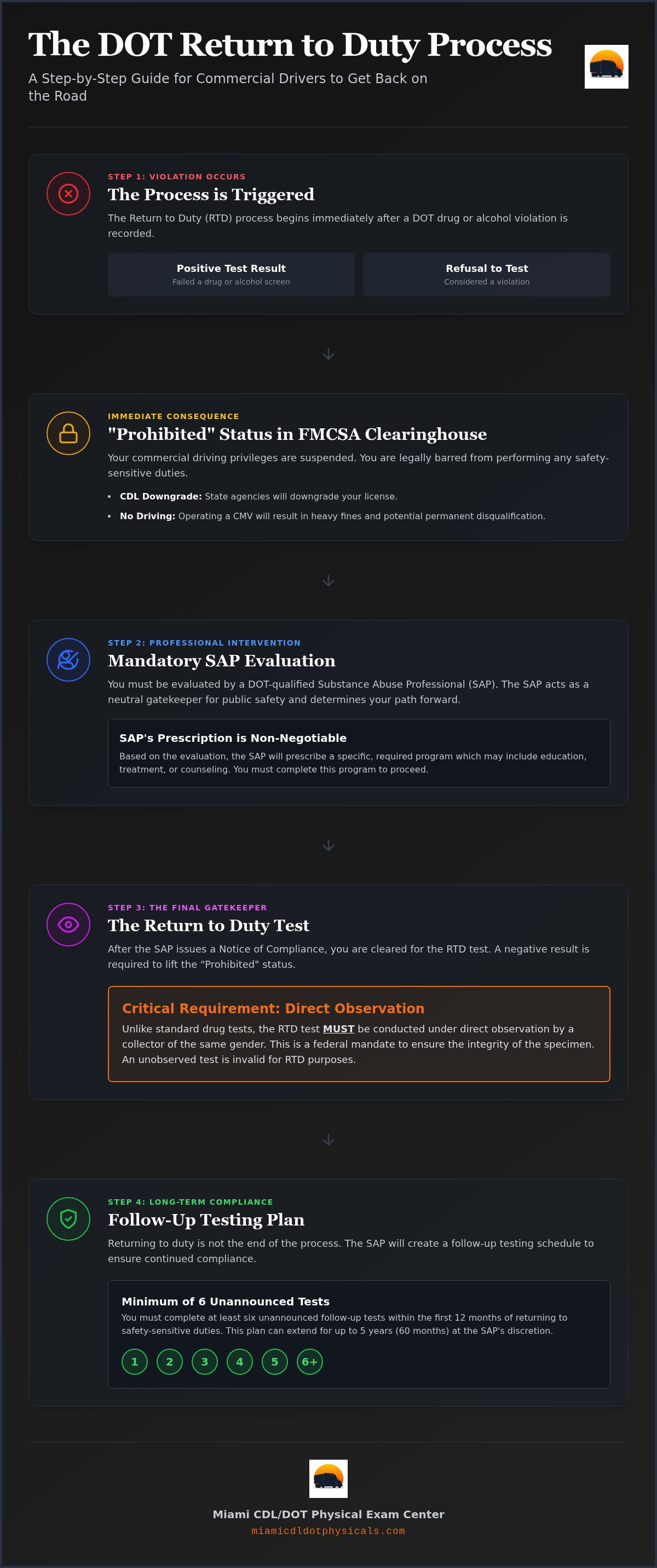
The DOT return to duty process isn't just another box to check. It's a strict federal requirement under 49 CFR Part 40 that every commercial driver must follow after a drug or alcohol violation. If you've tested positive, refused a test, or self-admitted to substance use, you're immediately placed in a prohibited status. This means you cannot perform any safety-sensitive functions, including driving a commercial motor vehicle, until you successfully complete the return to duty steps. When looking for a DOT return to duty drug test Miami area drivers need to clear their records, it's vital to understand that this specific test is the cornerstone of your professional recovery.
You might think a standard pre-employment test can get you back on the road, but that's a common mistake. A return to duty (RTD) test is different because it must be conducted under direct observation. This means a collector of the same gender must physically monitor the provision of the specimen to ensure its integrity. Federal law is very clear on this point: a standard, unobserved test will not change your status in the FMCSA Clearinghouse. Only a negative RTD result, verified by a Medical Review Officer (MRO), can move you from prohibited to not prohibited status.
The Legal Framework of Part 40 Compliance
The Department of Transportation views drug testing as a primary tool for maintaining public safety on our highways. These regulations aren't meant to be punitive; they're designed to ensure that every driver behind the wheel of a heavy vehicle is fit for duty. While a non-DOT workplace screening might have flexible rules set by a private company, DOT-regulated testing follows a rigid legal structure that leaves no room for error. This consistency protects you by providing a clear, predictable path to follow when your career is on the line. It ensures that every driver is held to the same high standard, which keeps the industry reputable and the public safe.
When the RTD Process Becomes Mandatory
A driver enters the prohibited phase the moment a violation is reported to the FMCSA Clearinghouse. Once that status is live, the clock starts ticking on your commercial license. Under rules effective in 2026, state licensing agencies are now required to downgrade the CDL of any driver in prohibited status, often within 60 days. Attempting to drive before your status is updated to not prohibited is a major violation that can lead to heavy fines and a permanent loss of your driving privileges. The RTD test is the final gatekeeper before resuming safety-sensitive duties.
The Mandatory Substance Abuse Professional (SAP) Evaluation
The Substance Abuse Professional (SAP) is the most critical partner in your journey back to work. Unlike a standard company doctor, the SAP acts as an independent gatekeeper representing the public interest. Their primary job is to evaluate why a violation occurred and determine what steps you must take to ensure it doesn't happen again. You can't just pick anyone for this role. You must find a qualified professional who meets the specific credentialing requirements set by the federal government. This isn't a choice your employer can make for you; it's a regulatory requirement that puts the SAP in charge of your path to recovery.
The Initial Assessment and Recommendation Phase
During your first meeting, the SAP will conduct a thorough face-to-face assessment. This isn't an interrogation. It's a professional evaluation of your history and the specific circumstances of the violation. Based on this interview, the SAP will prescribe a specific plan tailored to your situation. This plan might include drug education classes, intensive outpatient treatment, or individual counseling. These recommendations are completely non-negotiable. According to DOT's official procedures, an employer cannot hire you back or even send you for a test until the SAP confirms you've successfully completed this prescribed program. The SAP will log your initial evaluation and the start of your treatment plan directly into the FMCSA Clearinghouse to track your progress.
The Follow-Up Evaluation and Notice of Compliance
Once you've finished your education or treatment, you'll return for a follow-up evaluation. The SAP will review your progress reports and conduct another assessment to verify you've met all requirements. If they're satisfied with your progress, they'll issue a Notice of Compliance. This document is the green light your employer needs to schedule your DOT return to duty drug test Miami services. It's the moment you transition from the prohibited phase back into the testing phase. If you're an owner-operator struggling with these administrative burdens, joining an FMCSA Clearinghouse Consortium can help streamline the process. The SAP will also create a long-term follow-up testing schedule that stays with you for at least 12 months. This plan is designed to support your long-term success as you get back behind the wheel.
Navigating the FMCSA Clearinghouse During Return to Duty
The FMCSA Clearinghouse is the central nervous system of the federal drug and alcohol program. It's a secure online database that gives real-time access to your violation history. For any driver in the middle of a recovery plan, this portal is where your professional life is on display. You must take an active role in monitoring your own status through the driver portal. Don't assume the system updates itself instantly. It's your responsibility to ensure every milestone is recorded correctly. When you finally sit for your DOT return to duty drug test Miami, the negative result is the key that unlocks your ability to drive again. However, that result only matters if your employer reports it to the Clearinghouse within three business days.
Updating Your Driver Status to 'Not Prohibited'
Your status in the Clearinghouse doesn't change just because you finished a treatment program. The SAP must first enter the date they completed your initial assessment and the date they determined you were eligible for testing. Only after these dates are logged can an employer even order an RTD test. Once the negative result is uploaded, your status should shift from "Prohibited" to "Not Prohibited." This update typically reflects in the database within 24 hours, but technical glitches can happen. If you see a delay, check with your SAP first to ensure they've uploaded the "Ready for Testing" notice. Without that specific digital handshake, the system will block any attempt to clear your name.
Consortium Management for Owner-Operators
Owner-operators face a unique challenge because federal law prohibits them from managing their own drug testing and Clearinghouse reporting. You can't report your own RTD result. Instead, you must be enrolled in a DOT drug test Miami consortium to handle these administrative tasks. A professional FMCSA Clearinghouse consortium Florida provider acts as your designated agent. They ensure the five critical steps of the DOT return-to-duty process are followed: the violation report, the SAP designation, the "Ready for Testing" notice, the RTD test result, and the completion of the follow-up testing plan. Using a consortium removes the stress of administrative errors that could keep you off the road longer than necessary. It's the most efficient way to maintain long-term compliance while focusing on your driving career.
What to Expect During the Return to Duty Testing Process
The day of your test represents the final hurdle before you can legally resume your driving career. You must arrive at the collection site prepared with a government-issued photo ID and any specific authorization forms provided by your employer or SAP. Showing up without the correct identification can result in a turned-away collection, which may be reported as a refusal. When you schedule your DOT return to duty drug test Miami services, remember that this visit will differ significantly from a standard pre-employment or random screen. You should plan for extra time at the facility to ensure every part of the federal protocol is followed to the letter.
The Direct Observation Collection Procedure
Federal law mandates that all return to duty and follow-up tests be conducted under direct observation. This means a collector of the same gender must physically observe the specimen as it enters the collection container. While this can feel intrusive, it's a non-negotiable protocol designed to ensure the total integrity of the sample. Collectors are trained to handle this process with professionalism and respect for your dignity, but they must follow the specific steps required by the Department of Transportation. If you refuse to be observed, the collector must document the incident as a refusal to test. This is treated exactly like a second drug violation, which could effectively end your commercial driving career.
Laboratory Analysis and MRO Verification
Your specimen will undergo a standard 5-panel analysis at an HHS-certified laboratory. This screen checks for marijuana, cocaine, amphetamines, opioids, and phencyclidine (PCP). Once the lab completes its work, the results go to a Medical Review Officer (MRO). The MRO is an independent physician responsible for verifying that the testing process was followed correctly. If a result is flagged as positive, the MRO will contact you directly to ask if there's a legitimate medical explanation, such as a valid prescription. Be honest and provide your pharmacy information quickly to avoid delays. You should also stay hydrated but avoid over-consuming water right before the test. A "dilute" result happens when there's too much water in the sample, and in an RTD scenario, this often requires an immediate re-test under even stricter conditions. Only a verified negative result allows a return to safety-sensitive work. To ensure your testing is handled by experts who understand these complex federal rules, book your DOT drug test with an FMCSA-certified provider.
Follow-Up Testing and Long-Term Compliance Strategy
Completing your initial DOT return to duty drug test Miami is a significant victory, but it's important to view it as the start of a new phase rather than the finish line. Once you're back in the driver's seat, you enter a period of heightened oversight governed by a specific follow-up testing plan. This plan is separate from the standard random testing pool your employer already maintains. While you'll still be subject to random screens like any other driver, these follow-up tests are mandatory additions designed to ensure your long-term success and safety on the road. When you undergo the DOT return to duty drug test Miami drivers rely on for compliance, it triggers the start of this mandatory schedule.
The federal minimum for this program is at least six unannounced tests within the first 12 months of your return. However, your SAP has the authority to require more frequent testing or extend the duration of the plan for up to 60 months. This five-year window reflects the DOT's commitment to sustained recovery and public safety. Your employer is legally obligated to carry out this plan exactly as the SAP wrote it. They don't have the discretion to skip tests or reduce the frequency, even if you've been a model employee since your return. This consistency is what keeps the industry safe and your career on track.
Managing the Follow-Up Testing Schedule
To remain effective, these tests must stay completely unannounced. There is no set pattern, and you shouldn't be able to predict when your next collection will occur. This process is typically managed by the Designated Employer Representative (DER), who coordinates with the collection site to ensure compliance. If you decide to change employers during this period, your follow-up testing requirements don't disappear. The remaining tests must be completed with your new company. The SAP's plan is a permanent part of your regulatory record until every requirement is met, making it vital to maintain open communication with your DER during any career transition.
Completing the Journey: Final Clearinghouse Updates
Your journey is officially complete only when the final test in your SAP-mandated schedule is finished. At this point, your employer must log into the FMCSA Clearinghouse and mark your follow-up testing plan as "complete." This is a critical administrative step that many drivers overlook. Until this box is checked, your record won't reflect a fully restored status. Regularly checking your driver portal ensures that these updates happen on time. Maintaining a clean record after this point is the best way to ensure long-term career stability and protect the investment you've made in your professional recovery. For owner-operators, managing this through an FMCSA Clearinghouse Consortium is the most reliable way to guarantee that every final update is handled correctly.
Take Control of Your Professional Recovery Today
Reclaiming your commercial driving career requires a commitment to the federal return to duty process. It's a journey that starts with a qualified SAP and ends with a negative test result that restores your status in the Clearinghouse. By understanding the requirement for direct observation and the importance of the six mandatory follow-up tests, you can move forward without the fear of administrative delays or license downgrades. When you're ready to schedule the DOT return to duty drug test Miami drivers need for compliance, you don't have to navigate these complex rules alone.
Our team provides the expertise you need to clear your record efficiently. We offer FMCSA-Certified Medical Examiners, fast and professional testing results, and expert Clearinghouse consortium management to keep your paperwork in order. Schedule your DOT drug test and join our compliance consortium today to put this violation in the rearview mirror. You've done the hard work of completing your treatment; now let us handle the technical details of your compliance. Your career is worth the effort, and we're here to help you succeed.
Frequently Asked Questions
How long does the DOT return to duty process typically take?
The timeline for the return to duty process varies significantly based on the Substance Abuse Professional's (SAP) specific treatment or education plan. Some drivers might complete requirements in a few weeks, while others with intensive treatment needs could take several months. You can't rush the process because the SAP has the final authority to determine when you're ready for a DOT return to duty drug test Miami services. Cooperation is the fastest path back.
Can I use a different SAP if I don't like the first one's recommendations?
Federal regulations strictly prohibit SAP shopping. Once you have had an initial evaluation with a qualified professional, you are required to complete the specific education or treatment program they prescribe. You cannot seek a second opinion simply because you disagree with the first SAP's findings. Attempting to switch providers to find a more lenient plan is a violation of the return to duty protocols and will likely result in further career delays.
Who is responsible for paying for the SAP evaluation and RTD drug test?
The Department of Transportation does not mandate who pays for the return to duty process. Employer policy or individual contracts usually determine these costs. In many cases, the driver pays for all fees associated with the SAP evaluation and the drug screening. Verify your company's specific policy before beginning the process. This helps you avoid unexpected financial burdens as you work toward getting back on the road.
What happens if I fail my return to duty drug test?
Failing this test is a major setback. You will remain in prohibited status in the FMCSA Clearinghouse. If this happens, you must start the entire return to duty process over from the beginning. This includes a new SAP evaluation and a new prescribed treatment plan. Work with a provider specializing in DOT return to duty drug test Miami to ensure you understand every requirement before your next attempt.
Is the return to duty test always an observed collection?
Federal law under 49 CFR Part 40 requires that all return to duty and follow-up tests be conducted under direct observation. A collector of the same gender must witness the provision of the specimen. This rule is a non-negotiable safety standard intended to prevent the subversion of the testing process. Any refusal to undergo an observed collection is legally treated as a second violation. This can lead to a permanent loss of your commercial driving privileges.
Can I work a non-driving job while I am in the return to duty process?
You are only prohibited from performing safety-sensitive functions while in the return to duty process. While you cannot drive a commercial motor vehicle, you can legally work in other roles:
- Warehouse labor or loading dock work
- Administrative office support
- Vehicle maintenance and mechanical repairs
Many drivers maintain these positions to support themselves financially while completing their SAP-mandated programs. Once your status updates to not prohibited, you can resume driving duties.
How do I find my current status in the FMCSA Clearinghouse?
Check your current status by logging into your account on the official FMCSA Clearinghouse website. The Driver Portal dashboard clearly shows if you are in prohibited or not prohibited status. It also tracks which steps of the return to duty process have been uploaded by your SAP or employer. Monitor this portal regularly. It is the best way to ensure your records are updated promptly as milestones are completed.
Do I need to take a new DOT physical after completing the RTD process?
While the DOT return to duty process focuses on drug and alcohol compliance, your employer may require a new DOT physical exam before you return to the road. If your medical examiner's certificate expired during your time away from safety-sensitive duties, a new exam is mandatory. Even if your card is still valid, many companies use a fresh physical to ensure you meet fitness-for-duty standards after a long absence. This ensures total regulatory compliance.


