
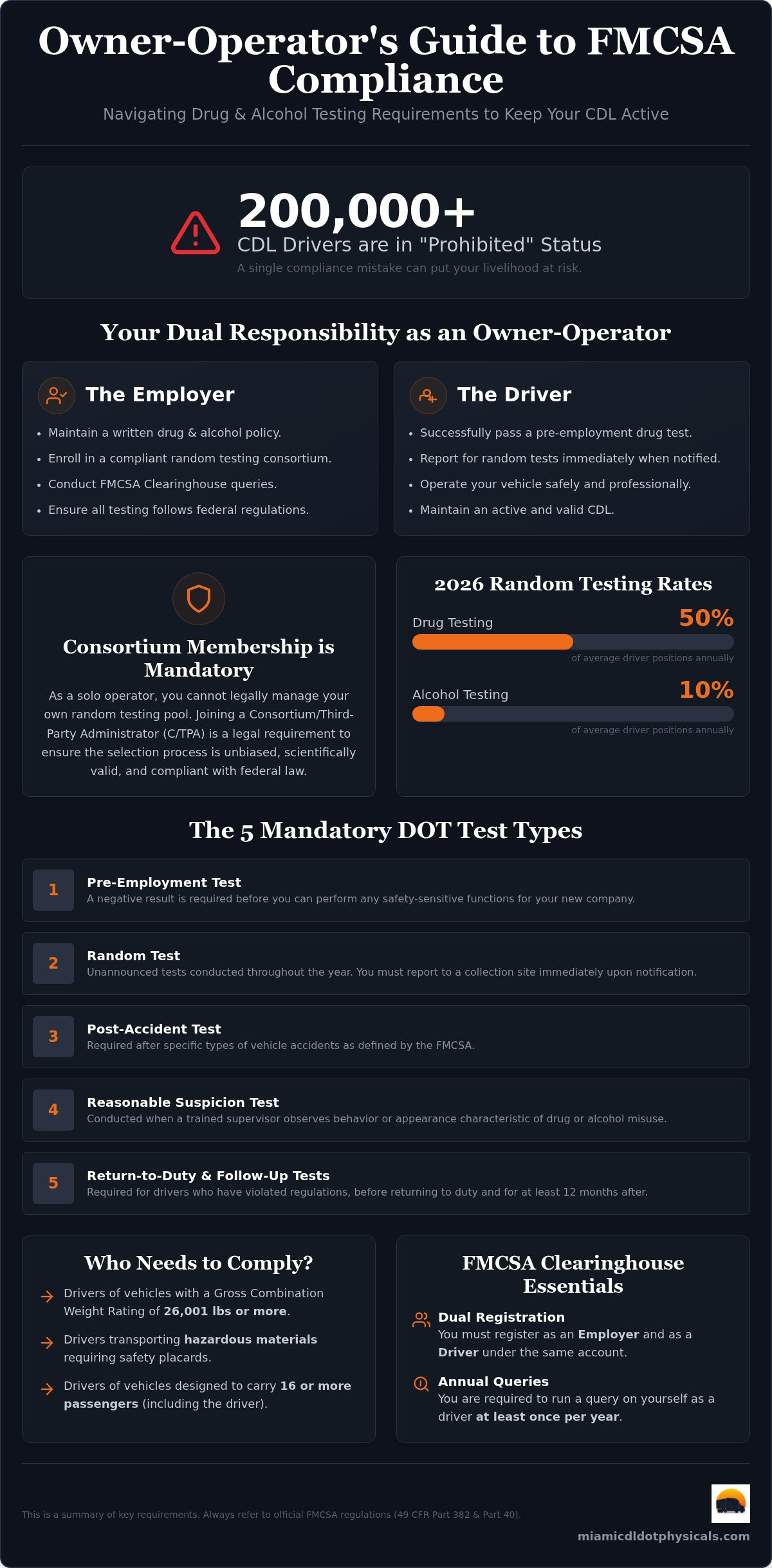
Over 200,000 CDL drivers are currently in "prohibited" status in the FMCSA Clearinghouse, with many facing a permanent downgrade of their license. It's a stressful reality for any solo driver. You're balancing the roles of both the business owner and the driver, which makes staying on top of owner operator drug testing program requirements feel like a full-time job. You might feel confused by the difference between a consortium and a pool, or perhaps you're worried that a single missed notification could end your career.
We understand that your livelihood depends on your CDL. This guide will show you how to master these federal mandates to keep your business fully compliant with FMCSA regulations. We'll break down the 2026 random testing rates, explain why joining a consortium is a legal necessity for solo operators, and provide a clear path to managing the FMCSA Clearinghouse with ease. By the end of this article, you'll have a "set it and forget it" solution to protect your business and your future on the road.
Key Takeaways
- Understand your dual role as both employer and driver to ensure you're meeting all FMCSA safety standards simultaneously.
- Learn the specific owner operator drug testing program requirements for 2026, including the mandatory 50% random drug testing rate.
- Discover why solo drivers cannot legally manage their own random pools and how a consortium acts as your essential compliance shield.
- Simplify the FMCSA Clearinghouse process by mastering dual registration and the annual query requirements to keep your CDL active.
- Follow a clear, two-step plan to formalize your business and enroll in a professional testing program today.
FMCSA Drug and Alcohol Testing Requirements for Owner-Operators
If you run your own truck, the FMCSA sees you through two different lenses. You're the driver responsible for safe operation, but you're also the motor carrier responsible for compliance. This dual role is the "Employer-Driver" dynamic, and it's the foundation of all owner operator drug testing program requirements. You can't simply ignore the administrative side because you're the only one on the payroll. Federal law requires you to perform the same oversight that a safety director at a large fleet would provide.
One of the biggest hurdles is the random testing pool. You cannot legally manage your own random selections. The FMCSA requires testing to be truly random and scientifically valid. If you were in charge of your own pool, you'd know exactly when your name was coming up, which defeats the purpose of the safety program. To stay legal, you must join a consortium that groups you with other drivers to ensure the selection process is unbiased and meets federal percentage mandates.
Beyond the testing itself, you're required to maintain a written drug and alcohol policy under 49 CFR §382.601. This document isn't just a formality; it's a rulebook that outlines exactly how your business handles violations, testing procedures, and driver rights. All testing must follow the strict protocols of 49 CFR Part 40. This regulation dictates the "how-to" of transportation workplace testing, covering everything from how the urine sample is collected to how the laboratory reports the results.
The Legal Framework: 49 CFR Part 382
This specific regulation outlines the "what" and "why" of testing for commercial drivers. As a motor carrier, you're responsible for ensuring every test is conducted at the right time and documented correctly. During a DOT audit, claiming you didn't know the rules won't save your business from heavy fines. This is where a Service Agent, or Consortium/Third-Party Administrator (C/TPA), becomes your best ally. They help you navigate owner operator drug testing program requirements by handling the technical details of 2026 compliance, acting as a bridge between the regulations and your daily operations.
Who is Covered Under These Requirements?
These rules apply to anyone who must meet Commercial Driver's License (CDL) requirements to operate. Specifically, you're covered if you drive:
- Vehicles with a gross combination weight rating of 26,001 lbs or more.
- Trucks transporting hazardous materials that require safety placards.
- Vehicles designed to carry 16 or more passengers, including the driver.
If you fall into any of these categories, you're legally mandated to be part of a compliant testing program from the moment you start your business.
The 5 Mandatory Types of DOT Drug and Alcohol Tests
Compliance isn't a one-time event. It's a series of triggers based on your professional activity and the specific situations you encounter on the road. Meeting owner operator drug testing program requirements means understanding when each of these five tests applies. These categories form the backbone of the FMCSA drug and alcohol testing requirements that keep your business legal and your CDL active.
Pre-Employment Testing: Your Entry into the Industry
You cannot legally perform safety-sensitive functions until you have a negative pre-employment drug test result on file. This is a non-negotiable first step for every new motor carrier. Even if you've been driving for years under another company's authority, starting your own business requires a fresh test. The Medical Review Officer (MRO) must provide a verified negative result before you are legally permitted to operate a commercial motor vehicle. Once you receive this result, place a copy in your Driver Qualification (DQ) file to prove compliance during a future audit.
Random Testing Pools: Frequency and Selection
Random testing is the most common way drivers interact with the program. For 2026, the FMCSA has set the minimum random drug testing rate at 50% and the alcohol testing rate at 10%. Because you're in a consortium, your name is part of a larger pool of drivers, ensuring the selection is scientifically valid and unpredictable.
If you're notified of a selection while you're on a long-haul trip, you don't have the luxury of waiting until you return home. You must report to the nearest collection site immediately after notification. Delaying the test or finishing a delivery first can be classified as a "refusal to test," which carries the same weight as a positive result. If you need to find a site quickly while on the road, utilizing a national network for DOT drug testing ensures you can stay compliant without disrupting your schedule.
The remaining test types are triggered by specific events:
- Post-Accident: Required if there's a fatality, or if you receive a citation and a vehicle is towed or someone receives immediate medical treatment away from the scene. You have 8 hours for an alcohol test and 32 hours for a drug test.
- Reasonable Suspicion: Triggered when a trained supervisor observes physical signs of impairment. While rare for solo operators, it applies if you ever hire employees.
- Return-to-Duty: Necessary after a violation. This involves a rigorous process with a Substance Abuse Professional (SAP) and multiple follow-up tests.
Staying ahead of these requirements protects your livelihood. A single violation can lead to a "prohibited" status in the Clearinghouse, costing thousands of dollars in return-to-duty fees and lost income.
Why Solo Drivers Must Join a Drug and Alcohol Testing Consortium
A Consortium/Third-Party Administrator (C/TPA) acts as your essential compliance partner. While previous sections discussed the specific tests you need, the consortium is the mechanism that makes those tests legally valid for a solo driver. You can't pull your own name out of a hat and call it a random selection. The FMCSA mandates that random testing be scientifically valid and unpredictable. By joining a consortium, you're grouped into a larger pool of commercial drivers. This allows the administrator to meet the 50% drug and 10% alcohol testing rates required by law while ensuring every driver has an equal chance of being selected during every draw.
Attempting a "standalone" program as a single-driver fleet is a fast track to a failed audit. Without a C/TPA, you lack the necessary "blind" selection process that federal auditors look for. Beyond selection, these organizations manage your written drug and alcohol policy, provide access to a Medical Review Officer (MRO), and maintain the meticulous records needed to prove your compliance history. This professional oversight ensures you're always meeting owner operator drug testing program requirements without needing to be a legal expert yourself.
Benefits of a Managed Consortium
Joining a managed program removes the guesswork and bias from the selection process. When your name is drawn, the system generates the notification automatically, leaving no room for human error or favoritism. You also gain access to a broad, nationwide network of DOT drug test collection sites. This is vital for long-haul operators who might be states away from home when a random selection occurs. If you face a DOT audit or a roadside inspection, your C/TPA provides the professional documentation and guidance you need to prove you're following all safety regulations.
What to Look for in a C/TPA Provider
Not all providers offer the same level of service. You need a partner that provides full transparency in reporting and seamless integration with the federal database. Finding a provider who understands the specific owner operator drug testing program requirements is essential for your long-term success. This ensures your FMCSA Clearinghouse Compliance is always up to date without you having to manually enter every data point.
Look for a provider that includes MRO services in their package, as this professional review is required for every lab result. For a deeper look at how these programs are managed effectively, you can review our FMCSA clearinghouse consortium management guide. A good provider makes compliance a "set it and forget it" part of your business, allowing you to focus on the road instead of paperwork.
FMCSA Clearinghouse Compliance: Queries and Reporting for 2026
The FMCSA Clearinghouse is a secure online database that gives employers real-time access to information about CDL driver drug and alcohol program violations. As an owner-operator, you have a unique responsibility in this system. You must register in two separate roles: as an employer and as a driver. This dual registration is necessary because you must act as the company running the check and as the individual providing consent for that check to happen. Failing to set up both roles correctly is a frequent mistake that can lead to non-compliance with owner operator drug testing program requirements.
Once your accounts are active, you must designate your Consortium/Third-Party Administrator (C/TPA) within the Clearinghouse portal. This step is critical. It authorizes your consortium to report drug and alcohol violations on your behalf and helps manage your random testing status. Without this link, the FMCSA cannot verify that you are part of a valid testing pool, which could trigger an investigation or a downgrade of your operating authority.
Managing Your Clearinghouse Account
To perform the required checks on yourself, you need to purchase query bundles through the portal. Each query costs $1.25, and you can buy them in various quantities depending on your needs. A "Limited Query" checks the database for the existence of a violation record, while a "Full Query" provides the specific details of that violation. For the 2026 calendar year, you must complete an annual query for yourself and any other drivers in your company no later than 365 days after your previous query date.
Reporting Duties for the Owner-Operator
Your duties as a motor carrier involve more than just taking tests. You're legally required to report "Actual Knowledge" of drug or alcohol use. This means if you personally witness a driver using a controlled substance while on duty, it must be documented in the Clearinghouse. You also have a duty to report any test refusals. Under FMCSA rules, a refusal to test is treated exactly like a positive result and will immediately change a driver's status to "prohibited."
Managing these reporting tasks can be complex while you're focused on moving freight. Many drivers find that a "set it and forget it" approach is the safest way to protect their CDL. You can simplify your path to compliance by joining a professional FMCSA Clearinghouse Consortium that handles these queries and reporting requirements for you automatically.
How to Set Up Your Owner-Operator Compliance Program Today
Starting your journey as an independent driver requires more than just a truck and a trailer. You need a solid foundation that meets all owner operator drug testing program requirements from day one. The process moves quickly, but skipping a step can lead to a "prohibited" status before you've even hauled your first load. Follow this logical sequence to ensure your business is road-ready for 2026.
Step 1 is formalizing your business entity and obtaining your DOT number. Once your authority is active, Step 2 is to enroll in a reputable drug consortium. This is your most important move; it establishes your "compliance shield" by placing you in a valid random testing pool. Step 3 involves completing your pre-employment drug screen. You cannot perform safety-sensitive duties until the Medical Review Officer verifies a negative result. Finally, Step 4 is to register and designate your consortium in the FMCSA Clearinghouse portal so federal records accurately reflect your active status.
The Compliance Checklist for New Operators
Your administrative work doesn't end with a negative test result. You must develop a written drug and alcohol policy that complies with 49 CFR §382.601. This document serves as your company's official rulebook and is one of the first things a DOT auditor will ask to see. Additionally, you need to set up a Driver Qualification (DQ) file for yourself. This file should contain your application, road test certificate, and a copy of your current medical examiner’s certificate. Ensuring your CDL medical card is current and properly linked to your testing program is vital for maintaining your "certified" status with the state licensing agency.
Maintaining Long-Term Compliance
Staying compliant is a continuous process. You must keep your contact information updated with your C/TPA so you never miss a notification. When you're selected for a random test, respond within the required window to avoid a "refusal to test" violation. Auditors look for a clear paper trail that proves you've been part of a consortium without any gaps in coverage. Beyond drug testing, your physical health plays a huge role in your career longevity. See our guide on how to pass DOT physical exams to stay healthy and ensure you remain road-ready throughout 2026 and beyond.
Secure Your Career and Stay Road-Ready for 2026
Managing your business as a solo driver is a major achievement, but it comes with the responsibility of federal oversight. You've learned that meeting owner operator drug testing program requirements isn't just about passing a single test. It's an ongoing commitment to the FMCSA "Employer-Driver" dynamic. By joining a consortium, you ensure your random testing is handled legally and professionally. This protects your CDL from the risks of non-compliance or missed notifications.
Don't let complex paperwork or Clearinghouse deadlines slow you down. Our team provides FMCSA-certified medical examiners and nationwide collection site access to keep you moving. We offer complete Clearinghouse management to act as your administrative partner. This ensures every query and report is filed correctly. Join our FMCSA Clearinghouse Consortium and stay compliant today to gain the peace of mind that comes with expert support. You've worked hard to build your business; let us help you protect it so you can focus on the road ahead.
Frequently Asked Questions
Do I need a drug testing consortium if I am a solo owner-operator?
Yes, solo drivers must join a consortium. Federal regulations require random selections to be scientifically valid and unpredictable. Since you cannot objectively select yourself for a test, you must be part of a larger pool managed by a Third-Party Administrator. This ensures the selection process remains unbiased. Joining a consortium is the only way to legally satisfy the random testing portion of the owner operator drug testing program requirements for 2026.
What happens if an owner-operator fails a DOT drug test?
A failed test leads to an immediate "prohibited" status in the FMCSA Clearinghouse. You must stop all safety-sensitive functions, including driving a commercial motor vehicle, right away. To get back on the road, you'll need to complete the Return-to-Duty process with a qualified Substance Abuse Professional. Under the Clearinghouse-II rule, state agencies will downgrade your CDL within 60 days if you remain in a prohibited status without starting the recovery process.
How often are random drug tests required for owner-operators in 2026?
For the 2026 calendar year, the FMCSA maintains a minimum random drug testing rate of 50% and a random alcohol testing rate of 10%. These selections occur multiple times throughout the year to ensure constant compliance. Because you're part of a consortium pool, your name has an equal chance of being picked during every selection period. You must report to a collection site immediately once you receive a notification from your administrator.
Can I use a non-DOT drug test for my pre-employment requirement?
You cannot use a non-DOT test to satisfy federal mandates. The FMCSA specifically requires a DOT-regulated 5-panel urine screen for all pre-employment checks. This test follows strict collection and laboratory protocols outlined in 49 CFR Part 40. Using the wrong type of test will leave a gap in your Driver Qualification file. This error can result in significant fines or a failed safety audit if discovered by DOT inspectors.
How much does it cost to join a DOT drug testing consortium?
Enrollment costs depend on the specific provider and the level of management you choose. Some programs charge a low annual fee and bill for individual tests as they occur. Other providers offer a flat-rate annual membership that includes all random testing costs. You should review the service agreement of your chosen C/TPA to understand their billing structure for enrollment, random selections, and any required Clearinghouse reporting fees.
Does the FMCSA Clearinghouse replace the need for a consortium?
The Clearinghouse and a consortium serve two different purposes. The Clearinghouse is a federal database used to track violations and perform mandatory driver queries. A consortium, or C/TPA, is the entity that actually manages your random testing pool and ensures you meet the owner operator drug testing program requirements. You're legally required to use both systems to maintain your operating authority and keep your CDL in good standing.
What drugs are included in the DOT 5-panel drug test?
The mandatory DOT 5-panel test screens for five specific categories of controlled substances. These include Marijuana (THC), Cocaine, and Amphetamines, which covers methamphetamine and MDMA. It also tests for Opioids, including codeine, morphine, and semi-synthetic drugs like oxycodone or hydrocodone. The final category is Phencyclidine, commonly known as PCP. All samples are analyzed at certified laboratories to ensure accuracy and legal defensibility.
How do I perform an annual query on myself in the Clearinghouse?
To perform a self-query, you must first log into the Clearinghouse portal using your employer credentials. You'll need to purchase a query credit, which currently costs $1.25 per check. Once you have a credit, enter your own driver information to run a limited query. This process verifies if there are any outstanding violations linked to your CDL. Federal law requires you to complete this check at least once every 365 days.


