

What if your next medical certification wasn't a source of dread, but just another routine check on your professional dashboard? Many commercial drivers walk into the clinic feeling like their entire career is at the mercy of a single blood pressure reading. It's a high-stakes moment. Confusion over allowed medications or missing paperwork often leads to frustrating delays and lost income. We understand that your time on the road is your livelihood. That's why we've developed the ultimate DOT physical exam checklist Miami drivers can use to stay compliant and stress-free in 2026.
You deserve a process that's fast, fair, and focused on keeping you behind the wheel. This guide provides a clear roadmap to help you pass your exam on the first try without the usual headaches. We'll walk you through the updated vision and hearing standards, explain how to manage chronic conditions for a longer certification, and detail the new National Registry II electronic filing requirements. By following this checklist, you'll walk into your appointment with the documentation you need to secure your medical card and get back to work immediately.
Key Takeaways
- Prepare your required documentation, including a valid photo ID and a detailed list of all current medications, to ensure a smooth and efficient appointment.
- Review the latest 2026 FMCSA health standards for vision, hearing, and blood pressure to understand how your results impact your certification length.
- Follow our comprehensive DOT physical exam checklist Miami to navigate the transition to the National Registry II system and secure your digital medical record.
- Identify which medications and chronic conditions require additional documentation or doctor clearances before you arrive at the exam center.
- Learn why scheduling your physical at least 30 days before your current card expires is essential for maintaining continuous compliance and avoiding downtime.
What is a DOT Physical Exam and Why is it Mandatory?
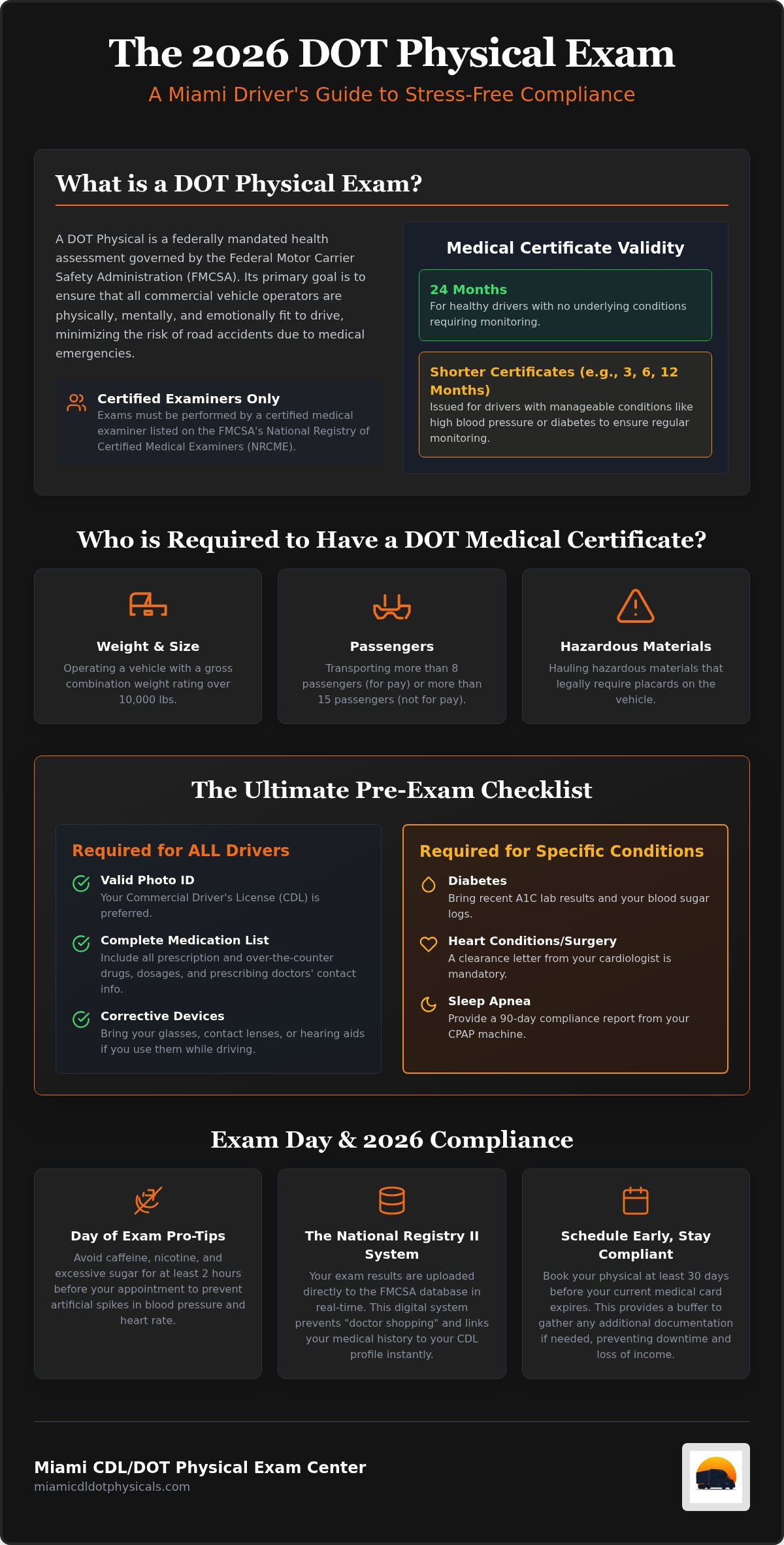
A Department of Transportation (DOT) physical is a federal safety requirement. It's governed by the Federal Motor Carrier Safety Administration (FMCSA). The purpose is clear: to ensure every driver on the road can safely operate a commercial motor vehicle (CMV) without endangering themselves or others. This isn't just a basic checkup. It's a specialized evaluation that focuses on physical, mental, and emotional health. By verifying that drivers are fit for duty, the FMCSA aims to reduce the risk of accidents caused by sudden medical emergencies.
When you use a DOT physical exam checklist Miami to prepare, you're getting ready for an exam that must be performed by a professional on the National Registry of Certified Medical Examiners (NRCME). Only these certified examiners have the training to evaluate drivers against federal standards. Most healthy drivers receive a medical certificate valid for 24 months. However, if you have conditions like high blood pressure or diabetes, your certificate might be shorter, such as six or twelve months, to ensure regular monitoring and safety on the road.
Who is Required to Have a DOT Medical Certificate?
Not every driver needs this certification, but it's mandatory if you operate certain vehicles in interstate commerce. You'll need a valid medical card if you drive a vehicle with a gross combination weight rating of over 10,000 lbs. It's also required for those operating vehicles designed to transport more than 8 passengers for compensation, or more than 15 passengers if not for compensation. Finally, any driver hauling hazardous materials that require placards must pass this exam to maintain their Commercial Driver's License (CDL). Staying compliant isn't just about following rules; it's about protecting your career.
The Role of the FMCSA National Registry in 2026
The 2026 regulatory environment is more integrated than ever. The FMCSA now uses the National Registry II system to receive exam results electronically. This digital shift means your medical examiner uploads your results directly to the federal database in real-time. This system has effectively ended the practice of "doctor shopping." In the past, a driver who failed an exam might try to visit a different clinic the next day. Now, your health history is linked to your profile instantly. Checking an examiner's credentials on the registry before booking is a vital step in your DOT physical exam checklist Miami to ensure your results are legally recognized and valid.
The 2026 DOT Physical Exam Checklist Miami: What to Bring
Preparation is the most effective way to avoid delays at the clinic. Using a detailed DOT physical exam checklist Miami helps you organize your documents before you arrive. You'll need a valid government-issued photo ID, which is usually your Commercial Driver's License. The examiner must verify your identity before starting the DOT Medical Exam. This verification is a standard part of the process to ensure all federal records are accurate.
Bring a complete list of all current medications. This list must include the exact dosages and the contact information for the prescribing doctors. If you wear corrective lenses or use a hearing aid, bring them to the appointment. You'll be tested with them to ensure you meet the federal safety standards for vision and hearing. Some drivers prefer to download and partially complete the Medical Examination Report Form (MCSA-5875) ahead of time to save a few minutes in the waiting room. Arriving with these items ready shows the examiner you take your compliance seriously.
Essential Paperwork for Chronic Conditions
If you manage a chronic health issue, you need specific documentation to secure your certification. Drivers with diabetes should bring their most recent A1C results and blood sugar logs. If you have a history of heart disease or have undergone heart surgery, a letter from your cardiologist is mandatory. This letter should state that you're cleared to operate a commercial vehicle safely. For those diagnosed with sleep apnea, bring a compliance report from your CPAP machine covering the last 90 days. These records prove that your condition is under control and that you aren't a risk for sudden fatigue or a medical emergency on the road.
Personal Preparation for the Morning of the Exam
What you do in the hours before your exam can impact your results. Avoid drinking excessive caffeine or using nicotine for at least two hours before your appointment. These substances can cause temporary spikes in your blood pressure, potentially leading to a shorter certification period or a "pending" status. Drink plenty of water so you're ready to provide a urine sample. This isn't a drug test; it's a screen for sugar, protein, and blood to check your kidney function. Wear loose, comfortable clothing. This allows the examiner to easily place a blood pressure cuff and listen to your heart and lungs without restriction. If you're looking for an efficient experience, you can find more details at Miami CDL/DOT Physicals.
Health Standards: Vision, Hearing, and Blood Pressure
The core of your medical certification involves meeting specific physical benchmarks set by the federal government. These standards ensure your Medical Fitness for Duty and help prevent accidents on the road. When you review your DOT physical exam checklist Miami, you'll see that the examiner focuses heavily on vision, hearing, and cardiovascular health. These tests are objective and designed to confirm you can handle the physical demands of long-haul driving.
Vision is a primary safety factor. You must have at least 20/40 acuity in each eye and in both eyes combined. This requirement applies whether you use corrective lenses or not. You also need a horizontal field of vision of at least 70 degrees in each eye and the ability to recognize the colors of traffic signals. Hearing standards are just as vital. You must perceive a "forced whisper" in your better ear from a distance of five feet. If you can't pass the whisper test, you'll need to pass an audiogram to stay compliant.
The examiner will also perform a urinalysis. Don't confuse this with a drug test. This specific screen checks for protein, blood, and sugar in your system. These markers are used to evaluate your kidney function and can signal underlying health issues like undiagnosed diabetes. It's a quick test that provides a snapshot of your internal health and helps the examiner decide if you're safe to operate a heavy vehicle.
Understanding Blood Pressure Certification Tiers
Blood pressure readings often cause the most anxiety for drivers. To earn a full two-year medical card, your blood pressure must be 140/90 or lower. If your numbers are higher, the FMCSA uses a tiered system to determine your certification length:
- Stage 1 (140-159/90-99): You'll likely receive a one-year certification. This gives you time to manage your levels before the next check.
- Stage 2 (160-179/100-109): This results in a one-time, three-month provisional card. You must get your pressure under control during this window.
- Stage 3 (180/110 or higher): This is an immediate disqualification. You can't be certified until your reading drops below 140/90.
Vision and Hearing Waivers
If you don't meet the standard requirements, you aren't necessarily out of a job. The FMCSA offers waiver programs for drivers with certain physical impairments, such as monocular vision. Obtaining an alternative vision or hearing standard certificate requires extra steps and documentation from specialists. Part of knowing how to pass your DOT physical in 2026 is understanding these waiver options before you walk into the clinic. Including waiver status in your DOT physical exam checklist Miami ensures you have the right federal exemptions ready for your examiner to review.
Disqualifying Medications and Health Conditions
Certain medications act as an immediate red flag for examiners. Methadone, most anti-seizure drugs, and high-dose narcotics are generally disqualifying because they can severely impair your reaction time. Other substances, like benzodiazepines for anxiety or stimulants for ADHD, fall under "Medical Examiner's Discretion." This means the examiner decides if the medication interferes with your safety. To make this process smoother, always include a clearance letter from your prescribing doctor in your DOT physical exam checklist Miami. This letter must state that the medication does not interfere with your ability to operate a commercial vehicle safely. Without it, your certification will likely be delayed.
It's vital to address the reality of medical marijuana. Even if you have a state-issued card, marijuana remains a Schedule I substance under federal law. The FMCSA does not recognize medical marijuana as a valid treatment for commercial drivers. Testing positive will disqualify you, regardless of state legality or professional recommendations. Honesty about your health history is the best policy. If you have questions about specific medications, you can consult with our certified examiners to understand your options before your appointment.
Managing Sleep Apnea and CPAP Compliance
Compliance is the key to staying on the road if you've been diagnosed with sleep apnea. You must provide a 90-day compliance report from your CPAP machine. This report needs to show you're using the device for at least 4 hours a night for 70% of the time. If your data is outdated or the machine is broken, your certification will be placed in a "pending" status until you provide current records. A smart tip is to bring your actual machine or the data card to the clinic. This allows the examiner to verify your usage immediately and prevents long-term delays in your certification process.
Diabetes and the Insulin-Treated Driver Rule
The rules for diabetic drivers are much more manageable than they used to be. Under the Insulin-Treated Diabetes Mellitus (ITDM) rule, you can operate a CMV if your condition is stable and well-managed. You'll need your treating specialist to complete the ITDM Assessment Form (MCSA-5870) within 45 days of your exam. This form proves you're under specialist oversight and aren't at risk for hypoglycemic episodes. Renewing your CDL medical card Miami is entirely possible for diabetic drivers who stay proactive with their paperwork and health logs. Keeping these forms as part of your DOT physical exam checklist Miami ensures you're prepared for every requirement.
Scheduling Your Exam and Maintaining Compliance
Timing is the most critical factor when it's time to renew your medical card. You should schedule your appointment at least 30 days before your current certificate expires. This buffer is essential because it gives you time to resolve any "Determination Pending" statuses or gather missing specialist letters without your CDL being downgraded. Using your DOT physical exam checklist Miami to prepare ensures you don't miss these deadlines. Before you book, always verify the examiner's status on the FMCSA National Registry. Only results from certified examiners are legally valid in the 2026 digital system.
After you pass, you must ensure your State Driver Licensing Agency (SDLA) receives the updated information. While examiners upload results to the federal database, many states still require you to submit a copy of your certificate to keep your driving record current. We recommend maintaining a dedicated "driver folder" for your records. Store copies of your long-form physical, your medical certificate, and any clearance letters from your specialists. Having these documents organized makes future renewals much faster and protects you during company audits or roadside inspections. This proactive approach keeps you compliant and ready for the road at all times.
What Happens After the Exam?
If you meet all health standards, the examiner issues your medical examiner's certificate (MEC) immediately. However, if the examiner finds a condition that requires more documentation, they may place your exam in a "Determination Pending" status. You usually have a short window to provide the necessary information before the exam is invalidated. A professional DOT physical Miami center ensures that once you're cleared, your results are uploaded to the federal system accurately and without delay. This electronic filing is your official proof of medical fitness in 2026.
Integrating Drug Testing and Clearinghouse Needs
Many busy professionals prefer to handle all their compliance requirements in a single visit. Combining your physical with a DOT drug test Miami is a smart way to save time and reduce administrative stress. If you're an owner-operator or manage a small fleet, using a provider that offers FMCSA Clearinghouse Consortium services is a major advantage. These services help you manage random testing pools and ensure you're always in line with federal drug and alcohol regulations. Staying organized with a complete DOT physical exam checklist Miami helps you manage these moving parts efficiently. Contact Miami CDL/DOT Physical Exam Center to book your streamlined appointment today and keep your career moving forward.
Stay Road-Ready and Compliant in 2026
Staying on the road requires more than just driving skill; it demands a proactive approach to your health and regulatory compliance. By following a comprehensive DOT physical exam checklist Miami, you've already taken the most important step toward a successful certification. You now know exactly which documents to bring, how to manage your blood pressure before the appointment, and how the 2026 digital filing system works. This preparation eliminates the stress of "pending" statuses and keeps your career moving forward without interruption.
Our team is here to act as your partner in this high-stakes environment. We provide FMCSA-certified medical examiners who understand the nuances of the latest regulations. We offer convenient scheduling designed for busy commercial drivers and prioritize same-day medical card issuance so you can get back to work immediately. Don't leave your livelihood to chance. Book Your Same-Day DOT Physical Exam Today and experience a streamlined, professional process. We look forward to helping you stay safe and compliant on the highway.
Frequently Asked Questions
Can I pass a DOT physical with high blood pressure?
Yes, you can pass with high blood pressure, but the reading determines how long your medical card remains valid. A reading below 140/90 qualifies you for a full two-year certificate. If your pressure is between 140/90 and 159/99, you'll likely receive a one-year certification. Higher readings may result in a shorter three-month provisional card, giving you time to work with a doctor to lower your levels through medication or lifestyle changes.
What medications are not allowed for a CDL medical card?
Methadone is strictly prohibited for all commercial drivers. Other disqualifying medications include high-dose narcotics, certain anti-seizure drugs, and any habit-forming substances that impair your ability to operate a vehicle safely. While some medications like stimulants for ADHD or anti-anxiety meds are allowed, they require a specific clearance letter from your prescribing physician. Medical marijuana remains disqualifying under federal law, even if you have a valid state-issued medical card.
Does the DOT physical include a drug test?
No, a standard DOT physical does not include a drug test. The urinalysis performed during the exam is a screen for protein, blood, and sugar to evaluate your kidney function and check for undiagnosed diabetes. However, many employers require a separate DOT drug test to be performed during the same appointment. These are two distinct services with different federal requirements, although they are often bundled together for your convenience.
What happens if I fail my DOT physical exam?
If you don't meet the standards, the examiner might place your results in a "Determination Pending" status. This isn't an immediate failure; it's a pause that allows you to provide missing documentation or resolve a temporary health issue. If you are officially disqualified, you cannot drive commercially until the condition is corrected. You may also explore federal waiver programs if your disqualification involves specific physical impairments like vision or hearing loss.
How long does a DOT physical exam take to complete?
Most drivers complete their entire exam in 30 to 45 minutes. This timeframe includes the health history review, the physical examination, and the required urinalysis. You can speed up the process by arriving prepared with your DOT physical exam checklist Miami and all necessary specialist letters. Having your medication list and previous medical records ready allows the examiner to finalize your certification and issue your medical card without unnecessary administrative delays.
Do I need a new DOT physical if I change employers?
Your medical certificate is tied to you as a driver, not to a specific company. It remains valid until the expiration date printed on the card, regardless of where you work. However, many employers require a new physical or a company-specific drug test as part of their hiring process. Always keep a copy of your long-form physical and your medical card in your personal records to prove compliance during any job transition.
Can I get a DOT physical if I have a pacemaker?
Yes, you can be certified with a pacemaker, provided your condition is stable and well-documented. You must bring a letter from your cardiologist that details your diagnosis and confirms the device is functioning correctly. The examiner will also need to see a recent report from your last pacemaker check. Drivers with pacemakers are typically issued a one-year medical certificate to ensure their heart health is monitored regularly by a certified medical professional.
How do I renew my CDL medical card if it has already expired?
Schedule an appointment for a new exam immediately because it's illegal to operate a commercial vehicle with an expired card. Once you pass, the examiner uploads your results to the National Registry to update your federal profile. You must also submit the new certificate to your State Driver Licensing Agency to prevent your CDL from being downgraded. Following a DOT physical exam checklist Miami helps you gather all required documents quickly during an urgent renewal.


