

Your CDL isn't just a license; it's your livelihood, and the MCSA-5875 form is the legal gatekeeper that stands between you and the open road. Most drivers feel a spike of anxiety when they see the detailed medical history section. It's completely normal to worry that a simple mistake or an honest omission might trigger a red flag and stall your career. Finding the right guidance for the DOT physical exam form Miami drivers need shouldn't be another source of stress.
We've designed this guide to help you master the complexities of the MCSA-5875 form, ensuring your next examination is smooth, compliant, and successful. You'll learn exactly how to document your health history to FMCSA standards and finally understand the difference between the medical report and your certificate. We'll walk through every section of the form so you can arrive at your appointment with total confidence and leave with your medical card in hand. This guide covers the latest 2026 standards, including how the National Registry II rule affects your paperwork, so you can stay focused on the drive ahead.
Key Takeaways
- Understand the critical legal distinction between the MCSA-5875 Medical Examination Report and the MCSA-5876 Medical Examiner’s Certificate.
- Learn how to accurately navigate the 32 health history questions on the DOT physical exam form Miami drivers use to prevent unnecessary application delays.
- Identify the specific federal standards for vision, hearing, and blood pressure required to pass your examination successfully.
- Discover the most common paperwork errors, such as illegible handwriting and missing signatures, that frequently cause certification setbacks.
- See how combining your physical exam with DOT drug testing and Clearinghouse services creates a streamlined path to full federal compliance.
What is the DOT Physical Exam Form MCSA-5875?
The Medical Examination Report (MER) Form, officially designated as MCSA-5875, is the cornerstone of the commercial driver certification process. The Federal Motor Carrier Safety Administration (FMCSA) mandates this specific form to ensure every interstate driver meets uniform health standards. It isn't just a simple checklist; it's a comprehensive document that records your entire physical qualification history. When you're searching for the DOT physical exam form Miami drivers are required to use, you're looking for this exact federal document. It provides a standardized framework that prevents inconsistencies between different medical offices across the country.
This form remains valid for the duration of your medical certification, which is typically up to 24 months. However, if you have certain health conditions like high blood pressure or diabetes, your certification period might be shorter. Once the exam is finished, the medical examiner is required by law to store the original MCSA-5875 for at least three years. This record-keeping ensures that there's a clear clinical trail for every driver on the road, supporting both regulatory audits and public safety initiatives.
The Legal Significance of the MCSA-5875
Signing the MCSA-5875 is more than a formality; it's a legal declaration of your current health status. When you put your name on that document, you're testifying that the information you've provided is true and complete. Omitting medical conditions or providing false information on these federal forms can lead to serious consequences, including the immediate revocation of your medical certificate and potential civil penalties. This strict requirement exists to protect you, your employer, and the general public. By providing an honest health history, you allow the examiner to make an accurate assessment, which helps prevent health-related accidents and reduces your personal legal liability in the event of an on-road incident.
Medical Report vs. Medical Certificate
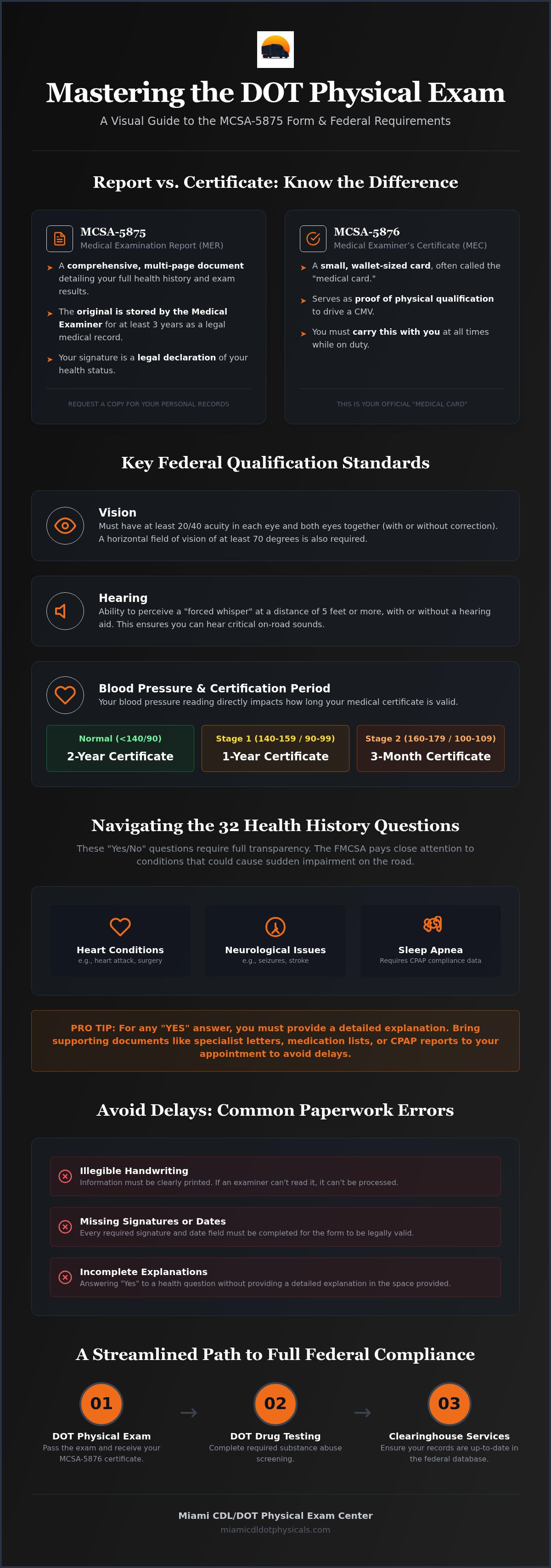
The MCSA-5876 is the official Medical Examiner’s Certificate, commonly known as a medical card, that you must keep in your possession whenever you're on duty.
It's vital to understand that the MCSA-5875 (the report) and the MCSA-5876 (the certificate) serve different purposes. The full report contains your sensitive, detailed medical data, which is why the original stays with the medical examiner rather than your employer. The certificate is a much smaller document that simply confirms you're physically qualified to drive. You should always ask for a copy of your full DOT physical exam form Miami report for your own records. Keeping a personal copy allows you to track your health trends over time and ensures you have all the necessary documentation ready for your next renewal or if you decide to switch carriers.
Step-by-Step Guide to Completing the Driver Health History
Completing the health history section of the DOT physical exam form Miami drivers receive is the first hurdle in the certification process. You must provide accurate personal data, including your full legal name, date of birth, and commercial driver's license number. This information must match your official state records exactly to avoid administrative delays. Once the basics are covered, you'll face the core of the document: the 32 health history questions. These are simple "Yes/No" prompts, but they require careful consideration before you check a box.
Don't leave the "Explanation" column blank for any "Yes" answers. Specify the date of the event, the diagnosis, and the current status of the condition. If you're unsure how your specific history impacts your status, you can consult with a certified examiner before your official appointment. Documenting your surgeries, medications, and chronic conditions accurately shows the examiner that you're proactive about your health and safety on the road.
Managing the 32 Health History Questions
The FMCSA pays close attention to conditions that could cause sudden impairment. Heart disease, history of seizures, and obstructive sleep apnea are high-priority categories. If you use a CPAP machine, bring your usage reports. For medications, list the drug name, dosage, and the prescribing doctor's contact information. Understanding these DOT physical requirements ahead of time helps you gather the necessary medical records. If you've had a recent surgery, a clearance letter from your specialist will significantly speed up the process.
The Role of the Driver’s Signature
Your signature at the bottom of Section 1 is a binding legal statement. It verifies that everything you've disclosed is complete and true. Since June 23, 2025, the National Registry II rule has streamlined how this data moves, making accuracy even more vital. Errors or omissions discovered later can lead to reports in the FMCSA Clearinghouse, which may affect your future employment. Take five minutes to review every answer before you hand the form to the medical examiner. A quick double-check ensures you haven't missed a "Yes/No" box or forgotten to list a daily medication. This final review protects your career and ensures the examination begins on the right foot.
Understanding the Examiner’s Role in Reviewing the Form
The medical examiner acts as the final authority on whether your health status meets federal safety requirements. When you hand over your completed DOT physical exam form Miami, the examiner doesn't just file it away. They use your self-reported history as a clinical roadmap to guide the physical assessment. If you've disclosed a history of heart issues or respiratory trouble, the examiner will spend more time evaluating those specific systems. Their goal is to ensure that any existing conditions are stable and well-managed so they don't pose a risk while you're behind the wheel.
During the exam, the provider must record specific data points for vision, hearing, and blood pressure. You need at least 20/40 acuity in each eye and the ability to perceive a forced whisper from five feet away. Blood pressure is a major factor in determining your certification interval. While a healthy driver might receive a full two-year certificate, someone with stage 1 hypertension might only get a one-year clearance. In complex cases, the examiner uses the "Clinical Notes" section to document why they believe a driver is safe to operate despite certain health challenges. This detailed justification is essential for maintaining your medical file's integrity during federal audits.
Physical Qualification Standards and Form Entry
The examiner is required to perform a urinalysis as part of the physical qualification process. It's a common misconception that this is a drug test; instead, the examiner checks for protein, blood, and glucose to screen for underlying issues like kidney disease or undiagnosed diabetes. They also record your pulse and heart rhythm to identify potential cardiovascular risks. If the examiner needs more information from your primary care doctor before making a decision, they'll mark the form as "Incomplete." This is a temporary status that gives you time to provide missing records, whereas a "Disqualified" status means you don't currently meet the federal standards to operate a commercial vehicle.
National Registry of Certified Medical Examiners (NRCME)
Every professional conducting these exams must be listed on the National Registry of Certified Medical Examiners. You should always verify that your examiner has a valid 10-digit NRCME number before the appointment begins. This certification ensures they've been trained on the specific physical demands of commercial driving and the nuances of the MCSA-5875. Once the exam is over, the examiner is responsible for uploading your results to the federal database. To ensure you're fully prepared for this interaction, you can review this guide on how to pass your DOT physical. This electronic transmission is what allows state licensing agencies to see your updated status almost instantly.
Common Errors on the DOT Physical Form That Cause Delays
Even a small oversight on the DOT physical exam form Miami drivers complete can put your career on hold. Accuracy is your best defense against administrative delays that keep you off the road. Illegible handwriting is a primary culprit for data entry errors. If the medical examiner can't read your health history, they can't accurately upload it to the federal database. This confusion slows down the issuance of your medical card and can lead to errors in your permanent record. Many drivers also forget to sign or date the driver portion of the form. Without a signature, the examiner cannot legally proceed with the physical, as that signature serves as your formal declaration of truthfulness.
Inconsistent medication lists are another common red flag. If your current form doesn't match the medications you reported during previous exams, it raises questions about your health management. You must list the drug name, dosage, and the prescribing physician for every medication you take. If you have a chronic condition, arriving without a specialist's clearance letter is a guarantee for a delay. The examiner needs to see that your condition is stable and that your treating physician supports your ability to drive. To ensure your paperwork is handled with professional precision, you can schedule your DOT physical exam with our certified team.
The Problem of Incomplete Medical History
Omitting a past surgery, even one from years ago, can lead to a temporary disqualification. The examiner needs to verify that the procedure didn't result in long-term impairment that affects your reaction time or physical stamina. If you have gaps in your medical records, be honest about them. It's better to explain a missing record than to be caught hiding a condition during the physical assessment. Examiners value transparency. Being proactive with your chronic condition documentation shows that you take your professional responsibilities seriously and understand the safety stakes involved.
Digital Intake and Form Accuracy
Modern clinics are moving away from the paper DOT physical exam form Miami drivers traditionally used. Digital intake portals offer a significant advantage because they flag missing fields before you even enter the exam room. This ensures your form is 100% complete and ready for review. Digital forms also eliminate the handwriting issue, making the data transmission to the National Registry seamless and error-free. They streamline the entire process, allowing the examiner to focus on your health rather than deciphering penmanship. This transition to digital records is part of a broader federal push to improve the accuracy of driver medical data nationwide.
Ensuring Federal Compliance with Professional Driver Services
Maintaining compliance requires more than just filling out the DOT physical exam form Miami once every two years. It's about building a streamlined system that covers all federal requirements without disrupting your schedule. Integrating your physical exam with DOT drug testing is one of the most effective ways to manage your professional standing. Many carriers and owner-operators prefer to handle these requirements simultaneously to minimize downtime. When you choose a provider that offers integrated services, you ensure that all your medical and safety data is handled by experts who understand the full scope of FMCSA regulations.
For owner-operators, joining an FMCSA Clearinghouse Consortium is a vital step in maintaining federal compliance. This consortium manages your random drug testing pool and ensures all results are reported correctly to the federal database. This level of oversight prevents administrative gaps that could lead to fines or license suspension. The value of same-day medical card issuance cannot be overstated for active drivers. Leaving an appointment with your certificate in hand allows you to return to work immediately, avoiding the stress of waiting for mail or digital updates.
Establishing a long-term relationship with a certified medical examiner also provides significant advantages. An examiner who knows your health history can offer more personalized guidance and help you prepare for future renewals more effectively. They become a partner in your career, helping you navigate changes in regulations and health standards with ease. This partnership reduces the anxiety often associated with the medical history disclosure process.
Beyond the Physical: Full Compliance Solutions
There is a powerful synergy between your medical certification and the FMCSA Clearinghouse. Your physical exam confirms you are fit to drive, while your drug testing record proves you are operating safely. Managing these together simplifies your paperwork and keeps your record clean. If you are selected for random drug testing during your medical renewal window, handling both at once saves time and reduces travel. For a deeper look at the entire process, read our comprehensive DOT physical guide. This integrated approach ensures no part of your compliance file is left to chance.
Preparing for Your Next Certification
Don't wait until the last minute to think about your expiration date. Set a reminder at least 30 days before your medical card expires to allow time for any necessary specialist follow-ups. When you arrive for your appointment, bring your driver's license, a current list of medications, and any required clearance letters. This preparation ensures your DOT physical exam form Miami is completed in a single visit. Ready to secure your medical status? Schedule your DOT physical exam or drug test today.
Secure Your Career with a Compliant DOT Physical
Mastering the details of the MCSA-5875 form is a vital step in protecting your professional driving career. By accurately documenting your health history and arriving prepared with your medical records, you eliminate the common errors that cause certification delays. Remember that the DOT physical exam form Miami drivers use is a legal declaration; your honesty and precision ensure a smoother interaction with the medical examiner. Integrating your physical with drug testing and Clearinghouse management provides a total compliance solution that keeps you moving without administrative hurdles.
Don't let paperwork stress slow you down or jeopardize your livelihood. Our center provides full FMCSA compliance services to help you navigate every regulation with ease. When you work with our NRCME certified medical examiners, you can expect a professional, efficient process and same-day medical card results. We value your time and your commitment to safety.
Book Your FMCSA-Certified DOT Physical Exam Now to stay compliant and confident on the road. We're here to support your success and look forward to helping you meet your professional requirements with total peace of mind.
Frequently Asked Questions
Can I fill out the DOT physical form online before my appointment?
Many modern clinics allow you to complete the driver portion of the DOT physical exam form Miami digitally through secure patient portals. This proactive step ensures that all mandatory fields are filled before you arrive at the exam room. If your provider still uses paper, you can download the MCSA-5875 from the federal registry and print it. Having the form ready reduces your wait time and allows you to review your medical history carefully at home.
What is the difference between form MCSA-5875 and MCSA-5876?
The MCSA-5875 is the Medical Examination Report Form, which contains your detailed health history and the examiner's clinical findings. In contrast, the MCSA-5876 is the Medical Examiner’s Certificate, or the actual medical card you carry while driving. While the full report stays on file with the medical examiner for at least three years, the certificate is the only document you are legally required to present to your employer or safety officials.
Do I need to disclose every surgery I have ever had on the form?
You must disclose all significant surgeries and medical procedures on the health history section of the form. The examiner needs this context to determine if a past surgery affects your current ability to safely operate a heavy commercial vehicle. Omitting a procedure, even one from years ago, can be seen as a legal violation of federal standards. If the surgery resulted in full recovery with no lasting impairment, the examiner will simply note it.
What happens if I make a mistake on the medical history section?
If you realize you made an error on your DOT physical exam form Miami, inform the medical examiner before the physical assessment begins. They can help you correct the information and initial the changes to maintain the document's legal integrity. Honest mistakes are common, but leaving incorrect information on the form can lead to delays or future questions about your health status. Accurate documentation is your best tool for ensuring a successful, stress-free examination.
How long does the examiner keep the MCSA-5875 on file?
Certified medical examiners are required by federal law to maintain the original MCSA-5875 Medical Examination Report for at least three years from the date of the exam. This requirement ensures a clinical record exists for federal audits or safety investigations. Drivers should always request a copy of this full report for their personal files. Having your own record makes it easier to provide consistent information during your next renewal cycle or when visiting a new clinic.
Does the DOT physical form include a drug test?
A standard DOT physical does not include a drug test, though it does require a urinalysis. The urinalysis performed during the exam screens for protein, blood, and glucose to identify underlying health issues like undiagnosed diabetes. However, many employers and owner-operators choose to schedule a DOT drug test at the same time as their physical to meet all federal compliance requirements in a single visit. These are two distinct services with separate reporting procedures.
Can I get a copy of my full Medical Examination Report?
You are entitled to a copy of your completed MCSA-5875 report upon request. While you are only required to carry the MCSA-5876 certificate, keeping the full report is highly recommended. It provides a detailed record of what was discussed and recorded during your exam. This documentation is especially helpful if you have chronic conditions that require ongoing monitoring or if you need to provide specific health details to a motor carrier's safety department during an audit.
Is the DOT physical form the same in every state?
The MCSA-5875 is a federal document mandated by the FMCSA for all interstate commercial drivers. This means the form is identical regardless of which jurisdiction you are in when you complete it. The standardization ensures that every driver is held to the same physical qualification standards across the entire country. Using the correct, current version of this federal form is essential for maintaining a valid commercial driver's license and staying in full compliance with national safety rules.


