

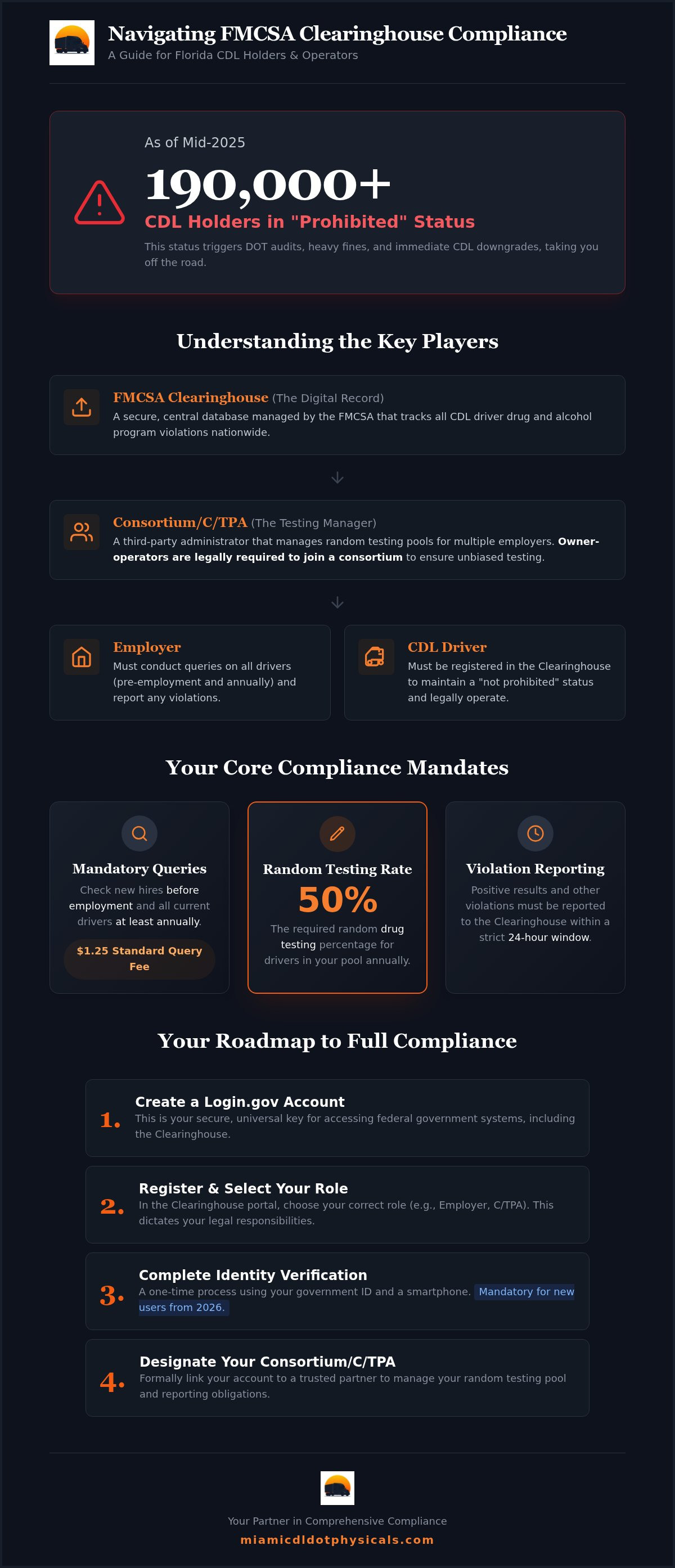
As of mid-2025, over 190,000 CDL holders were stuck in a "prohibited" status in the FMCSA Clearinghouse. For Florida-based operators, these numbers represent more than just data. They reflect the very real risk of DOT audits, heavy fines, and immediate CDL downgrades. Joining a reliable FMCSA Clearinghouse consortium Florida is the most effective way to eliminate the constant pressure of managing random testing pools and 24-hour reporting windows. It's a heavy administrative burden that often takes your focus away from the road.
We understand that your livelihood depends on total regulatory compliance. This comprehensive guide simplifies the process by showing you exactly how to manage your drug and alcohol program. While we serve customers nationally, we specialize in providing Florida operators with a compliance safety net that protects their business. You'll learn how to handle mandatory queries for the standard $1.25 fee and maintain the 50% random drug testing rate required for 2026. This article outlines the essential steps to automate your record keeping and secure your professional future.
Key Takeaways
- Learn how the Clearinghouse tracks violations and why registration is mandatory for every CDL holder to maintain a "not prohibited" status.
- Navigate the new 2026 identity verification protocols required for all employers and C/TPAs to ensure secure system access.
- Discover how joining an FMCSA Clearinghouse consortium Florida automates your random drug testing pool and keeps you compliant with annual testing percentages.
- Follow a clear, step-by-step roadmap to enroll in a DOT-compliant program and register your business without administrative stress.
- Simplify your operations by combining DOT physicals and drug testing services into a single, efficient compliance safety net.
Understanding the FMCSA Clearinghouse and Consortium Requirements
The FMCSA Clearinghouse is the central record-keeping hub for CDL safety. It serves as a digital gatekeeper, ensuring that drivers with drug or alcohol violations don't simply move from one state to another to hide their history. This database is managed by the Federal Motor Carrier Safety Administration (FMCSA) and is mandatory for everyone involved in commercial transportation. To keep your "not prohibited" status, you must be active in the system. For many, especially those looking for an FMCSA Clearinghouse consortium Florida, understanding how these digital and physical requirements fit together is the first step toward total compliance.
Why Owner-Operators Must Join a Consortium
If you're an owner-operator, you're both the employer and the employee. This unique position creates a conflict of interest for random drug testing. Federal law requires you to join a consortium, also known as a C/TPA. You cannot manage your own random testing pool. The consortium places you into a larger group of drivers from various companies. A computer then selects names at random for testing. This process ensures the selection is completely unbiased and compliant with federal standards. Failing to join a pool isn't just a minor oversight; it can lead to the immediate suspension of your operating authority, effectively grounding your truck until you're compliant.
The Connection Between the Database and the Testing Pool
There's often confusion about where the consortium ends and the Clearinghouse begins. Think of it this way: the consortium performs the physical work, and the Clearinghouse handles the digital record. When you go for a test, the consortium manages the collection and the lab process. If a violation occurs, the Clearinghouse is the place where that information is stored for future employers to see.
Employers use the database to run specific queries. You must check the system before hiring a new driver and at least once every twelve months for existing ones. Managing this manually is a massive administrative burden. A professional FMCSA Clearinghouse consortium Florida often acts as your designated agent. They can report violations and even perform queries on your behalf. This partnership reduces your paperwork and ensures you never miss the strict 24-hour reporting window for positive results. It's a streamlined system designed to keep you on the road and out of the auditor's office.
Navigating the Clearinghouse Identity Verification in 2026
Effective April 27, 2026, the FMCSA implemented a mandatory identity verification process for new users. This security update isn't just another administrative hurdle; it's a vital defense against fraudulent compliance reporting and data theft. The FMCSA Drug & Alcohol Clearinghouse requires this verification for Employers without a Portal Account, Consortium/Third-Party Administrators (C/TPAs), and Medical Review Officers (MROs). By verifying every user, the system ensures that the sensitive drug and alcohol history of commercial drivers remains accurate and protected from unauthorized access.
To complete this process, you'll need a valid government-issued ID and a smartphone. The system uses secure web applications to match your physical identity with your digital profile. This verification is a one-time requirement for new registrants, but it's essential for maintaining your ability to hire drivers and report violations. It's a quick step that provides long-term security for your business operations and your drivers' personal data.
Registration Steps for Florida Fleet Owners
The first step for any Florida operator is creating a Login.gov account. This serves as your primary entry point for most federal systems. Once your account is active, you'll need to select your specific user role. Choosing the correct role—Employer, Driver, or C/TPA—is critical because it dictates what information you can see and what reports you're legally required to file. After selecting your role, the portal will prompt you to begin the identity verification step. Follow the on-screen instructions to scan your ID and take a "selfie" for verification. This process usually takes less than ten minutes but is required before you can perform any queries or manage your driver pool.
Designating a Consortium as Your C/TPA
Once your identity is verified, you must link your account to a professional partner. Navigate to the "C/TPA" section of your dashboard to search for your FMCSA Clearinghouse consortium Florida. Selecting a consortium that understands the local landscape ensures your compliance is handled by experts who know the state-specific requirements. After finding your provider, you'll need to authorize them to act on your behalf. You can specify exactly which tasks they manage, such as reporting drug test violations or conducting the mandatory annual queries for your drivers.
Setting these permissions correctly is the key to a hands-off compliance strategy. Most operators authorize their C/TPA for all reporting and query tasks to reduce their own administrative workload. If you're feeling overwhelmed by these new digital requirements, working with a specialist at miamicdldotphysicals.com can help you bridge the gap between medical exams and digital Clearinghouse management. This partnership allows you to focus on your fleet while experts handle the $1.25 queries and reporting windows that keep your authority active.
The Role of a Consortium in Random Drug Testing Compliance
A consortium, or C/TPA, is the backbone of your drug and alcohol program. It maintains a large "random pool" of drivers drawn from various small companies and owner-operators across the state. By grouping thousands of drivers together, an FMCSA Clearinghouse consortium Florida ensures that the testing frequency meets federal mandates without placing an unfair burden on a single small fleet. For 2026, the FMCSA has set the minimum annual random drug testing rate at 50% and the alcohol testing rate at 10%.
Selections are never made by hand. They must use a scientifically valid method, typically a computer-generated algorithm, to ensure every driver has an equal chance of being picked in every cycle. A consortium eliminates the guesswork of random selection, giving you peace of mind that your pool is legally defensible. Understanding these Clearinghouse requirements for owner-operators is the best way to stay ahead of DOT auditors and maintain your operating authority.
Types of Required DOT Testing
Staying compliant means knowing when a test is mandatory. It isn't just about the random draws; several other scenarios require immediate action. Professional consortiums help you manage these different requirements to ensure no gaps in your safety records.
- Pre-employment: You must receive a verified negative drug test result before any driver performs a safety-sensitive function.
- Random: These are unannounced screens conducted throughout the year based on the computer-generated selection from the consortium pool.
- Post-accident: Triggered by specific criteria, such as a fatality or a citation issued after a vehicle is towed from the scene.
- Reasonable Suspicion: Conducted when a trained supervisor observes physical signs or behaviors suggesting drug or alcohol use.
Managing Random Selection Notifications
When a name is drawn, the consortium notifies the employer or the designated contact immediately. This is where the timeline becomes critical. Once you notify a driver that they've been selected for a random screen, they must report to a collection site immediately. There is no grace period for finishing a long route or waiting until the next morning. The FMCSA views any delay as a potential attempt to subvert the test.
If a driver fails to report promptly, it's treated as a refusal to test. This is a major violation that must be reported to the Clearinghouse within 24 hours. A refusal carries the same consequences as a positive result, leading to an immediate "prohibited" status and a mandatory return-to-duty process. Using a professional FMCSA Clearinghouse consortium Florida ensures these notifications are handled efficiently, protecting both the driver's livelihood and your company's reputation.
FMCSA Compliance Guide for Florida-Based Operators
Staying compliant requires a methodical approach to both digital and physical requirements. For many, the process feels overwhelming, but breaking it down into specific steps ensures you never miss a deadline or a reporting window. If you're managing a fleet or operating as an individual, your first move is to enroll in a DOT-compliant FMCSA Clearinghouse consortium Florida. This partnership provides the regulatory safety net you need to handle random testing pools and mandatory reporting without the administrative headache.
Once your consortium is in place, follow these essential steps to secure your operating authority:
- Register your business: Complete your profile in the FMCSA Clearinghouse and verify your identity as required by the 2026 protocols.
- Purchase a Query Plan: You must buy query credits in advance through the portal. Both limited and full queries cost a flat rate of $1.25 each.
- Conduct mandatory queries: Perform a "Full Query" for every new hire before they start safety-sensitive work. You also must run a "Limited Query" for every driver on your roster at least once every 12 months.
- Maintain secure records: Keep copies of all test results, query consents, and consortium enrollment papers. These documents are the first things a DOT auditor will ask to see.
Managing these tasks manually is a risk most operators can't afford. You can simplify your entire workflow by joining our FMCSA Clearinghouse Consortium, which integrates your medical exams and drug testing into one seamless process.
The Return-to-Duty (RTD) Process
When a driver records a violation or a refusal to test, the Clearinghouse immediately places them in a "prohibited" status. Since November 18, 2024, State Driver Licensing Agencies have been required to downgrade the CDLs of any driver in this status. To get back on the road, the driver must first meet with a Substance Abuse Professional (SAP) for a formal evaluation. After completing the SAP's recommended treatment or education, the driver must take a Return-to-Duty drug test. Only a negative result on this specific test, reported to the Clearinghouse, allows the driver to resume safety-sensitive functions.
Annual Compliance Checklist
Compliance isn't a one-time event; it's an ongoing commitment. Use this checklist every January to ensure your operations remain audit-ready. First, verify that every driver has had their annual limited query performed within the last 365 days. Second, update your driver roster with your consortium to ensure your random pool is accurate. Finally, log in to your Clearinghouse dashboard to check for any unresolved alerts. These simple habits prevent the "prohibited" statuses that can ground your fleet and result in heavy civil penalties.
Comprehensive Compliance Solutions with Miami CDL/DOT Physical Exam Center
Miami CDL/DOT Physical Exam Center serves as a vital bridge between your physical health requirements and federal drug compliance mandates. We recognize that commercial drivers don't have time to waste on fragmented services. Our FMCSA Clearinghouse consortium Florida is built specifically to support owner-operators and fleets who need a reliable compliance safety net. We offer a unified solution that ensures you're never left guessing about your standing with the Department of Transportation.
Managing a compliant drug and alcohol program involves significant administrative heavy lifting. From random pool management to the strict 24-hour reporting windows for violations, the paperwork is constant. We handle these tasks for you. This partnership allows you to focus on the road while we manage the digital and physical requirements of your program. You can maximize your efficiency by combining your CDL medical card renewal with our comprehensive drug testing services. This one-stop-shop approach saves you time and reduces the risk of missed deadlines.
Why Florida Drivers Trust Our Consortium
Although we serve customers nationally, we possess a deep understanding of the unique transportation needs across Florida. Our team provides expert guidance on the latest 2026 FMCSA regulatory changes, including the new identity verification protocols and reporting standards. We pride ourselves on fast, professional service that respects the busy schedules of commercial drivers. We don't just provide a service; we act as a seasoned ally in a high-stakes environment where one mistake can ground your entire operation. Our FMCSA-certified medical examiners and compliance specialists work together to keep your records flawless.
Getting Started with Your Compliance Program
Enrolling in our program is a straightforward process designed for immediate results. Contact us to enroll in our drug and alcohol testing consortium today to secure your random pool membership. We assist with every step of the Clearinghouse designation process and help you manage your query plan credits effectively. Our goal is to ensure you stay road-ready with a partner that understands the high stakes of CDL compliance. Let us handle the complexities of federal regulations so you can keep your business moving forward. We provide the reliability and ease you need to maintain your livelihood without the stress of constant regulatory changes.
Secure Your Professional Future on the Road
Maintaining compliance doesn't have to be a source of constant stress or administrative burden. By understanding the 2026 identity verification updates and the mandatory random testing rates, you've already taken the first step toward protecting your CDL and your business. A professional FMCSA Clearinghouse consortium Florida acts as your compliance safety net; it automates the random selection process and ensures your reporting windows are always met. This proactive approach prevents the sudden CDL downgrades that now follow a "prohibited" status in the federal database.
Our team of FMCSA-certified medical examiners provides full-service drug and alcohol consortium management to help you stay road-ready. We serve Florida drivers nationally, offering a streamlined process that combines your medical exams with total Clearinghouse oversight. Don't let complex regulations slow your business down or risk your livelihood with unnecessary fines. Efficiency and reliability are just a click away.
Join our FMCSA Clearinghouse Consortium today and stay compliant! We look forward to being your partner in professional success and keeping your fleet moving safely through 2026 and beyond.
Frequently Asked Questions
Do owner-operators in Florida really need to join a consortium?
Yes, owner-operators must join a consortium because federal regulations prohibit individuals from managing their own random testing pools. This requirement ensures that the selection process remains completely unbiased and scientifically valid. By joining an FMCSA Clearinghouse consortium Florida, you satisfy the legal mandate to be part of a larger pool. This partnership protects your operating authority and removes the conflict of interest that occurs when an employer is also the sole driver.
What is the difference between a limited query and a full query?
A limited query confirms whether the Clearinghouse contains any information about a driver, while a full query provides specific details regarding violations. You must perform a full query for all new hires, which requires the driver to grant consent through their Clearinghouse portal. For annual checks, a limited query is sufficient if you have the driver's written consent on file. If a limited query shows a "record found," you must conduct a full query within 24 hours.
How much does it cost to register for the FMCSA Clearinghouse in 2026?
Registering your business or driver account in the Clearinghouse is free of charge. However, you're required to purchase a query plan to perform the mandatory background checks. In 2026, the flat rate for both limited and full queries is $1.25 per query. These credits must be purchased in advance through the federal portal. Effective April 27, 2026, new registrants must also complete a secure identity verification process to access the system and perform these tasks.
Can a consortium report drug test violations for me?
Yes, a consortium acting as your designated C/TPA can report drug and alcohol violations on your behalf. This includes positive test results and refusals to test, both of which must be reported within 24 hours. By authorizing an FMCSA Clearinghouse consortium Florida to handle these reports, you ensure that your business remains compliant with strict federal reporting windows. This reduces your administrative burden and helps prevent the heavy civil penalties associated with late or missing reports.
What happens if I fail to perform the annual Clearinghouse query?
Failing to conduct the mandatory annual query is a significant regulatory violation that can trigger a DOT audit. The statutory maximum civil penalty for Clearinghouse violations reached $7,155 per violation in 2025 and adjusts annually for inflation. Beyond fines, missing these queries means you might unknowingly employ a driver in a prohibited status. This oversight creates massive liability for your company and could lead to the immediate suspension of your commercial operating authority during a roadside inspection.
How do I change my status from "prohibited" to "not prohibited"?
To move from a prohibited to a not prohibited status, a driver must successfully complete the Return-to-Duty (RTD) process. This begins with an evaluation by a qualified Substance Abuse Professional (SAP). The driver must then follow the SAP's specific plan for treatment or education. Once finished, the driver must take an RTD drug test and receive a negative result. This result must be reported to the Clearinghouse to lift the prohibition on safety-sensitive duties and restore the CDL.
Does the Clearinghouse replace the requirement for a DOT physical exam?
No, the Clearinghouse does not replace the need for a DOT physical exam. These are two distinct components of commercial driver compliance. The Clearinghouse is a database that tracks drug and alcohol violations, while the DOT physical evaluates a driver's overall medical fitness to operate a commercial vehicle safely. You still need a valid medical certificate from a certified examiner. Our center provides both services to ensure your records are complete and your CDL remains active and valid.
How often are drivers selected for random drug testing?
Drivers are selected for random testing multiple times throughout the year based on a computer-generated algorithm. For 2026, the FMCSA has maintained the minimum annual random drug testing rate at 50% and the alcohol testing rate at 10%. Because the selection process is truly random, a driver could be picked once, multiple times, or not at all during a calendar year. Being part of a consortium pool ensures these percentages are met across the entire group of participants.


