

A single DOT audit can ground your fleet faster than a total engine failure, yet many drivers still view compliance as a mountain of paperwork they'll climb eventually. If you're managing a small fleet or operating as an owner-operator, you already know that the FMCSA doesn't accept "too busy" as an excuse for missing a random test. You need a system that works in the background while you focus on the road.
Learning how to join a DOT drug consortium is the most effective way to turn a complex legal requirement into an automated compliance shield. You shouldn't have to spend your limited downtime deciphering federal codes or manually tracking testing pools. We understand that your livelihood depends on staying legal and avoiding costly fines that can reach thousands of dollars per violation. It is about more than just a certificate; it is about protecting your professional reputation.
In this 2026 guide, we provide a clear roadmap to secure your enrollment. You'll learn the exact steps to register with a consortium, how to handle FMCSA Clearinghouse queries, and what it takes to get instant certification. This article breaks down the simple enrollment process so you can automate your random testing selections and keep your business moving forward without the fear of an unexpected audit.
Key Takeaways
- Understand why 49 CFR Part 382 requires owner-operators to use a consortium to manage mandatory random drug and alcohol testing pools.
- Follow a streamlined 5-step process on how to join a DOT drug consortium to gain instant compliance certification and avoid costly federal fines.
- Identify the best C/TPA for your needs by evaluating their collection site network and checking for hidden fees in their service agreements.
- Learn how to properly designate your consortium in the FMCSA Clearinghouse to automate reporting and simplify your administrative workload.
- Verify your eligibility by confirming your safety-sensitive status and ensuring your CDL medical physical is current and valid.
What is a DOT Drug Consortium and Why is it Mandatory?
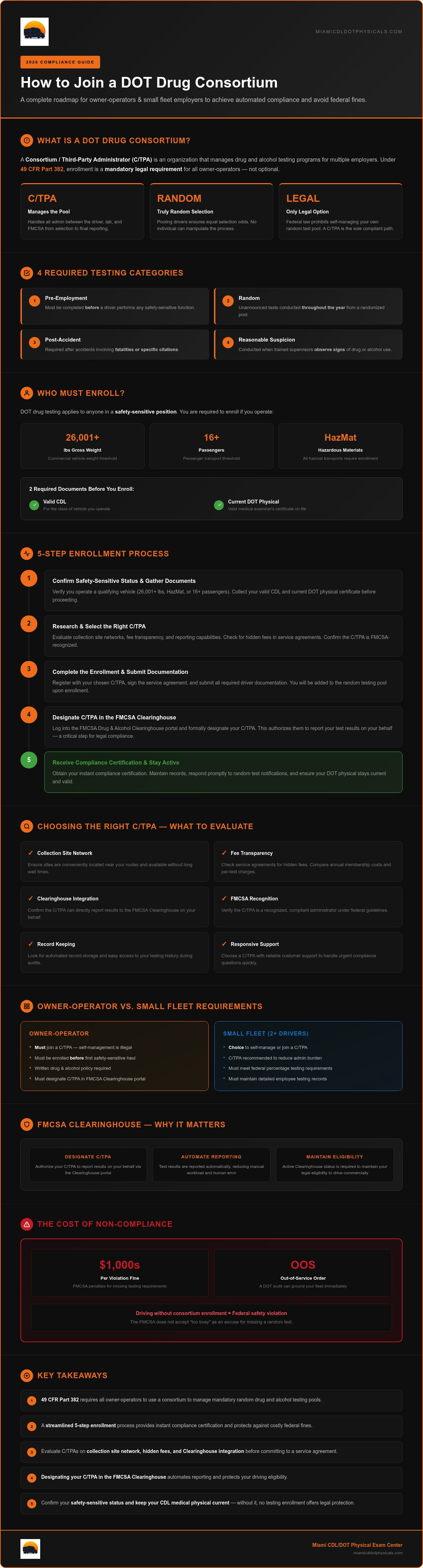
A DOT drug consortium, often referred to as a Consortium/Third-Party Administrator (C/TPA), is an organization that manages the drug and alcohol testing programs for multiple employers. Under 49 CFR Part 382, joining a consortium is a mandatory regulatory requirement for all owner-operators. It isn't an optional service; it's a legal framework designed to keep the roads safe by ensuring drivers are sober and alert. When you look into how to join a DOT drug consortium, you're essentially hiring an expert to handle the complex administrative requirements of the FMCSA.
The primary goal of this system is to ensure a truly random selection process that individual drivers cannot manipulate. The federal government requires that a specific percentage of drivers are tested every year. By pooling drivers together, the consortium ensures that every driver has an equal chance of being selected in every drawing. This system provides the structure for several critical testing categories:
- Pre-employment: Must be completed before a driver performs safety-sensitive functions.
- Random: Unannounced tests conducted throughout the year.
- Post-accident: Required after accidents involving fatalities or specific citations.
- Reasonable suspicion: Conducted when trained supervisors observe signs of drug or alcohol use.
The Role of a Consortium/Third-Party Administrator (C/TPA)
C/TPAs act as the vital middleman between the driver, the laboratory, and the FMCSA. They manage the entire testing lifecycle, from the moment a name is drawn to the final reporting of results. They maintain detailed testing records and ensure the random pool meets federal percentage requirements. By providing a reliable DOT drug test framework, they ensure that your testing process follows every federal guideline. This takes the administrative burden off your shoulders and places it in the hands of compliance experts.
Why Owner-Operators Cannot Self-Manage Testing
Federal law prohibits a single-driver company from managing their own random testing pool. The logic is simple: you cannot impartially select yourself for a drug test. Without an external manager, there's no way to prove the selection was truly random. Joining a consortium is the only legal way for an owner-operator to operate. If you don't have a membership, you're essentially driving in violation of federal safety standards. Understanding how to join a DOT drug consortium is the first step toward securing your business against audits and heavy fines.
Determining Your Eligibility and Compliance Needs
Before you research how to join a DOT drug consortium, you must verify that your specific role requires federal drug and alcohol testing oversight. The Department of Transportation applies these rules to anyone in a safety-sensitive position. For most commercial drivers, this means anyone operating a vehicle with a gross weight rating over 26,001 pounds, transporting hazardous materials, or carrying 16 or more passengers. If you fall into these categories, compliance isn't a suggestion; it's a requirement for your CDL.
To move forward, you need two foundational pieces of documentation. First, you must hold a valid CDL for the class of vehicle you operate. Second, you must have a current DOT physical on file. Without a valid medical examiner’s certificate, you aren't legally allowed to perform safety-sensitive duties, regardless of your drug testing status. You should also identify which DOT agency governs your work. While the FMCSA covers trucking, agencies like the FAA or FTA have their own specific nuances for drug and alcohol programs.
Requirements for Owner-Operators
Owner-operators face the strictest requirements because they cannot legally manage their own testing pools. You're required to be enrolled in a random pool before you ever perform a safety-sensitive haul. Beyond enrollment, you must have a written drug and alcohol policy that outlines your company’s procedures. You also need to designate your chosen C/TPA within the FMCSA Clearinghouse portal so they can report your results on your behalf. This step is critical for maintaining your eligibility to drive.
Requirements for Small Fleet Employers
Small fleet employers with two or more drivers have a choice. You can manage your own internal testing pool or join a larger consortium. Most small businesses choose the consortium model because it drastically reduces the administrative burden of tracking multiple driver files and selection dates. Understanding how to join a DOT drug consortium as a group can save your business hours of manual data entry and record-keeping. If you're managing a team, it's helpful to understand the specifics of FMCSA Clearinghouse consortium management to ensure your fleet stays audit-ready.
If you're unsure about your current medical status or need to renew your credentials, you can book your next DOT exam to ensure your physical and drug testing requirements are fully met.
How to Join a DOT Drug Consortium: 5 Simple Steps
Establishing your membership doesn't have to be a multi-week ordeal. If you have your paperwork ready, the process of how to join a DOT drug consortium is efficient and direct. Following these five steps ensures you meet every federal requirement while minimizing the time you spend away from your primary business operations.
Step 1: Selecting a Certified C/TPA
Your first move is to find a reputable Consortium/Third-Party Administrator (C/TPA) that understands the specific nuances of your DOT agency. A quality administrator does more than just hold your name in a list. You need a partner that offers full-service management, which must include a Medical Review Officer (MRO) to verify all test results. Verify that they have a vast national network of collection sites. This is vital because you don't want to be forced to drive hundreds of miles out of your way just to provide a sample. Ensure your chosen provider is fully updated with the 2026 FMCSA regulations to avoid any compliance gaps.
Step 2: The Pre-Employment Drug Test
Before you can be officially added to a random testing pool, you must provide a negative pre-employment test result. This is a non-negotiable requirement for all new drivers or those who have had a gap in coverage exceeding 30 days. The test must be a 5-panel DOT-approved urine screen, which checks for specific controlled substances as defined by federal law. Once the lab processes the sample, the results go to an MRO for final verification. Only after the MRO clears the result can you legally perform safety-sensitive functions. This step protects your business by ensuring every driver is compliant from day one.
Step 3: Complete the Enrollment Application
Once you've selected your partner, you'll fill out a formal application and pay the annual membership fee. This document establishes the legal relationship between your company and the C/TPA. It's a simple process, but accuracy is key to preventing future delays in the FMCSA Clearinghouse. Most providers offer an online portal to make this step as fast as possible.
Step 4: Submit Detailed Driver Information
Understanding how to join a DOT drug consortium also means understanding the importance of data accuracy. You'll need to provide comprehensive data for every driver you intend to enroll. This includes full legal names, dates of birth, and CDL numbers. The consortium uses this data to manage your random selections and report to the FMCSA Clearinghouse. Having this information organized beforehand makes the enrollment much faster and prevents errors in your compliance file.
Step 5: Secure Your Certificate of Enrollment
After your application is processed and your pre-employment test is cleared, you'll receive a Certificate of Enrollment. This is your proof of compliance. Keep a digital copy in your office and a physical copy in your vehicle. During a roadside inspection or a formal DOT audit, this certificate is the first thing an officer will ask to see to verify you're in a random testing pool. It's your shield against the heavy fines associated with non-compliance.
Choosing the Right Consortium for Your Business
Selecting a partner is the most critical decision you'll make after learning how to join a DOT drug consortium. Not all providers offer the same level of protection or convenience. A low upfront membership fee often hides significant costs that appear later as separate charges for random tests, MRO reviews, or even basic administrative support. You need a transparent partner that handles the heavy lifting so you can focus on driving. It's about finding a service that values your time and provides peace of mind through every mile.
A primary factor to evaluate is the size and accessibility of their collection site network. If you're an over-the-road driver, you cannot afford to waste three hours searching for a clinic that accepts your consortium's specific paperwork. High-quality providers offer a national footprint, ensuring that a compliant facility is always within reach of your route. Additionally, verify that the consortium provides automated reporting. You should receive Management Information System (MIS) compliance reports regularly to prove your program is active and meeting federal testing rates.
Beyond the paperwork, consider their availability for emergencies. Accidents don't only happen during business hours. A reliable consortium must offer support for post-accident testing situations, providing clear guidance when stress levels are high and the clock is ticking on federal deadlines. This level of support turns a simple registration into a true compliance partnership.
Key Features of a High-Quality Consortium
Modern compliance relies on technology to eliminate human error. Look for a C/TPA that utilizes Electronic Chain of Custody (eCCF) forms. These digital documents speed up the testing process and reduce the risk of lost paperwork. A user-friendly online portal is also essential; it allows you to manage driver lists, view results, and download certificates instantly. Most importantly, ensure the provider offers direct integration with the FMCSA Clearinghouse to handle your required reporting automatically.
Red Flags to Avoid
Be wary of any provider that does not offer a written drug and alcohol policy as part of your membership. This policy is a federal requirement, and without it, you are not fully compliant. Other warning signs include limited collection sites in rural areas or a lack of transparency regarding how often random selections are made. If a provider cannot clearly explain their selection frequency or their process for handling "shy bladder" situations, they may not have the expertise needed to protect you during a DOT audit.
If you are ready to secure your fleet and simplify your regulatory requirements, you can join our FMCSA Clearinghouse Consortium today for comprehensive, automated compliance management.
Maintaining Compliance: Clearinghouse and Record Keeping
Enrollment is just the first half of the battle. To stay legal, you must integrate your consortium membership with the FMCSA Clearinghouse. This digital database tracks every drug and alcohol violation across the country. If you've just learned how to join a DOT drug consortium, your next immediate task is to register your company and all drivers in this portal. Compliance is a continuous process, not a one-time registration event.
The Role of the FMCSA Clearinghouse
The Clearinghouse ensures that drivers with unresolved violations can't simply jump to a new company to avoid the consequences. As an employer or owner-operator, you must conduct annual queries on every driver to check for existing violations. For owner-operators, federal law requires you to designate your C/TPA in the portal. They act as your authorized representative, reporting any violations or refusals to test on your behalf. Since you can't legally report on yourself, this designation is a technical requirement to maintain an "active" status. While you manage your substance abuse records, check our guide on how to pass DOT physical exams to ensure your medical compliance is just as strong as your drug testing program.
Effective record keeping is the backbone of a successful safety program. You must maintain specific documents for federally mandated timeframes to stay audit-ready:
- 5 Years: Records of alcohol test results with a concentration of 0.02 or greater, verified positive drug test results, and refusals to test.
- 2 Years: Records related to the drug and alcohol collection process and training.
- 1 Year: Records of negative drug test results and alcohol test results with a concentration of less than 0.02.
What Happens During a DOT Audit?
A DOT audit is a stress test for your organization. Auditors won't just ask if you've looked into how to join a DOT drug consortium; they'll demand hard proof of participation. You must provide your semi-annual and annual random testing statistics, often referred to as MIS reports. They will also look for a copy of your signed drug and alcohol policy. High-quality C/TPAs provide "Audit Support" to help you gather these documents quickly when an inspector arrives. Having an expert in your corner makes the difference between a clean inspection and a business-ending fine. They handle the data so you can handle the driving.
Secure Your Compliance and Protect Your Livelihood
Staying compliant in 2026 requires more than just checking a box. It's about building a system that protects your CDL and your business from the heavy financial impact of a failed audit. By following the steps on how to join a DOT drug consortium, you've taken the first step toward automating your regulatory requirements. Remember that your membership must be active and your Clearinghouse designations must be accurate to ensure full legal protection on the road.
We've covered the necessity of choosing a partner with a vast collection network and the technical expertise to handle your MIS reports. Don't let the administrative burden of testing pools and query schedules slow you down. Our team provides the expert oversight you need to keep your focus where it belongs: on your next haul. With our FMCSA-Certified Medical Examiners and national testing network access, we handle the complex Clearinghouse management so you don't have to.
Ready to simplify your safety program? Join the Miami CDL/DOT Physical Exam Center Consortium Today and drive with the confidence that your compliance is in expert hands. We're here to support your success every mile of the way.
Frequently Asked Questions
Do I need to join a consortium if I am an owner-operator?
Yes, owner-operators are legally required to join a consortium. Federal regulations under 49 CFR Part 382 state that any single-driver company must be part of a random testing pool managed by an outside party. You cannot impartially select yourself for a random test, so the consortium acts as the independent manager. This ensures your business stays compliant and avoids the heavy fines associated with operating outside the federal testing framework.
How much does it cost to join a DOT drug consortium?
Costs for joining a consortium typically involve an annual membership fee and separate charges for the actual tests. Some providers bundle services, while others use a pay-per-test model. When researching how to join a DOT drug consortium, look for transparency in their pricing structure. You should account for the cost of the initial pre-employment test, annual enrollment, and any Medical Review Officer fees that might apply during the year.
Can I use a non-DOT drug test to join a consortium?
No, you cannot use a non-DOT drug test for federal compliance. The FMCSA only recognizes specific 5-panel urine screens conducted at certified laboratories. These tests must follow strict chain-of-custody procedures and be verified by a Medical Review Officer. If you've recently taken a non-DOT test for a different purpose, it won't count toward your enrollment requirements. You'll need to complete a fresh, DOT-approved pre-employment screen to enter the pool.
What is a C/TPA and how is it different from a consortium?
A C/TPA (Consortium/Third-Party Administrator) is the service provider that manages the testing program. The consortium is the actual pool of drivers from different companies who are grouped together for random selection. In the industry, these terms are often used interchangeably. Essentially, the C/TPA is the expert team you hire to handle the administrative work, while the consortium is the tool they use to meet federal random testing percentages.
How often are random drug tests conducted in a consortium?
Random drug tests are conducted throughout the entire calendar year. The FMCSA sets annual testing rates, which require a specific percentage of the average number of driver positions to be tested for drugs and alcohol. Selections are made at least quarterly, but many consortiums draw names monthly to ensure a steady pace. Because the process is truly random, you could be selected once, multiple times, or not at all during a single year.
What happens if I miss a random drug test notification?
Missing a random drug test notification is extremely serious and is usually treated as a refusal to test. Federal law equates a refusal to a positive result. If you miss your window, you must be immediately removed from all safety-sensitive duties. You'll then have to complete the Return-to-Duty process with a Substance Abuse Professional. It's vital to keep your contact information updated with your C/TPA to ensure you never miss a notification.
How do I designate a consortium in the FMCSA Clearinghouse?
You designate a consortium through the official FMCSA Clearinghouse website. Once you've registered your company, navigate to the dashboard and select the option to designate a C/TPA. You'll search for your provider by name and select the specific permissions they need to report violations or perform queries. This is a critical step in learning how to join a DOT drug consortium because it allows your administrator to legally manage your federal records.
Does joining a consortium guarantee I will pass a DOT audit?
Joining a consortium doesn't guarantee you'll pass an audit, but it provides the essential documentation you need to succeed. An audit looks at your entire safety program, including your written policy and record-keeping habits. While the consortium manages your random pool and testing data, you're still responsible for maintaining your driver files and conducting required queries. A high-quality provider will offer audit support to help you organize these files during an inspection.


