

A failed DOT physical isn't a career-ending sentence; it's a temporary roadblock that requires a specific, time-sensitive map to navigate. You've worked hard for your CDL, so seeing a "disqualified" box checked feels like losing your livelihood in an instant. If you've failed DOT physical what next Florida drivers should focus on is the 60-day window before the state initiates a mandatory license downgrade. This timeline is strict, and the uncertainty of how to fix the situation can be incredibly stressful.
We understand that your license is your life, and the confusion over FMCSA standards only adds to the pressure. This article outlines the exact steps you need to take to protect your CDL and return to the road safely and legally. You'll learn why certain medical conditions trigger a failure, how to secure the necessary specialist clearances, and the process for a successful re-examination with a certified NRCME examiner. Let's get your career back on track with a clear, professional plan.
Key Takeaways
- Identify the critical 60-day timeline for a failed DOT physical what next Florida drivers must follow to avoid an automatic license downgrade.
- Distinguish between a temporary disqualification and a permanent medical bar to understand your specific path back to the road.
- Learn how to address common disqualifying conditions like high blood pressure and diabetes through specialist clearances and updated FMCSA forms.
- Follow a structured requalification plan that guides you from receiving your initial results to passing a successful re-examination.
- Access a complete documentation checklist to ensure you have every necessary medical record ready for your next appointment with a certified NRCME examiner.
Understanding the "Not Certified" Result: Disqualification vs. Temporary Delays
When an examiner completes your medical evaluation, they issue the Medical Examiner's Certificate, also known as Form MCSA-5876. If the "Not Certified" box is checked, it means you don't currently meet the federal safety standards required to operate a commercial vehicle. This result isn't always a permanent ban. In many cases, it functions as a temporary disqualification that lasts only until you resolve a specific health issue. If you've failed DOT physical what next Florida drivers should know is that a failure today doesn't mean you're off the road forever.
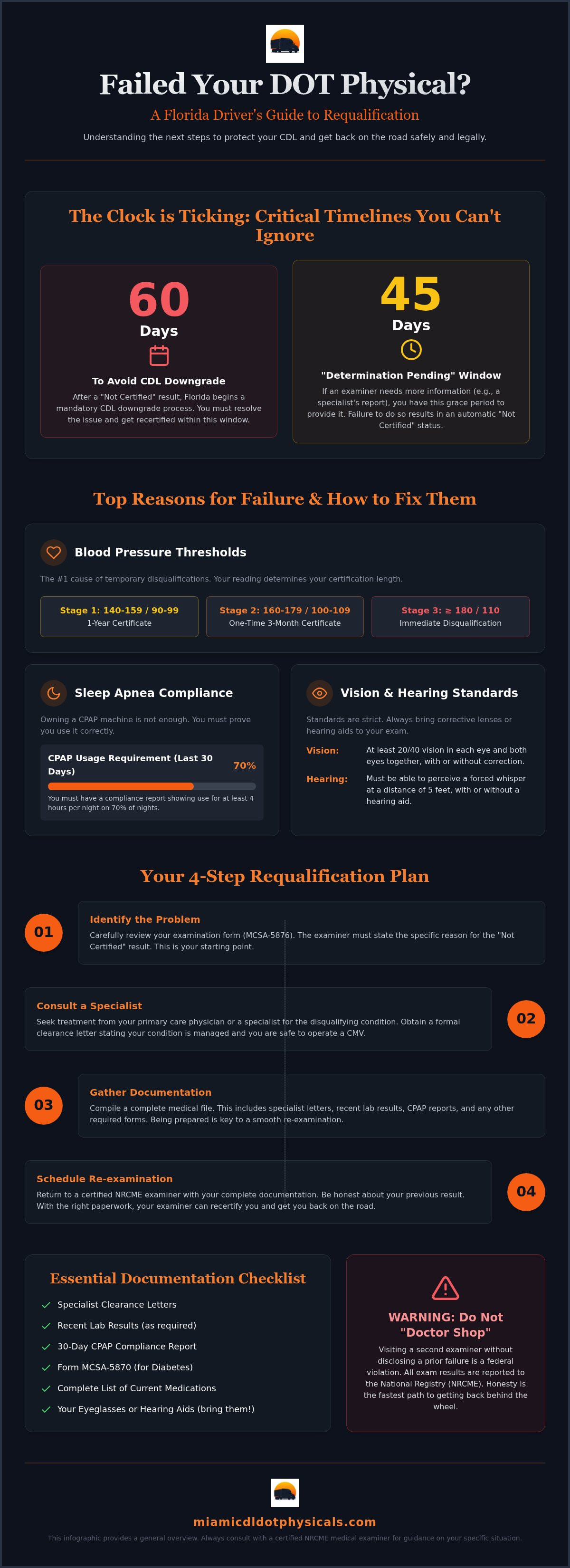
Sometimes, an examiner won't issue an outright failure. They may place your status in "determination pending." This is a 45-day grace period used when the examiner needs more information, such as a specialist's clearance or a specific lab result. If you provide the documents within those 45 days, the examiner can certify you without a new exam. However, if that window closes without the required proof, the status automatically converts to "Not Certified" in the federal system.
One of the most dangerous mistakes a driver can make is "doctor shopping." This involves visiting a second examiner to try and get a passing result without disclosing the previous failure. This is a federal violation. Maintaining a Commercial Driver's License (CDL) requires total honesty during the medical history portion of the exam. If you're caught withholding information about a prior disqualification, you could face heavy fines or the permanent loss of your driving privileges.
The Role of the National Registry (NRCME)
Every certified medical examiner is required by law to report exam results to the National Registry of Certified Medical Examiners (NRCME). This creates a digital paper trail that follows you regardless of which state you're in. When an examiner enters a "Not Certified" result, it's visible to federal authorities and state licensing agencies. Transparency is the fastest way back to the driver's seat. Being upfront about your health history allows your examiner to act as a partner, helping you navigate the specific steps needed for requalification.
Short-Term Certification: A Warning, Not a Failure
You might receive a medical card that's valid for only 3 months or 6 months instead of the standard two years. This typically happens when you have a manageable condition like hypertension that isn't yet fully controlled. View this as a warning rather than a failure. The FMCSA grants these short-term certifications to give you time to work with your doctor and stabilize your health metrics. Don't waste this time. Many short-term cards are "one-time" issues, meaning if your numbers haven't improved by the expiration date, you'll likely face a disqualification. This period is also an ideal time to address other health needs, such as dental work; if you're looking for specialized care, you can visit Merida Medical All inclusive Medical Tourism to explore their all-inclusive coordination services.
Understanding why drivers fail is the first step toward fixing the issue. If you've received DOT medical exam results that aren't what you hoped for, it's usually due to one of five common factors. If you've failed DOT physical what next Florida drivers should focus on is identifying the specific clinical reason for the disqualification and gathering the right paperwork for a re-evaluation.
The regulatory landscape for conditions like diabetes has improved. The FMCSA shifted from a slow waiver system to the current MCSA-5870 form. Now, your treating physician provides the data, and the medical examiner makes the final call. Similarly, vision and hearing standards are strict but manageable. You must have 20/40 vision in each eye and pass a "whisper test" from at least five feet away. If you use hearing aids or corrective lenses, bring them to every appointment.
Sleep apnea compliance is another frequent hurdle. It's a common misconception that owning a CPAP machine is enough. Examiners require a compliance report showing you've used the device for at least four hours a night for 70% of the time over the last 30 days. Without this data, your certification will be delayed.
Managing Blood Pressure and Heart Health
Blood pressure thresholds are the leading cause of short-term certifications. Stage 1 hypertension (140-159/90-99) typically results in a one-year card. Stage 2 (160-179/100-109) allows for a one-time, three-month certificate to get your numbers down. Stage 3 (180/110 or higher) is an immediate disqualification until your pressure is below 140/90. Many drivers experience "White Coat Syndrome," where stress spikes their numbers during the exam. Practice deep breathing and avoid caffeine before your visit.
If you have a history of heart attacks, stents, or pacemakers, you aren't automatically disqualified. You simply need recent records from your cardiologist. These documents must confirm that you've passed a stress test and are stable enough for the physical demands of driving. Once your health is managed, you can schedule a professional DOT physical exam to get back on the road.
Disqualifying Medications and Mental Health
Certain medications trigger an automatic failure because they interfere with alertness. This includes most narcotics, habit-forming drugs, and anti-seizure medications. If you take medication for depression or anxiety, it's rarely an issue as long as the condition is stable. You will need a "Letter of No Impairment" from your doctor stating the meds don't cause drowsiness or side effects that would make driving dangerous.
Differentiating between managed mental health and disqualifying psychiatric conditions is key. Examiners look for stability and long-term compliance with treatment. Taking these steps ensures that after you've failed DOT physical what next Florida regulations require is handled with precision and care.
The CDL Downgrade Timeline: Why You Have 60 Days to Act
Failing your medical exam isn't just a clinical setback; it's a regulatory countdown. In Florida, the state licensing agency must initiate a CDL downgrade within 60 days of receiving notice that a driver is no longer medically certified. The clock starts the moment your "Not Certified" status hits the federal database. If you've failed DOT physical what next Florida drivers should prioritize is resolving the medical issue before this window closes. If you don't act, your commercial privileges vanish, and you're automatically issued a standard Class E license.
The risks of ignoring this timeline are severe. Driving a commercial motor vehicle (CMV) with an invalidated medical card is a serious violation. You face immediate disqualification, heavy personal fines, and potential legal action if an accident occurs. Your carrier's insurance will likely refuse coverage for an uncertified driver, which can lead to immediate job loss. If your license is downgraded, you'll have to pay a $75 reinstatement fee in Florida, plus standard license fees, just to get your commercial status back after you finally pass your physical.
Self-Certification Categories and Your Status
Most commercial drivers in Florida fall into Category A, which is Non-excepted Interstate. This category requires you to maintain a valid medical certificate on file with the state at all times. You cannot simply "switch categories" to an excepted status, such as Category C or D, to avoid the medical exam requirements. This is a common mistake that often leads to a suspended license rather than a simple downgrade. You should check your current medical status regularly on the Florida Department of Highway Safety and Motor Vehicles (FLHSMV) portal. This ensures you know exactly when the state has updated your record and how much time you have left to submit a passing result.
The Federal vs. State Data Link
The way your medical data reaches the state has undergone a major shift. As of June 23, 2025, medical examiners are required to transmit all DOT physical results electronically to the FMCSA. The federal system then automatically alerts the state licensing agency of your status. This digital link means the state often knows you've failed before you even leave the clinic. The paper medical card is no longer the primary source of truth for authorities.
While the FMCSA has issued a temporary waiver through April 10, 2026, allowing drivers to carry a paper copy as valid proof for up to 60 days, this is only to cover processing lags. The electronic record in the state database is what determines if you're legally allowed to drive. Because the paper trail is disappearing, it's vital to work with an examiner who understands these electronic filing requirements to ensure your eventual passing result is recorded correctly and quickly.
How to Overcome a Failed Physical: A Step-by-Step Requalification Plan
Once you have the summary, schedule an appointment with your primary care physician or a specialist. For drivers in the Fort Lauderdale area, Unic Advanced Health Services offers primary care and chronic disease support to help you meet federal health standards. If your failure was due to high blood pressure, your doctor may need to adjust your medication or lifestyle. If it was a vision issue, you might need a new prescription or corrective surgery. The goal of this visit is to stabilize your condition and secure a formal clearance letter. This letter is your ticket back to the driver's seat. It must address the FMCSA concerns by name and provide proof that you're now within the legal limits.
If you are asking yourself about a failed DOT physical what next Florida professionals suggest that a structured plan is the only way to avoid a permanent license downgrade.
For drivers who prefer a clinic in the Miami area, Stay Medical Clinic offers personalized primary care and chronic disease management to help you get back on the road safely.
A vague note from your doctor isn't enough to pass a federal audit. To satisfy standards, the clearance letter must explicitly state that the driver is "medically fit to operate a commercial vehicle." It needs to be specific to your condition. For diabetics, the letter must include your most recent A1C lab results. For those with sleep apnea, it should include a 30-day CPAP reading log showing consistent use for at least four hours per night. For drivers seeking clearance related to neck or back pain, Coral Way Disc Center can provide the specialized documentation needed to prove musculoskeletal fitness.
The letter must also list every medication you're currently taking. Your specialist must confirm that these drugs don't cause drowsiness or any form of impairment that would interfere with driving. Providing this level of detail prevents the medical examiner from having to guess about your health status, which speeds up the certification process.
After you have your clearance letter and supporting records, return to a certified NRCME examiner. It's helpful to bring your previous "Not Certified" summary to the new appointment. This shows the examiner that you've taken the necessary steps to address the original failure point. During the re-examination, the doctor will focus heavily on the specific condition that caused the initial disqualification while still performing a full physical.
When the examiner determines you meet all standards, they'll issue a new medical certificate. They will then upload this result directly to the FMCSA portal. This electronic transmission is what clears your status in the federal and state databases. To ensure your paperwork is handled correctly, schedule your DOT physical exam with a provider who specializes in complex requalifications. This professional approach protects your CDL and gets you back to work legally.
Preparing for Your Re-Examination: Documentation and Compliance Checklist
Success in your re-examination starts long before you sit on the exam table. If you've failed DOT physical what next Florida drivers should do is treat the second attempt with extreme precision. Showing up with a "wait and see" attitude is a mistake that leads to more delays. You need a complete file of medical records, including recent cardiac stress test results, diabetic logs, and the specialist letters discussed earlier. At the Miami CDL/DOT Physical Exam Center, we assist drivers by ensuring they understand exactly which documents are required to prove they meet federal safety standards.
Your behavior in the 24 hours leading up to the exam is just as important as your paperwork. To stabilize your blood pressure, avoid all caffeine and nicotine for a full day before your appointment. These stimulants can cause temporary spikes that lead to a short-term card or an outright failure. Drink plenty of water and get a full night's sleep. These small steps can be the difference between a two-year certification and another "Not Certified" result. Taking control of these variables reduces the stress often associated with the 60-day downgrade timeline.
Never attempt to hide a medical condition or a previous failure. The NRCME database and the FMCSA Clearinghouse make it easy for examiners and authorities to track your medical history across state lines. Honesty is your best policy. When you're upfront about your health, a certified examiner can act as a partner to help you find a legal path to compliance. Lying on a federal form can lead to permanent disqualification and heavy fines. Transparency is always the fastest way back to the road.
The Essential Driver Document Bag
Organize your paperwork in a dedicated folder so nothing gets lost. This bag should include your current driver's license and your most recent medical card. Bring a typed list of all your treating physicians, their specialties, and their current contact information. If you have a condition like diabetes, ensure you have specific FMCSA forms, such as the MCSA-5870, already filled out and signed by your specialist. Having these documents ready shows the examiner you're a professional who takes regulatory requirements seriously—a quality that is highly valued by top South Florida employers like Vision Movers.
Shift your perspective on the DOT physical. It shouldn't be a hurdle you clear every two years; it's a vital health checkup that protects your livelihood. Maintaining heart health and stable blood sugar on the road is difficult, but it's essential for a long career. Pack healthy snacks, stay hydrated, and find time for light exercise during your breaks. For a deeper dive into staying ready, read our guide on How to Pass Your DOT Physical in 2026. Staying proactive keeps you in the driver's seat and prevents the panic of a failed DOT physical what next Florida drivers feel when they aren't prepared.
Secure Your CDL and Return to the Road
Failing a medical exam is a significant challenge, but it's one you can overcome with a clear strategy and the right partners. Remember that the 60-day state downgrade timeline is your most urgent priority. By identifying the specific medical reasons for your "Not Certified" status and working with specialists to secure compliant documentation, you can turn a temporary setback into a successful requalification. It's essential to stay proactive rather than waiting for the state to act on your commercial license status.
If you've failed DOT physical what next Florida drivers should do is act immediately to gather their records and seek professional guidance. Transparency with your examiner and a commitment to long-term health maintenance will ensure you meet all federal standards and keep your career moving forward. Our FMCSA-certified medical examiners provide fast, professional certifications and expert guidance on federal compliance. We're here to help you navigate the complex digital paper trail and get back behind the wheel safely and legally.
Schedule your professional DOT physical or re-evaluation today to protect your livelihood. We're dedicated to your professional success and look forward to seeing you back on the road with confidence.
Frequently Asked Questions
Can I get a second opinion if I fail my DOT physical?
Yes, you can seek a second opinion, but you must be transparent about your previous results. Withholding information about a prior disqualification is a federal violation and can lead to serious penalties. If you've failed DOT physical what next Florida drivers should do is address the underlying medical issue first. Once you have a specialist's clearance, returning for a new exam is the legal and professional way to requalify.
What happens to my CDL if I do not pass the medical exam within 60 days?
If you don't submit a passing medical certificate within 60 days, the Florida Department of Highway Safety and Motor Vehicles will automatically downgrade your CDL. Your commercial driving privileges will be revoked, and you'll be issued a standard Class E license. To get your CDL back later, you'll have to pay a state reinstatement fee in addition to standard license fees once you finally pass a new DOT physical and update your record.
Is high blood pressure an automatic fail for a DOT physical?
High blood pressure isn't an automatic permanent fail, but it can limit your certification length. Readings between 140/90 and 159/99 usually result in a one-year certificate. If your pressure is 180/110 or higher, you'll be disqualified immediately. You can requalify once your blood pressure stays consistently below 140/90. Managing your health with a primary physician is the best way to ensure you pass your next exam without facing unnecessary delays or shorter certification periods.
Can I drive while my DOT medical certification is "Pending"?
You can only drive while your status is "Pending" if your current medical certificate has not yet expired. If your previous card is already past its expiration date, you are legally disqualified from operating a commercial motor vehicle until a new certificate is issued. The 45-day pending window is simply a grace period to provide extra documentation; it doesn't extend your legal right to drive if your old card has already reached its end date.
What medications will disqualify me from getting a CDL medical card?
Several categories of medications trigger an automatic disqualification. These include methadone, anti-seizure medications, and most habit-forming narcotics or stimulants. Even some legal prescriptions for anxiety or depression can be an issue if they cause drowsiness. If you take any regular medication, bring a "Letter of No Impairment" from your prescribing doctor. This letter must confirm the drug doesn't interfere with your ability to safely operate a heavy commercial vehicle during your daily shifts.
Do I have to tell a new examiner that I failed a previous DOT physical?
Yes, you are legally required to disclose any previous medical disqualification on your health history form. Because all results are transmitted to the National Registry (NRCME), the new examiner will likely see your "Not Certified" status in the system anyway. Being honest about your health history builds trust and allows the examiner to focus on the specific steps needed to get you back on the road legally and safely without risking federal flags.
How much does it cost to get a re-evaluation after a failure?
The cost for a re-evaluation varies across Florida clinics. Most providers charge a fee similar to a standard physical, though some may offer different rates for follow-up appointments. Since prices aren't regulated by the FMCSA, you'll need to check with individual medical centers to confirm their current rates. Focus on finding a certified examiner who understands the requalification process rather than just looking for the lowest price to ensure your paperwork is handled correctly.
Can I get a waiver for certain medical conditions?
Yes, the FMCSA offers formal exemptions for specific conditions like vision impairments, hearing loss, or physical disabilities through the Skill Performance Evaluation (SPE) program. These waivers require a separate application process through the federal government and can take several weeks or months to approve. If you've failed DOT physical what next Florida requirements include is checking if your specific condition qualifies for one of these federal medical exemptions to maintain your commercial driving career.


