

A failed DOT physical doesn't have to mean the end of your time behind the wheel. While a medical disqualification feels like a dead end, it's actually just a regulatory detour that many successful drivers have handled before you. It's completely normal to feel overwhelmed by the complex 2026 updates to the CDL medical waiver program, especially with the ongoing transition to the National Registry II electronic system. You've worked hard for your license. The fear of losing your livelihood over a vision, hearing, or diabetic condition is a heavy burden, but the right information makes it manageable.
We're here to simplify the process and help you get back on the road. This guide provides a clear roadmap for securing the variances and exemptions needed to keep your career on track. You'll learn the specific eligibility requirements for federal waivers, the crucial differences between state and federal rules, and how to handle the latest temporary paper certificate extensions effective through October 2026. By following these step-by-step instructions, you can approach your next medical exam with total confidence and a solid plan for compliance.
Key Takeaways
- Understand how a medical variance serves as a regulatory bridge for drivers with specific physical conditions to maintain their commercial driving status.
- Learn the critical differences between federal interstate exemptions and state-level intrastate waivers to ensure you apply for the correct operating authority.
- Identify the specific vision and hearing impairments that are eligible for the CDL medical waiver program under the latest 2026 standards.
- Master the two-step application process, beginning with a specialized DOT physical to obtain the necessary medical documentation for your waiver request.
- Discover why working with an FMCSA-certified medical examiner is essential for correctly identifying variance needs and submitting accurate documentation to the National Registry.
What is the CDL Medical Waiver Program?
The CDL medical waiver program is a regulatory pathway that allows commercial drivers with specific medical conditions to operate safely and legally. Federal law sets strict physical standards for anyone holding a Commercial Driver's License (CDL), but the government recognizes that many professional drivers can perform their duties safely even if they fall outside standard physical metrics. Instead of forcing experienced professionals out of the industry, the FMCSA provides these variances to maintain a skilled workforce without compromising road safety.
A medical variance acts as a formal acknowledgement that you're qualified to drive despite a specific medical disqualification. This program isn't a "free pass" or a way to skip the medical exam. It's a rigorous validation process. You must prove that your condition is stable and that you can operate a vehicle as safely as any other driver. By providing this flexibility, the FMCSA ensures that the trucking industry doesn't lose valuable talent due to conditions that are well-managed or don't impact actual driving performance.
The Difference Between Waivers, Exemptions, and Variances
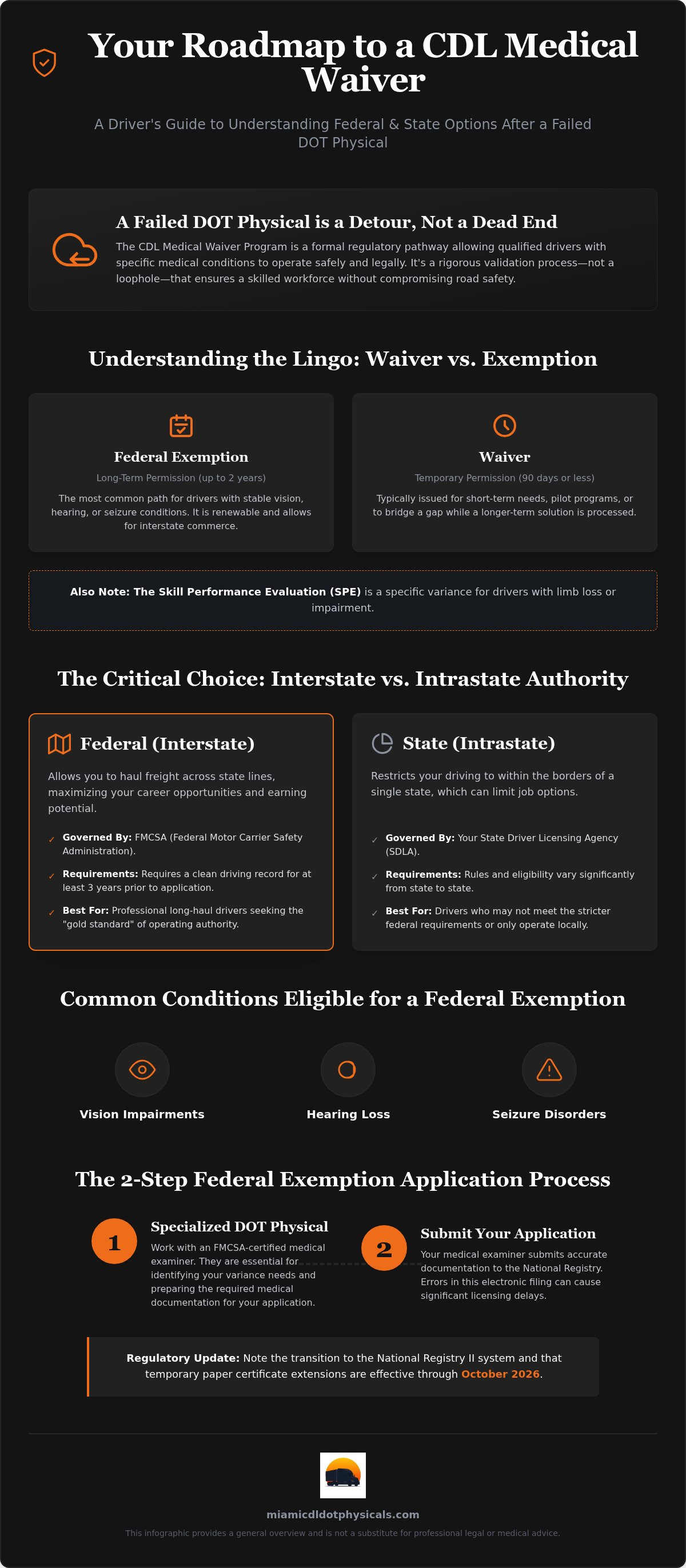
While people often use these terms interchangeably, they have distinct legal meanings. A medical variance is the broad umbrella term for any deviation from the standard rules found in 49 CFR 391.41. Within that umbrella, you'll find two main categories:
- Waivers: These are typically temporary permissions, often issued for a period of 90 days or less, usually to address short-term needs or specific pilot programs.
- Exemptions: These are longer-term federal permissions that can last for up to two years and are renewable if your medical status remains stable.
The Skill Performance Evaluation (SPE) is the primary variance for drivers with physical impairments such as limb loss or impairment. Most drivers seeking relief for vision, hearing, or seizure disorders will apply for a federal exemption rather than a temporary waiver.
Who Governs the Waiver Process in 2026?
Navigating this process requires understanding which agency has authority over your license. The Federal Motor Carrier Safety Administration (FMCSA) manages all variances for interstate commerce. If you plan to cross state lines, you must follow federal guidelines. However, if you only drive within a single state, your State Driver Licensing Agency (SDLA) manages your intrastate-only variances. These state-level rules can vary significantly from federal standards.
Your FMCSA-certified medical examiner plays a vital role here. They must note the need for a variance on your Medical Examiner’s Certificate during your DOT physical. This document must then be electronically synced with your driving record through the National Registry system. In 2026, successfully utilizing the CDL medical waiver program requires that your paperwork is perfect, as errors in the electronic filing system can lead to immediate licensing delays.
Interstate vs. Intrastate Waivers: Choosing Your Path
Choosing between an interstate and an intrastate waiver is one of the most important decisions you'll make for your career. This choice depends entirely on your "self-certification" status, which you declare at the DMV. If you operate in Category 1 (Interstate Non-Excepted), you must meet federal standards or obtain a federal variance. If you choose Category 2 (Intrastate Non-Excepted), you're restricted to driving within your home state's borders. While staying within state lines might seem easier, it significantly limits your earning potential and career growth in the long-haul trucking sector.
When to Seek a Federal (Interstate) Exemption
Drivers who want the freedom to haul freight nationwide should pursue a Federal FMCSA Medical Exemption. These programs specifically address vision impairments, hearing loss, and seizure disorders. To qualify, the FMCSA typically requires a clean driving record for at least three years before you apply. This means no major accidents, serious traffic violations, or license suspensions during that period. Although the federal CDL medical waiver program involves more paperwork and a longer waiting period, it's the gold standard for professional drivers. It ensures you aren't limited by geography when looking for the best-paying routes and specialized hauling opportunities.
Understanding Intrastate-Only Variances
If you don't meet the rigorous federal requirements, an intrastate-only variance might be your best option. Many states offer more lenient medical standards for drivers who stay within state lines. When you use this type of waiver, your state DMV or DOT will add a "K" restriction to your license. This code tells law enforcement and employers that your medical qualification is only valid for commerce within your home state. This is often a practical solution for local delivery drivers or municipal workers who don't need to cross state lines.
Be careful with this choice. An intrastate waiver is completely invalid the moment your tires cross a state line. Operating outside your home state with a "K" restriction can result in heavy fines and the immediate suspension of your license. To determine which path is right for your specific health needs, it's best to schedule your DOT physical with a certified examiner who can review your medical history. These experts help you understand if your condition qualifies for the federal level or if you should stick to local routes for now to keep your career moving forward.
Conditions Eligible for the CDL Medical Waiver Program
The CDL medical waiver program focuses on four primary areas where drivers often fail standard physicals: vision, hearing, seizure disorders, and physical impairments. Each category has its own set of rigorous criteria. Hearing loss, for instance, doesn't have to end your career. If you fail both the whisper test and an audiometry exam, the federal hearing exemption provides a path forward. You'll need to provide medical records from an audiologist or ENT showing that your condition doesn't interfere with safe driving. You can find detailed application requirements through the FMCSA Driver Exemption Programs portal.
Similarly, the standards for seizure disorders are strict because of the high risk involved. To qualify for a federal exemption, you must typically be seizure-free and off all anti-seizure medications for a specific period, often up to eight years for certain conditions. This requires extensive documentation from a neurologist to prove your condition is stable and well-managed without the need for active pharmaceutical intervention.
The 2026 Standard for Vision and Diabetes
Recent regulatory shifts have changed how we handle common conditions like diabetes and vision loss. Insulin-treated diabetes is no longer managed through a traditional "waiver" process. Instead, you and your treating clinician must complete the MCSA-5870 form, which your medical examiner reviews during your physical. This change removes the long waiting periods previously associated with the CDL medical waiver program for diabetic drivers.
Vision standards have also evolved significantly. Under the updated alternative physical qualification standards, many monocular drivers can now qualify without seeking a full federal exemption if they meet specific visual field and acuity requirements. The Medical Examiner now has more authority to certify vision if specific criteria are met. This shift streamlines the process for many experienced drivers who have adapted to monocular vision over time and can demonstrate safe operation during their exam.
Skill Performance Evaluation (SPE) for Physical Impairments
Drivers with lost or impaired limbs, such as hands, feet, arms, or legs, utilize the Skill Performance Evaluation (SPE) certificate. This is a specialized variance for fixed deficits that don't change over time. It's designed for drivers who can prove their physical limitation doesn't prevent them from controlling a heavy vehicle.
Unlike other exemptions, the SPE requires an "on-road" performance test. You must demonstrate to an FMCSA specialist that you can safely operate a commercial motor vehicle (CMV) using any necessary prosthetic devices or vehicle modifications. It's a practical, results-based assessment. Once granted, you must renew your SPE certificate every two years. Keeping this certificate current is vital, as an expired SPE immediately invalidates your medical certification and your right to drive.
How to Apply for a Federal FMCSA Medical Exemption
Applying for the CDL medical waiver program requires precision and patience. It's a multi-step process that starts at the doctor's office and ends with a federal decision. You shouldn't navigate this alone, as missing a single document can reset your timeline by months. Follow these steps to ensure your application package is professional and complete.
- Step 1: Complete your exam. Visit a certified medical examiner for a DOT physical exam. If you don't meet the standard requirements, the examiner will issue a "disqualified" status or a short-term certificate. This documentation is the necessary first step to prove you need a variance.
- Step 2: Consult your specialist. Depending on your condition, you must visit a specialist, such as an Ophthalmologist or Cardiologist. They'll need to provide detailed medical records that support your ability to drive safely.
- Step 3: Submit the package. Send your formal application and all supporting medical documents to the FMCSA Medical Programs office. Ensure every form is signed and dated.
- Step 4: Monitor the Federal Register. Federal law requires a 30-day public comment period for all exemption requests. The FMCSA publishes your request in the Federal Register to allow for transparency.
- Step 5: Carry your Final Disposition. If approved, you'll receive a Final Disposition letter. You must carry this letter with your medical card at all times while operating a commercial vehicle.
Essential Documentation and Forms
The success of your application depends on using the correct forms. For insulin-treated diabetes, you'll need the MCSA-5870 form. For vision issues, use the MCSA-5871. A critical part of your package is your Motor Vehicle Record (MVR) for the last three years. The FMCSA reviews this to ensure you have a history of safe operation. Ask your specialist to use the exact language required by the FMCSA, specifically stating that your condition is stable and doesn't interfere with your ability to safely operate a commercial motor vehicle (CMV).
Processing Times and Renewal Requirements
The federal review process is not instant. You should expect a decision within 180 days of the FMCSA receiving your completed application. This timeline includes the mandatory public comment period and the internal medical review. While your waiver is "pending," you cannot legally drive in interstate commerce if your current medical certificate has expired. Always start your renewal process at least 90 days before your current exemption expires. This buffer ensures you don't face a gap in your ability to work while the CDL medical waiver program administrators process your update.
The Role of Your FMCSA-Certified Medical Examiner
Your medical examiner acts as the primary gatekeeper for your commercial driving career. During a DOT physical, they're responsible for identifying any conditions that fall outside standard safety parameters. An expert examiner doesn't just stop at a disqualification. They serve as a partner, helping you understand how the CDL medical waiver program can bridge the gap between your health status and federal requirements. By choosing an examiner listed on the National Registry of Certified Medical Examiners (NRCME), you ensure that your professional future is in the hands of someone who understands the complex 2026 compliance landscape.
Collaboration is the foundation of a successful waiver application. Your examiner must coordinate with your treating specialist to verify that your condition is stable and well-managed. Once the FMCSA or state agency grants your variance, the examiner has a specific regulatory duty. They must mark the "Accompanied by a waiver/exemption" box on your Medical Examiner’s Certificate. If this box is left unchecked, your CDL will remain invalid even if you have the waiver in hand. This administrative step is critical for ensuring your status syncs correctly with the National Registry II electronic system.
Preparing for Your Exam with a Potential Condition
Coming prepared is the best way to reduce stress during your appointment. Bring all relevant medical records, current medication lists, and signed letters from your specialists. These documents provide the examiner with the evidence they need to support your case for a variance. You should also refer to our guide on how to pass your DOT physical for detailed health preparation tips. Transparency is your greatest asset. Be honest about your medical history to avoid being flagged for "doctor shopping." The FMCSA system now tracks exam results in real-time. Attempting to hide a disqualification by visiting multiple clinics can lead to a fraud investigation and permanent license revocation.
Next Steps After a Disqualification
If you receive a disqualification, stay calm. It's often a temporary status while you gather more information. Ask your examiner for the specific regulation number in 49 CFR 391.41 that caused the disqualification. This number tells your specialist exactly what medical benchmarks you need to meet for an exemption. Request the necessary FMCSA exemption application forms from the clinic staff immediately so you can begin the process while the exam details are fresh. Finally, book a follow-up consultation. Once your specialist provides the required findings, your examiner can review the data and help you finalize your submission for the CDL medical waiver program.
Secure Your Future on the Road
A medical condition doesn't have to end your commercial driving career. By understanding the CDL medical waiver program, you've taken the first step toward staying compliant and protecting your livelihood. Success in this process depends on choosing the right path between interstate and intrastate authority and ensuring your medical documentation is flawless. You now have the roadmap to navigate these regulations, from gathering specialist letters to managing the National Registry II electronic updates. Don't let paperwork or medical anxiety slow you down. Our FMCSA-certified medical examiners provide expert guidance on complex medical compliance and offer an efficient, driver-focused exam process designed to get you back to work safely. Schedule your professional medical certification at our FMCSA-certified center today. We're here to help you navigate every regulatory hurdle with confidence and clarity. Your expertise is a vital part of the nation's supply chain, and we're committed to helping you stay in the driver's seat for years to come.
Frequently Asked Questions
Is a CDL medical waiver the same as a federal exemption?
Technically, they're different, though many drivers use the terms interchangeably. A medical variance is the broad umbrella term for any deviation from standard rules. A waiver is usually a temporary permission lasting 90 days or less, often for specific pilot programs. A federal exemption is a longer-term permission that typically lasts for two years and is renewable. Most drivers seeking relief for vision or hearing issues are actually applying for a federal exemption.
Can I drive while my medical waiver application is being processed?
You can only drive if you possess a currently valid Medical Examiner’s Certificate. If your previous certificate has expired or you've been disqualified during your latest physical, you can't legally operate a commercial vehicle in interstate commerce while your application is pending. The FMCSA review process can take up to 180 days. It's vital to keep your current certification active or apply well in advance of your expiration date to avoid downtime.
How long does a federal vision or hearing exemption last?
Federal vision and hearing exemptions typically last for two years from the date they're issued. To maintain your driving status without interruption, you must begin the renewal process at least 90 days before the current exemption expires. This buffer allows the FMCSA enough time to review your updated medical records and publish the required notice in the Federal Register. Failing to renew on time results in an immediate medical disqualification on your driving record.
What happens if I fail the DOT physical but don’t apply for a waiver?
If you fail your physical and choose not to apply for a variance, you'll lose your medical certification. Your State Driver Licensing Agency is notified electronically, and they'll eventually downgrade your CDL to a standard non-commercial driver's license. This prevents you from legally operating any commercial motor vehicle. You must resolve the medical disqualification through the CDL medical waiver program or medical treatment before you can regain your professional commercial driving privileges.
Can an owner-operator apply for a medical waiver program?
Yes, owner-operators have the same right to apply for the CDL medical waiver program as fleet drivers. The application process remains identical, requiring a DOT physical from a certified examiner and supporting documentation from a medical specialist. Since you act as your own motor carrier, you're responsible for ensuring all variance documents are kept on file. You must also ensure your medical status is correctly updated in the FMCSA Clearinghouse and with your state licensing agency.
How much does it cost to apply for an FMCSA medical exemption?
The FMCSA doesn't charge a fee to process or grant a federal medical exemption. However, you're responsible for the costs associated with the required medical examinations. This includes the initial DOT physical and any specialized evaluations from ophthalmologists, audiologists, or neurologists needed to support your application. These professional fees vary by provider. You should view these costs as a necessary investment in maintaining your professional credentials and your long-term career in the industry.
What medical conditions are most commonly granted waivers in 2026?
In 2026, the most frequent variances are granted for vision impairments, hearing loss, and seizure disorders. Drivers with monocular vision often utilize updated alternative physical qualification standards to stay on the road. Hearing exemptions are common for those who can't pass the whisper test but can demonstrate safe operation. Additionally, drivers with missing or impaired limbs frequently secure Skill Performance Evaluation (SPE) certificates, which allow them to drive specially equipped or modified commercial vehicles safely.
Can I get a waiver for high blood pressure or sleep apnea?
No, the FMCSA doesn't typically issue waivers or exemptions for high blood pressure or sleep apnea. These conditions are considered manageable through standard medical treatment and lifestyle changes. If you have these conditions, your medical examiner may issue a short-term medical certificate, such as a three-month or one-year card, to monitor your progress. Once your blood pressure is under control or your CPAP compliance is verified, you can receive a standard medical certification without a variance.


