
Your medical examiner's certificate is only half the battle. Without the correct self-certification, your commercial license is essentially a countdown to disqualification. It's a stressful reality for many professionals who realize too late that a simple paperwork error can ground their vehicle. If you're looking to stay compliant with the CDL medical card requirements Miami drivers must follow in 2026, you need more than just a physical. You need a clear plan to bridge the gap between your medical exam and the state's registry.
We understand that the transition to the National Registry II system has created hurdles, including the temporary paper certificate exemption active from April 11 to October 11, 2026. You deserve a process that's efficient and reliable so you can focus on the road. This guide simplifies the federal self-certification process and clarifies exactly how to report your status. We'll cover the four specific certification categories, explain current health standards, and provide the step-by-step instructions you need to keep your CDL active without any interruptions.
Key Takeaways
- Learn how to link your Medical Examiner’s Certificate to your state record to prevent your commercial license from being downgraded to "not-certified" status.
- Identify which of the four federal commerce categories fits your operation so you can choose the correct certification type without paperwork errors.
- Master the step-by-step process for meeting CDL medical card requirements Miami and ensuring your MCSA-5876 form is correctly processed by state agencies.
- Discover the critical timelines and the 15-day processing window you need to manage to avoid automatic license disqualification.
- Understand the 2026 health standards for vision, hearing, and blood pressure so you can arrive prepared for your professional DOT physical.
What is the CDL Medical Self-Certification Process?
Self-certification is the formal declaration you make to your State Driver Licensing Agency (SDLA) regarding your medical status and the type of driving you perform. It's a mandatory federal requirement for anyone holding a Commercial driver's license. This process creates a vital link between your Medical Examiner’s Certificate (MEC) and your driving record. Without this link, the state has no way of knowing you're medically fit to operate a heavy vehicle. Understanding the CDL medical card requirements Miami drivers face is essential because the FMCSA uses this data to ensure every operator on the road meets strict safety standards.
The FMCSA requires this declaration to determine which set of medical rules applies to you based on your specific job duties. If you fail to complete this step, your state agency will automatically "downgrade" your license. This means you lose your commercial privileges and can only operate a standard passenger vehicle until the paperwork is corrected. It's a simple administrative step, but missing it can bring your career to a sudden halt.
The Role of the FMCSA in Medical Oversight
Federal regulations under 49 CFR 383.71 govern how medical certifications are handled across the country. In 2026, the shift toward electronic data integration is more critical than ever. The FMCSA maintains the National Registry of Certified Medical Examiners to ensure that only qualified professionals perform these high-stakes exams. When you visit a certified examiner, they enter your results into a federal system designed to reduce fraud and improve road safety. This system allows states to verify your medical status quickly, though you still have a personal responsibility to ensure your self-certification category remains accurate.
Who is Required to Self-Certify?
Compliance isn't a one-time event. You must self-certify your medical status during several key moments in your professional life. Staying on top of CDL medical card requirements Miami ensures you don't face unexpected delays during these transitions:
- New Applicants: Every person applying for an original CDL must declare their commerce category before their license is issued.
- Renewals and Upgrades: When you renew your license, upgrade to a higher class, or add specific endorsements, you must re-verify your medical status with the state.
- Medical Changes: If you suffer a significant injury or illness that could affect your ability to drive, you must update your certification to remain legal.
Every professional driver starts somewhere, and having a solid foundation is vital. For those looking for top-tier instruction for teen and adult learners, Seattle Driving Academy provides the comprehensive training programs necessary to master the road safely before advancing to specialized commercial certifications.
By keeping your certification current, you protect your livelihood and ensure you're always ready for the next haul. The process is designed to be straightforward, but it requires your active participation to keep the system updated.
Choosing the Correct Self-Certification Category
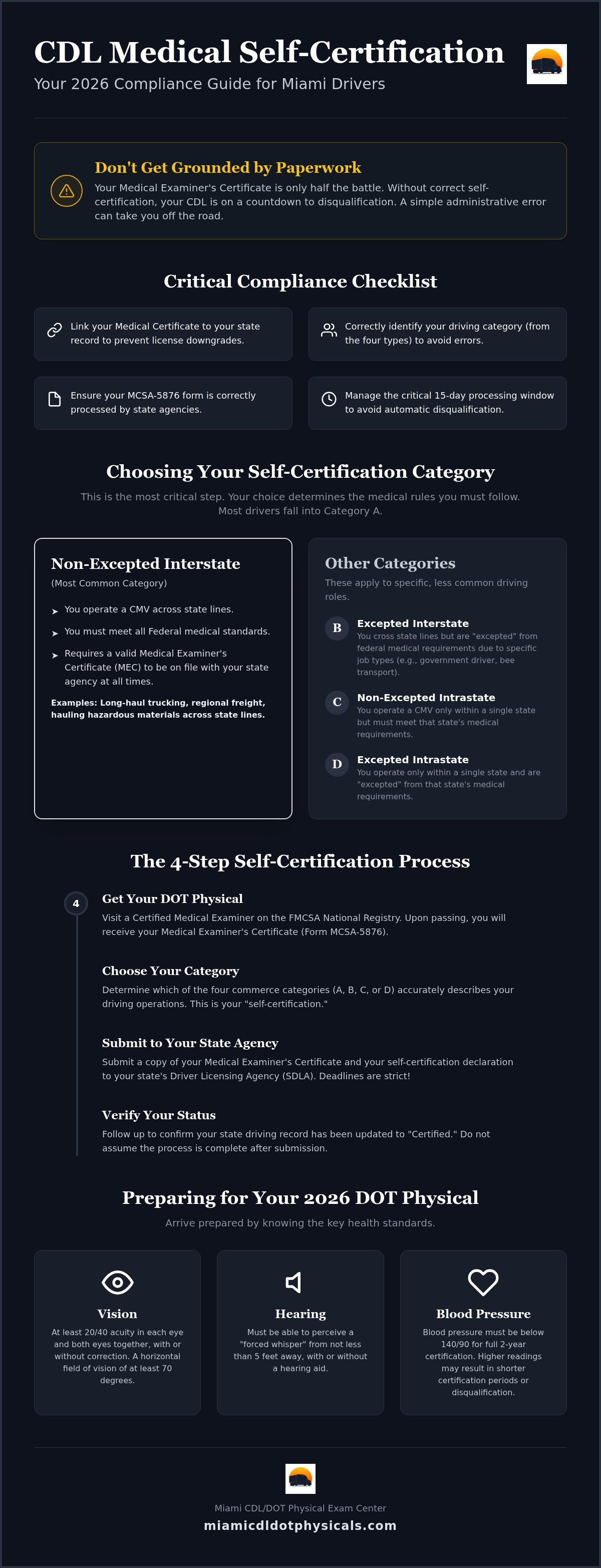
Selecting your commerce category is the most confusing part of the certification process. If you pick the wrong one, you might inadvertently invalidate your license or subject yourself to unnecessary medical oversight. Federal law divides commercial driving into four distinct categories based on where you drive and what you carry. To stay compliant with the CDL medical card requirements Miami drivers must meet in 2026, you need to understand the difference between interstate and intrastate commerce, as well as non-excepted and excepted status.
Use this simple decision framework to find your fit. First, ask if you ever cross state lines or haul cargo that originated in another state. If you do, you're an interstate driver. Next, determine if your driving falls under a specific federal exception. If you don't qualify for an exception, you're non-excepted. Most commercial drivers find themselves in the Non-Excepted Interstate category. If you're unsure about your specific health qualifications, it's best to consult with a professional DOT physical examiner who can guide you through the medical standards.
Non-Excepted Interstate (Category A)
Category A is the gold standard for commercial driving. It covers long-haul truckers, regional freight movers, and anyone hauling hazardous materials across state lines. If you choose this category, you must maintain a valid Medical Examiner’s Certificate on file with your state agency at all times. This category ensures you meet the full Federal medical requirements for safety. Common examples include commercial towing across state borders and general freight operations.
Excepted Interstate and Intrastate (Categories B, C, and D)
The "Excepted" categories apply to drivers who perform very specific types of work. This includes school bus drivers employed by a school district, government employees operating municipal vehicles, and certain farm vehicle operators. Intrastate categories (C and D) are for those who never leave their home state and only haul cargo that stays within state lines. It's important to verify your cargo's origin. Even if you never leave the city, hauling a container that just arrived from an out-of-state port often classifies you as an interstate driver. Understanding these nuances is a key part of mastering the CDL medical card requirements Miami mandates for professional license holders.
Step-by-Step Guide: How to Self-Certify Your Medical Status
Self-certification is a linear process that requires precision to avoid license downgrades. Following a logical sequence ensures you don't miss a deadline or submit incomplete paperwork. To satisfy the CDL medical card requirements Miami drivers face in 2026, follow these five essential steps.
First, schedule a professional physical with an FMCSA-certified medical examiner. This professional handles the complex medical evaluation and ensures your data enters the federal system correctly. Second, obtain your physical Medical Examiner’s Certificate, also known as Form MCSA-5876. Even with digital transitions, you must keep this document on your person while driving. Third, access your State Driver Licensing Agency (SDLA) portal. In 2026, most states have fully integrated online systems for this purpose. Fourth, submit your MEC along with your formal self-certification declaration. Finally, verify your record. Don't assume the system updated automatically; log back in after a few days to confirm your status is officially "Certified."
Preparing Your Documentation
Before you hit the submit button, double-check every detail on your paperwork. Ensure your Medical Examiner’s Certificate is signed by the provider and remains clearly legible. Any blurriness in a digital scan can lead to a rejected application and a lapse in your driving status. You must also verify that the name, address, and license number on your certificate match your CDL exactly. Discrepancies between these documents are a leading cause of processing delays. Form MCSA-5876 serves as your primary proof of fitness and must be accurate to maintain your driving privileges.
Methods of Submission
Online portals are the fastest and most reliable way to update your records in 2026. These systems provide immediate confirmation that your documents were received, which is vital given the ongoing National Registry II transition. While mail and fax options still exist in some jurisdictions, they're becoming secondary and significantly riskier. Paper mail can get lost, and faxed copies often lose the clarity required for state systems to read them. In-person visits are generally reserved for complex cases or when you're upgrading your license class. For drivers who need to Book Your Road Test as part of that upgrade process, third-party scheduling services can be a helpful resource to avoid long wait times. If you're managing CDL medical card requirements Miami from the road, the digital route is your best ally. It saves time and provides a clear digital trail of your compliance.
Maintaining compliance with CDL medical card requirements Miami means staying ahead of the calendar. You shouldn't wait until the final week of your certificate’s validity to seek a renewal. Don't wait. State agencies typically require a 15-day processing window to manually update your driving record once you submit your paperwork. If your card expires during this window, the system may automatically trigger a downgrade. It’s your responsibility to monitor your "Certified" status through your state’s online portal to ensure you meet all CDL medical card requirements Miami drivers are held to in 2026.
The FMCSA Clearinghouse now plays a larger role in your medical status than in previous years. This federal database tracks your drug and alcohol testing history, but it also communicates with state licensing systems. A medical disqualification can flag your profile, making it difficult for employers to verify your eligibility for duty. To keep your record clean and your career on track, schedule your DOT physical well before your current card reaches its end date.
The Consequences of a Medical Downgrade
If your medical certificate expires before you renew your self-certification, your commercial privileges vanish immediately. Your CDL technically remains valid as a standard Class D license, but you cannot legally operate a commercial motor vehicle. This lapse often triggers an automatic notification to your employer’s insurance carrier, which can lead to immediate suspension from duty. Re-certifying after a lapse requires you to submit a fresh medical certificate and potentially pay administrative fees to reinstate your commercial status.
New 2026 Electronic Reporting Standards
The regulatory landscape changed significantly following the June 2025 rule update. Examiners are now required to transmit medical results directly to the FMCSA National Registry within one business day. While this speeds up the federal side of the process, it doesn't always update your state-level driving record instantly. You still need to verify that your state agency has received and processed the data manually. If you notice a discrepancy between the federal registry and your state record, contact your medical examiner immediately to ensure the data was transmitted without errors.
Preparing for Your DOT Physical and Medical Certification
Success at the clinic starts long before you sit on the exam table. Your physical health is your most valuable professional asset. To meet the CDL medical card requirements Miami standards in 2026, you must pass specific benchmarks for vision, hearing, and cardiovascular health. Your vision needs to be at least 20/40 in each eye, with or without corrective lenses. Hearing is usually tested via a whisper test at a distance of five feet. Blood pressure is equally critical; a reading under 140/90 is the baseline for a standard two-year certificate. If your pressure is higher, you might only receive a temporary card while you work with a physician to stabilize your numbers.
Managing chronic conditions like diabetes or sleep apnea doesn't automatically disqualify you. It just means you need better documentation. If you use insulin, ensure you have the appropriate federal forms completed by your treating clinician before your appointment. For those with sleep apnea, bring at least 90 days of CPAP compliance logs to show you're using the device as prescribed. An FMCSA-certified examiner isn't there to find reasons to fail you. Their goal is to partner with you to ensure you stay behind the wheel safely for years to come. Arriving with a full list of your current medications and dosages will make the process much smoother.
Tips for a Successful Exam
Preparation reduces the stress that often spikes blood pressure during an appointment. Avoid caffeine and nicotine for at least two hours before your exam. Drink plenty of water and arrive early so you aren't rushing. If you've had recent surgeries or major medical events, bring a release letter from your specialist stating you're cleared for commercial driving. For a deeper dive into preparation, read our guide on How to Pass Your DOT Physical. These small steps ensure you meet the CDL medical card requirements Miami mandates without unnecessary delays.
Next Steps for Drivers and Fleets
Compliance is a continuous cycle. We recommend booking your exam at least 30 days before your current card expires to allow for any administrative processing at the state level. Beyond the physical, owner-operators and fleets should consider joining a drug testing consortium to stay fully compliant with federal safety regulations. This proactive approach prevents the panic of a last-minute renewal. Don't leave your livelihood to chance. Schedule your certified DOT physical today to stay compliant and keep your career moving forward.
Secure Your Driving Privileges for the Long Haul
Managing the federal self-certification process is a critical skill for every commercial driver. By identifying your correct commerce category and submitting your MCSA-5876 form early, you prevent the administrative errors that lead to license downgrades. Remember that state agencies often need at least 15 days to process your updates. Staying proactive ensures that you remain fully compliant with all CDL medical card requirements Miami mandates in 2026. Your health is the engine of your career. Keeping it documented is just as important as the physical exam itself.
We're here to handle the complex medical reporting so you can focus on the road ahead. Our clinic provides FMCSA-Certified Examiners, full FMCSA Clearinghouse support, and same-day medical cards to keep your schedule moving without delay. Don't let a paperwork lapse ground your vehicle or affect your standing with your employer. Schedule Your Certified DOT Physical Exam now to lock in your certification. You've built a strong career in this industry; let's work together to ensure your commercial privileges stay active and secure.
Frequently Asked Questions
How often do I need to renew my CDL medical card?
A DOT medical certificate is typically valid for up to 24 months. Your medical examiner might issue a shorter certificate for 3, 6, or 12 months if you have health conditions like high blood pressure that require frequent monitoring. Always check the expiration date on your Form MCSA-5876. This ensures you stay compliant with the CDL medical card requirements Miami standards before your current card lapses.
Can I self-certify online or do I have to go in person?
Online self-certification is the fastest and most efficient method in 2026. Most state agencies provide dedicated portals where you can upload a scan of your Medical Examiner’s Certificate and complete the declaration form instantly. While in-person visits to a driver license office are still possible, they often involve longer wait times. Using the digital portal ensures you receive an immediate confirmation that your documents were successfully received by the state.
What happens if I forget to self-certify after my physical?
If you forget to self-certify, your state licensing agency will automatically downgrade your commercial license to a non-commercial Class D status. This happens even if your medical exam was successful and your physical card is valid. You cannot legally operate a commercial motor vehicle during a downgrade. To fix this, you must submit your current medical certificate to the state and wait for them to update your record to "Certified."
Do I need a medical card if I only drive intrastate?
Yes, you still need a medical card even if you only drive within state lines. Intrastate drivers must self-certify in either the Non-Excepted Intrastate or Excepted Intrastate category. Unless you fall into a specific exempt group, such as certain municipal government employees, you'll need to pass a DOT physical. Keeping a valid medical card on file is necessary to meet the CDL medical card requirements Miami and federal law mandate.
Which self-certification category should I choose if I am an owner-operator?
Most owner-operators should choose the Non-Excepted Interstate (Category A) designation. This category offers the most flexibility, allowing you to haul freight across state lines or transport cargo that originated outside your home state. Since most freight is part of interstate commerce, choosing this category ensures you don't accidentally violate federal rules. You'll need to maintain a valid DOT medical certificate at all times to keep this status active and legal.
What medical conditions will disqualify me from getting a CDL medical card?
Several medical conditions can lead to disqualification, including uncontrolled high blood pressure, epilepsy, or a clinical diagnosis of alcoholism. Severe vision or hearing loss that cannot be corrected to federal standards will also prevent certification. However, many conditions like certain types of diabetes now have waiver programs or alternative standards. It's best to discuss your health history with a certified medical examiner to explore your options for a limited-term certificate.
How long does it take for the state to update my medical status?
State agencies typically require a 15-day processing window to update your driving record after you submit your paperwork. While the 2025 electronic reporting standards require examiners to transmit results to the federal registry within one business day, the state-level update isn't always instant. You should log into your state's driver portal about 10 days after submission to verify that your status has officially changed to "Certified" to avoid any license issues.
Can I change my self-certification category later?
You can change your self-certification category at any time by submitting a new self-certification form to your state licensing agency. This is common for drivers who move from long-haul interstate work to local intrastate routes. If you switch from an "Excepted" category to a "Non-Excepted" one, you must also provide a valid Medical Examiner’s Certificate. Always keep a copy of your submission and confirmation for your own professional records.


