

Believing in a CDL medical card grace period is one of the fastest ways to lose your livelihood in 2026. Many drivers assume they have a few weeks of leeway after their certificate expires, but the reality is much harsher. If your medical card isn't current, you are no longer medically qualified to operate a commercial motor vehicle. We understand the stress of trying to find a fast appointment while your expiration date looms, especially when your paycheck depends on staying behind the wheel.
You deserve clear answers about your certification status to avoid an immediate license downgrade. In this article, we explain exactly what happens the moment your card lapses and why relying on a rumored grace period is a dangerous gamble. We also clarify the 60 day waiver for paper certificates and how the shift toward electronic reporting affects your compliance requirements this year.
By the end of this guide, you will know if you can legally drive today and the specific steps to fix an expired card. We provide a clear path forward so you can stay on the road, maintain your federal compliance, and avoid the expensive and time consuming process of a full CDL re-testing.
Key Takeaways
- Understand that federal law requires a valid certificate at all times, meaning a formal CDL medical card grace period does not exist once your current card expires.
- Learn how a lapsed medical status triggers an automatic license downgrade in the federal database, which legally prevents you from operating commercial vehicles.
- Clarify the specific rules for paper certificates and how the temporary 60 day waiver provides administrative breathing room while state agencies process your new exam.
- Discover the critical steps for identifying your true expiration date and why scheduling your DOT physical 30 days in advance is the best way to stay compliant.
- Find out how to fast-track your certification with same-day results to avoid the high costs and stress of a full CDL re-testing process.
Does a CDL Medical Card Grace Period Actually Exist?
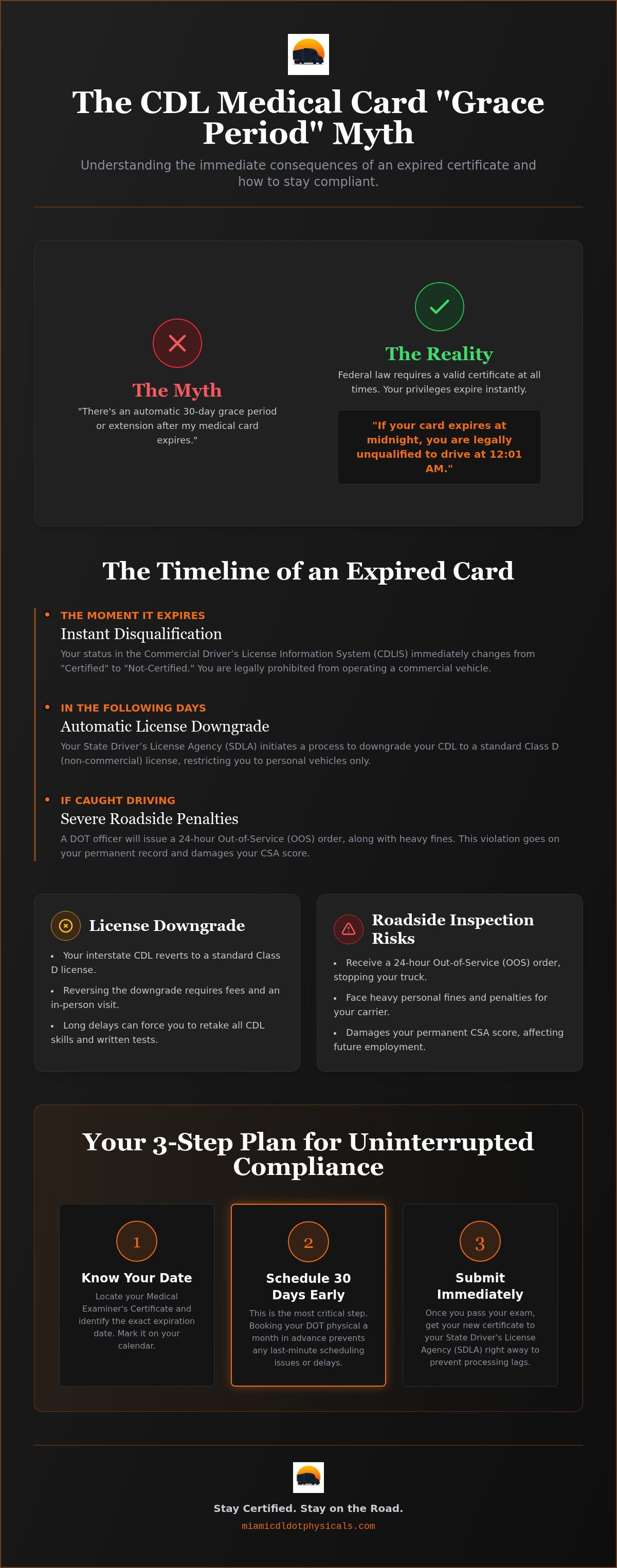
Many drivers search for a CDL medical card grace period when they realize their certificate is about to expire. The hard truth is that federal law, specifically 49 CFR 391.45, requires you to have a valid medical certificate at all times while operating a CMV. There is no hidden buffer built into the law. If your card expires at midnight, you are legally unqualified to drive at 12:01 AM. Relying on the idea of a "grace period" is a dangerous misconception that can result in immediate fines or being pulled off the road during an inspection. While the FMCSA occasionally issues temporary waivers during national emergencies, these are rare exceptions and not standard operating procedure. The expiration date on your Medical Examiner’s Certificate is a non-negotiable deadline for all commercial operations.
The Myth of the 30-Day Extension
Rumors often circulate in truck stops about an automatic 30 day extension for medical renewals. These stories are usually based on old information or a misunderstanding of how state agencies process paperwork. In 2026, the landscape is much stricter than it was during the COVID-era. The emergency policies that once allowed for extended deadlines have long since expired. Don't risk your career. If you rely on hearsay instead of the date printed on your card, you risk receiving an Out-of-Service (OOS) order. This doesn't just stall your current load; it goes on your permanent driving record and can affect your future employment.
Federal vs. State Enforcement Policies
The FMCSA sets the federal safety standards, but your State Driver’s License Agency (SDLA) is responsible for enforcement. Maintaining a Commercial driver's license (CDL) requires you to keep your medical status updated in the Commercial Driver’s License Information System (CDLIS). Once your card expires, the state system begins a countdown to flag you as "non-certified." There is often a slight delay between the moment your card expires and when the state officially downgrades your license. Your CDL might appear "active" for a few days due to administrative processing times, but this does not mean you are legal. Law enforcement officers can check the actual expiration date on your physical card or in the national registry. If those dates don't align with a valid exam, the "active" status of your license won't protect you from a citation. You are either compliant or you aren't.
The Immediate Consequences of an Expired CDL Medical Card
Once the clock strikes midnight on your expiration date, the consequences are swift and automated. Your status in the Commercial Driver’s License Information System (CDLIS) changes from "certified" to "not-certified" instantly. This is not just a minor paperwork error; it is a legal disqualification. You effectively lose your commercial driving privileges the moment that card lapses. There is no hidden CDL medical card grace period that protects you from these system updates. If you are behind the wheel of a commercial vehicle when this happens, you are operating illegally.
Automatic Downgrade to Class D
Most states initiate an automatic downgrade when they receive notice of an expired medical certificate. Your interstate CDL reverts to a standard Class D operator license. This change restricts you to driving personal vehicles only. Reversing this process is an administrative nightmare. You cannot simply show a new card to a roadside officer and resume your route. You must often visit a state licensing office in person, pay reinstatement fees, and wait for the system to update. If you allow the downgrade to persist for several months, some states require you to retake the written and skills tests from scratch to regain your CDL.
Roadside Inspection Risks
Modern roadside inspections are highly digital and efficient. In 2026, DOT officers verify your medical status through real-time database queries during every stop. If you are caught driving a CMV with an expired card, the officer will issue a 24-hour Out-of-Service (OOS) order. This stops your truck exactly where it stands, requiring your company to send a relief driver or tow the vehicle. You also face heavy personal fines, and your carrier may receive significant penalties for allowing an unqualified driver on the road. These violations stay on your record and damage your CSA score, which makes you a liability for future employers.
Fleet managers monitor CDLIS status closely to avoid massive insurance risks. If an uncertified driver is involved in an accident, the company faces "negligent entrustment" lawsuits that can cost millions of dollars. Because of this risk, many fleets maintain zero-tolerance policies. They may terminate your contract immediately if your medical card expires. The financial loss from a single day of being OOS often exceeds the cost of a renewal appointment. If you are nearing your deadline, it is vital to schedule a DOT physical exam immediately to keep your career on track and your license active.
Understanding the 15-Day Rule for Paper Medical Certificates
While you cannot drive on an expired certificate, the FMCSA provides a specific window for drivers who have just passed their physical. This is often confused with a CDL medical card grace period, but it serves a very different purpose. The 15-day rule refers to the period during which you must carry your physical Medical Examiner’s Certificate (MEC) while the state updates your electronic record. While this was traditionally a two-week window, federal waivers in 2026 have extended this period to 60 days in many jurisdictions to allow for administrative processing. The paper MEC is the only legal "bridge" recognized by the FMCSA. It proves you are medically qualified even if the computer system hasn't caught up yet. In 2026, this transition period is critical because of the ongoing shift toward fully electronic reporting and the National Registry II system.
Proof of Certification for Roadside Inspections
If you are stopped for a roadside inspection shortly after your exam, the officer might see a "not-certified" status in the database. This happens because state agencies often take several days to process new medical data. You can avoid a citation by presenting your valid, signed paper certificate. This window is not an extension of your old, expired card. It is a validation period for your new certification. Motor carriers must also keep a copy of this paper MEC in your Driver Qualification (DQ) file until your CDLIS record is officially updated. In 2026, the temporary waiver allows you to use this paper copy for up to 60 days, but carrying the physical card remains your primary defense against an unwarranted ticket or an out-of-service order.
Ensuring Your SDLA Receives the Data
Don't assume your medical examiner handles every part of the process. While examiners must submit results to the National Registry, you still have a responsibility to ensure your State Driver’s License Agency (SDLA) receives the information. In 2026, digital submission has improved the speed of these updates, but system glitches still occur. Common mistakes include submitting blurry photos of certificates to state portals or failing to include the required self-certification form. If your state doesn't receive the data, they will proceed with a license downgrade regardless of your physical exam results. Always verify your status through your state’s online portal a few days after your appointment. This simple check ensures that your hard work in the clinic translates to a legal status on the road and prevents any unexpected interruptions to your driving schedule.
Steps to Take if Your Medical Certification Is About to Expire
Your first step is to verify the exact expiration date on your Medical Examiner’s Certificate (MEC). Many drivers mistakenly rely on the date printed on their actual license, but these two dates often differ. To avoid the CDL medical card grace period trap, schedule your DOT physical at least 30 days in advance. This buffer gives you time to resolve any medical issues that might arise during the exam. Bring a valid government ID, a list of current medications, and your glasses or hearing aids to the clinic. If you manage chronic conditions like high blood pressure, bring a clearance letter from your primary physician to ensure same-day issuance.
Emergency Checklist for Last-Minute Renewals
If you are down to your last few days, you need a streamlined plan. First, use the FMCSA National Registry to find a certified medical examiner who offers same-day results. Speed is your priority when you are facing a potential downgrade. Prepare your documentation beforehand to avoid multiple trips to the clinic.
- Gather recent logs for CPAP machines if you have sleep apnea.
- Bring a list of all dosages and prescribing doctors for your medications.
- Ensure you have your most recent A1C results if you are diabetic.
- Learn how to pass your DOT physical by managing your diet and hydration 24 hours before your visit.
Communicating with Your Motor Carrier
Notify your safety manager as soon as you schedule your appointment. Carriers track medical expiration dates closely to maintain their own safety ratings. If your card expires, most fleets will place you on an immediate administrative suspension. This means you cannot drive, even if you are in the middle of a multi-day haul. Some companies have established relationships with clinics and can help you secure a priority slot if your deadline is approaching. Understanding your company policy on expired status prevents surprises during your next dispatch. If you are within 48 hours of your deadline, you must schedule a DOT physical exam immediately to protect your career and your license status.
How to Fast-Track Your DOT Physical and Stay Compliant
Choosing a clinic that specializes in CDL medical cards is the most effective way to protect your career and avoid unnecessary downtime. General practitioners often lack the specific FMCSA certification required to issue a valid certificate on the spot, leading to delays that can cost you a week of work. Specialized examiners understand the urgency you face and prioritize the speed of the exam without sacrificing accuracy. Because there is no real CDL medical card grace period, you need a provider who can process your results and hand you a certificate immediately. These professionals act as your partners in maintaining compliance, ensuring you meet all federal standards before you leave the office. They know the common pitfalls that cause drivers to fail and can offer guidance on managing your health for a long career.
Why Same-Day Issuance Matters
Same-day issuance eliminates the dangerous gap where you are legally unable to drive. If you walk out of a clinic with only a promise of a digital update, you are at the mercy of state-level administrative delays. Having a validated, paper MEC in your hand provides instant peace of mind and legal protection. It serves as your primary defense during a roadside stop while the state system processes your data. Many professional examiners also handle DOT drug tests and physicals simultaneously. This one-stop approach saves you time and ensures all your compliance paperwork is synchronized. By completing both at once, you simplify your Driver Qualification file and make it easier for your safety manager to verify your status.
Maintaining Long-Term Compliance
Staying ahead of your expiration date is easier when you have a structured plan. Set multiple digital reminders for your next DOT physical exam at least 60 days before your current card expires. This proactive approach ensures you never have to worry about the CDL medical card grace period trap again. For owner-operators, participation in an FMCSA Clearinghouse Consortium is equally vital for staying on the road. The FMCSA Clearinghouse tracks drug and alcohol violations, and maintaining an active, compliant status in this system is just as important as your medical certification. Your medical examiner can often help you understand how these two systems work together to keep you eligible for dispatch. Don't wait until the last minute and risk a license downgrade that could take weeks to fix. Schedule your exam today to protect your CDL and keep your truck moving.
Protect Your Livelihood with Proactive Certification
Waiting until the last minute is a risk you don't need to take. As we have discussed, the idea of a CDL medical card grace period is a myth that can lead to an immediate license downgrade and lost wages. Your expiration date is a firm deadline. The administrative hurdles of reinstatement are far more expensive than a timely renewal. By understanding the paper bridge rules and choosing an examiner who specializes in commercial compliance, you stay in control of your driving status.
Our FMCSA Certified Medical Examiners provide the expert regulatory compliance you need to navigate these rules with ease. We prioritize your schedule with same-day medical card issuance so you can leave our clinic and head straight back to work. Don't let an expired certificate stall your career or damage your safety record. Every day you spend off the road is a day of lost income.
Schedule Your Same-Day DOT Physical Exam Now to ensure you remain fully qualified and ready for the road ahead. We are here to make the certification process simple, fast, and reliable. Keep your truck moving and your license secure.
Frequently Asked Questions
Is there a 15-day grace period for a CDL medical card?
No, there is no 15 day grace period for an expired card. While people often confuse the 15 day rule with a buffer, that time frame actually refers to the historical window for carrying a paper certificate after passing a new exam. In 2026, the FMCSA has extended this paper waiver to 60 days. You must be medically qualified before you drive, and an expired card means you are legally grounded until you pass a new physical.
What happens if my CDL medical card expires on a weekend?
Your medical certification becomes invalid at midnight on the expiration date, regardless of whether it falls on a Saturday or Sunday. System updates are automated, so your status in the CDLIS database will likely switch to "not-certified" immediately. You cannot legally operate a commercial vehicle on Monday morning without a new exam. To avoid this, schedule your appointment with a certified medical examiner early to ensure your CDL medical card grace period concerns don't become a reality.
Can I still drive a personal vehicle if my CDL medical card is expired?
Yes, you can usually drive a personal vehicle, but your license status depends on your state’s processing speed. Once your medical card expires, the state begins the process of downgrading your CDL to a standard Class D operator license. While you are downgraded, you can operate a car, but you lose all commercial driving privileges. If you continue to drive a CMV during this time, you face significant fines and out of service orders.
How long do I have to renew my medical card before my CDL is cancelled?
The timeline for full cancellation varies by state, but the downgrade to a non-commercial license often happens within 30 to 60 days of expiration. If you don't provide a new medical certificate during this window, your commercial privileges are removed entirely. In some jurisdictions, if the license remains downgraded for more than one year, you may be required to retake all written and skills tests to regain your commercial status. It's much easier to renew early.
Does the FMCSA offer any extensions for medical certificates in 2026?
The FMCSA does not offer general extensions for medical certificates in 2026 unless a specific regional emergency waiver is active. Currently, the only broad waiver in effect is the 60 day allowance for carrying a paper copy of a newly issued certificate. This is not an extension for an old card. Drivers in South Dakota have a specific extension until August 29, 2026, but most drivers must follow the standard expiration dates printed on their current cards.
What should I do if my state agency hasn’t updated my medical status yet?
Carry your physical Medical Examiner’s Certificate in the cab at all times. Federal law allows you to use this paper copy as proof of qualification for up to 60 days after your exam while the state updates its records. If you notice a delay, contact your State Driver’s License Agency immediately to confirm they received your results. Some states allow you to upload a digital copy of your new card through an online portal to speed up the process.
Can a DOT officer fine me if I have a paper certificate but the system says expired?
An officer should not fine you if you present a valid, signed paper certificate that was issued within the last 60 days. The paper MEC serves as the legal proof of your qualification during the administrative processing window. However, if your paper certificate is also expired or if you are in a state like Texas that mandates electronic-only verification, you could face penalties. Always check your state’s specific requirements for paper documentation to avoid a CDL medical card grace period misunderstanding.
How much does it cost to fix a downgraded CDL?
The cost to fix a downgraded license includes the price of a new DOT physical and state-specific reinstatement fees. These administrative fees vary significantly depending on your state. This does not include the indirect costs of lost wages while you are unable to drive or the potential cost of retaking CDL exams if the downgrade lasts too long. Resolving the issue quickly by getting a new physical is the best way to minimize the financial impact on your livelihood.


