
Your CDL medical card is a professional asset, not just a regulatory hurdle. For many drivers, obtaining a CDL medical card Miami feels like a high-stakes gamble where a single blood pressure reading could sideline a career. It's frustrating to waste hours in a slow clinic only to leave with more questions about interstate compliance than when you arrived. You deserve a process that respects your time and secures your livelihood without unnecessary stress.
This 2026 guide helps you master the latest federal requirements to secure your certification with total confidence. You'll learn how to navigate the current FMCSA electronic transmission rules and understand exactly what examiners look for regarding vision, hearing, and blood pressure. We provide the specific steps needed to achieve a valid two-year card and explain how to utilize the current temporary paper waivers if your state is still transitioning systems. By following this roadmap, you can ensure a fast, same-day certification process that keeps your wheels turning and your records compliant.
Key Takeaways
- Identify the federal health standards required to maintain your professional status and road safety.
- Determine which of the four FMCSA medical certification categories fits your specific driving operations to avoid compliance friction.
- Select a qualified examiner for your CDL medical card Miami by verifying their status on the National Registry.
- Assemble your medication lists and medical history ahead of time to ensure a smooth, successful physical exam.
- Leverage the efficiency of specialized centers that provide same-day results and manage electronic filing with the FMCSA.
What is a CDL Medical Card and Why is it Mandatory?
Your CDL medical card, officially known as the Medical Examiner’s Certificate (Form MCSA-5876), is the only document that stands between your professional license and a state-mandated downgrade. The Federal Motor Carrier Safety Administration (FMCSA) mandates this certification to ensure every driver possesses the physical stamina and health required for heavy-duty hauling. It's a federal benchmark designed to prevent medical emergencies on the road, linking your personal health directly to public safety standards. When you secure a CDL medical card Miami, you're proving you meet strict vision, hearing, and cardiovascular requirements necessary for the job.
Operating a commercial vehicle without a valid card carries heavy penalties. If your medical certification expires, your Commercial Driver's License (CDL) is typically downgraded to a non-commercial status within days. This transition effectively ends your ability to work legally. Beyond losing your driving privileges, you and your carrier face significant fines during roadside inspections. Law enforcement can place your vehicle out of service immediately, leading to missed deadlines and damaged professional reputations. Keeping this card current is a matter of protecting your livelihood.
The Difference Between the Long Form and the Medical Card
Many drivers feel confused by the paperwork provided after an exam. The "Long Form" (MCSA-5875) is a comprehensive medical report detailing your full physical history and the examiner's findings. This document stays in your private records and the carrier’s safety file. In contrast, the "Medical Card" is the actual certificate you must carry while driving. Modern regulations require examiners to transmit this data electronically to the FMCSA. This system ensures your State Driver Licensing Agency (SDLA) receives real-time updates, although carrying a physical backup remains a smart professional habit.
Who Needs a CDL Medical Card in 2026?
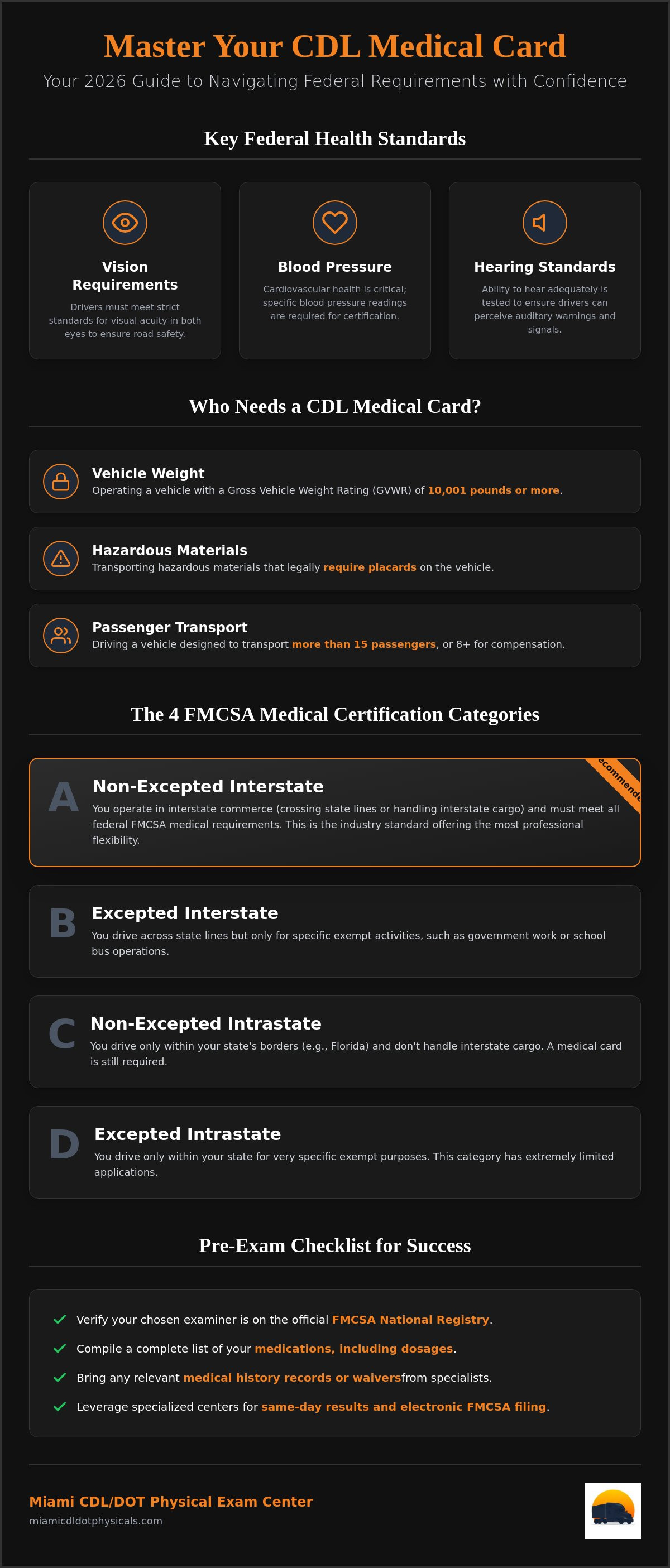
The requirement for medical certification is triggered by the type of vehicle you operate and the cargo you carry. You must maintain a current CDL medical card Miami if your vehicle meets any of these criteria:
- A gross vehicle weight rating (GVWR) or gross combination weight rating of 10,001 pounds or more.
- The transport of hazardous materials that require placards.
- A vehicle designed to transport more than 15 passengers, or more than 8 passengers for compensation.
The 2026 standards place a high emphasis on the National Registry of Certified Medical Examiners. Examiners must now use a streamlined electronic reporting system to prevent administrative delays. This update helps you avoid the "clerical limbo" that previously caused drivers to be penalized even after passing their physicals.
Understanding the Four FMCSA Medical Certification Categories
Every commercial driver must self-certify into one of four specific categories when applying for or renewing a license. This choice is a legal declaration of how you intend to operate your vehicle. It determines whether you're required to keep a medical certificate on file with the state. Most professional drivers will need a CDL medical card Miami to support a "Non-Excepted Interstate" certification. This is the industry standard because it covers nearly all standard commercial driving activities.
The four categories are defined by where you drive and what you carry:
- Non-Excepted Interstate (Category A): You operate in interstate commerce and must meet all FMCSA medical requirements. This applies if you cross state lines or handle cargo that originated outside of Florida.
- Excepted Interstate (Category B): You drive across state lines but only for specific exempt activities. Common examples include school bus operations, government work, or transporting human corpses.
- Non-Excepted Intrastate (Category C): You only drive within Florida borders and don't handle interstate cargo. You still need a medical card, but your license is restricted to the state.
- Excepted Intrastate (Category D): You drive only in Florida for very specific exempt purposes. This category has extremely limited applications for most professional haulers.
How to Choose the Correct Category
Choosing the right category depends on your route and your cargo. Ask yourself: Do I ever cross state lines? Does my trailer contain goods that started their journey in another state? If the answer to either is yes, you belong in Category A. We recommend Category A for most drivers because it offers the most professional flexibility. It ensures you won't face a license downgrade if you suddenly pick up a route heading north. Incorrectly self-certifying at the DMV can lead to immediate administrative issues.
State-Specific Filing Requirements
Federal rules set the health benchmarks, but filing happens with the Florida Department of Highway Safety and Motor Vehicles. When you complete a CDL medical card renewal Miami, the examiner handles the electronic transmission to the federal registry. However, you should always keep a digital copy of your certificate on your phone. If the state system experiences a delay, having your own proof prevents you from being placed out of service during an inspection. If you're ready to update your status, visiting a specialized DOT exam center ensures your paperwork is filed correctly the first time.
Buying Guide: How to Select a Qualified DOT Medical Examiner
Choosing the right clinic for your physical is a business decision that impacts your schedule and your compliance record. A general practitioner might be excellent for treating a cold, but they often lack the specific training required to navigate FMCSA medical certification requirements. You need an examiner who understands that your ability to drive is your ability to earn. Prioritizing a facility that specializes in occupational health ensures you aren't stuck in a waiting room full of sick patients while your drive clock is ticking. When you search for a CDL medical card Miami, look for providers who treat you like the professional you are.
Beyond basic qualifications, evaluate a clinic by its ability to handle your entire compliance profile. High-efficiency hubs offer integrated services like DOT drug testing and FMCSA Clearinghouse consortium management. This "one-stop-shop" approach is a massive time saver. Instead of coordinating with three different offices, you can manage your physical, your testing, and your federal reporting in a single visit. This level of integration reduces the risk of data entry errors and ensures your records are always audit-ready.
Why NRCME Certification Matters
Only providers listed on the National Registry of Certified Medical Examiners (NRCME) can legally perform your exam. This isn't just a suggestion; it's a strict federal mandate. If you receive an exam from an unlisted provider, your certificate will be rejected, and your license could be downgraded immediately. You can verify any examiner’s credentials on the official FMCSA website using their unique registry number. These certified professionals are experts in 49 CFR 391.41, which defines the physical standards for commercial drivers. Having an examiner who knows these rules inside and out provides a layer of security for your career.
Service Speed and Driver Convenience
In the trucking industry, time is your most valuable commodity. A clinic that requires an appointment three weeks in advance simply doesn't fit the reality of a driver's life. Dedicated exam centers prioritize walk-in availability and same-day certificate issuance to keep you moving. While you might see varying rates across the city, it's vital to weigh the DOT physical exam cost Miami against the true cost of downtime. A slightly cheaper clinic that wastes four hours of your day is actually the more expensive option. A professional CDL medical card Miami center is designed to get you through the process in under 45 minutes so you can get back to work.
How to Prepare for Your CDL Medical Exam
Preparation turns a stressful appointment into a routine administrative step. Many drivers fail or receive shortened certifications simply because they arrived at the clinic unprepared. To secure your CDL medical card Miami for the full two-year period, you must arrive with the correct documentation and physical readiness. Start by completing the driver portion of the MCSA-5875 form before you walk through the clinic doors. This saves time and ensures your medical history is accurate and ready for the examiner's review.
Bring a comprehensive list of all current medications, including exact dosages and the prescribing doctor's name. If you have chronic conditions like heart disease or a history of stroke, you'll need recent clearance letters from your specialist. Your diet also plays a role in your results. Avoid caffeine, energy drinks, and high-sodium foods for at least 24 hours before your exam. These substances can spike your blood pressure and lead to a temporary disqualification or a restricted one-year card. Arriving hydrated and well-rested is the best way to ensure your body reflects your true health status.
Managing Blood Pressure and Vision Tests
The most common hurdle for drivers is the blood pressure check. To qualify for a standard two-year certification, your reading must be below 140/90. If your pressure is between 140/90 and 159/99, you'll likely receive a one-year card. For vision, you must have at least 20/40 acuity in each eye and both eyes combined. If you wear glasses or contacts, make sure they're with you and your prescription is current. Taking slow, deep breaths during the clinical assessment helps keep your heart rate steady and your readings accurate.
Special Considerations: Sleep Apnea and Diabetes
If you've been diagnosed with obstructive sleep apnea, you must bring a CPAP compliance report. Examiners need to see that you're using the device as prescribed to ensure you're alert and safe on the road. For more details on these specific rules, consult our DOT physical sleep apnea Florida compliance guide. This resource explains exactly what data your examiner needs to see.
Drivers with insulin-treated diabetes also have a clear path to certification under current federal rules. You'll need to provide Form MCSA-5870, completed by your treating clinician, to prove your condition is well-managed. Having these documents ready ensures your CDL medical card Miami is issued without friction. If you're ready to get certified by experts who understand these requirements, you can book your DOT physical exam today to keep your career moving forward.
Efficient Medical Certification with a Professional Exam Center
Securing your CDL medical card Miami is simpler when you partner with a facility designed for the trucking industry. General clinics often treat DOT physicals as a secondary service, leading to long wait times and administrative errors. In contrast, a specialized exam center functions as a high-efficiency hub for professional drivers. These centers prioritize your schedule, ensuring you move through the process quickly without sacrificing the thoroughness required for federal compliance. This partnership approach transforms a mandatory hurdle into a streamlined part of your professional routine.
One of the most significant advantages of a professional center is the management of electronic data. As of the 2026 standards, examiners must transmit your Medical Examiner’s Certificate (Form MCSA-5876) directly to the FMCSA. Professional centers utilize secure, integrated systems to handle this upload immediately. This process triggers an update to your State Driver’s Licensing Agency (SDLA), reducing the risk of manual filing errors that could lead to a license downgrade. Additionally, many specialized centers provide automated renewal reminders. This proactive service ensures you never miss an expiration date, keeping your status active and your truck on the road.
Beyond the Physical: Drug Testing and Clearinghouse
Efficiency increases when you can manage all your regulatory requirements in one visit. Professional centers often provide integrated DOT drug testing alongside your physical exam. This saves you from making multiple trips across the city to different labs. For owner-operators and small fleets, the FMCSA Clearinghouse Consortium management is a critical service. Joining a consortium ensures you remain compliant with random drug testing pools, a federal requirement that is often difficult to manage alone. By centralizing these services, you ensure that all your testing data is accurate, timely, and correctly reported to the national database.
Staying Compliant Year-Round
Maintaining your certification requires more than just a biennial visit. It's vital to understand the risks of administrative lapses. You can learn more about the specific penalties and legal risks in our guide on what happens if my DOT medical card expires. To stay organized, we recommend keeping a dedicated "compliance folder" that contains digital and physical copies of your current medical card, recent drug test results, and any specialist clearance letters. This habit makes roadside inspections and annual carrier audits completely stress-free.
The Miami CDL/DOT Physical Exam Center is committed to the long-term success of every driver we serve. We provide the expertise and speed needed to navigate the evolving federal landscape with total confidence. Don't leave your livelihood to chance or wait in a crowded general practice waiting room. Schedule your professional CDL medical exam today and experience a faster, more reliable path to full compliance.
Secure Your Professional Standing on the Road
Your career depends on more than just driving skill; it requires a commitment to federal health standards and meticulous record-keeping. Mastering the self-certification categories and preparing your medical documentation ensures that your physical exam is a routine victory rather than a stressful hurdle. Selecting a facility that understands the specific demands of the trucking industry is the final step in protecting your livelihood. When you're ready to secure your CDL medical card Miami, prioritize efficiency and certified expertise to avoid any compliance friction.
Our FMCSA Certified Medical Examiners provide comprehensive DOT compliance services to keep your records audit-ready. With same-day medical cards issued and professional drug testing available, we help you manage all your requirements in a single, streamlined visit. Don't let administrative delays or slow clinics keep you off the road. Get Your CDL Medical Card Miami Results Today and stay focused on the miles ahead. We're here to help you succeed in every professional requirement with ease.
Frequently Asked Questions
How long is a CDL medical card valid under federal law?
A CDL medical card is valid for a maximum of two years under federal law. Your examiner may issue a certificate for a shorter duration, such as one year or six months, if you have certain health conditions like high blood pressure or heart disease. Always check the expiration date on your specific card to ensure you remain compliant with FMCSA standards and avoid license downgrades.
Can I still get a medical card if I have high blood pressure?
You can still receive a medical card with high blood pressure, but the duration of your certification will likely be shorter. Readings below 140/90 typically qualify for the full two-year card. If your blood pressure falls between 140/90 and 159/99, you'll receive a one-year certificate. Readings higher than this may result in a temporary three-month card to allow time for medical management and blood pressure control.
What happens if my CDL medical card expires before I renew it?
Your commercial driver's license will be downgraded to a non-commercial status almost immediately if your card expires. This means you cannot legally operate a commercial vehicle until you pass a new physical and update your records. Operating with an expired CDL medical card Miami results in significant fines and being placed out of service during roadside inspections by law enforcement or DOT officers.
Do I need a new medical card if I move to a different state?
You don't need a new physical exam just because you moved, as the medical card is a federal certification valid in all states. However, you must provide a copy of your current, valid certificate to your new state's licensing agency when you transfer your license. You'll also need to complete a new self-certification form to match your driving category in your new home state.
What medical conditions automatically disqualify a driver from a CDL?
Certain conditions like active epilepsy, severe hearing loss, or vision that doesn't meet the 20/40 standard will automatically disqualify a driver. The use of habit-forming drugs or medical marijuana is also a disqualifying factor under federal law, regardless of state-level rules. Some conditions that were previously disqualifying, such as insulin-treated diabetes, now have clear pathways to certification through specific assessment forms and specialist reviews.
Is a drug test required as part of the standard DOT physical exam?
A drug test isn't a standard part of the DOT physical exam, though a urinalysis is required to check for protein, blood, and sugar levels. Most drivers undergo drug testing as a separate requirement for pre-employment, random pools, or post-accident protocols. Specialized centers often provide both services during the same visit to help you maintain your CDL medical card Miami with minimal downtime and total compliance.
How do I submit my medical certificate to the state licensing agency?
Certified medical examiners now transmit your certificate details electronically to the FMCSA, which then shares that data with your state licensing agency. This automated system reduces the need for you to visit the DMV in person. We still recommend keeping a digital or paper copy of your certificate in your vehicle for at least 60 days to prove certification during the transition to the new electronic system.


