

A single compliance oversight in your drug testing program can cost your company far more than the price of a laboratory screen. With the FMCSA maintaining a 50% random testing rate for 2026 and federal rules for observed collections recently updated, the margin for error is thinner than ever. Many employers feel overwhelmed when a driver asks what happens if you fail a dot drug test in Florida, especially as federal reclassifications of certain substances create confusion around workplace safety standards.
We understand that keeping up with these shifting regulations while managing a busy fleet feels like a full-time job. You want to protect your team and your bottom line, but the complexity of federal mandates versus varying state laws is a constant source of stress. This article provides a comprehensive roadmap for building a legally compliant, safety-focused program that meets every 2026 requirement. You'll learn the essential steps for random selection logistics, the critical role of a Medical Review Officer, and exactly how to handle positive results to maintain a productive, risk-free workplace.
Key Takeaways
- Build a strong legal shield for your business by establishing a written drug-free workplace policy that clearly defines prohibited substances and testing procedures.
- Understand the mandatory return-to-duty process and immediate safety-sensitive removal required for employees to clarify what happens if you fail a dot drug test in Florida.
- Choose the correct screening level for your team by comparing standard DOT 5-panel requirements with expanded 10-panel or 12-panel options for non-regulated staff.
- Protect the integrity of every sample by partnering with a certified collection site that follows strict chain of custody protocols to prevent tampering.
- Maintain long-term compliance through annual policy reviews that account for the latest 2026 federal regulatory shifts and FMCSA random testing rates.
The Foundation of Workplace Drug Testing: Why Compliance Matters
Workplace drug testing is far more than a simple administrative hurdle. It's a structured, professional program designed to identify substance use that could impair safety and job performance. For any business operating in Miami's fast-paced logistics or service sectors, these programs serve a critical dual purpose. They protect the public from avoidable accidents while simultaneously reducing the employer's legal liability. When your team is on the road, you need to know they're sharp, focused, and compliant with all state and federal regulations.
Implementing a robust drug-free workplace program offers significant financial benefits. By participating in the Florida Drug-Free Workplace program, employers can often secure discounts on their workers' compensation insurance premiums. Beyond insurance, a clean workforce leads to higher productivity and lower turnover. You spend less time dealing with the fallout of workplace accidents and more time growing your business. It's a proactive investment in your company's long-term health.
Confusion often arises when a driver or supervisor asks what happens if you fail a dot drug test in Florida. For the employer, the immediate answer is a mandatory removal from safety-sensitive duties. This is why having a clear understanding of drug testing methods and laboratory protocols is so vital. It allows you to act with confidence rather than hesitation when a test result arrives.
Federal vs. Non-Mandated Testing Standards
You must distinguish between DOT and non-DOT testing to maintain compliance. DOT testing is a federal mandate for employees in safety-sensitive positions, such as those governed by the FMCSA or FAA. These rules are non-negotiable and follow strict procedures for collection and reporting. Non-DOT testing refers to employer-driven policies for general staff members. While you have more flexibility with non-DOT programs, keeping your standards consistent between both groups creates a much stronger legal defense during disputes.
Legal Protections for Modern Employers
A comprehensive, written drug-free workplace policy acts as your company's primary legal shield in the event of a lawsuit or unemployment claim. The Medical Review Officer (MRO) is another essential layer of protection. This licensed physician validates every test result, ensuring that legitimate prescription use is accounted for before a result is reported as a "fail." This professional oversight is a core part of what happens if you fail a dot drug test in Florida, as it prevents wrongful disciplinary actions. Finally, ensure your background check processes comply with the Fair Credit Reporting Act (FCRA) to maintain full regulatory alignment.
Pre-Implementation Checklist: Setting Your Corporate Policy
Your drug testing program is only as strong as the paper it's written on. A formal, written policy is the most critical document in your drug-free program. It isn't just a set of rules; it's a contract between you and your employees. This document must clearly define which substances are prohibited. While most focus on illegal narcotics, your policy should also address the misuse of prescription medications. You need to be explicit about the fact that marijuana remains a prohibited substance for safety-sensitive roles, regardless of recent federal reclassifications of certain FDA-approved products.
To stay compliant with federal oversight, you should align your policy with the official DOT drug and alcohol testing rules. This ensures your safety-sensitive employees understand exactly where the line is drawn. Your policy must also state the clear consequences of a positive test or a refusal to test. If a driver asks what happens if you fail a dot drug test in Florida, they should be able to find the answer in your handbook: immediate removal from safety-sensitive duties and a referral to a Substance Abuse Professional (SAP). Remember that a refusal to test is legally equivalent to a positive result. This includes failing to show up at the collection site within the required timeframe or providing a tampered sample.
Defining Testing Circumstances and Triggers
Your policy needs to outline exactly when a test will occur. Pre-employment screens establish a baseline before a new hire's first day of work. For current employees, random selection is the industry standard. You must use a scientifically valid method for these unannounced events to ensure fairness. For CDL drivers, the 2026 FMCSA random drug testing rate remains at 50% of the average number of driver positions. Include provisions for reasonable suspicion testing as well. This requires documenting observable signs of impairment, such as slurred speech or erratic behavior, before you request a sample from the employee.
Supervisor Training and Documentation Requirements
Managers and supervisors are your first line of defense. They must be trained to recognize the physical, behavioral, and performance indicators of drug and alcohol misuse. Objective documentation is vital here. It protects your business from potential discrimination claims by providing a clear, factual record of why a test was ordered. For companies managing general staff alongside safety-sensitive roles, reviewing a non-DOT drug test Miami guide helps clarify the different standards required for each group. If you're ready to formalize your program, you can partner with a certified compliance center to ensure your policy meets every 2026 standard.
Selecting the Right Test: DOT and Non-DOT Options
Choosing the correct screening panel is the first step toward a compliant workplace. For companies regulated by the Department of Transportation, the choice is made for you by federal law. However, for non-regulated staff, you have the flexibility to expand your search. While urine testing remains the gold standard for most programs, it's vital to understand that detection windows vary significantly between methods. Hair follicle testing can identify substance use up to 90 days in the past, whereas urine typically captures use within the last few days. As of 2026, the DOT has still not authorized oral fluid testing for federally mandated tests because the required laboratory certifications are still pending. Therefore, urine remains the only current option for DOT compliance.
Regardless of the method you choose, always ensure your samples are processed by SAMHSA-certified laboratories. These facilities meet the highest federal standards for accuracy and reliability. Using a certified lab protects you from the legal fallout of a "false positive" result. Understanding what happens if you fail a dot drug test in Florida is crucial because the consequences are standardized at a federal level. Once a lab confirms a positive result, the employee is immediately disqualified from safety-sensitive duties. They must then navigate the official return-to-duty process, which includes an evaluation by a Substance Abuse Professional and a series of unannounced follow-up tests.
The 5-Panel Standard for Transportation
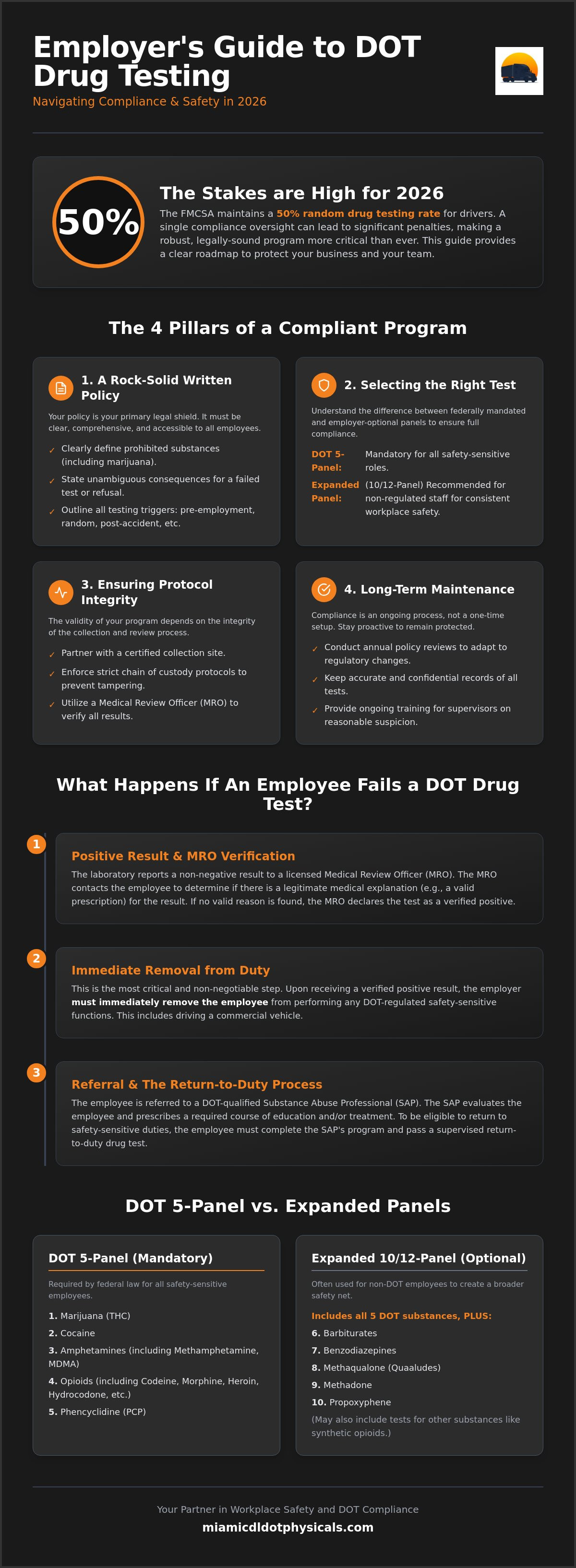
The 5 panel drug test Miami is the benchmark for federal compliance. This screen specifically looks for marijuana, cocaine, amphetamines, opiates, and phencyclidine (PCP). Even with recent changes to marijuana's federal classification, it remains a prohibited substance for all safety-sensitive employees. For non-DOT programs, many Miami employers opt for 10-panel or 12-panel tests. These expanded screens include common prescription medications like benzodiazepines and barbiturates, providing a more comprehensive view of workplace safety.
DOT-Specific Compliance and FMCSA Integration
Commercial drivers and transport companies face unique requirements under the FMCSA. In 2026, the FMCSA continues to enforce a 50% random drug testing rate for CDL drivers. Managing these pools can be a logistical nightmare for small fleets or owner-operators. This is where a consortium becomes invaluable. By joining a consortium, you pool your drivers with others to ensure your random selection process is scientifically valid and fully compliant. For a deeper look at these specific regulations, consult our DOT drug test Miami reference guide. Knowing what happens if you fail a dot drug test in Florida ahead of time allows you to manage the situation with professional efficiency rather than panic.
Operational Checklist: Executing the Testing Program
Executing a drug testing program requires precision and a reliable partner. Your first step is securing a partnership with an FMCSA-certified collection site to ensure professional handling. This partnership ensures that every sample follows a strict chain of custody protocol. Proper documentation prevents sample tampering or loss, which are common grounds for legal challenges. For observed collections, a new June 10, 2026 rule requires that if a same-sex observer is unavailable, the site must contact your Designated Employer Representative (DER) to arrange an alternative. This level of detail is exactly what protects your business from liability.
Next, implement random selection software or join a professional consortium. For 2026, the FMCSA and PHMSA require a 50% random testing rate. Using a consortium ensures these picks are unbiased and scientifically valid. Beyond randoms, ensure your team has immediate access to post-accident testing kits or 24/7 collection locations. Finally, maintain all testing records in confidential files separate from general personnel records. Understanding what happens if you fail a dot drug test in Florida helps you manage these sensitive files, as you'll need to track SAP reports and return-to-duty testing results for several years.
Post-Accident Protocols and Timelines
Certain "trigger" events mandate a post-accident test. These include any accident involving a fatality, or a citation issued to the driver when a vehicle is towed from the scene. The clock starts immediately. You must complete alcohol testing within 2 hours and drug testing within 32 hours of the incident. For those managing fleets in South Dade, our guide on DOT drug testing Homestead FL offers specific local logistics to help you meet these tight windows.
Managing Positive Results and Refusals
When a laboratory reports a positive screen, the Medical Review Officer (MRO) takes over. The MRO interviews the donor to determine if there's a legitimate medical explanation for the result. If no medical reason exists, the result is verified as positive. This is the point where employers must understand what happens if you fail a dot drug test in Florida to ensure they follow federal removal protocols. The driver must be removed from duty and referred to a Substance Abuse Professional (SAP). The SAP oversees the mandatory return-to-duty process, which includes a minimum of six unannounced follow-up tests in the first 12 months. Documenting a refusal to test is just as critical, as federal law treats a refusal the same as a positive result. If you need assistance managing these complex results, you can join our FMCSA Clearinghouse Consortium for expert guidance.
Ensuring Long-Term Compliance and Program Maintenance
Compliance isn't a one-time setup; it's a continuous process that requires regular attention. You should review and update your drug-free workplace policy annually to reflect new state and federal laws. Staying current with federal regulatory changes is mandatory for safety-sensitive industries. In 2026, we've seen specific adjustments to random testing rates and observed collection protocols that must be mirrored in your corporate documents. If your policy doesn't reflect these current standards, you're vulnerable during a legal dispute or a DOT audit.
Integrating your results with the FMCSA Clearinghouse is another non-negotiable step for all CDL drivers. You must report drug and alcohol violations, including test refusals, to the federal database promptly. This system ensures that the entire industry knows what happens if you fail a dot drug test in Florida, which prevents disqualified drivers from moving to another company without completing the required return-to-duty steps. Positioning a professional medical center as your long-term compliance partner simplifies this burden. It gives you a single, reliable point of contact for testing, MRO services, and data management.
The Role of a Consortium for Small Fleets
A consortium is a lifesaver for small fleets and owner-operators who don't have a dedicated HR department. It simplifies compliance by pooling your drivers with others to meet the 50% FMCSA random testing requirement. This setup provides automated random selections and consolidated reporting, which are essential when a DOT investigator asks for your records. For more details on managing this database, see our FMCSA clearinghouse consortium Florida guide. It's the most efficient way to ensure you never miss a selection or a filing deadline.
Next Steps for Program Implementation
The best way to start is by scheduling a consultation for a full policy review or consortium enrollment. This proactive step ensures your program is airtight before a problem arises. You should also prepare for a potential DOT audit by ensuring every Driver Qualification File (DQF) is complete. Your files should include:
- A current FMCSA medical examiner's certificate.
- A verified negative pre-employment drug test result.
- The annual motor vehicle record (MVR) review.
- Full documentation of any completed return-to-duty processes.
If you're still unsure about what happens if you fail a dot drug test in Florida, or if you need to secure your program's compliance today, contact our exam center. We're here to serve as your dependable ally in Miami's high-stakes professional landscape.
Secure Your Fleet with Professional Compliance Management
Maintaining a compliant drug testing program is a continuous commitment to safety and legal protection. By establishing a clear written policy and partnering with certified experts, you eliminate the guesswork that often leads to costly litigation or audit failures. We've explored the administrative foundation and the operational steps required to keep your team on the road in 2026. Having a firm grasp on what happens if you fail a dot drug test in Florida ensures that you act decisively and legally when safety is at stake.
Our team provides the FMCSA-Certified Medical Examiners and expert MRO oversight you need to manage your workforce with confidence. We offer complete FMCSA Clearinghouse management and consortium solutions to keep your records audit-ready and your drivers compliant. Schedule Your Workplace Drug Testing or Join Our Consortium Today to streamline your operations. You don't have to navigate these complex federal mandates alone; we're here to be your dependable local partner in building a safer, more productive workplace.
Frequently Asked Questions
Is workplace drug testing mandatory for all businesses in Florida?
Workplace drug testing is not mandatory for all private Florida businesses, but it is highly recommended. Companies that implement a program according to the Florida Drug-Free Workplace Act can qualify for significant discounts on workers' compensation premiums. However, if your business operates in safety-sensitive industries like transportation or aviation, federal law mandates a testing program regardless of state-level voluntary status. It is a vital tool for reducing liability and protecting your team.
What is the difference between a DOT and a non-DOT drug test?
The primary difference lies in the regulatory oversight and the flexibility of the testing process. DOT tests are strictly regulated by federal law and apply only to safety-sensitive positions. These tests must follow specific collection and laboratory procedures. Non-DOT tests are employer-driven policies for general staff. You have more freedom with non-DOT tests to choose different testing panels, such as 10-panel screens, or different collection methods like hair follicle testing.
How long does a drug test take to show results in 2026?
Negative results are typically delivered within 24 to 48 hours after the sample reaches the laboratory. If an initial screen shows a potential positive, the process takes longer. The lab must perform a confirmatory test, and a Medical Review Officer must then review the findings. This verification process usually extends the timeline to 3 to 5 business days. We prioritize speed and accuracy to ensure your employees return to work as quickly as possible.
Can an employee refuse a workplace drug test without penalty?
Employees cannot refuse a test without facing significant consequences. Under federal regulations, a refusal to provide a sample is legally equivalent to a positive result. This triggers the same removal from duty and return-to-duty requirements as a failure. Understanding what happens if you fail a dot drug test in Florida is essential for every driver, as a refusal will be reported to the FMCSA Clearinghouse and stay on their record for years.
What drugs are typically included in a standard workplace screening?
A standard DOT 5-panel screen includes marijuana, cocaine, amphetamines, opiates, and phencyclidine (PCP). Non-DOT employers often choose to expand this list to capture more substances. These expanded 10-panel or 12-panel tests typically include benzodiazepines, barbiturates, methadone, and propoxyphene. Choosing the right panel depends on your specific industry risks and the level of safety required for the role. We help you select the most appropriate screen for your workforce needs.
What happens if an employee has a medical marijuana card in Florida?
A medical marijuana card does not protect a safety-sensitive employee from federal consequences. Even with the April 2026 reclassification of certain marijuana products, the DOT continues to prohibit its use in any form. If a driver tests positive, the Medical Review Officer cannot verify it as a negative result based on a medical card. Knowing what happens if you fail a dot drug test in Florida is critical here, as the driver must still complete the full return-to-duty process.
How often should random drug testing be conducted for CDL drivers?
Random testing must be spread reasonably throughout the calendar year. For 2026, the FMCSA requires employers to randomly test 50% of their average driver positions for drugs and 10% for alcohol. You must use a scientifically valid method for selection, such as a computer-based random number generator. Joining a consortium is the most efficient way for small fleets to stay compliant with these high testing rates without the administrative headache.
What is the role of a Medical Review Officer (MRO) in workplace testing?
The Medical Review Officer acts as an independent safeguard for the accuracy of the testing program. This licensed physician reviews laboratory results and interviews donors who have a confirmed positive result. The MRO determines if there's a legitimate medical reason, such as a valid prescription, for the presence of a substance. Their oversight ensures that the final result is legally defensible and protects the employee from wrongful disciplinary actions based on legitimate medication use.


