

Failing the whisper test does not have to be the end of your career. Many drivers believe that any sign of hearing loss leads to an immediate disqualification, but the reality is much more manageable. You've worked hard for your license, and it's natural to feel stressed when regulations regarding your CDL medical card and hearing aids seem to stand in the way of your livelihood. We understand that the pressure of a DOT physical is high, especially when your ability to provide for your family depends on a single medical certificate. You deserve a clear path forward that respects your experience and your time.
This guide shows you exactly how to pass your exam under the 2026 FMCSA standards. You'll learn the specific requirements for the whisper test versus audiometric testing and how to properly document hearing aid use. We will also cover the hearing exemption process so you can walk into your next exam with total confidence. By understanding the three-tier compliance pathway, you can turn a potential regulatory hurdle into a simple, successful step in your professional routine.
Key Takeaways
- Understand the mandatory FMCSA hearing standards, including the requirement to hear a forced whisper from at least five feet away.
- Learn how the two-stage testing process works, starting with the whisper test and moving to audiometry if a backup is needed.
- Discover how to maintain your CDL medical card and hearing aids by ensuring your medical examiner correctly notes your equipment on your certificate.
- Explore the FMCSA Hearing Exemption Program, which offers a legal pathway for drivers who cannot meet standard testing thresholds.
- Follow a practical pre-exam checklist to ensure your hearing aids are optimized and your paperwork is ready before your appointment.
Understanding the FMCSA Hearing Standards for Commercial Drivers
Driving a commercial vehicle requires more than just good vision and physical strength. The Federal Motor Carrier Safety Administration (FMCSA) sets specific hearing benchmarks to ensure every driver can interact safely with their environment. If you are concerned about your CDL medical card and hearing aids, it's vital to know that the standards are designed to be fair. The primary goal is simple: you must be able to hear well enough to respond to emergencies and perform your duties without hesitation.
The 49 CFR 391.41(b)(11) Standard
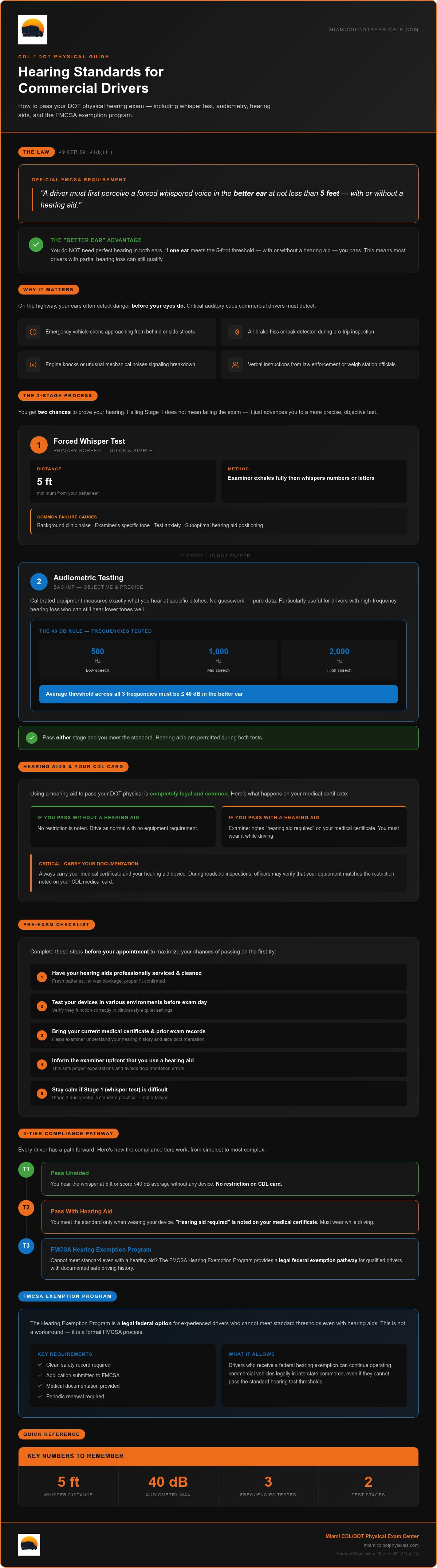
The federal regulation governing hearing is found in section 49 CFR 391.41(b)(11). This rule applies to all commercial drivers, whether you operate a heavy-duty tractor-trailer or a smaller delivery van. According to the FMCSA handbook, a driver meets the standard if they "first perceives a forced whispered voice in the better ear at not less than 5 feet with or without the use of a hearing aid."
This "better ear" rule is a significant advantage for many drivers. You do not need perfect hearing in both ears to pass. If one ear meets the five-foot threshold, you satisfy the requirement. The regulation specifically accounts for those who use technology to assist their senses. If you require a device to meet this distance, your medical examiner will simply note that a hearing aid is required on your medical certificate. This keeps your CDL medical card and hearing aids compliant with federal law while allowing you to stay on the road.
When Hearing Becomes a Safety Concern on the Road
The FMCSA prioritizes hearing because sound serves as an early warning system. On the highway, your ears often detect danger before your eyes do. High-quality hearing allows you to identify critical auditory cues such as:
- Emergency vehicle sirens approaching from behind or side streets.
- The distinct hiss of an air brake leak during a pre-trip inspection.
- Engine knocks or unusual mechanical noises that signal an imminent breakdown.
- Verbal instructions from law enforcement or weigh station officials.
Modern truck cabs are built with heavy insulation to reduce road noise. While this makes the ride more comfortable, it also makes it harder to hear external sounds. Certified medical examiners look for your ability to cut through that insulation and remain aware of your surroundings. Passing the hearing test proves you can handle these real-world challenges effectively. Our examiners understand the nuances of hearing aid technology and will work with you to ensure your testing is accurate and fair.
The Two-Stage Hearing Test: Whisper Test and Audiometry Explained
The DOT physical provides two opportunities to prove your hearing ability. Most drivers start with the forced whisper test. It's a quick screen. If you fail this, don't panic. The examiner will then use an audiometer for a more precise measurement. This second stage is often helpful for drivers managing their CDL medical card and hearing aids because it removes the variability of a human voice and provides a more accurate assessment of your auditory health.
How the Forced Whisper Test is Conducted
During this test, the examiner stands at least five feet away from your better ear. They will ask you to face away or cover the ear not being tested. The examiner exhales completely and then whispers a series of numbers or letters. You must repeat these correctly. Failures often happen because of background noise in the clinic or the examiner's specific tone. You should focus entirely on the examiner's voice and avoid guessing if you aren't sure. If you are struggling, stay calm. The transition to the next stage is a standard part of the process. If you want to ensure your exam is handled by experts who understand these regulations, schedule your DOT physical with a certified professional.
Audiometry is more objective than the whisper test. It uses calibrated equipment to measure exactly what you hear at specific pitches. This is particularly useful if you have high-frequency hearing loss but can still hear lower tones well. The machine provides a clear data point that leaves no room for guesswork. For those using technology to assist their hearing, this test provides a controlled environment to verify that your equipment is functioning at the necessary levels.
Calculating Audiometric Averages (The 40dB Rule)
To pass this stage, the examiner looks at your hearing threshold at three specific frequencies: 500 Hz, 1,000 Hz, and 2,000 Hz. These frequencies represent the range of most human speech. The examiner records the decibel level at which you can hear each tone in your better ear. They then add these three numbers together and divide by three to find the average. The average hearing loss must not exceed 40 decibels in the better ear. This calculation ensures that your CDL medical card and hearing aids requirements are met through data rather than just a subjective whisper. Understanding this math helps take the mystery out of the exam room and gives you a clear target for your hearing health. If you wear hearing aids, you can perform this test with them in, provided they are adjusted correctly before the session begins.
Passing Your DOT Physical with Hearing Aids: Requirements and Best Practices
You can absolutely use hearing aids to pass your DOT physical. The FMCSA recognizes that modern technology allows drivers to maintain high safety standards even with hearing loss. When you use a device to meet the hearing requirement, your examiner will check the "Hearing Aid Required" box on your Medical Examiner’s Certificate. This makes the device a legal requirement for your operation of a commercial vehicle. It's a straightforward process that ensures your CDL medical card and hearing aids work together to keep your career moving forward.
Integrity is essential during the examination. Your hearing aid must be functional and turned on throughout the entire physical process. If you qualify while wearing the device, you are legally obligated to wear it every time you are behind the wheel. Operating a vehicle without your hearing aids once they are listed on your medical card can lead to significant fines. You could also be placed out of service during a roadside inspection if a DOT officer notices you aren't wearing the required equipment.
The Spare Power Source Requirement
The FMCSA requires drivers who use hearing aids to carry a spare power source at all times. This means you must have extra batteries or a functional backup charging solution in your cab. During the physical, your examiner will verify that you have these spares on hand. It's a simple check that prevents safety issues on long hauls. To keep your batteries in peak condition, store them in a padded, moisture-proof case. The constant vibration of a truck can wear down loose batteries or damage delicate charging ports if they aren't secured properly.
Selecting the Right Hearing Aid for Trucking
Not all devices are built for the road. When choosing equipment to support your CDL medical card and hearing aids, look for models with advanced noise cancellation. A loud diesel engine creates constant background hum that can drown out speech. Speech enhancement features help you hear dispatchers or law enforcement over that noise. Many modern aids also offer Bluetooth connectivity. This allows you to stream GPS directions or phone calls directly into your ear, keeping your hands on the wheel and your focus on the road. Maintenance is also vital. Dust from construction sites and sweat from loading docks can clog microphones. Clean your devices daily and use a dehumidifier box during your reset periods to ensure they last.
Failing the Hearing Test: The FMCSA Hearing Exemption Program
Failing both the whisper test and the audiometric calculation doesn't mean your career is over. The FMCSA provides a hearing waiver program specifically for drivers who are otherwise qualified but fall outside the standard auditory thresholds. This program ensures that hearing loss doesn't unfairly end a productive career. It's designed to accommodate safe, experienced drivers who can demonstrate they operate their vehicles without compromising road safety. Your certified medical examiner plays a vital role here by documenting your test results accurately and providing the necessary paperwork to start your application.
The exemption is not an automatic pass. It's a formal legal process that requires you to prove your ability to drive safely. While your CDL medical card and hearing aids might not meet the standard 40dB average in your better ear, the exemption bridges that gap. If you are ready to start this process, book your DOT physical appointment today to get the professional documentation you need.
Step-by-Step: Applying for a Hearing Exemption
The application process starts with a specialized medical evaluation. You must visit an audiologist or an otolaryngologist (ENT) to receive a comprehensive hearing exam. This specialist will provide a detailed report on your hearing health and your ability to perceive sounds necessary for driving. Once you have this report, you submit your application directly to the FMCSA. They will then publish your request in the Federal Register for a public comment period, which is a standard part of the transparency process.
In 2026, the average processing time for a hearing exemption ranges from 60 to 180 days. During this period, you cannot operate a commercial vehicle in interstate commerce if your current medical certificate has expired. It's vital to plan for this gap in your employment. Keep copies of all correspondence and follow up with the FMCSA if you haven't received an update after the 90-day mark.
Renewing Your Hearing Exemption
Once granted, a hearing exemption is typically valid for two years. You must stay ahead of the expiration date to avoid a lapse in your driving status. We recommend starting the renewal process at least 90 days before your current exemption expires. This lead time accounts for any delays in the Federal Register or additional medical reviews. Renewal applications are often simpler than initial ones, provided your medical condition hasn't changed. You will still need a fresh evaluation from your hearing specialist to confirm you continue to meet the safety requirements of the program and to ensure your CDL medical card and hearing aids documentation remains current.
Exam Prep: A Driver’s Checklist for Hearing Health
Preparation is the difference between a one-visit approval and a stressful delay. If you're concerned about your CDL medical card and hearing aids, taking a few proactive steps can ensure a smooth appointment. Walking into the clinic with the right documentation and a clear auditory system allows the examiner to process your certificate quickly. For a complete look at general readiness beyond hearing, see our guide on how to pass your DOT physical.
Day-of-Exam Preparation
Protect your ears from loud noises for at least 24 hours before your test. Exposure to high decibel levels, such as loud music, power tools, or heavy machinery, can cause temporary hearing fatigue. This "threshold shift" can make you perform worse on the whisper test than you normally would. Give your ears a rest so they are as sharp as possible for the examiner.
Clean your ears properly. Significant wax buildup can act like a natural earplug, dulling the sounds of a whispered voice or an audiometer tone. If you're prone to impaction, consider a professional cleaning a few days before your appointment. Finally, confirm your hearing aid batteries are at a 100% charge or that your devices are fully powered. A weak battery can lead to intermittent sound or lower volume, which might cause an unnecessary failure during the testing process.
Documentation to Bring
Efficiency in the exam room depends on having your paperwork ready. Your examiner needs to verify that your CDL medical card and hearing aids meet current federal standards. Bringing a recent audiologist report or your current hearing aid prescription can help the examiner understand your history. This is especially helpful if you require audiometric testing instead of the whisper test. Be prepared to provide the following items:
- A copy of your most recent audiogram from a hearing specialist.
- Your existing FMCSA hearing exemption letters, if you've already been granted a waiver.
- A list of all current medications, as some can impact balance or auditory clarity.
- Your backup power source or spare batteries to satisfy the FMCSA safety requirement.
Having these items organized shows the medical examiner that you are a professional who takes compliance seriously. It reduces the need for follow-up appointments and keeps your certification process on track. Our certified examiners are here to help you succeed, and following this checklist ensures we have everything we need to validate your health and safety on the road.
Secure Your Future on the Road
Your ability to hear is a critical safety tool, but it's not the only factor in your professional success. The 2026 FMCSA standards provide clear pathways for drivers to maintain their livelihood through technology and fair testing protocols. Whether you pass the whisper test on your first try or use the audiometric calculation, you have options. Managing your CDL medical card and hearing aids is a manageable part of your career maintenance when you have the right information and a certified partner by your side.
Don't let regulatory stress slow you down. Our FMCSA-certified medical examiners provide expert guidance on complex health requirements to help you stay compliant. We offer same-day medical card processing so you can get back to work without unnecessary delays. We understand the high stakes of your exam and treat your time with the respect it deserves. Schedule your professional DOT physical exam today and take the next step in your driving career with total confidence. You've earned your place behind the wheel, and we're here to help you keep it.
Frequently Asked Questions
Can I use hearing aids during the DOT whisper test?
Yes, you are fully permitted to use hearing aids during the forced whisper test. If you rely on these devices to pass the exam, the examiner will mark your medical certificate with the "Hearing Aid Required" restriction. You must then wear your aids at all times while operating a commercial vehicle. This ensures your CDL medical card and hearing aids work together to maintain road safety during every shift.
What happens if I fail the hearing portion of the DOT physical?
You aren't immediately disqualified from the industry if you fail the initial screen. If the whisper test is unsuccessful, the examiner will move to an audiometric test for a more precise measurement. If you cannot meet the standards for either test, you may apply for an FMCSA Hearing Exemption. This federal waiver allows safe, experienced drivers to continue working after a thorough review of their driving history and medical reports.
Do I need a special waiver to drive with hearing aids?
No, a waiver is not required just for wearing hearing aids. As long as your devices allow you to meet the standard five-foot whisper requirement or the 40-decibel audiometric average, you are qualified. The only additional rule is carrying a spare power source, such as extra batteries, in your cab. A formal waiver or exemption is only necessary if you cannot meet the hearing standards even while wearing your equipment.
Is the hearing test required for every CDL medical card renewal?
Yes, the hearing examination is a mandatory part of every DOT physical appointment. Whether you are renewing your certificate every two years or more frequently due to other health conditions, the examiner must verify your auditory health. This consistent checking ensures that any changes in your hearing are caught early. It helps you maintain a valid CDL medical card and hearing aids setup throughout your professional driving career.
Does the FMCSA allow cochlear implants for commercial drivers?
Yes, the FMCSA permits the use of cochlear implants to meet the hearing standard. The medical examiner will treat a cochlear implant similarly to a hearing aid during your physical. You must be able to perceive the forced whisper or pass the audiometric test using the device processor. If you pass, your medical certificate will reflect the requirement to wear the device while driving to stay compliant with federal safety regulations.
What is the specific decibel limit for the DOT hearing test?
The average hearing loss in your better ear must not exceed 40 decibels. This average is calculated using results from three specific frequencies: 500 Hz, 1,000 Hz, and 2,000 Hz. If your hearing loss is greater than this threshold in both ears, you will fail the audiometric portion of the exam. At that point, you would need to explore the federal hearing exemption program to maintain your driving status.
Am I required to tell my employer that I wear hearing aids?
Your medical certificate will state "Hearing Aid Required," which is a part of your driving credentials that employers must review. While you don't need to disclose private medical details, your employer must know about this restriction to ensure you are compliant during roadside inspections. Being transparent about your equipment helps your fleet manager support your needs, such as ensuring you have access to charging ports or functional spare batteries.
Can I take the hearing test in only one ear?
No, the examiner must test both ears, but you only need to pass in one. The FMCSA uses a "better ear" standard for qualification. This means as long as either your left or right ear meets the 5-foot whisper requirement or the 40-decibel average, you qualify for your medical card. This rule is designed to be fair to drivers who may have significant hearing loss in only one ear but maintain safety.


