

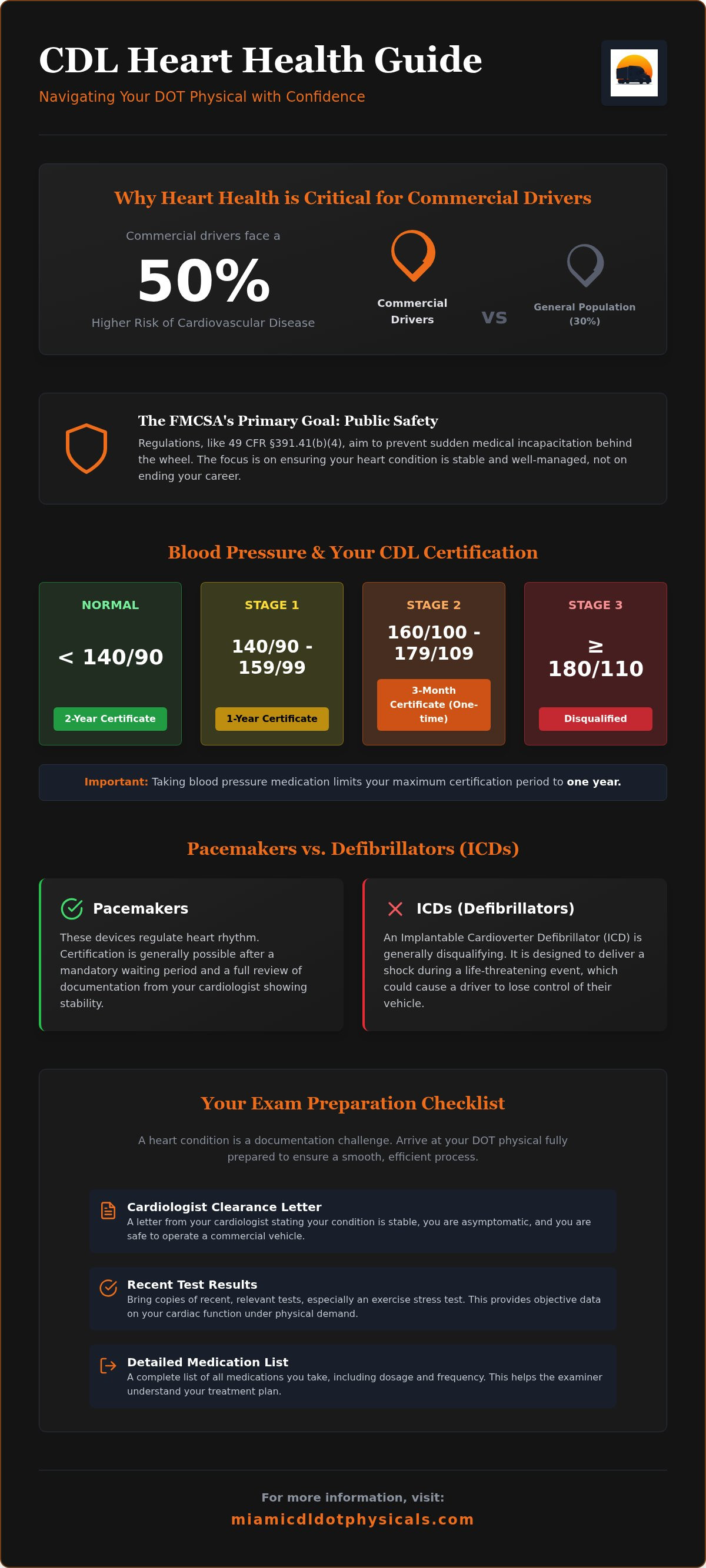
Recent data shows that commercial drivers face a 50% higher risk of cardiovascular disease compared to the general population. This statistic often turns a routine DOT physical into a source of intense anxiety, especially when your livelihood depends on that certificate. You might worry that a past procedure or a current prescription will automatically pull you off the road. We understand that confusion over waiting periods and documentation requirements only adds to the stress of maintaining your career.
The good news is that a heart condition is rarely an automatic career ender. It's actually a management and documentation challenge that most drivers can successfully overcome with the right preparation. Our goal is to help you manage the requirements for a CDL medical card and heart conditions so you can continue driving safely and legally. By knowing the rules, you can approach your next exam with confidence instead of dread.
In this guide, we'll explain the specific FMCSA standards for blood pressure and heart health updated for 2026. You'll learn the exact waiting periods required after events like a heart attack or bypass surgery. We also provide a clear checklist of the paperwork your medical examiner needs to see. This information ensures you're prepared to pass your physical and keep your career moving forward without unnecessary delays.
Key Takeaways
- Understand the FMCSA's focus on long-term stability and how their cardiovascular standards aim to prevent sudden medical emergencies while you're behind the wheel.
- Learn the specific certification tiers for hypertension and the mandatory waiting periods for a CDL medical card and heart conditions after a major event like a heart attack.
- Identify the exact documentation you need from your cardiologist to ensure a smooth, efficient exam process without multiple trips to the clinic.
- Discover why preparation, including a detailed medication list and stress test results, is the key to maintaining your commercial driving status legally and safely.
The FMCSA Cardiovascular Standard: Why Heart Health Matters for Your CDL
The Federal Motor Carrier Safety Administration (FMCSA) prioritizes safety above all else. Their primary goal is simple: prevent sudden incapacitation behind the wheel. When you're operating a vehicle that can weigh up to 80,000 pounds, a heart event isn't just a personal health crisis. It's a significant public safety risk. This is why the standards for a CDL medical card and heart conditions are so rigorous. The agency wants to ensure that every driver is physically capable of handling the demands of long-haul transport without the risk of a sudden medical emergency.
Regulation 49 CFR §391.41(b)(4) is the core rule governing your certification. It states that a driver must have no current clinical diagnosis of myocardial infarction (heart attack), angina pectoris, or heart failure. While that sounds final, the reality is more flexible. FMCSA examiners look for stability and long-term health management. If your condition is stable, asymptomatic, and supported by the right documentation, you can often maintain your certification and stay on the road safely.
Understanding Regulation 49 CFR §391.41(b)(4)
The legal language of §391.41(b)(4) focuses on cardiovascular disease known to cause syncope (fainting), dyspnea (shortness of breath), or collapse. To an examiner, this translates to one vital question: what is the risk of sudden death or loss of consciousness? Even "mild" heart issues require professional scrutiny because the physical demands of driving a truck are higher than most people realize. You aren't just sitting; you're managing a massive machine, often in high-stress traffic or extreme weather. The examiner's role is to partner with you to ensure your condition doesn't pose a threat to yourself or others.
The Link Between Commercial Driving and Cardiac Stress
The trucking industry presents unique challenges for heart health. Long hours behind the wheel and a sedentary lifestyle contribute to higher risks. Research from the American Association of Occupational Health Nurses shows that commercial drivers have a cardiovascular disease incidence rate of 50%, which is much higher than the 30% seen in the general public. Because heart disease is the leading cause of sudden death in the U.S., the DOT physical acts as a critical screening tool. When you obtain a Commercial Driver's License (CDL), you are entering a profession where heart health is a major part of your job performance. The exam helps you identify risks early so you can stay on the road safely and legally.
Common Heart Conditions and DOT Certification Guidelines
Managing a CDL medical card and heart conditions requires understanding that not all cardiac issues are treated the same by the FMCSA. While some conditions only require a shorter certification period, others involve specific waiting periods or mandatory diagnostic testing. The agency relies on Medical Expert Panel recommendations to set these benchmarks. These guidelines help examiners distinguish between a managed condition and a high-risk situation, ensuring you stay safe while protecting your livelihood.
Managing Hypertension for Your Medical Card
High blood pressure is the most common condition examiners encounter during a physical. If your reading is below 140/90 mmHg, you can qualify for a standard two-year certificate. However, if your blood pressure is higher, the certification length drops significantly. Stage 1 hypertension (140/90 to 159/99) results in a one-year card. Stage 2 (160/100 to 179/109) gives you a one-time, three-month certificate to get your levels under control. If your reading hits 180/110 or higher, you're disqualified until you can bring it down to 140/90 or less. Taking medication for blood pressure won't disqualify you, but it does limit your maximum certification period to one year.
Heart Devices: Pacemakers and Defibrillators
There's a major regulatory difference between a pacemaker and an Implantable Cardioverter Defibrillator (ICD). A pacemaker is designed to keep your heart rhythm steady. You can typically be certified with a pacemaker after a mandatory waiting period and a thorough documentation review from your cardiologist. In contrast, an ICD is generally disqualifying. This is because an ICD is designed to shock the heart back into rhythm during a life-threatening event. That shock can cause a driver to lose control of the vehicle instantly. If you have questions about how your specific device affects your status, scheduling a professional DOT physical exam can provide the clarity you need.
For drivers who have experienced a heart attack or have heart failure, the "Ejection Fraction" (EF) is a critical number. This percentage measures how well your heart pumps blood with each beat. To meet FMCSA standards after a heart attack or bypass surgery, your EF must be at least 40%. If you've had a heart attack, you must also complete a minimum two-month waiting period and pass a satisfactory stress test before returning to work. These checks ensure that your heart is strong enough to handle the rigors of the road without failing under the physical stress of the job.
Understanding Waiting Periods and Stability Requirements
Timing is everything when you're trying to get back on the road after a cardiac event. The FMCSA establishes specific waiting periods to ensure your heart has reached a state of clinical stability before you resume driving. These timelines aren't suggestions; they're mandatory benchmarks that medical examiners must follow to protect public safety. Understanding how these periods apply to your CDL medical card and heart conditions helps you plan your return to work without missing a beat or facing unexpected disqualifications.
Why the FMCSA Mandates Waiting Periods
Clinical stability is the primary reason for mandatory delays. The first few months after a heart procedure are the most critical for identifying post-operative complications or medication side effects. A waiting period is the time required to prove recovery and physical stability before you can apply for re-certification. The examiner needs to see that your body has adjusted to the changes and that you're no longer at high risk for a sudden event while behind the wheel. These standards are outlined in the FMCSA Cardiovascular Advisory Panel Guidelines, which provide the framework for every certification decision.
- Heart Attack (MI): You must complete a minimum two-month waiting period before you're eligible for certification.
- Bypass Surgery (CABG): This major procedure requires a three-month waiting period to allow the chest wall and heart tissue to heal fully.
- Stents (PCI): For a Percutaneous Coronary Intervention, the waiting period is much shorter, typically requiring only one week of stability before you can be cleared.
If you need to travel long distances during your recovery period while waiting for re-certification, RN MEDflights offers professional medical assistance on commercial airlines for non-emergency patients to ensure a safe journey.
The Importance of Regular Stress Testing
Passing the initial waiting period is only the first step. To maintain your medical card, you'll often need to undergo an Exercise Tolerance Test (ETT). This test proves your heart can handle physical exertion without showing signs of distress. The FMCSA requires you to exceed 6 METS (Metabolic Equivalents) during the test to demonstrate adequate cardiac capacity. If you've had a heart attack, you'll need a satisfactory stress test 4 to 6 weeks after the event and then again every two years. For those who have undergone bypass surgery, an annual ETT becomes mandatory starting five years after the procedure.
Stability also dictates how often you'll need to see an examiner. Most drivers with a history of heart conditions are limited to a one-year (annual) certification rather than the standard two-year (biennial) card. This allows the medical examiner to monitor your condition closely and ensure your health hasn't declined. Keeping up with these tests and appointments is the only way to stay compliant and keep your career moving forward.
How to Prepare for Your DOT Physical with a Heart Condition
Preparation is the bridge between anxiety and a successful certification. When you're managing a CDL medical card and heart conditions, showing up to the clinic empty-handed is the fastest way to trigger a delay. Most drivers fail the physical not because they're unhealthy, but because they lack the specific proof the FMCSA requires. You should treat your physical like a business meeting where documentation is your most valuable asset.
To start, gather a complete list of all medications you take. This list must include the exact dosages and the names of the doctors who prescribed them. If you take blood pressure medication, the examiner needs to verify that it doesn't cause side effects like dizziness that could impair your driving. Beyond meds, you must bring copies of your most recent stress test or echocardiogram results. For general advice on the entire process, you can check out this how to pass DOT physical guide.
What Your Cardiologist's Clearance Letter Must Include
A vague note from your doctor saying you're "doing fine" isn't enough for a federal examiner. Your cardiologist's clearance letter is a formal legal document that must meet specific criteria to be accepted. It should clearly state your diagnosis and the dates of any procedures, such as stent placement or bypass surgery. The letter must explicitly use terms like "stable" and "asymptomatic" to describe your current status.
Cardiac specialists must also confirm that your current medications don't interfere with safe driving. Most importantly, the letter needs an explicit opinion on your fitness to operate a commercial vehicle. Without these specific details, the medical examiner may have to put your certification on hold until they can contact your specialist. Having this letter ready ensures your exam stays on track.
Day-of-Exam Tips for Heart Patients
Your behavior on the morning of the exam can significantly impact your blood pressure readings. Avoid excessive caffeine and nicotine for at least two hours before your appointment. These stimulants can cause a temporary spike that might push you into a higher hypertension tier. Take all prescribed heart and blood pressure medications exactly as scheduled. Some drivers mistakenly think they should skip meds to show their "natural" state, but this is a dangerous mistake that leads to disqualification.
Ensure you're well-hydrated, as dehydration can cause your heart rate to rise and your blood pressure to fluctuate. Staying calm and following your routine helps you present the most accurate picture of your health. If you're ready to secure your certification with a team that understands these requirements, you can schedule your DOT physical exam today. Proper preparation makes the difference between a three-month temporary card and a full certification.
Navigating Your CDL Medical Certification with Expert Support
Securing a CDL medical card and heart conditions certification doesn't have to be a battle. The process is much smoother when you view your medical examiner as a compliance ally rather than a gatekeeper. An examiner who understands the nuances of cardiac stability can help you navigate the regulations without unnecessary stress. Most heart-related issues are manageable with proactive care and clear communication between your cardiologist and your examiner. When you approach the exam with the right mindset, you protect both your health and your career.
Accuracy during the exam prevents future compliance issues and costly fines. As of 2026, medical examiners transmit results electronically to the National Registry II system. This update makes your Motor Vehicle Record (MVR) the official proof of certification, replacing the traditional paper card. Errors in this electronic filing can lead to immediate licensing delays. Working with an expert ensures that your data is handled correctly and that your status is updated in the FMCSA system without friction.
Choosing the Right FMCSA Medical Examiner
Don't settle for a clinic that treats you like a number. You need an examiner who prioritizes driver education and understands the specific stress thresholds of the trucking industry. Look for a facility that offers same-day results and electronic submission to ensure career continuity. If you're looking for more details on the renewal process and what to expect in the local market, check out this CDL medical card Miami guide for deep insights into 2026 standards.
Your Next Steps for CDL Compliance
Success starts well before you walk into the exam room. Review your medical history against the standards we've discussed and ensure your ejection fraction and stress test results meet the 2026 requirements. If you have a history of heart conditions, schedule your physical at least 30 days before your current card expires. This buffer gives you time to resolve any documentation gaps without losing your ability to drive. Taking charge of your health today keeps you in the driver's seat tomorrow. Book your professional exam with our FMCSA-certified medical examiners to ensure you meet every regulatory standard with ease.
Secure Your Career and Your Health
Maintaining your livelihood while managing a heart condition requires a proactive approach to federal regulations. By understanding specific waiting periods and keeping your heart health monitored, you can successfully navigate the requirements for a CDL medical card and heart conditions. Remember that documentation is your best defense. Having a detailed cardiologist clearance letter and recent stress test results ensures a smooth, efficient exam process without unnecessary delays.
Don't let compliance stress slow you down. Our FMCSA-Certified Medical Examiners provide compliance-focused driver screenings designed to get you back behind the wheel. We offer same-day medical card processing to respect your schedule and keep your career moving forward. Schedule your professional DOT physical exam today to ensure you meet the latest 2026 standards with confidence. You've worked hard to build your career, and with the right preparation, you can stay on the road safely for years to come.
Frequently Asked Questions
Can I get a CDL if I have had a heart attack?
Commercial drivers can return to the road after a heart attack if they meet specific FMCSA criteria. You must complete a minimum two-month waiting period to ensure clinical stability. Additionally, your cardiologist must confirm an ejection fraction of at least 40% and you must pass an exercise tolerance test (ETT). These steps prove your heart can handle the stress of commercial driving without a high risk of sudden incapacitation.
Will taking blood pressure medication disqualify me from a CDL medical card?
Taking blood pressure medication does not disqualify you from obtaining a medical card. However, it does change your certification timeline. Drivers who use medication to control hypertension are limited to a maximum one-year certificate. This allows the medical examiner to monitor your condition more frequently. Ensure you bring your full medication list, including dosages, to your appointment to avoid any processing delays or confusion during the exam.
How long is a CDL medical card valid for if I have a heart condition?
The validity of your certificate depends on the severity and management of your condition. For many CDL medical card and heart conditions, the standard is a one-year certification. If you have Stage 1 hypertension (140/90 to 159/99), you'll receive a one-year card. Stage 2 (160/100 to 179/109) results in a one-time, three-month certificate. Drivers with a history of heart attack or surgery also typically move to an annual renewal cycle.
What happens if I fail the heart portion of the DOT physical?
If you don't meet the cardiovascular standards, you'll face a temporary disqualification. This isn't necessarily a permanent career ender. Instead, it means you must address the specific medical issue, such as lowering your blood pressure or completing a mandatory waiting period. Once your condition is stabilized and you have the required documentation from your cardiologist, you can return to an FMCSA-certified examiner for a new physical to regain your status.
Can I drive a truck with a pacemaker?
Yes, you can drive a commercial vehicle with a pacemaker. The FMCSA allows certification for drivers with pacemakers provided they complete the required waiting period and have a stable heart rhythm. You'll need to provide documentation from your cardiologist confirming the device is functioning correctly and that you're asymptomatic. Note that while pacemakers are allowed, Implantable Cardioverter Defibrillators (ICDs) are generally disqualifying because the shock they deliver can cause immediate loss of vehicle control.
Is an EKG required for every DOT physical?
An EKG is not a mandatory requirement for every routine DOT physical. However, the medical examiner has the authority to request one if they detect an irregular heartbeat or if you have a history of certain heart conditions. Examiners use these tests to screen for underlying issues that could lead to sudden incapacitation. If you have a known cardiac history, bringing your most recent EKG results to your appointment can significantly speed up the certification process.
What is the minimum ejection fraction required for a CDL?
The FMCSA requires a minimum ejection fraction of 40% for drivers who have experienced a heart attack or undergone bypass surgery. This measurement is a key indicator of how well your heart pumps blood to the rest of your body. If your ejection fraction falls below this threshold, you won't meet the physical qualifications for a commercial license. Your cardiologist will typically measure this during an echocardiogram or similar diagnostic imaging session.
Do I need a cardiologist's clearance every year for my DOT physical?
Yes, you generally need a new clearance letter from your cardiologist every year if you have a history of significant heart conditions. Because most cardiac issues limit you to a one-year medical certificate, the examiner must verify your stability at each renewal. Providing a fresh letter that confirms you're asymptomatic and stable ensures that your CDL medical card and heart conditions documentation remains current. This proactive step prevents gaps in your driving eligibility.


