

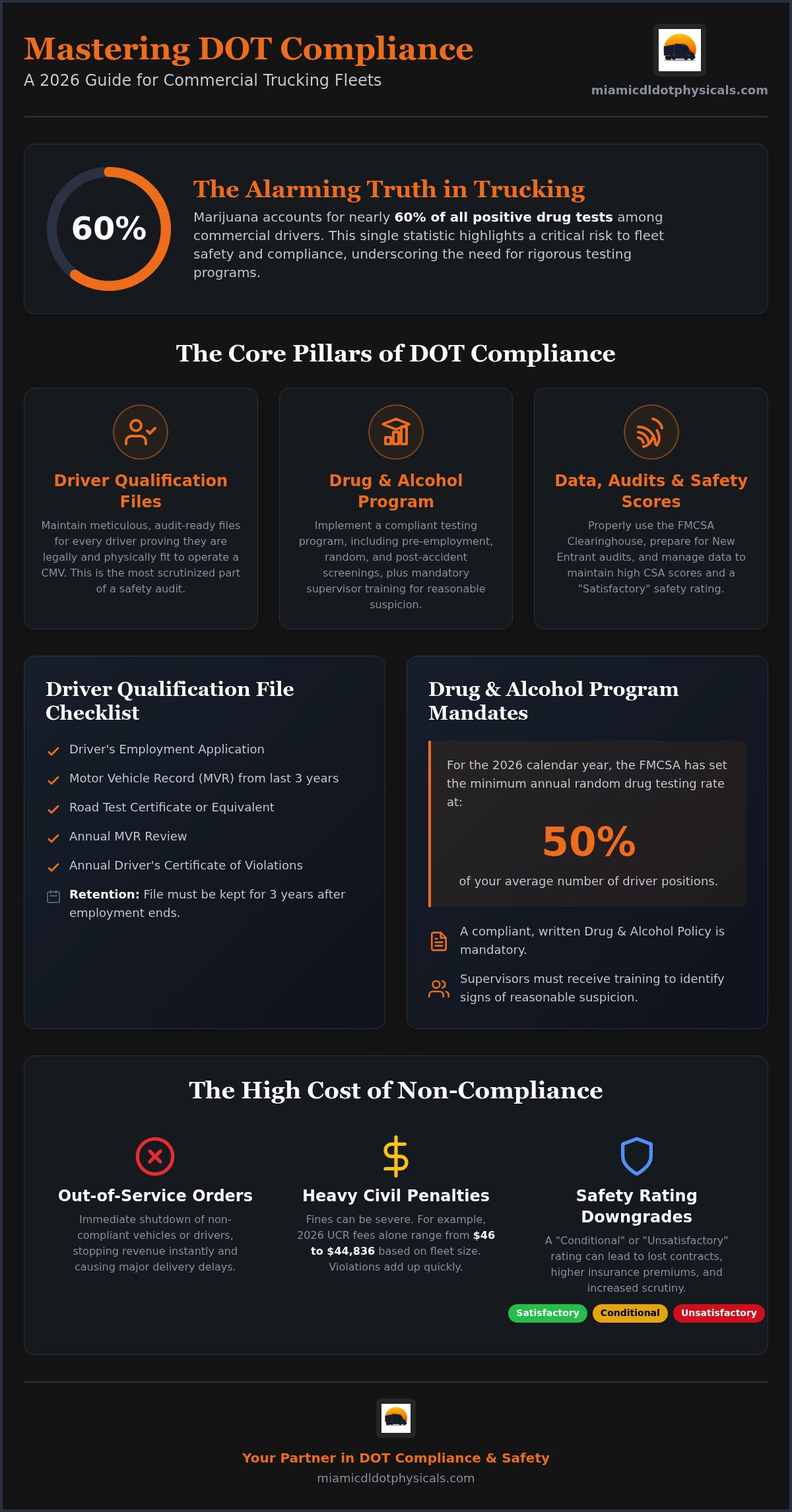
Did you know that marijuana accounts for nearly 60% of all positive drug tests among commercial drivers subject to DOT requirements? This single statistic highlights how easily a fleet's safety record can slip without rigorous oversight. Maintaining DOT compliance for trucking companies Miami requires more than just a basic understanding of the rules; it demands a constant focus on driver health and data integrity. We understand that the fear of failing a New Entrant audit or the confusion surrounding FMCSA Clearinghouse reporting can be overwhelming. Managing expiring medical cards for multiple drivers is a high-stakes race against the clock that you shouldn't have to run alone.
This 2026 guide is designed to help you master federal requirements for commercial fleet operations with total confidence. You'll gain a clear checklist for driver qualification files and learn how to navigate the latest mandates for drug and health screenings. We'll also cover the 50% random drug testing rate for the 2026 calendar year and show you how a reliable partner can help improve your CSA safety scores. By the end of this article, you'll have a practical roadmap to turn regulatory burdens into a streamlined, efficient process for your business.
Key Takeaways
- Learn how to manage Driver Qualification (DQ) files and mandatory medical standards to pass the most scrutinized portion of a safety audit.
- Discover the specific requirements for a compliant drug and alcohol policy, including the necessary training for supervisors to identify reasonable suspicion.
- Master the annual query process within the FMCSA Clearinghouse to simplify DOT compliance for trucking companies Miami and ensure your fleet stays on the road.
- Understand the timeline for the New Entrant Safety Assurance Program and the differences between off-site and on-site reviews.
- Identify the benefits of using a Clearinghouse Consortium to automate mandatory reporting and maintain high CSA safety scores.
The Core Pillars of DOT Compliance for Commercial Fleets
DOT compliance is the foundation of every successful trucking operation. It refers to a carrier's strict adherence to the Federal Motor Carrier Safety Regulations (FMCSR). These rules are established and enforced by the Federal Motor Carrier Safety Administration (FMCSA), which is the primary governing body for commercial vehicle safety. For those managing DOT compliance for trucking companies Miami, staying current with these rules isn't just about avoiding trouble; it's about building a reputation for safety. Your compliance efforts directly influence your CSA (Compliance, Safety, Accountability) scores. These scores serve as a public report card that shippers and insurance providers use to judge your operational risk. High-performing fleets prioritize these pillars to ensure they remain competitive and safe.
Understanding the FMCSA Regulatory Framework
The rules governing the industry are codified in Title 49 of the Code of Federal Regulations (CFR). Most carriers focus on Parts 300 through 399, which cover everything from driver qualification to vehicle maintenance standards. You must comply with these regulations if your vehicles exceed a gross weight of 10,001 lbs, transport hazardous materials, or carry more than eight passengers for compensation. Your USDOT number acts as a digital fingerprint for your company. It tracks your safety profile, roadside inspection results, and crash history. Maintaining a clean record under this number is essential for keeping your operating authority active. The FMCSA is targeting November 2026 for new rules that may require carriers to demonstrate safety knowledge before they even receive operating authority.
The Consequences of Non-Compliance
Ignoring federal standards carries massive financial and operational risks. Non-compliance often leads to out-of-service orders that park your trucks and stop your revenue immediately. Civil penalties have become more stringent for the 2026 calendar year. For instance, Unified Carrier Registration (UCR) fees for 2026 are set at $46 for fleets with two or fewer vehicles, $276 for 6 to 20 vehicles, and up to $44,836 for the largest operations. Beyond immediate fines, your safety rating—Satisfactory, Conditional, or Unsatisfactory—determines your business growth. A "Conditional" rating can trigger a spike in insurance premiums or cause you to lose major contracts. Roadside inspections feed directly into this profile, making every trip a test of your internal compliance systems and documentation accuracy.
Maintaining Driver Qualification (DQ) Files and Medical Standards
The Driver Qualification (DQ) file is often the first document an auditor requests during a safety review. According to FMCSA data, the majority of failures in new entrant audits stem from documentation errors rather than major safety violations. This makes the DQ file the most scrutinized record in your office. For those managing DOT compliance for trucking companies Miami, keeping these files pristine is a non-negotiable part of daily operations. A missing signature or an outdated record can lead to heavy fines or a "Conditional" safety rating. You must ensure every driver on your payroll has a complete file that proves they are legally and physically fit to operate a commercial vehicle.
Essential Components of a Driver Qualification File
A compliant DQ file isn't just a folder with a name on it. It must contain specific, time-sensitive documents to meet federal standards. At a minimum, you need the driver's employment application, a current Motor Vehicle Record (MVR) from the last three years, and a Road Test Certificate. Compliance doesn't stop after the initial hire. You must conduct an annual MVR review and have the driver sign a Certificate of Violations every 12 months. If a driver leaves your company, you are required to retain their DQ file for three years after their employment ends. Keeping these records organized helps you stay prepared for a surprise safety review at any time.
The DOT Physical Exam: What Drivers Need to Know
Medical standards are the heartbeat of fleet safety. Drivers must pass a physical exam conducted by a certified medical examiner listed on the National Registry. These exams check critical health markers like vision, hearing, and blood pressure. A urinalysis screens for underlying conditions like diabetes that could impair a driver's ability to operate a vehicle safely. While common issues like sleep apnea or hypertension can be managed, they require careful documentation from a specialist to keep a driver on the road. Most medical certificates are valid for two years, but drivers with certain health conditions may need to renew every few months to maintain their certification.
Preparation is key for a smooth exam process. Drivers should review this guide on how to pass DOT physical exams to understand what to bring and how to manage their health before the appointment. Scheduling a DOT physical exam at a specialized center ensures that the results are uploaded correctly to the FMCSA Clearinghouse and other federal databases. This level of precision protects your drivers' livelihoods and keeps your fleet in total compliance with 2026 standards.
Implementing a Compliant DOT Drug and Alcohol Testing Program
Every motor carrier must establish a formal, written workplace drug and alcohol policy before dispatching their first driver. This document isn't just a internal guideline; it's a federal requirement that outlines the company's expectations and the consequences of substance use. To maintain DOT compliance for trucking companies Miami, you must ensure every driver receives a copy of this policy and signs a certificate of receipt. The stakes are high because the FMCSA has held the random drug testing rate at 50% for the 2026 calendar year. This elevated rate reflects the industry's ongoing struggle with substance violations, particularly involving marijuana, which remains a prohibited substance for all safety-sensitive employees under federal law.
Supervisors play a critical role in this program. Federal regulations require any person supervising CDL drivers to undergo at least 120 minutes of training: 60 minutes on the physical, behavioral, and performance indicators of probable alcohol misuse and 60 minutes on controlled substance use. This "Reasonable Suspicion" training empowers your team to remove a driver from the road before an incident occurs. It's also vital to understand that a "Refusal to Test" carries the exact same weight as a positive result. If a driver stalls, leaves the collection site, or fails to provide a sufficient specimen without a medical explanation, they are immediately prohibited from performing safety-sensitive functions.
The Five Types of Mandatory DOT Testing
Your testing program must account for five specific scenarios to remain fully compliant with FMCSA standards. Failing to document even one of these can trigger a failed safety audit.
- Pre-employment: You must receive a verified negative drug test result before allowing a new hire to operate a commercial motor vehicle.
- Random Testing: Drivers must be placed in a scientifically valid random pool. For 2026, the random testing rates are 50% for drugs and 10% for alcohol.
- Post-accident: Testing is required after crashes involving a fatality, or when the driver receives a citation and there is a vehicle tow-away or immediate medical treatment away from the scene.
- Reasonable Suspicion: Conducted when a trained supervisor observes specific signs of impairment.
- Return-to-Duty: Required for drivers who have completed the Substance Abuse Professional (SAP) process following a violation.
DOT vs. Non-DOT Testing: Key Differences
It's important to distinguish between federal mandates and company-specific policies. DOT tests are strictly regulated 5-panel laboratory-based urine tests that follow 49 CFR Part 40 procedures. Non-DOT tests, however, are governed by state laws and can include wider panels or different specimen types like hair or oral fluid for office staff. Many carriers maintain a separate non-DOT policy to ensure a drug-free workplace for employees who don't hold a CDL. For a deeper look at the technical requirements of these screenings, you can reference this guide on DOT drug test Miami protocols. Keeping these programs distinct ensures that your federal safety scores aren't impacted by non-regulated personnel issues.
Navigating the FMCSA Clearinghouse and Random Pools
The FMCSA Clearinghouse is the central database that tracks drug and alcohol violations for CDL holders nationwide. It ensures that a driver cannot simply move to another state or company to hide a failed test. For anyone managing DOT compliance for trucking companies Miami, the Clearinghouse is a daily tool for maintaining safety standards. By 2026, the system has evolved into its second phase, known as Clearinghouse-II. This mandate requires State Driver Licensing Agencies (SDLAs) to remove commercial driving privileges from any driver in a "prohibited" status. This means a violation doesn't just stay on a report; it now triggers an automatic CDL downgrade across all participating states.
Employers and Medical Review Officers (MROs) share reporting duties. MROs report verified positive tests, while employers must report "actual knowledge" of use or a "refusal to test." Failing to report these violations within the required timeframe can lead to severe penalties during an audit. You must also conduct an annual query for every driver on your roster to ensure no new violations have been recorded by other employers. This continuous monitoring is the only way to guarantee that your drivers remain eligible to operate heavy machinery on public roads.
The Role of a Consortium for Owner-Operators
If you are an owner-operator, you cannot legally manage your own random testing pool or Clearinghouse reporting. Federal rules require you to join a consortium. A consortium acts as your compliance partner, handling the automated selection of drivers for random tests and ensuring all data is uploaded correctly to federal databases. Outsourcing these tasks to a professional FMCSA clearinghouse consortium Florida reduces the administrative burden on small fleets. It ensures that you never miss a selection or a reporting deadline, which is critical for staying in good standing with the FMCSA and avoiding the 20% UCR fee increases coming in 2027.
Querying and Reporting: Best Practices
You must conduct queries on every CDL driver you employ. There are two types: full and limited. A full query is required before a driver starts safety-sensitive functions. It requires the driver to log in to the Clearinghouse and grant electronic consent. A limited query is an annual requirement to check for any new violations. For limited queries, you can maintain a paper consent form on file for the duration of the driver's employment. This makes the annual check-up process much faster for larger fleets.
If a query returns a "Prohibited" status, you must immediately remove that driver from safety-sensitive duties. They cannot return to the road until they complete the official Return-to-Duty process with a Substance Abuse Professional. To keep your records accurate and your fleet moving, consider joining an FMCSA Clearinghouse Consortium to manage these queries and pool selections automatically. This proactive approach is the best way to maintain DOT compliance for trucking companies Miami while focusing on your core business operations.
Preparing for New Entrant Audits and Safety Reviews
The New Entrant Safety Assurance Program is a mandatory trial period for all new motor carriers. During the first 18 months of operation, the FMCSA monitors your safety performance closely. Most carriers receive an audit notice within the first 12 months. You'll typically get this notification 30 to 90 days before the actual audit date. Staying proactive with DOT compliance for trucking companies Miami ensures that this review is a routine verification rather than a business-ending event. It's the best way to prove you have the systems in place to operate safely and legally.
Audits generally take two forms. An off-site audit requires you to upload digital records to the FMCSA portal for review. An on-site comprehensive review involves an investigator visiting your place of business to inspect vehicles and files in person. Regardless of the format, certain "Automatic Failure" violations will result in an immediate fail. These include operating without a drug and alcohol testing program, using a driver with a disqualified CDL, or failing to maintain required insurance levels. If you do fail, you must submit a Corrective Action Plan (CAP) within a strict timeframe, usually 60 days for most carriers, to demonstrate how you've fixed the deficiencies.
The Self-Audit Checklist for Safety Directors
Don't wait for a notice to arrive before checking your records. Use a self-audit approach to catch errors early. Focus on these critical areas to ensure your documentation is airtight:
- Hours of Service: Verify that ELD records are accurate and that drivers aren't exceeding driving limits.
- Vehicle Maintenance: Ensure every truck has a current annual inspection on file and that Driver Vehicle Inspection Reports (DVIRs) are signed and filed.
- Medical Documentation: Confirm that every driver’s CDL medical card Miami is current and that the medical certificate is properly linked to their state driving record.
Leveraging Professional Services for Audit Success
Organizing hundreds of pages of documentation is a daunting task for any fleet manager. Third-party administrators (TPAs) can help you maintain a clean, digital filing system that makes audit submissions seamless. By using a professional service, you ensure that your drug testing records, DQ files, and Clearinghouse queries are always audit-ready. This level of organization is essential for maintaining DOT compliance for trucking companies Miami while scaling your operations. Partnering with a specialist for your mandatory screenings and consortium management provides the peace of mind that your fleet meets all federal standards before the investigator ever calls.
Secure Your Fleet's Future with Total Compliance
Mastering the complexities of federal regulations is a continuous cycle of documentation and health management. You now have the roadmap to handle everything from the initial New Entrant audit to the strict 50% random drug testing rates required in 2026. Prioritizing accurate Driver Qualification files and staying ahead of Clearinghouse-II mandates will protect your safety scores and your operating authority. Maintaining DOT compliance for trucking companies Miami is a significant responsibility, but it's also the foundation of a reliable and profitable business.
Managing these moving parts doesn't have to be a source of daily stress. You can ensure your fleet stays compliant with professional DOT services that simplify the entire process. Our team provides same-day medical certifications from FMCSA-certified medical examiners and automated Clearinghouse consortium management to keep your data current and your drivers ready for the road. Efficient compliance isn't just about avoiding fines; it's about building a reputation for excellence. Streamlining your safety protocols today ensures your trucks stay moving tomorrow. We're here to help you meet every professional requirement with ease and confidence.
Frequently Asked Questions
What is the most common reason trucking companies fail DOT audits?
The most common reason for audit failure is incomplete or inaccurate record-keeping, particularly regarding Driver Qualification (DQ) files. Many carriers fail because they lack current MVRs or signed certificates of violations. Documentation errors are cited more frequently than actual safety violations during New Entrant audits. Maintaining strict DOT compliance for trucking companies Miami requires a disciplined approach to filing every required document on time to avoid automatic failure.
How often do CDL drivers need to update their DOT medical card?
Most CDL drivers must update their DOT medical card every 24 months. However, the medical examiner may issue a certificate for a shorter period, such as 3, 6, or 12 months, if the driver has a managed health condition like hypertension or diabetes. It's the carrier's responsibility to track these expiration dates. Drivers must always carry a valid certificate and ensure the results are uploaded to the state licensing agency.
Does an owner-operator need to be in a drug testing consortium?
Yes, an owner-operator must be enrolled in a drug testing consortium. Federal regulations prohibit individuals from managing their own random testing pools. Joining a consortium ensures that you are part of a scientifically valid random selection process. This partnership also simplifies your reporting duties to the FMCSA Clearinghouse. It's a non-negotiable requirement for any single-driver company to stay legal and avoid immediate out-of-service orders during a safety review.
What documents are required in a Driver Qualification (DQ) file?
A compliant Driver Qualification file must include several specific documents to meet federal standards. You need the driver's employment application, an initial and annual Motor Vehicle Record (MVR), and a valid medical examiner's certificate. Additionally, the file should contain a record of road test or a copy of the CDL, a certificate of violations, and the annual review of the driving record. Keeping these documents organized is essential for managing DOT compliance for trucking companies Miami.
How do I check a driver’s status in the FMCSA Clearinghouse?
You check a driver's status by conducting a query through the official FMCSA Clearinghouse portal. Employers must perform a full query for all new hires and at least one limited query annually for existing drivers. A full query requires the driver's electronic consent within the portal. If the query returns a "Prohibited" status, the driver is legally barred from performing safety-sensitive functions until they complete the required return-to-duty process.
What happens if a driver fails a DOT drug test?
If a driver fails a DOT drug test, you must immediately remove them from all safety-sensitive duties. The violation must be reported to the FMCSA Clearinghouse within three business days. The driver cannot return to safety-sensitive work for any carrier until they complete an evaluation with a Substance Abuse Professional (SAP) and pass a return-to-duty drug test. This process is strictly regulated to ensure only sober drivers operate commercial vehicles on public roads.
Is a non-DOT drug test acceptable for CDL drivers?
No, a non-DOT drug test is not acceptable for federal compliance purposes for CDL drivers. DOT-regulated positions require a specific 5-panel urine test that follows the procedures outlined in 49 CFR Part 40. While a company can require non-DOT tests for its own internal policies or office staff, these results cannot be used to satisfy FMCSA pre-employment or random testing requirements. Only DOT-certified laboratory results are valid for your compliance files.
Can a driver with high blood pressure pass a DOT physical?
Yes, a driver with high blood pressure can pass a DOT physical as long as the condition is managed and falls within acceptable limits. If the blood pressure is 140/90 or higher, the examiner may issue a temporary certificate for a shorter duration to allow for medical management. Drivers using blood pressure medication can still be certified, but they typically require annual recertification to ensure their health remains stable while operating a heavy commercial vehicle.


