

A fleet’s consortium bill depends less on one advertised rate than on the number of covered drivers and what the package includes. FMCSA consortium pricing varies with fleet size, whether random testing is bundled, and whether Clearinghouse services are included. Owner-operators who operate commercial motor vehicles on public roads that require a commercial driver’s license must enroll in a consortium’s random testing pool.
It’s reasonable to want a clear cost before choosing a program, especially when employee and driver counts differ. Compare the full package, not just its enrollment fee: included random tests, Clearinghouse services, and member rates on additional tests can all affect a fleet’s total costs.
This guide explains how consortium packages are structured, how fleet size and covered-driver counts shape enrollment, and how Clearinghouse services and member test rates fit in. You’ll also learn what to compare when evaluating a program, so you can focus on an arrangement that fits your operation rather than a headline rate alone.
Key Takeaways
- Count the drivers covered by the program separately from your total employee headcount to assess the fleet’s enrollment needs.
- Compare membership terms by what they include, especially random testing and Clearinghouse services.
- Review how member rates for DOT drug and alcohol tests affect your expected testing costs.
- Look beyond the enrollment fee: separate collection and review charges can change the overall cost of a testing program.
Consortium membership packages with Clearinghouse services
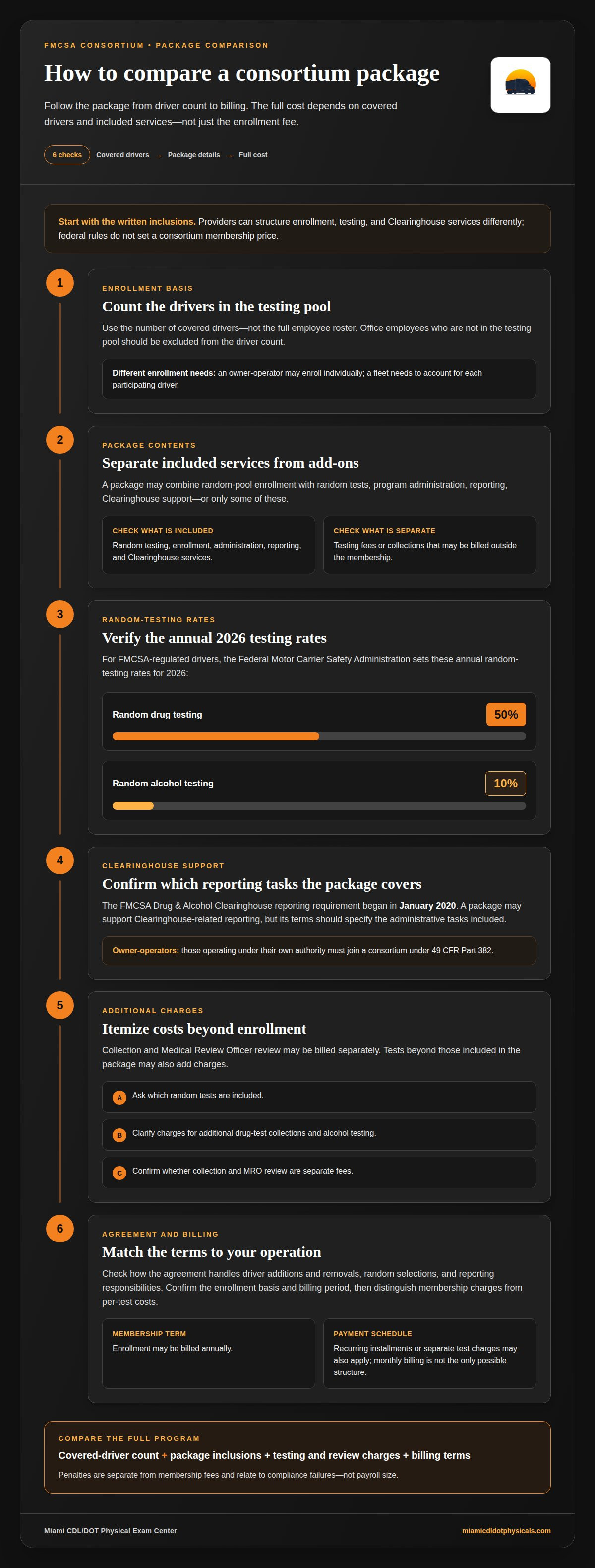
A consortium package can combine random-pool enrollment with FMCSA Clearinghouse support. It may include random tests, program administration, reporting, or a combination of these services. Compare the written inclusions carefully: similar membership terms can differ in whether testing fees are bundled or billed separately. These details are central to understanding FMCSA consortium pricing for a fleet or owner-operator.
For FMCSA-regulated drivers in 2026, the annual random drug testing rate is 50%, according to the Federal Motor Carrier Safety Administration. For FMCSA-regulated drivers in 2026, the annual random alcohol testing rate is 10%, according to the Federal Motor Carrier Safety Administration. Random testing is therefore a core service to examine when comparing packages, alongside any Clearinghouse administration.
Federal rules require an applicable drug and alcohol testing program, but they do not set a consortium membership price. Owner-operators operating under their own authority must join a consortium under 49 CFR Part 382. The FMCSA Drug & Alcohol Clearinghouse reporting requirement began in January 2020. A package can support Clearinghouse-related reporting, but its terms should explain which administrative tasks it covers.
Look for charges outside the membership. Collection and Medical Review Officer review may be billed separately, as may tests beyond those included in the package. Ask for an itemized description of included random tests, additional drug-test collections, alcohol testing, and Clearinghouse services. Those details help you compare the full program cost, not just enrollment.
Fleet enrollment should reflect the number of covered drivers, not the entire employee roster. For example, office employees who are not in the testing pool should be excluded when determining the program’s driver count. Review how the agreement handles driver additions and removals, random selections, and reporting responsibilities. Clear terms make FMCSA consortium pricing easier to compare with your fleet’s actual needs.
Annual consortium membership pricing by employee count
Enrollment is generally based on the drivers covered by the testing program, not everyone on an employer’s payroll. A trucking company with office staff and regulated drivers should separate those groups when estimating enrollment. The relevant count is the number of drivers participating in random testing. This driver-based approach makes FMCSA consortium pricing more relevant to the operation.
Owner-operators and fleets have different enrollment needs. An owner-operator may enroll individually, while an employer with several covered drivers needs to account for each participant. A consortium or third-party administrator coordinates random testing across members. As the number of enrolled drivers changes, the program’s scope and administrative workload may change too.
FMCSA consortium pricing can vary because providers offer different packages and billing structures. There is no single uniform annual rate. Compare the driver count, whether Clearinghouse administration is included, and whether random testing or collections are billed separately. These package details can explain why operations with similar headcounts receive different quotes.
Enrollment may be billed annually, while collection or review charges may apply per test. Monthly billing is not the only possible structure, so distinguish the membership term from the payment schedule. Check whether a quote shows annual enrollment, recurring installments, or separate test charges. This makes it easier to compare the actual billing arrangement without treating every fee as an annual membership cost.
Fleet size and testing activity both affect the program’s scope. Adding covered drivers changes the enrollment count, while testing frequency affects how often collections occur. The applicable random testing rates are set for FMCSA-regulated drivers, not all employees. A party administrator can explain how driver enrollment and package terms shape the employer’s charges.
For owner-operators and trucking companies, the comparison is about covered drivers and included services, not a universal fleet-size price. Review the agreement’s enrollment basis, billing period, testing charges, and Clearinghouse support. Penalties are separate from membership fees and relate to compliance failures, not payroll size. A clear breakdown helps you assess whether the arrangement fits your operation.
Consortium member discounts on drug and alcohol tests
Consortium packages may bundle a DOT drug test with enrollment rather than offer a separate member discount. For example, one-year, two-year, and three-year membership options can include one DOT drug test and random testing. A five-year option may also combine enrollment with a DOT drug test. Compare the included services, not just the word “discount.” A bundled test is valuable only if it matches your testing needs.
Packages can combine services in different ways. A DOT complete compliance package may pair a drug test with a testing policy, consortium enrollment, and motor vehicle record. A separate testing package may combine a five-panel DOT drug test with a breath alcohol test. These examples show why consortium members should check whether drug and alcohol testing are both included or whether one remains a separate service.
Before enrolling, identify which tests are included in the membership and which incur additional charges. Check whether the package covers random tests only or also includes a DOT drug test at enrollment. Confirm how collection and Medical Review Officer review are billed. This helps fleets compare a bundled offer with separate testing without assuming every advertised member rate covers the same services.
FMCSA drug and alcohol consortium enrollment also involves Clearinghouse reporting and recordkeeping. A third-party administrator may support these processes, but the package should make clear which party handles each task. Identify who records test completion and supports required reporting. Clear responsibilities matter for consortium members managing multiple drivers and test types.
For a practical comparison, list each package’s term, included drug test, alcohol test, random-testing coverage, and reporting support. Then match those items to your fleet’s expected testing activity. A DOT drug test bundled with enrollment may suit a new driver, while an established member may value broader random-testing coverage more. Treat a stated discount as a benefit only after comparing included services and separate collection charges.
What are typical FMCSA consortium enrollment fees and per-test costs?
FMCSA consortium bills often combine enrollment with testing-related charges, but packages differ in what they include. Some cover random testing within the membership term; others bill collection and Medical Review Officer review separately. Compare the full service breakdown rather than treating the enrollment fee as the complete program cost.
Membership terms can run one, two, three, or five years. A longer term may bundle random tests differently from annual enrollment, so compare each package’s coverage and renewal structure. Check whether Clearinghouse administration and an initial DOT drug test are included or priced separately. These details determine what enrollment covers, not just the length of the term.
Per-test costs depend on what happens when a driver is selected or needs another test. Collection and review may be separate charges, while an all-inclusive membership may include random-testing fees. A DOT drug test and an alcohol test are distinct services, so confirm whether both are part of the package you’re evaluating. Also distinguish random tests from tests required for other reasons.
For a useful estimate, organize the quote into three parts: enrollment term, included random testing, and charges for each additional collection or review. Then compare equivalent services across packages. For example, a package that includes random testing may not be directly comparable to enrollment that bills each collection separately. Comparing the same components helps show where the total differs.
Ask for a written breakdown showing the billing period, included tests, separate collection charges, and Clearinghouse support. For a fleet estimate, provide the covered-driver count and identify which package services the operation needs. These details clarify how enrollment and testing activity affect the total without confusing a membership charge with an individual test charge.
For help with the consortium service and its included compliance support, explore FMCSA Clearinghouse Consortium services.
Miami CDL/DOT Physical Exam Center: FMCSA Clearinghouse Consortium
Miami CDL/DOT Physical Exam Center offers an FMCSA Clearinghouse Consortium for owner-operators and fleets managing federal compliance requirements. Choose the consortium service when you need enrollment and support with Clearinghouse-related responsibilities as part of your testing program.
Drivers who also need a medical examination can get a DOT Physical Exam at the center. Consider consortium support alongside related driver requirements to coordinate the next steps for your operation. The right service depends on what the driver or fleet needs now, whether that is consortium support or a DOT physical.
Contact Miami CDL/DOT Physical Exam Center to discuss its FMCSA Clearinghouse Consortium.
Set Up Your Fleet’s Next Compliance Step
Use your current driver roster and testing needs to prepare for the next stage of compliance. Understanding FMCSA consortium pricing can help you plan; the practical next step is matching the service to your operation’s requirements. Decide whether you need consortium support, a driver medical examination, or drug testing, then choose the relevant service.
Miami CDL/DOT Physical Exam Center offers an FMCSA Clearinghouse Consortium, DOT Physical Exam, DOT Drug Test, and Non-DOT Drug Test. Drivers and fleet operators can use these services to address their specific compliance and testing needs.
Contact Miami CDL/DOT Physical Exam Center to discuss the next step for your operation. A focused conversation can help you move ahead with clarity and confidence.
Frequently Asked Questions
Do You Need To Join A DOT Consortium?
Yes. If you’re an owner-operator operating a commercial motor vehicle on public roads that requires a commercial driver’s license, you must join a consortium’s random testing pool. A fleet’s testing program must account for its covered drivers. A driver’s duties and vehicle operation determine whether FMCSA drug and alcohol testing requirements apply, not simply the person’s job title.
How Does A DOT Consortium Work?
A DOT consortium combines drivers from different employers or owner-operators into a random testing pool. The consortium or its administrator coordinates random selections and testing, while employers maintain responsibility for their programs. Members should know how selected drivers are notified, where collections take place, and how test records and Clearinghouse-related reporting are handled. These details clarify the process without changing the random nature of selection.
How much does an FMCSA drug and alcohol testing consortium cost per year?
There isn’t one annual amount for every fleet or driver. Cost depends on the number of covered drivers, membership term, included random testing, Clearinghouse services, and whether collections or review are billed separately. Annual enrollment and per-test charges may be structured differently across packages. The relevant factors for a specific quote are your enrollment needs and the services included.
What services are included in FMCSA consortium pricing?
Package contents vary. Enrollment may include random-testing-pool participation and administrative support, while some packages also include Clearinghouse services or a DOT drug test. Other costs, such as collections or review, may be separate. Check the written package description for what happens after a random selection, which records are maintained, and which reporting tasks the administrator handles.
How can a provider help you enroll in an FMCSA-compliant consortium?
A provider can guide enrollment in a testing pool and explain how its FMCSA Clearinghouse Consortium supports owner-operators and fleets. Share the number of covered drivers and whether your operation needs consortium enrollment, a DOT Drug Test, or another listed service. Miami CDL/DOT Physical Exam Center offers the FMCSA Clearinghouse Consortium to support this compliance need.


