

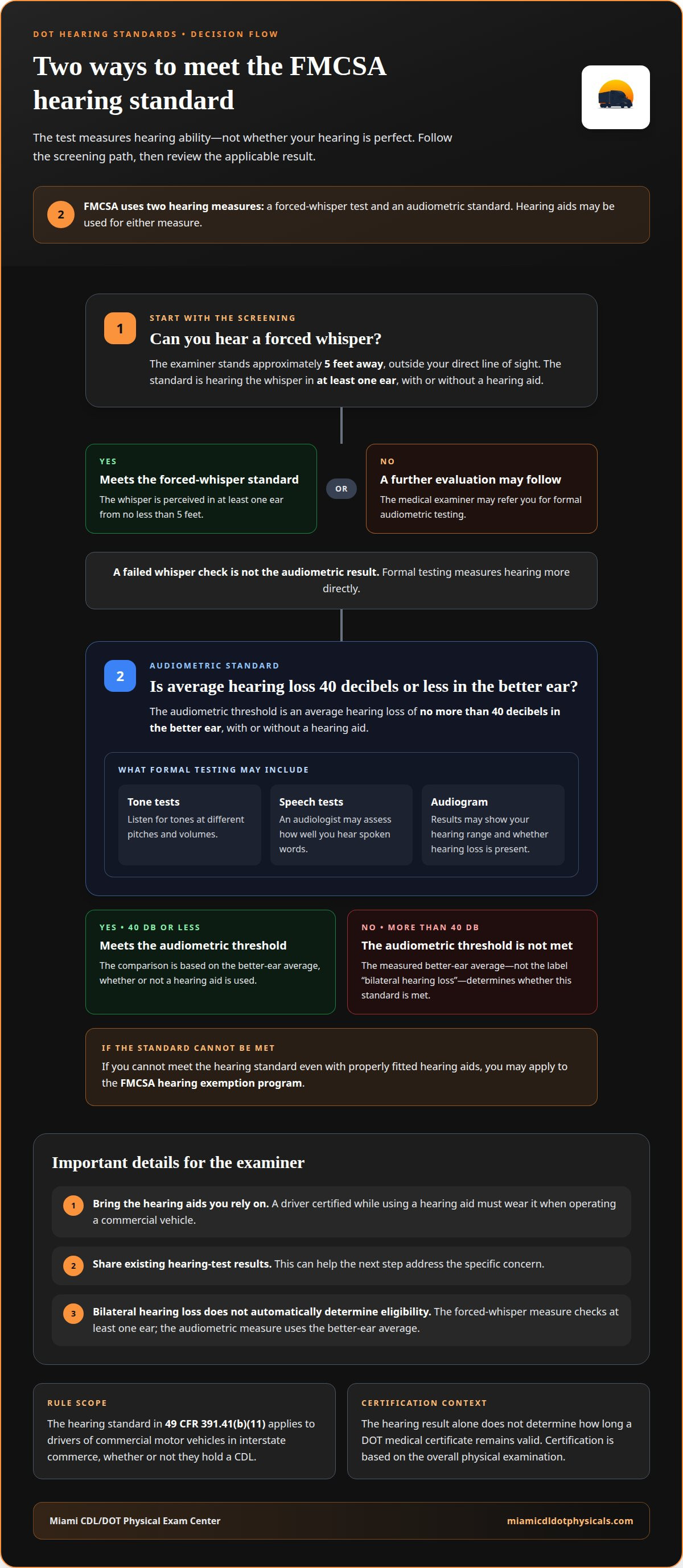
A DOT hearing test is about meeting a defined standard, not having perfect hearing. To understand how to pass a DOT hearing test, know that FMCSA accepts a forced whisper heard in at least one ear from no less than 5 feet, with or without a hearing aid; the audiometric standard is an average hearing loss of no more than 40 decibels in the better ear, also with or without a hearing aid, according to the Federal Motor Carrier Safety Administration. If you don’t pass the initial whisper test, the examiner may refer you for a formal audiometric evaluation.
It’s reasonable to want a clear idea of what to expect when your CDL depends on passing a DOT physical. The hearing check may be brief, but a referral for additional testing can add another step.
This guide explains how the whisper and audiometric standards work, how long the hearing evaluation may take, and how bilateral hearing loss or hearing aids can affect CDL eligibility. You’ll also learn what to expect during the test and what the next steps may be if you don’t meet a standard on the first attempt.
Key Takeaways
- Learn why a failed whisper check may lead to a more detailed audiometric evaluation, and what that test measures.
- Understand how hearing loss in both ears can affect CDL eligibility without assuming it automatically disqualifies you.
- See how FMCSA’s hearing standards assess listening ability and why hearing aids may matter during the exam.
- Know which details about your hearing, hearing aids, and recent ear or noise issues can help a professional prepare for your evaluation.
How long will the hearing test last?
A DOT hearing check may stay brief if the examiner completes only the forced-whisper screening. The Federal Motor Carrier Safety Administration describes the examiner standing approximately 5 feet away, outside your direct line of sight. If you don’t hear the whisper, the medical examiner may refer you for formal audiometric testing. That added evaluation changes the appointment’s scope, so there isn’t one fixed duration for every driver.
Formal testing commonly involves listening for tones at different pitches and volumes and indicating what you hear. The results may be recorded on an audiogram, which shows your hearing range and whether hearing loss is present. An audiologist may also use speech tests to assess how well you hear spoken words. The evaluation time depends on which tests are needed.
Passing the hearing test alone doesn’t determine how long your DOT medical certificate remains valid. The medical examiner makes a certification decision based on the overall physical examination, not the hearing result by itself.
The cost of a DOT physical and hearing test depends on the case and is provided after a quote request. Factors include the examination required and whether a referral leads to additional audiometric testing.
Pediatric hearing referrals follow a separate screening pathway, rather than the adult DOT process. The American Academy of Audiology recommends pure-tone screening for children ages 3 to 5 years. A child who doesn’t pass may be screened again; a second failed screening can lead to a middle-ear evaluation. If follow-up still shows a concern, referral to a pediatric audiologist supports a complete diagnostic evaluation. These steps apply to children, not CDL certification.
For an adult driver, the key first step is whether the initial forced-whisper check meets the standard. If formal testing is needed, it may include tone and speech tests, followed by an audiogram review. Share any existing hearing-test results with the medical examiner so the next step can address the specific concern.
Bilateral hearing loss and CDL eligibility
Hearing loss in both ears doesn’t automatically determine CDL eligibility. The FMCSA standard assesses hearing in at least one ear with the forced-whisper test, while the audiometric standard considers average hearing loss in the better ear. A driver with bilateral hearing loss may meet the audiometric threshold if the better-ear result qualifies, with or without a hearing aid.
Common reasons for not meeting the DOT hearing standard include not perceiving the forced whisper at the required distance or exceeding the permitted average hearing loss in the better ear. The measured result, rather than the label “bilateral hearing loss,” determines whether the standard is met.
In children, hearing difficulties can affect communication and learning. Trouble following spoken instructions, especially in noisy settings, may also relate to auditory processing, which affects how the brain interprets sound. This differs from hearing loss itself, so an audiologist’s assessment can help identify the issue.
Untreated or under-treated hearing loss is associated with cognitive decline, social isolation, anxiety, depression, and reduced quality of life. For a driver, difficulty understanding speech in a noisy cab or during a conversation can also make communication harder. These concerns don’t replace the FMCSA hearing criteria, but they make timely assessment important.
Some symptoms call for prompt professional attention. Sudden hearing loss, ear pain or drainage, pressure or fullness, and tinnitus in one ear are reasons to seek an assessment before relying on an over-the-counter hearing aid. A noticeable difference between ears also warrants professional evaluation.
For CDL decisions, focus on documented hearing results and the better-ear measurement, not assumptions based on the word “bilateral.” If you use hearing aids, tell the examiner and bring them to the DOT physical. The examiner can assess the applicable standard and determine whether further evaluation is needed.
FMCSA hearing standards for commercial drivers
FMCSA uses two hearing measures for commercial drivers: a forced-whisper test and an audiometric standard. According to the Federal Motor Carrier Safety Administration, a driver meets the forced-whisper standard by perceiving a forced whisper in at least one ear from no less than 5 feet, with or without a hearing aid. Understanding how to pass a DOT hearing test starts with knowing that the examiner assesses hearing at that distance, not whether both ears hear equally well.
The audiometric route measures hearing differently. Under this standard, average hearing loss in the better ear must be no more than 40 decibels, with or without a hearing aid, according to the Federal Motor Carrier Safety Administration. An audiometric evaluation provides measured results for comparison with this threshold. Hearing loss in both ears does not replace the better-ear calculation. If you’re learning how to pass a DOT hearing test, this distinction helps explain why a formal evaluation may matter.
The legal scope matters, too. The hearing standard in 49 CFR 391.41(b)(11) applies to drivers of commercial motor vehicles in interstate commerce, whether or not they hold a CDL, according to the Electronic Code of Federal Regulations. The rule is tied to operating a covered commercial motor vehicle, not simply carrying a particular license.
Drivers may wear hearing aids during the DOT physical hearing test. A driver certified while using a hearing aid must wear it when operating a commercial vehicle. Bring the hearing aids you rely on so the examiner can assess your hearing with them in place.
If you can’t meet the hearing standard, even with properly fitted hearing aids, you may apply to the FMCSA hearing exemption program. An application after a failed whisper test is reviewed through an assessment of driving history and safety. An exemption requires a separate application and isn’t an automatic result of failing the test.
To understand your result, focus on the forced-whisper assessment, the audiometric reading in the better ear, and whether you use a hearing aid. A Clearinghouse consortium addresses a separate federal compliance matter. It doesn’t change hearing thresholds or determine hearing-test eligibility.
What information should I provide before a professional DOT hearing test?
Give the examiner information that can help assess your hearing. Explain whether you use hearing aids in daily life, which ear or ears they support, and whether you brought them to the appointment. Mention recent hearing changes, previous hearing-test results, and any known diagnosis. If you have an audiogram, bring it so the examiner can review the recorded results.
Describe situations where hearing is difficult. For example, explain whether you struggle to follow speech in a noisy room, miss sounds on one side, or need people to repeat spoken instructions. Mention ringing in one ear, ear fullness, pain, drainage, or a sudden change in hearing. These details help distinguish a longstanding concern from a new symptom that may need attention.
- Tell the examiner if you wear hearing aids regularly, and bring them to the exam.
- Share relevant hearing-test records, including an audiogram, if you have one.
- Describe recent ear symptoms, hearing changes, and situations where speech is difficult to understand.
- Report recent loud-sound exposure, a cold or flu, an active ear infection, or significant earwax blockage.
Timing can matter. The CHEARS hearing study advises rescheduling after exposure to loud sound without ear protection within the 72 hours before an appointment. It also advises rescheduling if an upper respiratory infection, active ear infection, or earwax completely blocking the canal may interfere with participation. Share these details before testing so the examiner understands the circumstances.
Keep the information specific and factual. “I have trouble hearing conversation in a crowded room” gives clearer context than “my hearing is bad.” If you’re preparing for a DOT physical, schedule a DOT physical exam and bring relevant hearing information to the appointment.
Miami CDL/DOT Physical Exam Center
Commercial drivers across the country rely on facilities like the Miami CDL/DOT Physical Exam Center to complete the DOT physical process and understand the role hearing plays in certification. Turn to qualified medical examiners when you need a DOT Physical Exam or want your hearing results considered as part of your medical examination. Bring any hearing records and the hearing aids you use, so the examiner has relevant information for the appointment.
For owner-operators and fleets, the FMCSA Clearinghouse Consortium supports federal compliance requirements nationwide. It addresses a separate compliance need, while hearing eligibility remains tied to the applicable FMCSA standards and medical examination findings.
Find a certified examiner or schedule your DOT physical examination today.
Take the Next Step Toward CDL Readiness
Use what you’ve learned about how to pass a DOT hearing test to prepare for your next medical appointment. Bring relevant hearing information and be ready to explain how you manage hearing concerns in daily life. Clear communication helps the examiner understand your situation and assess it as part of the DOT physical.
Keep your medical and compliance needs organized as separate tasks. Miami CDL/DOT Physical Exam Center offers DOT physical exams, DOT drug tests, and non-DOT drug tests. Choose the service that matches your current requirement and share relevant details when arranging your appointment.
You don’t need to resolve every question about your hearing before taking the next step. A professional DOT physical can help assess your medical certification needs and identify what further evaluation may be relevant. If you’re ready to discuss your appointment, contact Miami CDL/DOT Physical Exam Center. Move forward with a clear plan and the information you need for your CDL requirements.
Frequently Asked Questions
Can You Use Hearing Aids During the Exam?
Yes. The FMCSA permits drivers to wear hearing aids during the DOT physical hearing test. Bring the devices you use so the examiner can assess your hearing with them. If you’re certified while using a hearing aid, you must wear it when operating a commercial vehicle. Mention any hearing aids you rely on in your daily routine.
What Are the FMCSA Hearing Standards for CDL Drivers?
The FMCSA hearing criteria include a forced-whisper test and an audiometric standard. According to the Federal Motor Carrier Safety Administration, the whisper must be heard in at least one ear from no less than 5 feet. For audiometric testing, average hearing loss in the better ear must be no more than 40 decibels. Both standards allow hearing aids.
What Happens If You Don't Pass the Whisper Test?
If you don’t meet the standard in the initial whisper test, the medical examiner may refer you for a formal audiometric evaluation. The measured results can clarify whether you meet the hearing standard through the audiometric route. A driver who still can’t meet the requirements, even with properly fitted hearing aids, may apply to the FMCSA hearing exemption program. The application includes a review of driving history and a safety evaluation.
What are the FMCSA hearing standards for commercial drivers?
The hearing rule in 49 CFR 391.41(b)(11) applies to drivers of commercial motor vehicles in interstate commerce, whether or not they hold a CDL, according to the Electronic Code of Federal Regulations. This means the standard is connected to operating a covered vehicle in interstate commerce, not simply holding a commercial license. The applicable hearing criteria include whisper and audiometric testing.
What happens during a DOT hearing test?
The examiner may begin with a forced-whisper screening. If that doesn’t establish that you meet the hearing requirement, formal audiometric testing may follow. In a tone test, you respond to sounds at different pitches and volumes. The results may be plotted on an audiogram, and an audiologist may also use speech testing to assess how well you hear spoken words.
What is the whisper test distance and how is it performed?
According to the Federal Motor Carrier Safety Administration, the forced-whisper standard requires hearing a whisper in at least one ear from no less than 5 feet. The examiner stands approximately 5 feet away and outside your direct line of sight. This positioning helps the examiner assess whether you can hear the whisper without relying on visual cues.


