

A positive test isn’t the only event that can result in a Clearinghouse violation record. Employers must report covered violations, including refusals and certain actual-knowledge violations, by the close of the third business day after obtaining the information, according to the Electronic Code of Federal Regulations. Knowing how to report a drug violation to the Clearinghouse starts with understanding who reports each item and what documentation is required.
When a driver’s record and ability to perform safety-sensitive work are involved, a clear process matters. This article explains how employers, medical review officers, and substance abuse professionals record violations, refusals, and return-to-duty information, and what happens after a report is submitted. It also explains how to distinguish reportable events from the steps that follow a violation.
Key Takeaways
- Learn which drug and alcohol program violations employers must report and why refusals can require careful documentation.
- Understand how employers and C/TPAs, medical review officers, and substance abuse professionals record different information.
- See how return-to-duty details, including test results and follow-up completion, become part of the driver’s record.
- Find out how an FMCSA Clearinghouse Consortium can support owner-operators and fleets with Clearinghouse compliance.
What Is the FMCSA Drug and Alcohol Clearinghouse?
The FMCSA Drug and Alcohol Clearinghouse tracks drug and alcohol program violations for commercial drivers. Its records help employers review a driver’s status and meet reporting and query responsibilities.
Clearinghouse Basics
The Clearinghouse is FMCSA’s online database for recording covered violations and reviewing driver records. Under 49 CFR Part 382, Subpart B, employers must report covered drug and alcohol program violations to the FMCSA Clearinghouse, according to the Electronic Code of Federal Regulations. Employers also use queries during driver investigations and employment. If a limited query shows a driver has records, an employer must conduct a full FMCSA Clearinghouse query within 24 hours, according to the Electronic Code of Federal Regulations.
Reportable Drug and Alcohol Violations
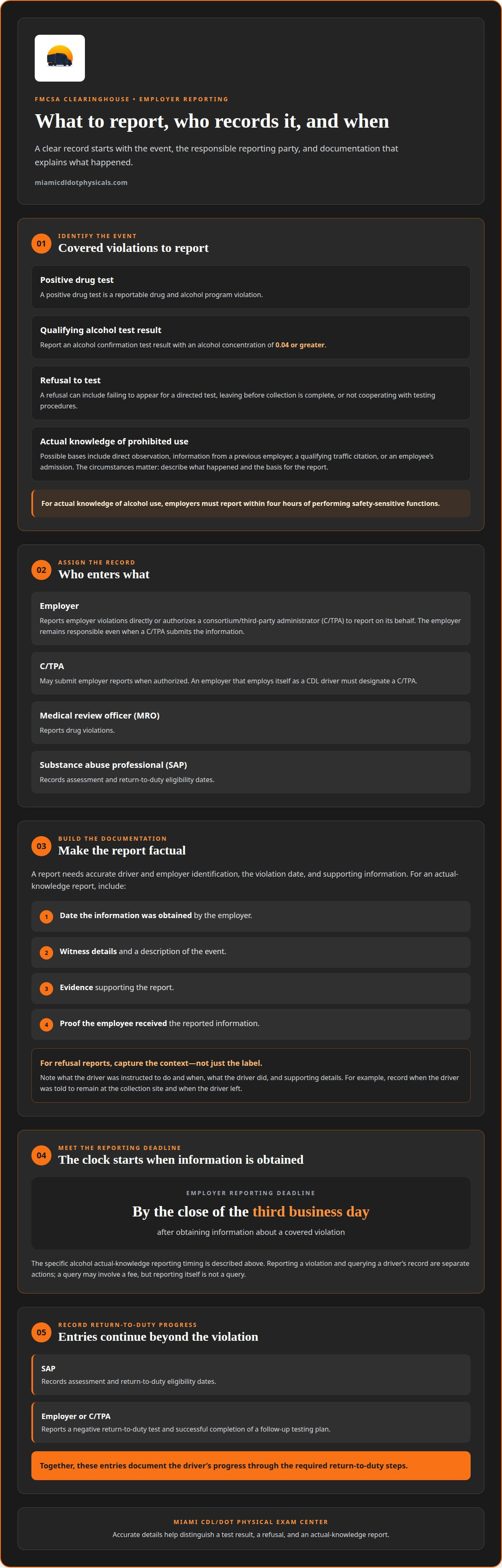
Reportable events include positive drug tests, qualifying alcohol test results, refusals to test, and actual knowledge of prohibited use. Under 49 CFR § 382.705(b), employers must report an alcohol confirmation test result with an alcohol concentration of 0.04 or greater, according to the Electronic Code of Federal Regulations. A refusal can include failing to appear for a directed test or not cooperating with the testing process.
Actual knowledge may come from direct observation, information from a previous employer, a traffic citation for driving a commercial motor vehicle under the influence, or an employee’s admission, subject to § 382.121. The circumstances matter: record what happened and identify the basis for the report.
Failing to report can leave an employer out of compliance with its federal reporting duty. The reporting requirement establishes that duty; enforcement consequences depend on the circumstances.
Reporting a violation and querying a driver’s record are separate actions. A query may involve a fee, but reporting itself is not a query.
The Clearinghouse became operational on January 6, 2020. The Electronic Code of Federal Regulations says employers must report actual knowledge of alcohol use within four hours of performing safety-sensitive functions.
How is driver violation and return-to-duty (RTD) information recorded in the Clearinghouse?
Different Clearinghouse users enter different records, so responsibility depends on what is being reported. Employers and designated C/TPAs handle employer reports, while medical review officers and substance abuse professionals enter records related to their respective roles.
Employer and Testing-Partner Responsibilities
An employer may report directly or authorize a consortium/third-party administrator (C/TPA) to report on its behalf. The employer remains responsible for reporting its violations, even when a C/TPA submits the information. An employer that employs itself as a CDL driver must designate a C/TPA under § 382.705(b)(6). This division helps owner-operators and fleets assign reporting tasks without confusing them with testing or medical review duties.
Violation Details and Documents
A report needs accurate driver and employer identification, the violation date, and supporting information. For an actual-knowledge report, include the date the employer obtained the information, witness details, a description of the event, evidence, and proof that the employee received the reported information. Clear documentation helps distinguish an observed event from a test result or a refusal involving a controlled substance.
Medical review officers report drug violations, while employers or their C/TPAs enter employer violation information. Substance abuse professionals record assessment and return-to-duty eligibility dates. Employers also report a negative return-to-duty test and successful completion of a follow-up testing plan. Together, these entries document the driver’s progress through the required RTD steps.
A driver who believes a record is inaccurate can raise the issue with the reporting party. FMCSA removes information it determines is false. Medical review officers, employers, and C/TPAs may request removal and explain why a record should be corrected.
Employers use records to assess driver status, and government agencies can access Clearinghouse information. A CDL or CLP holder with prohibited status loses commercial driving privileges until completing the return-to-duty process. Accurate reporting therefore matters for both employment decisions and licensing oversight.
Reporting refusals and Clearinghouse violations
A refusal is not limited to a driver saying, “I refuse.” DOT testing rules treat specific actions during collection as refusals, so employers should document the event and its context. A clear record helps distinguish a reportable refusal from a delay or misunderstanding.
Examples include failing to appear for a directed urine collection, leaving before collection ends, or refusing a monitored or observed collection. Refusal criteria also include failing to cooperate with collection procedures, follow directions during an observed collection, or take an additional drug test when directed.
- Record what the driver was instructed to do and when.
- Describe the driver’s actions, such as leaving before the specimen collection was complete.
- Keep supporting documents that explain the event rather than relying only on a “refusal” label.
Employers and C/TPAs must provide specific documentation for reports involving a refusal or actual knowledge under 49 CFR §§ 382.705(b)(3) and (4). For example, note when the driver was told to remain at the collection site and when the driver left. This detail gives the report a factual basis and helps clarify why the event meets refusal criteria.
Employers must report a drug and alcohol program violation by the close of the third business day after obtaining the information, according to the Electronic Code of Federal Regulations. To submit a violation, a registered employer or C/TPA logs into the Clearinghouse, opens My Dashboard, selects “Violations,” then “Report a Violation.”
Medical review officers also report certain refusals, including insufficient urine, specimen substitution or adulteration, and failure to complete a directed medical evaluation. For a positive drug test or refusal report, the MRO enters and verifies the driver’s CDL number and issuing state and country. Accurate details help match the report to the correct driver record.
Reporting Violations to the FMCSA Clearinghouse
Reports cover more than failed drug tests. Employers, medical review officers (MROs), and substance abuse professionals (SAPs) submit different violation and return-to-duty details, so the responsible reporter depends on the record.
Employers wondering how to report a drug violation to the Clearinghouse should first identify who is responsible for the report. Employers or designated C/TPAs report employer-known violations; MROs report verified drug-test violations and certain refusals. Reportable events include:
- A confirmed positive DOT drug test or an alcohol confirmation test at or above the applicable threshold.
- A driver’s refusal to take a required drug or alcohol test, including failure to provide a sufficient specimen or specimen tampering.
- Actual knowledge of prohibited drug or alcohol use, supported by the event details and evidence.
For teams determining how to report a drug violation to the Clearinghouse, the sequence is to gather event details, sign in, and submit the appropriate violation entry. Employers must report by the close of the third business day after obtaining the information, according to the Electronic Code of Federal Regulations. Actual-knowledge reports require driver and employer identifiers, the date the employer obtained the information, witness details, a violation description, supporting evidence, and proof the employee received the reported information.
Return-to-duty records follow a separate reporting path. SAPs enter the driver’s initial assessment date and return-to-duty eligibility date. Employers or their C/TPAs report a negative return-to-duty test and successful completion of the follow-up testing plan.
A driver doesn’t need to register before a drug violation can be added to their record. Owner-operators and fleets can use an FMCSA Clearinghouse Consortium for support with employer compliance responsibilities.
Miami CDL/DOT Physical Exam Center: FMCSA Clearinghouse Consortium
Miami CDL/DOT Physical Exam Center offers an FMCSA Clearinghouse Consortium for owner-operators and fleets managing federal compliance responsibilities. It can be a practical next step when an employer needs support with Clearinghouse-related obligations, including reporting violations and maintaining required records.
The consortium is distinct from a DOT Physical Exam: a physical exam addresses a driver’s medical qualification, while Clearinghouse compliance concerns drug and alcohol program records. Choose the service that matches the task, whether you need consortium support or a DOT physical.
For help with Clearinghouse compliance, contact Miami CDL/DOT Physical Exam Center.
Keep Your Compliance Process Moving
Make the handoff between reporting, testing, and driver support clear. Assign responsibility for each record, preserve the documentation behind decisions, and keep the employer, C/TPA, and testing partners aligned. A consistent process helps prevent missed details when a violation or return-to-duty event needs attention.
Knowing how to report a drug violation to the Clearinghouse is one part of a broader compliance routine. When your operation also needs driver testing or a physical exam, Miami CDL/DOT Physical Exam Center offers DOT Physical Exams, DOT Drug Tests, and Non-DOT Drug Tests. Choose the service that fits your immediate need while keeping your organization’s Clearinghouse reporting responsibilities clear.
For support with these driver health and testing needs, contact Miami CDL/DOT Physical Exam Center. A thoughtful next step can help your team stay organized and keep its compliance work moving forward.
Frequently Asked Questions
Who is required to report a drug or alcohol violation to the Clearinghouse?
Employers must report covered program violations, though a consortium/third-party administrator can submit reports on an employer’s behalf. Medical review officers enter drug-test violations and certain refusals, while substance abuse professionals record assessment and return-to-duty eligibility details. An employer that employs itself as a CDL driver must designate a C/TPA under § 382.705(b)(6). Employers, MROs, and SAPs need Clearinghouse registration to submit their assigned information.
How soon must an employer report a CDL driver’s drug or alcohol violation?
An employer must report a violation by the close of the third business day after obtaining the information, according to the Electronic Code of Federal Regulations. To report a drug violation to the Clearinghouse on time, record when the employer learned of the event and promptly pass the details to any C/TPA handling submissions. The reporting window begins when the employer obtains the information.
How do employers report a violation in the FMCSA Clearinghouse step by step?
To report a drug violation to the Clearinghouse, sign in to a registered employer account and open My Dashboard. Select “Violations,” then “Report a Violation,” choose the event type, and enter the requested driver and employer details. Add supporting documentation for refusals or actual-knowledge reports, then review the entries before submitting to reduce the risk of a record mismatch.
How do medical review officers and substance abuse professionals report Clearinghouse violations?
MROs submit drug-test violations assigned to their role, including confirmed positive results and reportable refusals. For positive or refusal entries, the MRO verifies the driver’s CDL number and issuing state and country. SAPs report the initial evaluation date and return-to-duty eligibility date through My Dashboard’s “RTD Process” and “Report RTD Information” options. For these professionals, the reporting process depends on their assigned role.


