

Your CDL self-certification and medical card serve distinct purposes. To learn how to self-certify your medical status with the state, choose the category that matches your commercial driving, then submit that declaration through your state's online CDL Self-Certification System—such as Florida's system if you hold a valid state license. If you drive in a non-excepted category, you also need current medical certification. According to the Federal Motor Carrier Safety Administration, a certified medical examiner completes Form MCSA-5876 to record whether you meet the physical qualification standards.
It’s easy to confuse the state filing with the medical exam, but they are separate steps. Here at Miami CDL/DOT Physical Exam Center, we help drivers navigate these requirements. This guide explains the four categories, how to choose the one that fits your work, how a medical card relates to state requirements, and how to submit or update your status online. It also covers how changes to your routes or duties can affect your category, so your CDL record reflects the commercial driving you do.
Key Takeaways
- Match your self-certification category to the commercial driving you perform, including whether your work is interstate or intrastate and excepted or non-excepted.
- Keep the state filing and medical certification distinct: each serves a different purpose in maintaining your CDL status.
- Review your category when your routes, job duties, cargo, passengers, or employer change in a way that affects your driving.
- Use Florida’s online system to submit or update your self-certification, then follow the steps for confirming your record is current.
How Does DOT Medical Card Self-Certification Work in Florida?
Florida’s Department of Highway Safety and Motor Vehicles handles CDL self-certification, which records your driving category. A certified medical examiner determines whether you meet medical qualification requirements. An expired or inaccurate certificate can result in CDL disqualification, denial of issuance or renewal, or a downgrade to a regular operator’s license.
-
Gather Medical Documentation
Schedule a DOT physical with a certified medical examiner and keep the resulting documents together. According to the Federal Motor Carrier Safety Administration, a Florida CDL Medical Examiner’s Certificate, Form MCSA-5876, must be completed by a certified medical examiner to determine whether a driver meets physical qualification standards for commercial motor vehicle driving. The examiner’s decision establishes medical certification; self-certification records the type of commercial operation you perform. Review the certificate’s expiration date and any limitations, then retain the paper copy issued after the exam. If an FMCSA variance applies, carry its documentation while operating.
-
File or Renew Your Med Card
Submit your self-certification category to Florida separately from your medical exam. Florida CDL holders with a valid Florida Commercial Driver License can use the state’s online CDL Self-Certification System to file without visiting a driver license office. Medical exam results follow a separate process. Since December 15, 2025, results are transmitted electronically from the National Registry to FLHSMV and posted to your CDLIS record, so you don’t take the paper certificate to the state.
After each DOT physical, confirm the result appears on your Florida driving record and keep the examiner’s paper copy in case of a state-side issue. Florida suggests carrying your medical card for at least 15 days after electronic submission while the record updates. Start renewal before the card expires, and track the expiration date rather than relying on your self-certification filing to renew medical qualification. An expired card can put your CDL status at risk even when your declared driving category remains accurate.
The four CDL self-certification categories
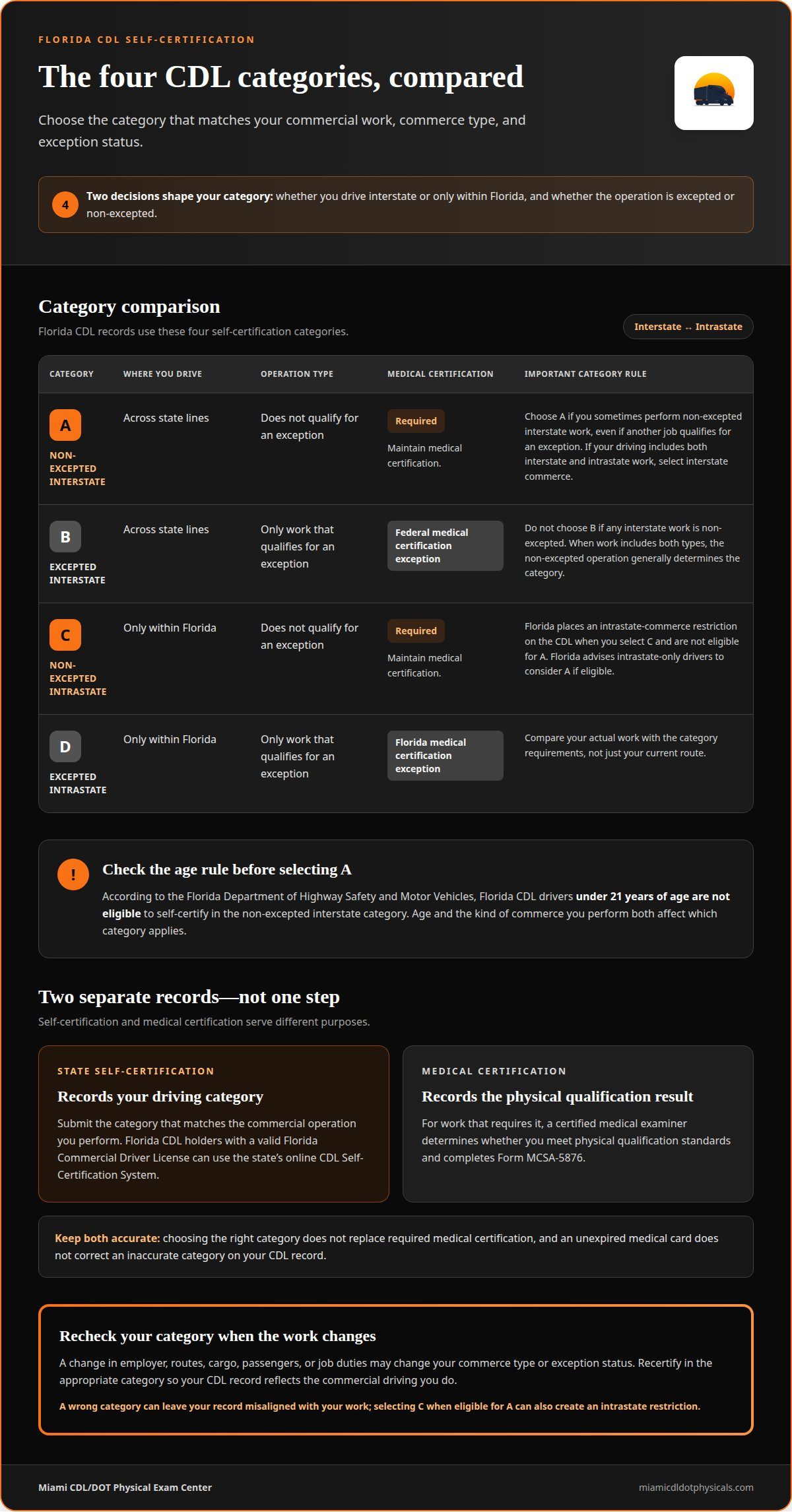
Florida CDL applicants and renewing drivers choose one of four categories based on the type of commerce they engage in and whether their operations qualify for an exception. States administer self-certification through their driver licensing agencies, and Florida’s category rules apply to Florida CDL records.
- Choose Category A for non-excepted interstate driving. Select A if you operate, or expect to operate, across state lines in work that does not qualify for an exception. This category requires medical certification. If your driving includes both interstate and intrastate work, select interstate commerce. If you sometimes perform non-excepted interstate work, choose A even if another job qualifies for an exception.
- Choose Category B for excepted interstate work. Select this category if you operate, or expect to operate, only in interstate commerce that qualifies for an exception. Category B drivers are excepted from federal medical certification requirements. Don’t choose B if any of your interstate work is non-excepted; the non-excepted operation generally determines your category when your work includes both types.
- Choose Category C for non-excepted intrastate driving. Select C for work conducted only within Florida that does not qualify for an exception. It requires medical certification. Florida places an intrastate-commerce restriction on a driver’s CDL when the driver selects C and isn’t eligible for A. Florida advises intrastate-only drivers to consider A if eligible, which preserves the option to operate interstate.
- Choose Category D for excepted intrastate work. Select D if you operate, or expect to operate, only within Florida in operations that qualify for an exception. This category is excepted from Florida medical certification requirements. Before filing, compare your actual work with the category requirements, not just your current route.
- Update your category when your work changes. If your employer, routes, cargo, passengers, or job duties change your commerce type or exception status, recertify in the appropriate category. A wrong choice can leave your CDL record misaligned with your work; selecting C when eligible for A can also create an intrastate restriction. For work requiring medical qualification, a DOT physical exam supports the medical certification process.
Medical card and state self-certification
- Keep the medical exam and category filing distinct. Self-certification tells Florida what kind of commercial driving you do. Your medical card records the result of a physical qualification exam. Choosing the correct category does not replace medical certification when your operation requires it, and an unexpired medical card does not correct an inaccurate category on your CDL record.
- Apply the age rule before selecting non-excepted interstate. According to the Florida Department of Highway Safety and Motor Vehicles, Florida CDL drivers under 21 years of age are not eligible to self-certify in the non-excepted interstate category. If you’re under 21, don’t select that category. Your age and the kind of commerce you perform both affect which category applies.
- Account for every type of commercial work. If you sometimes operate in non-excepted interstate commerce, select Category A and maintain a valid medical card, even if another job qualifies for an exception. If your driving includes both interstate and intrastate commerce, choose interstate commerce for self-certification. Base your selection on all your work, not just your usual route.
- Check the medical requirement for intrastate work. Drivers who operate only in non-excepted intrastate commerce must meet Florida medical certification requirements. Florida’s medical standards for this work largely mirror FMCSA requirements. Category C covers non-excepted intrastate operations, while Category D covers excepted intrastate operations. Whether medical certification is required depends on the exception status of the work.
- Keep your certification current to protect your CDL status. A medical card lapse can lead Florida to downgrade a CDL to a regular operator’s license, and missing current medical documentation may affect CDL issuance or renewal. Required medical certificates remain subject to Part 383, including during active deployment. Florida provides no active-deployment exception; without an acceptable certificate, the state must begin the downgrade process. Drivers certified under an FMCSA variance must carry its documentation while operating.
Using Florida’s online self-certification system
Florida CDL holders with a valid Florida Commercial Driver License can submit self-certification online without visiting a driver license office. Use these steps to select and submit the category that matches your commercial driving.
- Start with a valid Florida CDL. The online CDL Self-Certification System is available to holders of a valid Florida Commercial Driver License. If you’re applying for an original CDL or renewing one, complete self-certification at the driver license office as part of that process. The online option does not apply to every applicant or license transaction.
- Decide which category matches your work. Before entering your information, determine whether you operate interstate or intrastate and whether your operations qualify for an exception. Florida uses four categories. If your work includes both excepted and non-excepted operations, the non-excepted category generally controls. Consider all your current duties, not just your most frequent route.
- Enter the appropriate category in the state system. Submit the category that reflects your commercial driving status. Self-certification is an administrative declaration. It does not determine medical fitness or replace a required medical examination. Keep these responsibilities separate as you complete the online filing.
- Keep your medical record and state declaration aligned. Since December 15, 2025, medical exam results are transmitted electronically from the National Registry to FLHSMV and posted to your CDLIS record. After filing or completing a physical, confirm the relevant status appears on your Florida driving record. Retain your examiner’s paper copy in case of a state-side problem.
- Update your filing when your work changes. A new employer, route, cargo, passenger group, or job duty may affect your category. Review the correct category before submitting an update. Florida’s online filing is distinct from a DOT physical and CDL issuance or renewal transaction; treat any charge according to the transaction it covers. For help with the medical-exam step, get support with your CDL medical requirements.
Miami CDL/DOT Physical Exam Center
Miami CDL/DOT Physical Exam Center helps commercial drivers meet medical requirements connected to maintaining CDL status. If your category requires a current medical certificate, schedule a DOT Physical Exam to complete the medical examination step. The exam and Florida self-certification filing are separate, so submit your category through the state system as well.
For owner-operators and fleet companies managing federal compliance, the FMCSA Clearinghouse Consortium is also available. Choose support based on the task: a medical exam for certification needs or consortium support for Clearinghouse requirements. The center’s services complement these steps but do not replace Florida’s category filing.
Contact Miami CDL/DOT Physical Exam Center to discuss the medical or Clearinghouse service relevant to your CDL requirements.
Make CDL compliance part of your routine
Make CDL compliance part of your regular work-planning routine. When your responsibilities change, consider whether your declared status still reflects the driving you do. Connecting this decision to your work planning can help you avoid treating certification as an isolated filing. Knowing how to self-certify your medical status with the state is one part of managing your professional requirements.
For medical and testing needs, Miami CDL/DOT Physical Exam Center offers DOT Physical Exams, DOT Drug Tests, and Non-DOT Drug Tests. Choose the service that matches the task, whether you need a medical exam or a drug test.
Contact Miami CDL/DOT Physical Exam Center to discuss the service relevant to your needs. Take your next compliance step with a clear plan and confidence in what comes next.
Frequently Asked Questions
How to obtain a Med Card?
Complete a DOT physical with a certified medical examiner. The examiner evaluates whether you meet the physical qualification standards for commercial driving and completes Form MCSA-5876 if you qualify. The card documents that medical determination; it doesn’t select your Florida driving category. If you have a medical condition or take medication, bring relevant information to discuss during the examination.
Need more information about medical requirements?
First determine whether your question is about medical qualification or state category selection. For example, if you’re unsure whether a health condition affects certification, you need information about the DOT physical. If you’re unsure which commerce category fits, review your commercial duties. Miami CDL/DOT Physical Exam Center provides DOT Physical Exams for drivers who need the medical examination step.
What does self-certifying medical status with a state mean?
Self-certification means declaring the type of commercial driving you do to the state licensing agency. This declaration helps the state apply the appropriate CDL category and related medical requirements. It is not a medical examination or a personal judgment about your fitness to drive. For example, your interstate work and exception status help determine which category to report.
How do commercial drivers self-certify their medical status with the state DMV?
Follow the process set by the state that issued your CDL, since submission methods and eligibility depend on the state and license transaction. In Florida, holders of a valid Florida Commercial Driver License can submit through the online CDL Self-Certification System. Drivers applying for an original CDL or renewing one complete certification at the driver license office as part of that process.
What documents or forms are required to self-certify medical status?
Florida’s self-certification is a category declaration, while medical qualification is documented separately. A certified examiner completes Form MCSA-5876 after the DOT physical, according to the Federal Motor Carrier Safety Administration. Florida CDL holders no longer physically present MCSA-5876, MCSA-5875, or accompanying medical waivers or Skill Performance Evaluation Certificates to the state; that information is submitted through FMCSA.
How do I submit a medical self-certification, and can it be done online?
Florida CDL holders with a valid Florida Commercial Driver License can use the online self-certification system to submit their category. Select the category that reflects your commercial operation, then complete the state’s online filing. Medical exam results are transmitted separately through the federal system. For an original CDL or renewal, complete category certification at the driver license office.


