

A DOT medical card doesn’t always last two years. The answer to how long a DOT medical card is good for is up to 24 months in the United States, according to the Federal Motor Carrier Safety Administration (FMCSA). An examiner may issue a shorter certificate when a health condition needs closer monitoring, so the expiration date on your certificate is the date to plan around.
It’s easy to assume every driver follows the same renewal schedule, but how long a DOT medical card is good for depends on your health and the examiner’s assessment. This guide explains why some drivers need annual re-examinations or shorter intervals, what an expired certificate means for your medical qualification, and how to keep renewal dates on your radar. You’ll also learn what to expect when your next DOT physical is due, so you can plan ahead and reduce the risk of a last-minute interruption to your work.
Key Takeaways
- For CDL and CLP holders, the Federal Motor Carrier Safety Administration says the state must change medical certification status to “not certified” within 10 days after the certificate expires.
- Health conditions that need closer follow-up can mean an annual re-examination or a shorter certification period.
- Set a renewal reminder 60 days before your certificate expires to give yourself time to plan.
- Schedule your next DOT physical a few weeks before the expiration date to help avoid a gap in certification.
How Long Is a DOT Medical Card Good For?
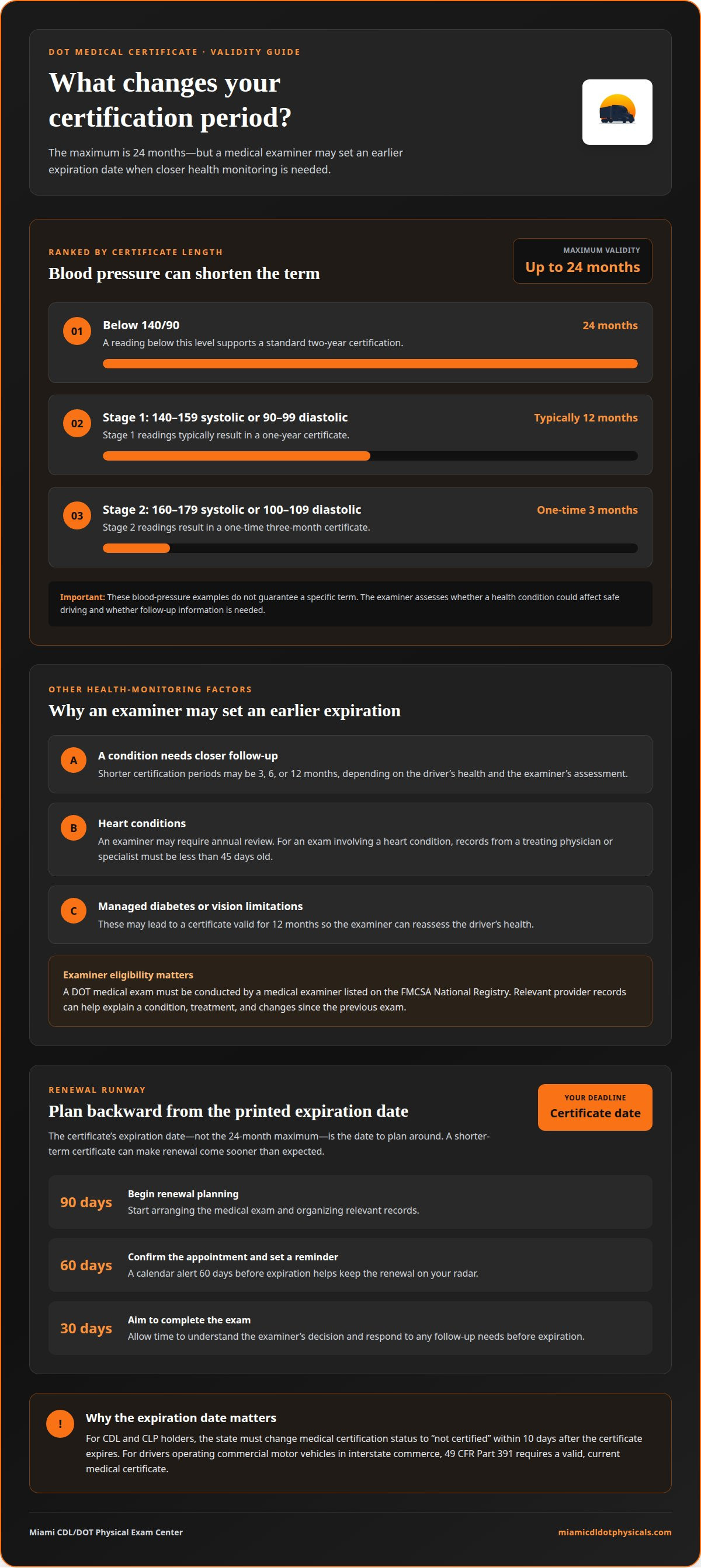
In the United States, a DOT medical certificate can remain valid for up to 24 months. The medical examiner may certify you for less time when your health requires closer monitoring.
Maximum Certificate Validity
The Federal Motor Carrier Safety Administration says a DOT physical examination is valid for up to 24 months in the United States. That’s the maximum, not a guaranteed term for every driver. The expiration date on your medical certificate determines when you need another exam. For drivers operating commercial motor vehicles in interstate commerce, 49 CFR Part 391 requires a valid, current medical certificate.
For CDL and CLP holders, the Federal Motor Carrier Safety Administration says the state must change medical certification status to “not certified” within 10 days after the certificate expires. An expired certificate can therefore affect more than your exam schedule. Plan around its printed expiration date, not the maximum period.
Shorter Certification Periods
A shorter certification period means the medical examiner sets an earlier expiration date to monitor a health condition. Depending on the driver’s health, a certificate may cover 3, 6, or 12 months. The examiner considers whether the condition could affect the driver’s ability to operate safely and whether follow-up records can clarify its status.
Blood pressure can affect the certification period. A reading below 140/90 supports a standard two-year certification. Stage 1 readings, from 140 to 159 systolic or 90 to 99 diastolic, typically result in a one-year certificate. Stage 2 readings, from 160 to 179 systolic or 100 to 109 diastolic, result in a one-time three-month certificate. These examples show why the examiner’s decision may be shorter than the maximum.
Medical Card and Examiner’s Certificate
“DOT medical card” is the common name for the Medical Examiner’s Certificate, the document showing that a certified medical examiner found you physically qualified. The card isn’t a separate exam or an additional certification. Its expiration date reflects the certification period granted after your medical exam.
That distinction matters when you plan a renewal: use the certificate’s expiration date as your deadline. After finding a driver qualified, the examiner completes the certificate and provides a copy of the results. Keep the document accessible, and arrange another exam before its stated expiration if you need to remain certified.
Annual re-examinations for certain drivers
An annual re-examination is a shorter review schedule, not a universal rule for every commercial driver. A medical examiner may require one when a health condition needs regular monitoring. Heart conditions are one example: examiners may require drivers to undergo annual review. This schedule helps assess whether the condition and its treatment remain compatible with commercial driving.
Managed diabetes or vision limitations may also lead to a medical certificate valid for 12 months. That shorter period gives the examiner an opportunity to reassess the driver’s health before extending certification. A treating provider’s documentation can help explain the condition, treatment, and relevant changes since the previous exam. Bring pertinent records to support a clear review.
The examiner conducting a DOT medical exam must be listed on the FMCSA National Registry. This is a requirement for examiners who perform these evaluations. The listing distinguishes an authorized medical examiner from a provider who may treat a driver but isn’t listed to conduct DOT certification exams. Confirming the examiner’s eligibility before your appointment helps keep the certification process on track.
Medical records matter most when they address the condition under review. For an exam involving a heart condition, records from a treating physician or specialist must be less than 45 days old. Recent documentation can give the examiner relevant details about treatment and current status. Older or incomplete records may not provide the information needed to assess the driver’s medical qualification.
Expect the examiner to consider your overall medical picture, not just a single diagnosis. The exam may include a review of your medical history and supporting records, followed by an assessment of your current health and ability to drive safely. If the examiner sets an annual interval, use the certificate’s expiration date to plan your next review. A change in your condition or treatment can also make updated documentation useful at the next exam.
Renewal tracking for medical cards
Track the expiration date printed on your certificate, then plan backward from it. A calendar reminder helps keep your renewal from slipping past the deadline.
Tracking Renewal Dates
Record the expiration date in a calendar you review regularly, and set an alert 60 days beforehand. Check the date several months ahead, especially if your certificate covers less than 24 months. Shorter periods for health monitoring can make renewal dates arrive sooner than expected. Keep the certificate details with your work records, so you can find the date without searching through paperwork.
Planning a Renewal Appointment
Plan the appointment before your current certificate reaches expiration. A practical schedule is to begin renewal 90 days ahead, confirm the appointment 60 days ahead, and aim to complete the exam 30 days ahead. These milestones leave time to organize relevant records and address scheduling changes. Consider your driving assignments and vehicle schedule when choosing an appointment date.
Renewal Steps and Timing
Use a simple sequence: note the expiration date, arrange your medical exam, then keep the resulting documentation with your records. A DOT physical must be conducted by a licensed medical examiner listed on the FMCSA National Registry. Completing the exam before expiration gives you time to understand the examiner’s decision and follow any next steps. Keep a copy of your new certificate accessible.
Early Renewal Timing
Scheduling your physical a few weeks before expiration is a useful target, especially when work plans are busy. Starting early gives you room to gather records or adjust an appointment if needed. Your new exam may result in a different certification period, depending on your health and the examiner’s findings. Afterward, update your calendar with the new expiration date and set your next reminder.
Can a DOT physical be valid for less than two years?
Yes. In the United States, a DOT physical examination is valid for up to 24 months, according to the Federal Motor Carrier Safety Administration. The examiner can issue a shorter medical certificate when a driver’s health calls for closer follow-up. A renewal exam before the printed expiration date helps prevent a lapse in medical qualification.
Schedule your next physical a few weeks before expiration. That gives you time to attend the exam, share relevant records, and understand the examiner’s decision before your current certificate ends. An earlier appointment is especially useful if a condition such as diabetes needs review or your certification period is shorter than the maximum.
A DOT physical must be conducted by a licensed medical examiner listed on the FMCSA National Registry. The listing identifies examiners authorized to perform commercial-driver medical examinations. A general healthcare provider who isn’t listed cannot complete the DOT certification exam. Choose an appointment with a listed examiner, and bring records about any condition under treatment.
Prepare for your visit by gathering relevant medical documentation. Include records related to ongoing conditions, such as diabetes, and information that helps explain your current health. If the examiner needs additional documentation, it may affect how the exam proceeds. Clear, relevant records help the examiner assess your ability to operate a commercial motor vehicle.
After the exam, the medical examiner determines whether you meet the physical qualification requirements and completes the certificate if you qualify. Your certification period may be shorter if monitoring is needed. Use the new expiration date to set your next renewal reminder, even if your previous certificate lasted longer.
For a renewal exam, schedule a DOT Physical Exam before your current certificate expires. Bring relevant records so the medical examiner can review your health during the appointment.
Miami CDL/DOT Physical Exam Center
Miami CDL/DOT Physical Exam Center provides comprehensive DOT physical exams for commercial drivers seeking initial certification or timely renewal. If your medical certificate is nearing its expiration date, or if your examiner previously established a shorter validity period to monitor an underlying health condition, scheduling a DOT physical exam is an essential next step. Always bring relevant medical records and a list of current medications to your appointment so the certified medical examiner can thoroughly review your health status and determine the appropriate certification duration.
Commercial motor vehicle operators, owner-operators, and fleet safety managers can also utilize the FMCSA Clearinghouse Consortium for ongoing federal compliance support. The ideal next step depends on your specific compliance needs: schedule an exam when your recertification is due, or enroll in the consortium to meet federal Drug and Clearinghouse requirements. Contact Miami CDL/DOT Physical Exam Center to schedule your upcoming physical examination or to discuss comprehensive safety and consortium support services.
Make Renewal Planning Part of Your Work Routine
Knowing how long a DOT medical card is good for helps you treat renewal as part of work planning, not an afterthought. Add the appointment to your calendar alongside route planning, fleet scheduling, or other professional commitments. If you drive for a company, share your renewal date with the person who coordinates your work so everyone can plan around it.
Your next step can be straightforward: decide when you need your exam, gather relevant medical records, and arrange the appointment. For help with that next step, contact Miami CDL/DOT Physical Exam Center about a DOT Physical Exam. A clear plan gives you more control over your schedule and helps you move forward with confidence.
Frequently Asked Questions
Can I renew early?
Yes. You can schedule a DOT physical before your current certificate expires, giving you time to plan around work and review your medical records. Keep in mind that taking a new DOT physical immediately voids previously issued medical certificates. If you’re considering an early exam, account for that change when planning your certification and driving schedule.
Is there a grace period after expiry?
No. There’s no grace period after a DOT medical certificate expires, so an expired certificate doesn’t keep you medically qualified to operate a commercial motor vehicle. For CDL and CLP holders, the state must change medical certification status to “not certified” within 10 days after expiration. Arrange your renewal before the printed date to avoid a gap in qualification.
When should you schedule your renewal?
Start planning 90 days before expiration, confirm an appointment 60 days ahead, and aim to complete the exam 30 days before the deadline. This schedule leaves room to gather records or adjust plans if work changes. If your certificate has a shorter term, use its actual expiration date for these reminders rather than assuming a two-year cycle.
How long is a DOT medical certificate valid for?
In the United States, a DOT physical examination is valid for up to 24 months, according to the Federal Motor Carrier Safety Administration. The certificate’s expiration date shows the period granted to you. For example, if your examiner issues a shorter term, plan your next exam around that earlier date, not the maximum validity period.
Can a DOT medical card be issued for less than 2 years?
Yes. A medical examiner can issue a certificate for less than 2 years when a driver’s health needs closer monitoring. For example, certain blood-pressure readings may lead to a shorter certification period, while managed diabetes or vision limitations may call for annual review. The assigned expiration date sets your renewal deadline, so record it as soon as you receive your certificate.
What medical conditions limit DOT medical certificate validity?
Conditions that may require closer follow-up include high blood pressure, heart conditions, managed diabetes, and vision limitations. The examiner considers how the condition affects safe driving, how it is currently managed, and whether updated records are needed. A shorter certification period allows reassessment sooner. Bring relevant documentation from your treating provider so the examiner can consider current information during your medical exam.


