
The panel is only one part of the total. How much a DOT drug test costs depends on the test required and what the quoted charge includes. Urine collection, laboratory analysis, and separate scheduling or collection fees can all affect the final amount. DOT drug tests use urine specimens and must be processed by an HHS-certified laboratory, so a rapid, point-of-care test is not a substitute for a compliant DOT test.
It’s reasonable to want a clear figure before arranging a test. The substances screened and the collection process help explain why the total can vary, and a collection fee may be separate from the testing charge. This guide explains how the panel, substances screened, and urine collection fees affect DOT drug test costs, then outlines what to expect when arranging testing in the United States.
Key Takeaways
- Separate the laboratory testing charge from urine specimen collection and scheduling fees to understand what the total includes.
- DOT testing follows specific requirements, so a broader panel or rapid test isn’t automatically a suitable substitute.
- Who pays can depend on the reason for testing, including whether it’s pre-employment or a return-to-duty test.
- Use the test purpose, panel, collection process, and location to identify the main factors behind the quoted cost.
Urine specimen collection fees
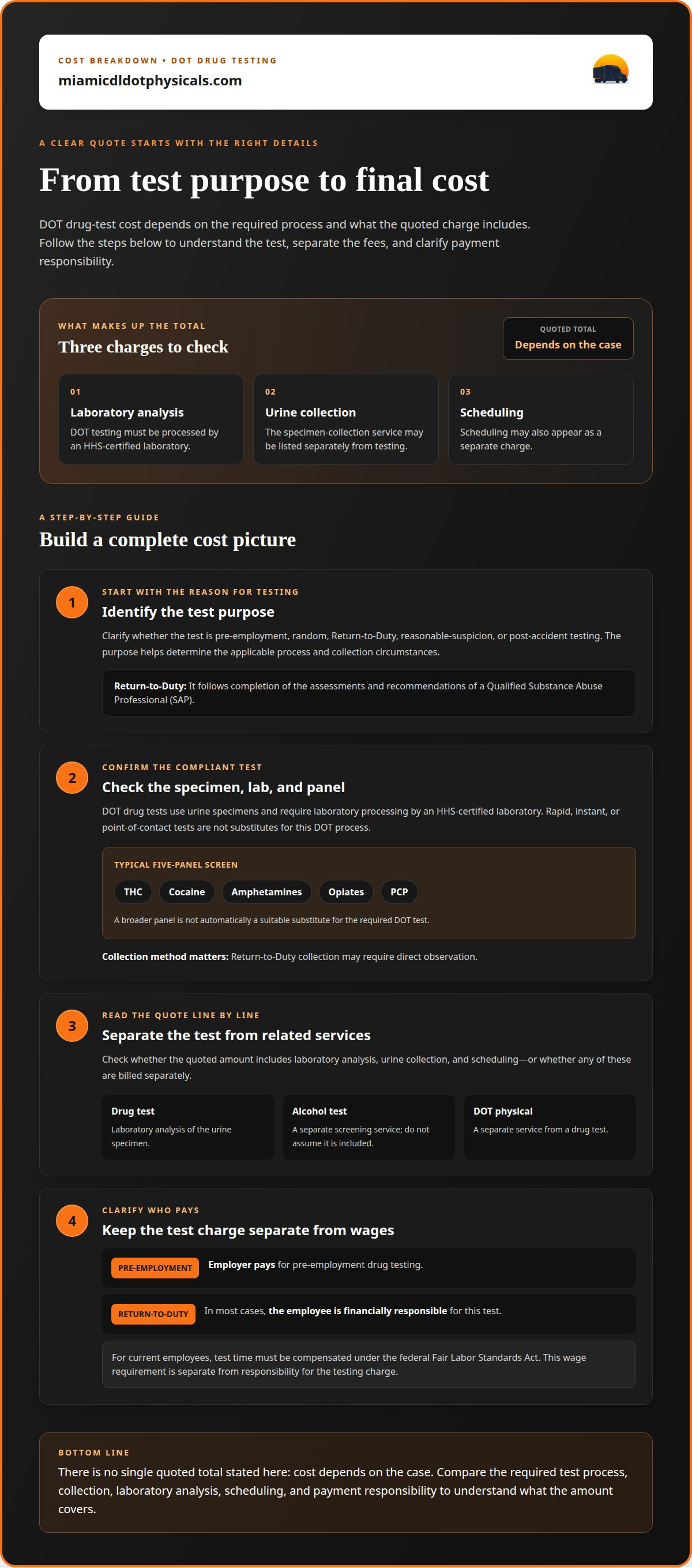
A DOT drug test has two distinct parts: collecting the urine specimen and laboratory testing. The collection fee covers the specimen-collection service, while laboratory analysis is a separate part of the process. Some quotes also list scheduling separately from collection, so the headline amount may not include every charge.
For a Return-to-Duty test, direct observation may be required during specimen collection. That means the collection method matters, not just the panel selected. Return-to-Duty testing takes place after the driver completes the assessments and recommendations of a Qualified Substance Abuse Professional. A standard five-panel test is commonly used for this purpose.
DOT testing has specific requirements. The U.S. Department of Transportation permits urine specimens for DOT drug tests, which must be processed by an HHS-certified laboratory. Rapid, instant, or point-of-contact tests are not substitutes for that laboratory process. Workplace alcohol testing is also separate from a urine drug test, so don’t assume one appointment includes both.
To understand a quote, separate its components:
- Collection: The appointment and process for providing the urine specimen.
- Laboratory analysis: Testing performed by an HHS-certified laboratory for DOT compliance.
- Additional charges: Scheduling or collection may appear separately from the listed testing fee.
This breakdown helps transportation employers and drivers understand what a quoted amount covers, without confusing a collection charge with laboratory analysis. The specimen process is sensitive, and the required test type determines how collection must be handled. A DOT physical exam is a separate service from a drug test, so scheduling one does not explain what a drug-test quote includes. Review the testing requirements and charges for each step to understand the service being arranged.
DOT drug test cost
The total depends on the required testing process, not simply the panel label. A DOT test uses a urine specimen and laboratory analysis. Rapid, instant, and point-of-contact tests are not substitutes for this regulated process. The price of a DOT drug test depends on the case and is provided after a quote request. The panel, collection, and scheduling can affect the total.
A typical five-panel test screens for THC, cocaine, amphetamines, opiates, and PCP. These panels identify specified substances; they are not general screens for every drug. Adding panels does not automatically make a test suitable for DOT compliance. The required test must follow the applicable transportation rules. A broader panel may be relevant for non-DOT workplace testing, which serves a different purpose.
Test results also depend on laboratory analysis. DOT drug tests must use HHS-certified laboratory testing. If an initial result requires confirmation, additional laboratory steps are needed before results are finalized. The U.S. Department of Transportation sets distinct initial and confirmatory cutoff levels, including for marijuana metabolites. These standards guide how the laboratory reports a result; they do not make the panel a menu of optional substances.
Keep related services separate in your cost estimate. A random drug test is still a drug test, while an alcohol test is a distinct screening service. Alcohol testing does not replace drug testing, and a medical appointment does not determine the required panel. Identify the reason for testing first, then match it to the applicable DOT process.
- Testing purpose: Pre-employment, random, and return-to-duty testing can involve different collection circumstances.
- Panel: Confirm which substances the required test must detect.
- Included charges: Separate laboratory testing from scheduling and specimen collection.
For transportation employers and drivers arranging compliant testing, DOT drug testing connects the required process with the right testing purpose.
Do employers or drivers pay for DOT drug tests?
Who pays depends on why the test is required. Employers pay for pre-employment drug testing. If you are completing the hiring process, the employer covers the pre-employment test rather than treating it as a personal screening expense.
Return-to-Duty testing follows a different process. In most cases, the employee is financially responsible for this test. It takes place after the employee completes the assessments and recommendations of a Qualified Substance Abuse Professional. The reason for testing matters: pre-employment and Return-to-Duty tests can have different payment arrangements.
Other DOT testing situations include random, reasonable-suspicion, and post-accident testing. The available payment rules do not establish one payer for every situation. Distinguish the reason for testing from the test itself, then clarify who is responsible for the charge before arranging the appointment.
For current employees, time spent taking a drug test must be compensated under the federal Fair Labor Standards Act. This wage requirement concerns time, not necessarily who pays the testing charge. Keep those responsibilities separate in payroll and testing records.
Use these steps to make the arrangement clear:
- Identify the test purpose. Mark it as pre-employment, Return-to-Duty, random, reasonable suspicion, or post-accident testing.
- Assign the testing charge. Apply the employer-paid rule for pre-employment tests and the usual employee responsibility for Return-to-Duty tests.
- Separate pay from wages. For a current employee, account for compensated test time independently from the test charge.
- Record the arrangement. Keep the reason for testing and payment responsibility together with the relevant workplace records.
This distinction helps avoid confusing the person taking a test with the person paying for it. For example, an employee may attend a test arranged through work, while the employee may be responsible for a Return-to-Duty test. Classify the test first, then apply the payment arrangement that fits its purpose.
What factors affect DOT drug testing prices, such as location and test type?
Location can affect the collection arrangements. A nearby collection site may involve different logistics from a site requiring additional travel or coordination. Local conditions can also affect service costs. The testing method still matters: DOT drug tests use urine, while hair and oral-fluid tests are different test types.
Panel size can change what a test screens for, but it does not make every panel suitable for DOT testing. A typical five-panel screen includes THC, cocaine, amphetamines, opiates, and PCP. A nine-panel test adds other substances, including barbiturates, benzodiazepines, and MDMA. Those expanded panels may be used for non-DOT testing, but they are not a substitute DOT panel.
Collection circumstances can also affect the process. For example, a Return-to-Duty test collected under direct observation involves a specific procedure. Scheduling, collection, and laboratory testing may appear as separate quote components. Comparing them helps you identify whether a quoted total covers the same services and testing purpose.
Use this sequence to understand the factors behind a quote:
- Confirm the purpose: Identify whether the test is DOT or non-DOT, and note the testing reason.
- Match the specimen: DOT testing uses urine, so hair or oral-fluid testing isn’t interchangeable.
- Review the panel: Check which substances the panel screens for and whether it fits the test purpose.
- Separate charges: Distinguish collection and scheduling from laboratory testing.
- Consider location: Account for collection-site access and any travel or coordination involved.
For a DOT test, an expanded panel or different specimen doesn’t automatically satisfy the required process. Focus on the correct test type first, then consider location and separate charges. Arrange DOT drug testing based on your testing purpose and collection needs.
Miami CDL/DOT Physical Exam Center
Our nationwide network helps commercial drivers and employers address DOT compliance needs efficiently. When considering the total cost of how much does a DOT drug test cost, keep the testing purpose, collection, and laboratory components distinct.
Services include DOT Physical Exams for drivers who need a medical examination and an FMCSA Clearinghouse Consortium for owner-operators and fleet companies managing federal compliance requirements. These services address needs separate from a drug-test quote, but may fit into the same broader compliance process.
Contact our national support team to discuss the service that fits your situation.
Make your next testing decision with confidence
Understanding how much a DOT drug test costs is only one part of planning. Next, identify the service that fits your requirement: a DOT drug test, a non-DOT drug test, or a DOT physical exam.
The center provides these services, with pricing based on the case and provided after a quote request. Share the requirement you need to meet to clarify which service applies.
For help moving forward, contact the center. A clear plan can make it easier to meet your work requirements.
Frequently Asked Questions
How Much Does a DOT Drug Test Cost?
There isn’t one fixed amount for every DOT drug test. The total depends on the required test, collection arrangements, and any separately charged scheduling. A quote should clarify what is included so you can understand the full charge. For testing arranged here, pricing depends on the case and is provided after a quote request.
Are onsite drug tests cheaper than clinic-based tests?
Not necessarily. Rapid onsite tests cannot replace a DOT-compliant laboratory test. DOT testing requires a urine specimen and laboratory processing, so compare the complete compliant service rather than just the collection setting. An onsite option may refer to a different kind of screening, such as a non-DOT test. The purposes differ, so the tests are not interchangeable.
What other costs should I account for beyond the test itself?
Account for separately charged collection or scheduling, as these may not be included in the testing charge. Also consider who pays based on the test purpose: employers pay for pre-employment testing, while employees are financially responsible for Return-to-Duty testing in most cases. For current employees, time spent taking a drug test must be compensated under the federal Fair Labor Standards Act.
How much does a DOT drug test cost in the United States?
There’s no single nationwide total for every DOT test. The required testing purpose, collection arrangements, and services included in a quote affect the final charge. A useful estimate should identify the DOT test and any separate charges, rather than combine unrelated services. For testing arranged here, the price depends on the case and is provided after a quote request.
What is the average price of a DOT urine drug test at a clinic?
There is no universal average for a clinic-based DOT urine test. The total may include laboratory testing as well as collection or scheduling charges. For a meaningful estimate, distinguish a DOT test from a non-DOT screen and review which services the quoted amount covers. The required DOT process, not simply the clinic setting, determines what is being arranged.
Does the DOT drug test price include collection, lab analysis, and Medical Review Officer review?
Not every quote includes all three components. Some bundled testing prices include laboratory analysis and Medical Review Officer review, while collection and scheduling may be charged separately. Ask for an itemized breakdown of the specific quote, including whether specimen collection and review are covered. This makes it easier to compare totals without assuming every provider bundles the same services.


