

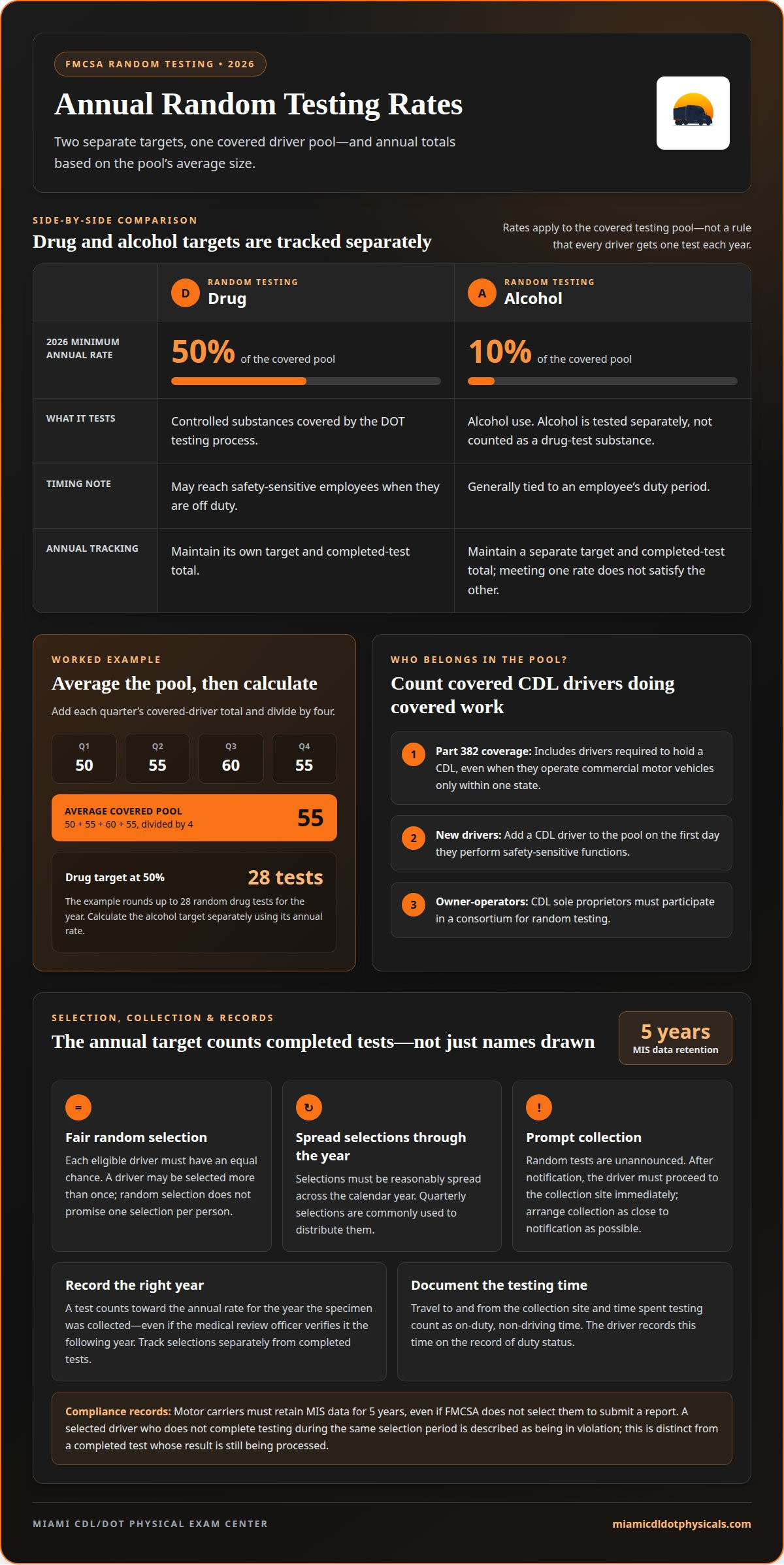
In 2026, the minimum annual random drug-testing rate under the FMCSA random testing requirements is 50%, and the minimum alcohol-testing rate is 10%, according to the Federal Motor Carrier Safety Administration. These percentages apply to the covered driver pool. A driver can be selected more than once because random selection gives each driver an equal chance; it doesn’t limit each person to one selection.
It’s easy to mistake the annual rates for a fixed number of tests per driver. In practice, the required totals depend on the average size of the covered pool, and both selections and completed tests must be tracked across the calendar year.
This article explains how to calculate annual drug and alcohol test totals, how random selection works, and what happens after a driver is notified. It also covers how collection and result reporting affect compliance, so you can understand the requirements and plan testing with confidence.
Key Takeaways
- Use the average number of covered drivers across the year to work out your fleet’s required test totals.
- Random selection must give each eligible driver an equal chance, so a driver may be selected more than once.
- Plan for prompt collection after notification and track tests in the appropriate calendar year.
- An FMCSA Clearinghouse Consortium can help owner-operators and fleets manage random-testing compliance.
Annual FMCSA random drug and alcohol testing rates
FMCSA sets minimum annual rates for random drug and alcohol testing of covered employees. These rates determine how many tests a carrier’s program must complete during the calendar year.
Annual Minimum Testing Rates
According to the Federal Motor Carrier Safety Administration, the minimum annual random drug-testing rate for covered employees in 2026 is 50%. According to the Federal Motor Carrier Safety Administration, the minimum annual random alcohol-testing rate for covered employees in 2026 is 10%. These percentages apply to the covered testing pool, not to a requirement that every driver receive a separate test each year.
The rates guide carriers as they plan testing and check whether their programs meet annual minimums. Random drug and alcohol tests have separate targets, so meeting one rate does not satisfy the other. Track drug and alcohol totals separately throughout program administration.
Random Test Timing
Random tests must be reasonably spread throughout the calendar year. Quarterly selections are commonly used to distribute them and avoid leaving most required tests until year-end. A driver may be selected more than once, since random selection does not guarantee that each person will be selected only once.
Timing also differs by test type. Random alcohol testing is generally tied to an employee’s duty period. Random drug testing may also reach safety-sensitive employees when they are off duty. These rules help supervisors and administrators determine when a selection can be carried out without treating the two test types as interchangeable.
Tested Substances
FMCSA random drug testing covers controlled substances, while alcohol testing checks for alcohol use. They are separate parts of a drug and alcohol testing program. Understanding the distinction helps employers arrange the appropriate test and record its result in the correct category.
When asked which substances are included in a drug test, the practical answer is controlled substances covered by the DOT testing process. Alcohol is tested separately and is not counted as a drug-test substance.
Supervisor training in drug and alcohol testing supports consistent administration of a random testing program. It helps supervisors distinguish between the tests, understand their different timing rules, and follow the employer’s notification process. Clear training can also prevent avoidable mix-ups when a driver is selected. Supervisors should know who administers the program and where to direct questions about selections, collections, and results.
How many drivers do I randomly test per year?
FMCSA random testing requirements use the average number of covered drivers in your pool to calculate annual test totals. They also specify which CDL drivers belong in the pool and how selection must work.
Drivers Covered by Part 382
Part 382 covers drivers required to hold a CDL, including those operating commercial motor vehicles only within one state. That coverage matters because location alone doesn’t remove an eligible driver from the random-testing pool.
Add a new CDL driver to the pool on the first day they perform safety-sensitive functions. This keeps the pool aligned with who is doing covered work, rather than counting only drivers employed at the start of the year.
To calculate the average pool, add the covered-driver totals for each quarter and divide by four. For example, quarterly pools of 50, 55, 60, and 55 drivers produce an average of 55. At the annual 50% drug-testing rate, that average requires 28 random drug tests for the year, rounded up. Use the annual alcohol-testing rate separately to calculate its test target; don’t combine drug and alcohol totals. This calculation turns the FMCSA random testing requirements into a practical annual target.
Random Driver Selection
Random selection must give each driver an equal chance, as required by 49 CFR §382.305(i). A valid selection method should not favor particular drivers or allow supervisors to choose who gets tested. This protects the random nature of the program and helps make selections fair across the covered pool.
A driver may be selected more than once. A completed test counts toward the pool’s annual requirement when it is completed in the same calendar year as the selection. Track selections and completed tests separately so the annual total reflects tests actually completed, not just names drawn.
Owner-operators who hold a CDL and operate as sole proprietors must participate in a consortium for random testing. A consortium for random-testing participation can be a practical option for meeting that pool requirement.
Specimen collection and test-result reporting
After a random selection, prompt collection and accurate records help a carrier document compliance. Motor carriers must retain MIS data for 5 years, even when FMCSA doesn’t select them to submit a report.
Specimen Collection
A selected driver must promptly take the required test, with collection arranged as close to notification as possible. Random tests are unannounced, and the driver must proceed to the collection site immediately after being notified.
Travel to and from the collection site, as well as time spent testing, counts as on-duty, non-driving time. The driver records this time on the record of duty status. This helps employers account for testing-related time while keeping collection and duty records aligned.
Result Reporting
Track test results under the correct testing year and in the motor carrier’s annual program records. A random test counts toward the annual rate for the year the specimen was collected, even if a medical review officer verifies it the following year.
Keep completed-test information separate from selection records. A selected driver who doesn’t complete testing during the same selection period is described as being in violation. This differs from a completed test whose result is still being processed, so record each event accurately.
Timing After Notification
Notification starts the immediate collection process, not a later appointment at the driver’s convenience. Random testing is generally unannounced, and notified drivers should go to the collection site promptly.
A driver who has taken a random or post-accident drug test may continue driving while the result is processed, unless a confirmed positive result is received. For annual test counts, use the specimen collection year, not the later verification date. This distinction helps carriers track timely testing and calculate the correct annual totals.
Failure to complete a selected test during the same selection period is described as a violation. Document the selection, notification, collection status, and result so the record accurately reflects what happened. A consortium can support program administration, but the motor carrier remains responsible for maintaining required records and accounting for completed tests.
FMCSA minimum annual random drug-testing rate
The federal minimum sets the share of the covered pool that must complete random drug tests. Knowing the rate helps a motor carrier plan selections without treating the percentage as a fixed schedule for each driver.
Minimum Drug-Testing Rate
The minimum annual random drug-testing rate for covered employees in 2026 is 50%, according to the Federal Motor Carrier Safety Administration. The rate applies to the covered pool, so carriers calculate the required total from the pool average rather than assigning a personal testing quota to every driver.
For example, an average pool of 55 covered drivers requires 28 random drug tests, rounded up. That count represents completed tests needed to meet the minimum, not a rule that exactly half of the drivers must be tested once. Follow-up tests prescribed by a substance abuse professional don’t count toward the annual 50% random-testing rate.
Keep drug-testing totals separate from alcohol-testing totals. The minimum rates differ, and completing enough drug tests does not satisfy the alcohol requirement. This distinction matters when administering the program and reviewing annual records.
Driver Selection Frequency
Covered CDL drivers are subject to random selection throughout the calendar year, but the annual 50% rate doesn’t prescribe how often each individual must be selected. Selection must give drivers an equal chance, so one driver may be picked more than once while another isn’t picked during that period.
FMCSA requires tests to be reasonably spread throughout the calendar year, and quarterly draws are commonly used. This helps carriers distribute selections instead of concentrating them near year-end. Add new drivers to the pool on their first day performing safety-sensitive functions so it reflects current operations.
A random drug-testing consortium can help owner-operators meet participation requirements and manage a selection pool. Explore FMCSA Clearinghouse Consortium support for help with random-testing participation and compliance administration.
Miami CDL/DOT Physical Exam Center: FMCSA Clearinghouse Consortium
Miami CDL/DOT Physical Exam Center offers nationwide FMCSA Clearinghouse Consortium services to support owner-operators and fleet companies with federal compliance requirements across the country. It can be a practical next step for any CDL-holding owner-operator who must participate in a random-testing consortium, or for a nationwide fleet seeking support with its compliance program.
A consortium pools employers into a shared random-testing selection pool. Participation can help meet random-testing requirements without requiring each small operation to manage its own pool. The consortium supports compliance administration, while carriers remain responsible for meeting applicable requirements and maintaining their records.
For help with consortium participation, contact Miami CDL/DOT Physical Exam Center.
Make your testing program easier to manage
Make FMCSA random testing requirements part of a routine with clear responsibilities. Decide who manages the testing pool, coordinates notifications, and records completed tests. Defined handoffs help keep the program organized as drivers and responsibilities change, without relying on one person to remember every detail.
Miami CDL/DOT Physical Exam Center provides services for related driver and employer needs, including DOT Physical Exams, DOT Drug Testing, and Non-DOT Drug Testing. Choose the next step based on what you need: a physical examination, a drug test, or support through a consortium.
Contact Miami CDL/DOT Physical Exam Center to discuss the service that fits your needs. A clear plan and the right support can make compliance work more manageable.
Frequently Asked Questions
Can a Driver Be Selected Multiple Times?
Yes. Random selection does not limit a driver to one selection, so the same person may be chosen again while another eligible driver is not selected. Each selection must follow the program’s random method and be handled as a separate event. For example, if a driver is selected again after completing an earlier test, the later selection still requires prompt attendance and its own record.
Can truck drivers drive before the company receives drug test results?
Generally, a driver who has taken a random or post-accident drug test may continue driving while the result is processed, unless a confirmed positive result is received. This applies to the period after specimen collection, not to a failure to attend a test. Employers should distinguish a pending result from a confirmed positive when managing a driver’s status.
Does a mechanic fall under Part 382?
Part 382 covers drivers required to hold a CDL, including drivers operating commercial motor vehicles only within one state. A mechanic’s job title alone doesn’t establish that they are a covered driver. The relevant distinction is whether the employee is a driver required to hold a CDL for the commercial vehicle operation. Mechanics who aren’t covered drivers aren’t included on that basis alone.
How Do Testing Pools Work?
A testing pool groups covered employees for random selection. A consortium combines multiple employers in a larger pool, which can help an owner-operator participate without managing a stand-alone pool. Employers subject to more than one DOT agency testing rule may combine covered employees in one pool. Each eligible driver must still have an equal chance of selection.
How Long Does a DOT Employee Have to Submit a Random Test?
A selected employee must proceed to the collection site immediately after notification. Under 49 CFR §382.305(l), FMCSA random tests are unannounced, and a notified driver must go promptly. The rule doesn’t provide a set number of hours for the driver to wait. If a selection is made during a workday, the employer should communicate the instruction clearly and arrange prompt testing.
What are the current FMCSA random drug and alcohol testing rates for 2026?
For covered employees in 2026, the Federal Motor Carrier Safety Administration sets a minimum annual random drug-testing rate of 50% and a minimum annual random alcohol-testing rate of 10%. These rates apply separately to the covered pool. A carrier should calculate each required test total from its average pool size, then track completed drug and alcohol tests separately through the calendar year.


