

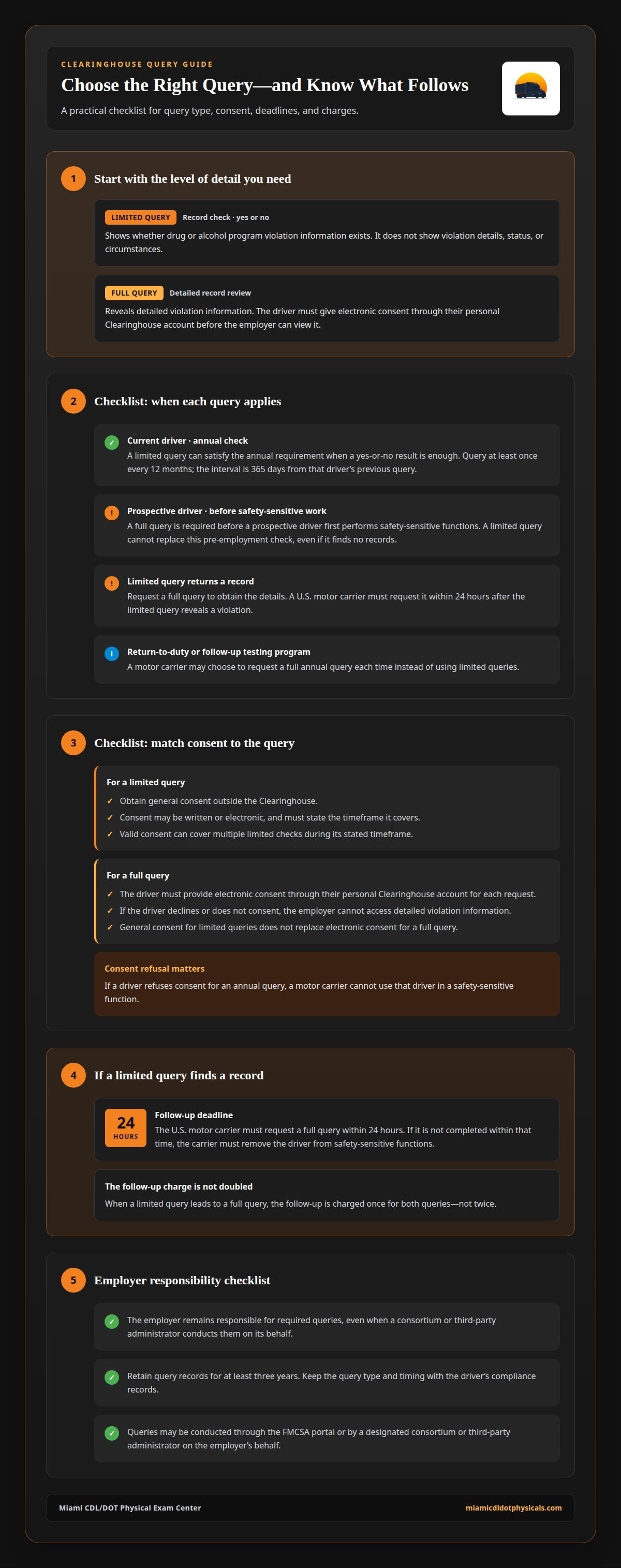
A limited query isn’t simply a cheaper substitute for a full query. The difference between a full query and a limited query in the Clearinghouse is the level of detail: a limited query shows whether a record exists, while a full query reveals violation details. If a limited query finds a record, the employer must request a full query. The follow-up is charged once for both queries, not twice.
That distinction helps employers choose the right query for each situation. A limited query can meet the annual query requirement for a current driver, while a full query is required before a prospective driver first performs safety-sensitive work.
This guide explains when each query applies, what consent drivers must provide, and what happens when a limited query returns a record. It also clarifies how the follow-up charge works, so employers can plan without mistaking a required second step for a second charge.
Key Takeaways
- Choose a limited query for a current driver’s routine annual check when a yes-or-no record result is enough.
- Know when a full query is necessary, including before a prospective driver first performs safety-sensitive work.
- Understand what consent the driver must provide and how the process differs between query types.
- See how the charge works if a limited query leads to a full query, and when a Clearinghouse consortium can help manage compliance.
What is the difference between a full and limited query?
A limited Clearinghouse query answers one question: does the driver’s record contain drug or alcohol program violation information? The result indicates either that no records were found or that records exist. It does not reveal specific violation details, whether the information is resolved or unresolved, or the circumstances behind it.
A full query provides detailed information about violations in a driver’s record. Employers use it before a prospective driver first performs safety-sensitive work and when a limited query shows that records exist. Before the employer can view those details, the driver must provide electronic consent through the Clearinghouse. This is the key difference in a full-query-versus-limited-query comparison in the Clearinghouse.
For a current CDL driver, employers must query the Clearinghouse at least once every 12 months. The annual interval runs 365 days from the date of the previous query for that driver. A limited query can satisfy this annual requirement, allowing an employer to check for records without requesting detailed information when the result is clear.
The right choice may differ for a driver in a return-to-duty or follow-up testing program. A motor carrier may request a full annual query each time instead of using limited queries. This approach provides detailed records when needed, while a limited query only indicates whether a record exists. Understanding when a full or limited query applies helps employers choose the right level of detail.
Employers may conduct either type through the FMCSA portal, or a designated consortium or third-party administrator may conduct queries on their behalf. Employers must retain query records for at least three years, according to the Electronic Code of Federal Regulations. Document the query type and timing alongside the driver’s compliance records.
In practice, use a limited query for a routine annual check when a yes-or-no result is sufficient. Use a full query when detailed information is needed, including for pre-employment screening or after a limited query identifies a record. The queries serve different purposes within the same federal compliance process.
Driver consent for full queries
A full query requires the driver’s electronic consent through a personal Clearinghouse account each time the employer requests one. This consent allows the employer to view detailed violation information. Without it, the employer cannot access the details in the Clearinghouse record.
A limited query uses general consent obtained outside the Clearinghouse. The driver may provide written or electronic consent, and the request must state the timeframe it covers. Employers can obtain consent annually or specify a period spanning multiple years, including the duration of employment.
This difference matters for an annual record check. General consent can cover limited queries during its stated timeframe, so the driver doesn’t need to approve each limited check individually when valid consent already applies. A limited result only indicates whether records exist; it doesn’t disclose violations or their status.
For a full query, the employer submits a request through the Clearinghouse, and the driver responds electronically through their account. Each request requires the driver’s electronic approval. If the driver declines or doesn’t provide consent, the employer cannot access detailed violation information or complete the full query.
Refusing an annual query has a separate consequence: a motor carrier cannot use the driver in a safety-sensitive function if the driver refuses consent. Keep the consent record aligned with the query type. For example, general written consent covering a defined employment period supports limited checks during that period, but it does not replace the driver’s electronic consent for a full query.
Consent also affects follow-up decisions. If a limited query returns a record, the employer needs the driver’s electronic consent before obtaining the detailed information through a full query. An employer managing these processes on its behalf can use an FMCSA Clearinghouse Consortium to help administer Clearinghouse queries and related compliance tasks.
When is a full Clearinghouse query required?
For covered CDL and CLP drivers, employers need full queries at key points in the screening process. These include when hiring a new driver and when a limited-query result reveals a violation.
Pre-Employment Full Query Requirements
A motor carrier must conduct a full FMCSA Clearinghouse query before a prospective driver first performs safety-sensitive functions. This pre-employment check applies to drivers covered by Parts 382 and 383, and it lets the employer review detailed records before assigning regulated work.
For example, a limited query cannot replace the required pre-employment full query, even if it returns no records. The driver must provide electronic consent before the employer can access detailed information. Missing this screening step means the carrier has not completed a required query before the driver begins safety-sensitive duties.
Employer Query Responsibilities
Employers remain responsible for required Clearinghouse queries when a consortium or third-party administrator conducts them on their behalf. A C/TPA can perform the query, but the motor carrier must ensure it is completed and the result is handled within the required timeframe.
After a limited query reveals a violation, a U.S. motor carrier must request a full query within 24 hours, according to the Electronic Code of Federal Regulations. If 24 hours elapse without completion of that full query, the carrier must remove the driver from safety-sensitive functions, according to the Electronic Code of Federal Regulations.
That deadline makes prompt follow-through essential. A yes result is not a detailed review: the employer still needs the full query and the driver’s electronic consent. If consent is not provided or the query remains incomplete, the employer cannot treat the limited result as clearance for continued safety-sensitive work.
Common compliance failures include skipping the pre-employment full query, relying on a limited result after it identifies a violation, or assuming a C/TPA’s involvement transfers the employer’s responsibility. Employers should track query status, consent, and the 24-hour follow-up window together so a record does not stall between the initial result and the required full review.
Charges when a limited query is followed by a full query
If a limited query returns a record and the employer follows up with a full query, the Clearinghouse charges once for both queries, not once per request. The follow-up does not create a second query charge.
To move from a limited result to a full query, the employer submits a full-query request through the FMCSA Clearinghouse. The driver must provide electronic consent before the employer can access detailed drug and alcohol violation information. A limited-query result alone does not show whether a record concerns resolved or unresolved violations.
For example, if an annual limited query returns “records found,” the employer needs a full query to review the details. The driver’s consent enables that review; it does not change the Clearinghouse charge for the linked requests. This distinction helps employers plan for the required follow-up without counting the pair as two charges.
Keep the query result, driver consent, and follow-up record together in the driver qualification file. This makes it easier to document why the employer requested the full query and how the drug and alcohol record was handled. A charge covers the Clearinghouse query process, not separate testing or other qualification services.
The cost rule does not remove the need to complete a full query when a limited query reveals a violation. Nor does paying the charge replace driver consent. Treat the limited result as a trigger for the next request, then track its completion and the driver’s eligibility to perform safety-sensitive duties under applicable requirements.
For support managing query processes and related compliance tasks, get help with Clearinghouse compliance.
Miami CDL/DOT Physical Exam Center: FMCSA Clearinghouse Consortium
Miami CDL/DOT Physical Exam Center offers an FMCSA Clearinghouse Consortium for owner-operators and fleet companies managing federal drug and alcohol compliance requirements. It can support your operation in coordinating Clearinghouse responsibilities alongside the query and consent rules covered above.
Use the consortium for Clearinghouse compliance support. The center also provides DOT Physical Exams and DOT Drug Tests, which address separate driver screening needs. Choose the service that matches the task, whether that is consortium administration, a physical exam, or a DOT drug test.
Contact Miami CDL/DOT Physical Exam Center for support with your Clearinghouse compliance needs.
Build a Clear Compliance Workflow
Make query management part of your broader driver-compliance workflow. Assign responsibility for tracking requests, consent, results, and follow-up records so each item has a clear place in your operation. A consistent process can make future hiring and routine record management easier to coordinate.
For Clearinghouse program administration, Miami CDL/DOT Physical Exam Center offers an FMCSA Clearinghouse Consortium. The center also provides DOT Physical Exams, DOT Drug Tests, and Non-DOT Drug Tests. Match each service to the specific screening or compliance need rather than treating them as substitutes.
As you refine your approach to the full query vs. limited query in the Clearinghouse, take the next step that fits your operation. Connect with Miami CDL/DOT Physical Exam Center to discuss support for your driver compliance needs and move forward with a clear plan.
Frequently Asked Questions
What happens if a Clearinghouse query reveals an unresolved violation?
The employer must follow up with a full query and address the driver’s status before assigning safety-sensitive work. If a limited query reveals a violation, the U.S. motor carrier must request a full query within 24 hours, according to the Electronic Code of Federal Regulations. If 24 hours pass without completing it, the carrier must remove the driver from safety-sensitive functions, according to the Electronic Code of Federal Regulations.
How often must limited queries be run?
Employers must query the Clearinghouse at least once every 12 months for each CDL driver they currently employ. The next annual query is due 365 days from that driver’s previous query date. For a driver hired after January 6, 2020, the motor carrier’s annual query is due within a year of the pre-employment query. Tracking each driver’s last query date helps prevent missed annual checks.
What Are the Consent Requirements?
Limited queries require general written or electronic consent obtained outside the Clearinghouse, and the consent request must state its timeframe. That period can cover multiple years if specified. A full query requires the driver’s electronic consent through a personal Clearinghouse account for each request. For example, consent for routine limited checks does not authorize access to detailed records through a full query.
What Is the FMCSA Drug and Alcohol Clearinghouse?
The FMCSA Drug and Alcohol Clearinghouse is a federal database of information about drug and alcohol violations involving covered commercial drivers. Employers, drivers, state driver licensing agencies, and law enforcement personnel can access relevant information through the system. For employers, it supports driver screening and monitoring by bringing violation records together, including records of positive tests, test refusals, and actual-knowledge violations.
Why do I need to purchase a query plan?
An employer needs a query plan to conduct Clearinghouse queries for itself and any designated consortium or third-party administrator. The employer purchases the plan through its registered Clearinghouse account; a C/TPA cannot purchase queries on the employer’s behalf. Plans are available only through the Clearinghouse and do not expire, so employers can use available queries over time.
What does a full query mean in the FMCSA Drug and Alcohol Clearinghouse?
A full query is an employer’s request to view detailed information about violations in a driver’s Clearinghouse record. The driver must provide electronic consent through the Clearinghouse before the system releases those details. The record may include positive drug or alcohol results, refusals to test, or actual-knowledge violations. A limited query, by contrast, does not reveal violation details.


