

DOT compliance is more than keeping a clean logbook. Knowing how to explain DOT compliance to new drivers starts with the rules that shape each shift: according to the Federal Motor Carrier Safety Administration, drivers generally may drive up to 11 hours within a 14-hour duty window and must take a 30-minute break after 8 hours on duty.
New drivers may see DOT requirements as paperwork, especially when medical qualification, vehicle safety, and drug and alcohol testing are all part of the job. Explain how each rule relates to the driver’s responsibilities and the carrier’s role.
This guide explains how DOT and FMCSA requirements affect new drivers, what hours-of-service and testing rules mean in practice, and how to handle vehicle inspections. Use it as a straightforward framework for onboarding, without overwhelming drivers with regulatory language.
Key Takeaways
- Explain DOT compliance as a shared responsibility: drivers follow safety and qualification rules, while carriers maintain required oversight and records.
- Help new drivers understand how FMCSA rules apply to their vehicle and work, including the role of licensing and medical qualification.
- Clarify that drug and alcohol testing can occur at different stages of safety-sensitive work, not only before employment.
- Make inspections part of the safety routine: identify defects, report them, and keep maintenance records in order.
What Are DOT Rules and Regulations?
DOT rules establish safety and operating requirements for commercial transportation. For new drivers, hours-of-service rules show how those requirements shape driving time, breaks, and fatigue management.
Hours-of-Service Records and ELD Use
Hours-of-service records document a driver’s duty time, driving time, and rest periods. Drivers who must keep records of duty status generally use electronic logging devices, subject to applicable exceptions. A new driver must report driving time from the previous 7 days before starting a job. Carriers retain hours-of-service and ELD data for at least six months, supporting accurate records during employment.
Driving Limits and Rest Breaks
Hours-of-service limits restrict driving and set minimum rest periods, helping drivers manage fatigue during transportation work. According to the Federal Motor Carrier Safety Administration, U.S. commercial drivers may not drive more than 11 hours in a single workday, subject to certain exceptions. Drivers also may not drive beyond the 14th hour after coming on duty. The Federal Motor Carrier Safety Administration requires a 30-minute break after 8 hours on duty. These limits help drivers plan stops before fatigue affects safe vehicle operation.
According to the Federal Motor Carrier Safety Administration, the listed limits cap driving at 60 or 70 hours in 7 or 8 consecutive days, respectively. A driver should plan each shift around the applicable limit, not just the hours behind the wheel.
Driver Hours-of-Service Responsibilities
Drivers must record duty status accurately and use required ELDs properly. Each entry should reflect the workday, including driving and off-duty periods, rather than relying on memory later. If a new driver worked or drove during the previous week, the carrier should review and sign the 7-day record, then account for those hours before assigning more driving. Accurate records help the carrier monitor hours and support motor carrier safety. They also show whether the driver has time available before accepting a trip.
State and Intrastate Rule Differences
Federal DOT requirements provide a baseline, while state DOTs may set additional restrictions. Intrastate driving can therefore involve state-specific rules, so a driver should learn which requirements apply to the routes and motor vehicle used. Ask the carrier to explain the applicable state rules during qualification and onboarding. A trip that stays within one state is not automatically exempt from DOT requirements; the vehicle and operation still matter. Knowing the route’s rules helps drivers document hours correctly and avoid relying on interstate assumptions.
DOT and FMCSA compliance overview
The U.S. Department of Transportation sets commercial transportation standards, while the Federal Motor Carrier Safety Administration enforces many rules for motor carriers. According to the Federal Motor Carrier Safety Administration, in interstate commerce, a commercial motor vehicle has a GVWR or GCWR of 10,001 pounds or more. That threshold helps determine which federal requirements apply to vehicles and their operations.
Compliance covers more than the truck. It includes the carrier’s responsibilities and each driver’s qualifications, license, medical status, and conduct. Before assigning a driver to a covered commercial motor vehicle, a motor carrier should verify and document the driver’s qualifications. Driver qualification records help show that the carrier reviewed relevant information, including driving history and medical certification. Drivers need to understand which requirements apply to their assigned vehicle and work.
Drug and alcohol rules are another part of safety oversight. Testing may be required before employment, through random selection, after an accident, or in other circumstances related to safety-sensitive duties. A driver’s eligibility for those duties may depend on completing required testing and Clearinghouse steps. Accurate records matter: incomplete documentation can complicate reviews of driver qualifications or carrier compliance, and violations can lead to enforcement action.
A useful way to explain DOT compliance to new drivers is to connect each requirement to real responsibilities, rather than presenting a stack of unrelated forms. For example, a valid license alone does not establish every qualification needed for a particular job. The carrier must maintain required records and monitor whether drivers remain qualified. Drivers should follow applicable requirements and promptly report relevant changes that could affect their ability to operate safely. Keep the focus on who is responsible for each step and why it matters.
For carriers managing Clearinghouse obligations, an FMCSA Clearinghouse Consortium can support the compliance process. It is a relevant next step when a carrier needs consortium participation for its Clearinghouse responsibilities.
How do DOT drug and alcohol testing rules work for new drivers?
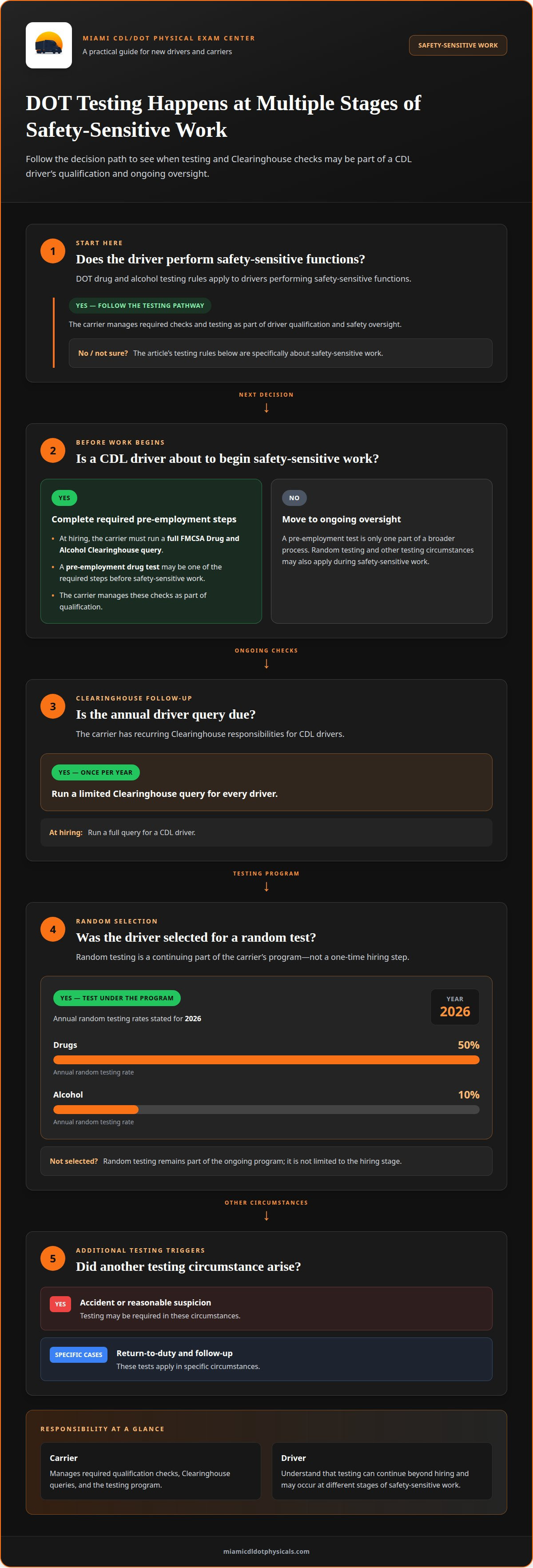
DOT testing rules apply to drivers performing safety-sensitive functions, and testing can occur at several stages of employment. Explain that a pre-employment test is only one part of a broader process. According to the Federal Motor Carrier Safety Administration, for 2026, annual random testing rates are 50% for drugs and 10% for alcohol. Random tests are a continuing part of a carrier’s program, rather than a one-time hiring step.
Before a CDL driver begins safety-sensitive work, the carrier must complete the required pre-employment steps. Carriers must run a full FMCSA Drug and Alcohol Clearinghouse query when hiring a CDL driver, then a limited query once per year for every driver. A pre-employment drug test may be one of the steps required before a driver can perform safety-sensitive work. Drivers should understand that the carrier manages these checks as part of qualification.
Testing may also be required after an accident or when there is reasonable suspicion. Return-to-duty and follow-up tests apply in specific circumstances after a prior positive drug test or refusal. A driver with that history may not perform safety-sensitive functions until completing the required return-to-duty process. Explain that a test result or refusal can affect eligibility to work, not just a hiring file.
For new drivers, the practical steps are to complete required pre-employment testing, respond to random testing selections, and follow instructions for any required post-accident or other test. A clean hiring test does not remove later obligations. The carrier’s testing program continues during employment, and the Clearinghouse query process supports required oversight of CDL drivers.
Explain the rules in plain language during onboarding. Clarify which tests apply, when the carrier coordinates them, and how a driver’s status affects safety-sensitive work. This helps new employees distinguish DOT testing from non-DOT workplace testing. Accurate records and timely participation help drivers and carriers manage their responsibilities.
What vehicle inspection and maintenance rules must drivers follow?
Vehicle inspections help identify safety defects before they turn into roadside problems. Drivers should inspect commercial vehicles before and after each trip, then report defects through the carrier’s process. Look for issues that could affect safe operation, such as a brake problem or damaged equipment. A walk-around is useful only when the driver records and reports what the inspection reveals.
Federal rules also require a periodic inspection of commercial motor vehicles. Under 49 CFR § 396.17, U.S. commercial motor vehicles must receive annual periodic inspections. Every truck and trailer must have a documented federal annual inspection at least once every 12 months. That recurring inspection is separate from a driver’s trip checks. Carriers should keep each vehicle’s inspection and maintenance history organized, including scheduled inspections, repairs, and ongoing work.
Maintenance records show what was inspected, what needed repair, and how the issue was addressed. Vehicle inspection and maintenance records must be held for at least 90 days. Vehicle maintenance records must also be kept for one year or six months after the vehicle leaves the fleet. These records help connect a reported problem with the repair and the vehicle’s return to service.
Take a defect seriously. Before a vehicle with a discovered defect returns to the road, the reporting driver, mechanic or agent, and next person operating it must provide three signatures. This creates a documented handoff: the issue is reported, repair work is recorded, and the next operator acknowledges the vehicle’s status. In the 2025 CVSA International Roadcheck, brake system violations accounted for 41.1% of vehicle out-of-service violations. That finding reinforces why drivers should report brake concerns promptly rather than treating them as minor inconveniences.
Give new drivers a clear practical rule: inspect, document, report, and follow the carrier’s maintenance process. They should not operate a vehicle with a known defect that makes it unsafe. Clear records help drivers and carriers track inspections, repairs, and readiness for the next trip.
Miami CDL/DOT Physical Exam Center
Miami CDL/DOT Physical Exam Center supports nationwide drivers and carriers with services related to key compliance responsibilities. A DOT Physical Exam addresses medical qualification, while the FMCSA Clearinghouse Consortium supports owner-operators and fleets across the country with Clearinghouse compliance. These services complement the requirements above; they do not replace a carrier’s responsibility to manage driver records, hours, vehicle inspections, or safety procedures.
Turn to the center when a driver needs a DOT physical or a carrier needs nationwide consortium support for Clearinghouse requirements. Identify the specific responsibility that needs attention to determine the next step, whether it involves medical qualification or compliance administration.
Contact Miami CDL/DOT Physical Exam Center to discuss the support you need.
Make Compliance Part of a Driver’s Routine
Effective onboarding gives new drivers more than rules to memorize. It builds a shared understanding of how safe decisions, accurate records, and timely communication fit into daily work. Keep the discussion practical: use situations drivers may encounter, explain who handles each responsibility, and encourage questions before a small concern becomes a bigger problem.
Explaining DOT compliance to new drivers also means recognizing when professional support is useful. Miami CDL/DOT Physical Exam Center offers DOT Physical Exams, DOT Drug Testing, and Non-DOT Drug Testing for drivers and employers with these needs.
For help with a physical exam or testing, contact Miami CDL/DOT Physical Exam Center. Each clear conversation helps a new driver build sound habits and move forward with confidence.
Frequently Asked Questions
How does DOT safety compliance reduce risk for fleets?
Consistent compliance helps fleets identify problems before they affect a trip or driver. Reviewing hours records, for example, can uncover an inaccurate log, while tracking incidents can help carriers address recurring safety concerns. Organized qualification and maintenance records also support informed dispatch decisions. Compliance cannot eliminate every risk, but it gives carriers and drivers a structured way to spot issues and respond.
What Are DOT Regulations and Who Must Follow Them?
DOT regulations are federal transportation and safety requirements for covered commercial operations. Motor carriers and drivers must follow the rules that apply to their vehicles, routes, and work. Requirements can differ, for example, depending on whether a vehicle operates in interstate commerce or only within one state. Carriers should identify the applicable federal and state rules and explain each driver’s responsibilities during onboarding.
What Happens If You Don't Comply?
Noncompliance can result in violations, roadside consequences, and closer regulatory review. During an inspection, a driver or vehicle may be placed out of service, disrupting a scheduled trip. Records may also be examined during audits or reviews, and missing or inconsistent documentation can create further problems. Address the underlying issue, document corrective action, and take steps to prevent the same lapse from recurring.
What are the most common roadside violations?
Roadside violations can involve driver records and vehicle condition. During the 2025 Roadcheck, 332 drivers were placed out of service for false logs, representing 10% of driver out-of-service violations. Drivers can reduce avoidable problems by recording work accurately, reporting vehicle defects, and keeping required documents accessible. Carriers should review records and address recurring errors rather than treating each inspection finding as an isolated event.
What are the six building blocks of DOT fleet compliance?
No single checklist covers every fleet’s obligations. A practical framework groups the work into driver qualification, hours records, drug and alcohol testing, vehicle inspections, maintenance documentation, and ongoing safety oversight. For example, a carrier can pair qualification reviews with a process for tracking medical status, then use incident records to identify where training or maintenance procedures need attention.
What is DOT compliance and how is it enforced?
DOT compliance means meeting the transportation safety and operating requirements that apply to a driver and carrier. Enforcement may include roadside inspections, carrier audits, and records reviews. An inspection, for example, may examine whether a vehicle’s condition and the driver’s documentation meet applicable requirements. Organized records and consistent procedures help carriers demonstrate compliance and identify gaps to correct.


