

A disputed DOT physical finding isn't always the last word. Learning how to contest a DOT physical finding starts with understanding what the examiner needs to resolve it: accurate medication and health records, any requested testing, and a clear view of your current driving status. The Electronic Code of Federal Regulations says an applicant must submit proof of a disagreement between the driver’s medical examiner and the motor carrier’s medical examiner concerning the driver’s qualifications.
A concerning result can put your work plans in doubt, so it’s reasonable to want a clear path forward. A second medical opinion may clarify a finding, but it does not replace full disclosure or the specific evidence required for a formal challenge.
This article explains how medication records and follow-up testing can affect a decision, whether you may drive while a determination is pending, and what a formal review requires. Use these points to understand the finding and choose a practical next step.
Key Takeaways
- Complete medication and health records can help clarify a disputed finding and support the examiner’s assessment.
- Follow-up testing may be requested when a condition could affect safe driving; understand what evidence the examiner needs.
- Your driving status while a decision is pending can depend on whether a prior medical certificate remains valid and whether you meet the relevant standards.
- A formal challenge under 49 CFR 391.47 requires evidence of a disagreement between the driver’s and motor carrier’s medical examiners.
Medication disclosure and treating-physician documentation
List every medication you take and describe its dose, purpose, and prescribing clinician during the medical exam. The examiner reviews your health history and supporting records to assess whether a condition or treatment could affect safe commercial driving. Missing or inaccurate information can invalidate an examination or Medical Examiner’s Certificate. If treatment relates to a finding, provide records or a letter from your treating physician explaining the diagnosis, treatment, stability, and any effects on your ability to function.
What DOT physical findings can disqualify a commercial driver? A finding that fails a federal medical standard can prevent certification, including vision that does not meet the required standard. The Federal Motor Carrier Safety Administration requires at least 70 degrees of peripheral vision in each eye along the horizontal meridian. Medication concerns and other health conditions are assessed against the applicable qualification standards and the evidence available.
Under 49 CFR 391.41 and 391.43, medical qualification and examination requirements govern the decision. Drivers with diabetes or a vision deficiency may have a medical variance or exemption pathway, depending on the condition and applicable criteria. For example, FMCSA’s insulin exemption program dates to 2003; monocular-vision exemptions may last up to two years and require annual medical and eye examinations.
How do state rules and CDL licensing agencies affect a DOT physical dispute? Intrastate drivers are subject to their state’s physical qualification rules, while CDL medical status is reflected in state licensing records. After an exam, results are transmitted to the state Driver Licensing Agency, which posts the examination status to the driver’s record within 1 business day of receiving the information.
How can I get a copy of my DOT physical examination report and medical determination? Ask the medical examiner for your examination results and determination. If the examiner finds you qualified, they provide a copy and complete the certificate. The examiner also reports results to the National Registry of Certified Medical Examiners. CDL holders can check certification status in state records and their Motor Vehicle Record, while the National Registry II system maintains examiner-related certification records. Keep treating-provider documents with your own records in case the finding is reviewed.
Additional testing and referrals
A DOT physical examiner may request testing or treatment if a condition could interfere with safe commercial driving. Sleep apnea is one example. The Department of Transportation does not require sleep apnea testing during every physical exam, but an examiner may recommend it based on the driver’s circumstances. A referral or additional test can help assess a specific safety concern; it does not automatically mean disqualification.
If the examiner’s decision is pending, a follow-up may be required within 45 days from the date of the exam. Use that time to complete the requested evaluation and provide the resulting report. For example, a cardiovascular concern may call for a stress test. For a driver with a current diagnosis of certain cardiovascular conditions, the test must have been performed within the last 12 months. The relevant findings help inform the examiner’s determination.
Clarify the purpose of any referral. Ask which condition the additional testing addresses, what results the examiner needs, and where the report should be sent. For example, a sleep specialist’s report can address a sleep-related concern raised during the exam. Relevant results help the medical examiner assess the issue using complete information.
Can I use a different FMCSA-certified medical examiner for a second examination? Yes. You may seek a second opinion from another medical examiner, but you must provide a complete and honest medical history. A second exam does not let you conceal an earlier finding or keep consulting examiners until one issues a passing result. If an examiner requests follow-up testing, understand what the test evaluates before arranging another examination. This keeps the review focused on evidence relevant to safe commercial driving.
Continuing to drive while awaiting a final determination
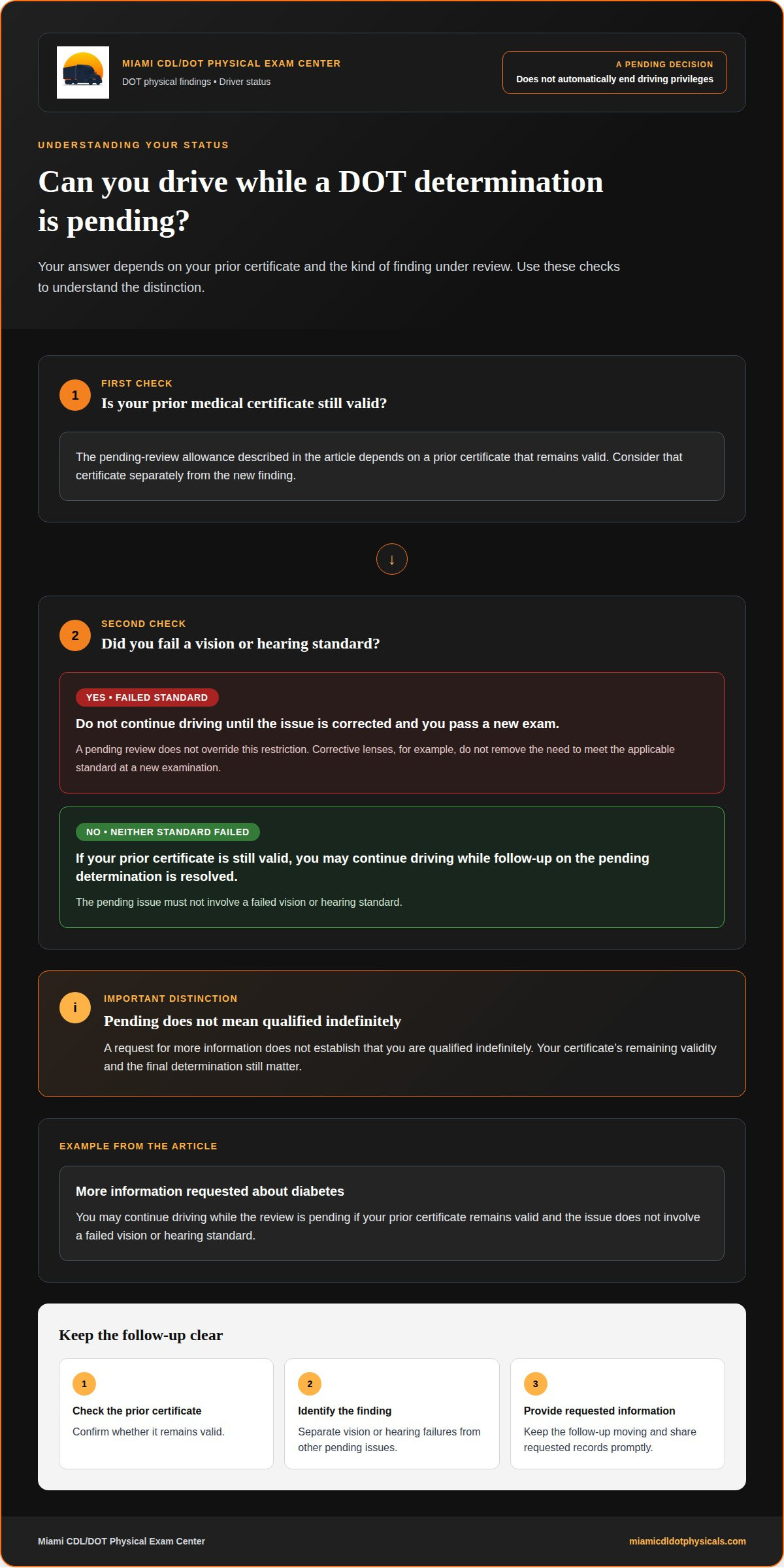
A pending DOT physical determination does not automatically end your driving privileges. A prior certificate may remain relevant while follow-up on a pending determination is resolved, but whether you may drive depends on your circumstances. The certificate must remain valid, and the pending issue must not involve a failed vision or hearing standard. Consider the prior certificate and the new finding separately when assessing your status.
This distinction matters when an examiner requests records or further assessment. For example, if an examiner needs more information about diabetes, you may continue driving while the review is pending if your prior certificate remains valid. The request does not establish that you are qualified indefinitely. The certificate’s remaining validity and the final determination still matter. Keep the follow-up process moving and provide requested information promptly.
Vision and hearing findings have a different immediate effect. If you fail either standard during the exam, you cannot continue driving until the issue is corrected and you pass a new exam. A pending review does not override this restriction. If corrective lenses address a vision issue, you must still meet the applicable standard at a new examination before resuming driving.
Use these distinctions to clarify your status with the medical examiner and motor carrier:
- Prior certificate still valid: A driver may continue while follow-up for a pending determination is resolved.
- Failed vision or hearing standard: Stop driving until the issue is corrected and a new exam is passed.
- Final determination issued: Follow the resulting medical qualification status and applicable regulations.
The Federal Motor Carrier Safety Administration’s medical certification process focuses on safe commercial driving, not simply on whether a challenge has begun. If you dispute a finding, do not treat an appeal, requested test, or second opinion as an automatic extension of your driving authority. Confirm whether your prior certificate remains valid and whether the specific finding requires you to stop driving. This distinction helps you and your carrier act on your actual medical status.
Formal challenges under 49 CFR 391.47
A formal challenge addresses a specific disagreement about a driver’s medical qualifications. It is different from correcting a clerical error or supplying missing records.
Formal Challenges to Medical Determinations
Under 49 CFR 391.47, the formal process applies when the driver’s medical examiner and the motor carrier’s medical examiner disagree about the driver’s qualifications. The Electronic Code of Federal Regulations requires the applicant to submit proof of that disagreement. This matters because dissatisfaction with an examination alone does not establish the evidence this process requires.
Gather documents showing both medical examiners’ positions, such as written determinations or related examination records. Identify the qualification issue and connect each document to it. The motor carrier’s examiner assesses the driver for the carrier, while the driver’s examiner conducts the medical examination. Keep the employer’s safety concerns separate from the medical findings. A motor vehicle safety dispute must be based on the disagreement about medical qualifications.
Correcting Inaccurate Medical Records
Correcting an inaccurate medical record means addressing an error in the source document or test result, rather than treating incorrect information as a medical disagreement. If a report contains a wrong date, measurement, or history entry, identify the exact item and contact the clinician or testing facility that created it. Request a corrected record and keep both the original and corrected versions.
How can I correct an inaccurate medical record or test result used in a DOT physical? Ask the originating provider to review the specific error and provide corrected documentation. Give the correction to the medical examiner handling the determination, and ask how it affects the result reported in the National Registry. For example, a corrected test value may change the evidence considered, but it does not resolve a separate disagreement between examiners.
Keep the correction and related examination records together. If you need a new DOT physical examination, schedule a DOT physical exam to document your current medical status for review.
Miami CDL/DOT Physical Exam Center
Miami CDL/DOT Physical Exam Center can help when a disputed finding raises questions about your current medical examination or the documentation needed for a new one. A DOT Physical Exam lets the examiner assess your current health information. Bring relevant medical records and test results for the examiner to consider.
A DOT physical does not replace a formal challenge under 49 CFR 391.47 or correct a source record. If your issue concerns a disagreement between medical examiners, follow the formal review process described above. For a new medical examination, the center can assess your current status; its FMCSA Clearinghouse Consortium serves owner-operators and fleet companies with federal compliance requirements.
Contact Miami CDL/DOT Physical Exam Center to discuss your DOT physical needs.
Make your next step clear
Knowing how to contest a DOT physical finding is most useful when it helps you decide what to do next. Set a clear goal for your next appointment: document your current medical status, complete a DOT drug test, or arrange a Non-DOT drug test. These services meet different needs, so choose the one that fits your situation rather than treating them as substitutes for a formal challenge.
Miami CDL/DOT Physical Exam Center offers DOT Physical Exam, DOT Drug Test, and Non-DOT Drug Test services. A new physical examination can document current findings, while a formal challenge remains a separate process. Focus your next step on the issue you need to address, and bring relevant records if you are arranging an examination.
Contact Miami CDL/DOT Physical Exam Center to discuss your next step. A clear plan can help you move forward with greater confidence.
Frequently Asked Questions
Can I appeal or challenge a DOT medical examiner's decision?
The Electronic Code of Federal Regulations states that an applicant must submit proof of a disagreement between the driver’s medical examiner and the motor carrier’s medical examiner concerning the driver’s qualifications. The process requires proof that the driver’s medical examiner and the motor carrier’s medical examiner disagree about the driver’s qualifications. A different opinion alone does not establish that specific disagreement. If you’re considering how to contest a DOT physical finding, identify the examiners’ positions and gather records that show the disputed qualification issue.
What is the process for requesting a second opinion or a new DOT physical?
You may seek a second opinion from a different medical examiner, and you must provide a complete, honest medical history. Bring records related to the finding, such as a treating clinician’s report or a corrected test result, so the new examination can consider relevant evidence. A second examination does not erase an earlier finding or replace a formal challenge when the disagreement is between the driver’s and carrier’s medical examiners.
What are the deadlines for challenging a DOT physical finding or medical certificate decision?
If an examiner leaves a determination pending and requires follow-up, the follow-up may be required within 45 days from the exam. That follow-up period is distinct from a formal challenge under 49 CFR 391.47, which requires proof of a disagreement between medical examiners. Track any stated follow-up date and the expiration of your current certificate, since a challenge does not itself extend certificate validity.
What are the risks of driving commercially while contesting a DOT physical finding?
Driving authority depends on your current medical status, not simply on whether you have started a challenge. You may continue driving while a pending determination is resolved if your prior certificate remains valid. However, after failing the vision or hearing standard, you cannot continue until the issue is corrected and you pass a new exam. Treating a challenge as automatic permission to drive can put your compliance at risk.


